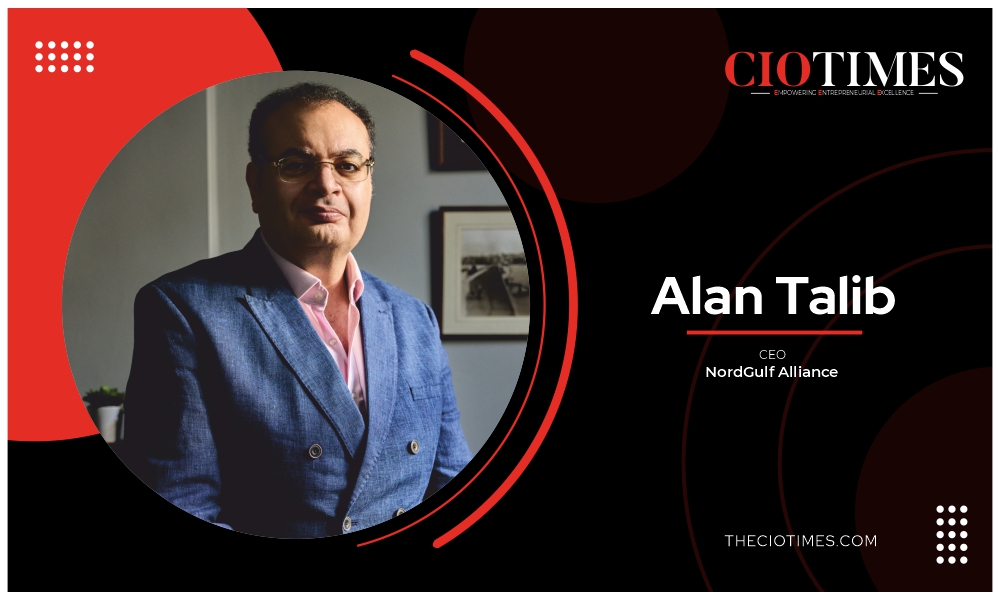
True visionary leaders are those who can see beneath the surface. They aren’t just looking at next quarter’s sales; they have this incredibly clear, exciting picture of where the company needs to be in five or ten years. In the business world, this isn’t just a nice-to-have, it’s everything. Such a visionary leader is Alan Talib, CEO at NordGulf Alliance. A true visionary like him gives everyone a north star. He turns employees from just punching the clock into people who are personally invested in a grander purpose. This powerful alignment fuels his bold innovation and helps the company avoid the trap of simply reacting to what competitors are doing.
Headquartered in the United Arab Emirates, the organization aims to act as a bridge between the innovation power of the Nordics and crafting strategies for the Gulf region. He recalls being twelve years old, standing behind the counter of his mother’s jewelry store in Kuwait’s Salmiya district, where he made his first sale as the afternoon sun cast light across the gold pieces. That early experience shaped a core belief: business is defined less by the product on display and more by the trust reflected in a customer’s eyes.
Years later, while selling Persian carpets from Bodø to Turku, he learned that trust expresses itself differently across cultures. Gulf customers valued hours of relationship-building over coffee, while Nordic buyers looked for certificates and systematic proof. The contrast intrigued him between two successful business environments, each with its own valid approach.
For nearly two decades, Alan has worked at the intersection of these worlds. At NordGulf Alliance, which he co-leads with his brother, Dr. Ahmed, the firm has supported more than 30 Nordic companies entering Gulf markets in renewable energy, biotech, and sustainable technology. Their methodology runs on two parallel tracks: Alan leads the cultural architecture and senior-level relationship building, while Dr. Ahmed ensures scientific validation through rigorous technical due diligence. Bound by NDAs and Nordic norms of discretion, he avoids naming clients, yet the results show a clear pattern: median time to secure board-level Gulf access now averages 8 – 12 weeks instead of the usual 18 – 24 months.
Dual Leadership
Alan’s leadership philosophy took shape as he watched his mother lose everything when Kuwait fell and then rebuild with resolve and grace. From her, he learned that real leadership is not about controlling circumstances but adapting intelligently to them.
Norway introduced him to a different set of strengths. In a society built on institutional trust, leadership was steady, quiet, and rooted in consistency rather than charisma.
He shares, “Where Gulf leadership flows from personal authority and family legacy, Nordic leadership emerges from competence and systematic reliability.”
Working from London’s global intersection, he now sees how these approaches reinforce one another. His style has become adaptable; he emphasizes structured processes and documented outcomes with Nordic partners, while with Gulf colleagues, he focuses on relationships and shared vision. Dr. Ahmed provides the technical backbone, ensuring every leadership decision is grounded in scientific reality. Each technology and partnership must clear both cultural and technical validation.
This combined methodology has shaped their outcomes. The team has enabled partnerships across six Nordic countries and five Gulf states, achieving an 80% success rate in securing signed agreements when both tracks’ cultural and technical align. The remaining 20%, where they recommend not moving forward, saves clients years of difficulty and millions in unnecessary costs.
Cross-Border Synergy
Alan describes a pivotal moment of clarity in a Dubai boardroom, forty floors above Sheikh Zayed Road. A Norwegian executive sat opposite his Emirati counterpart, both reviewing the same projections yet speaking past each other entirely. Efficiency metrics from the Norwegian side met questions about family connections and generational vision from the Emirati side, the two perspectives passing like ships in the night.
He saw this pattern repeat constantly. Each party held what the other needed, yet they rarely connected. NordGulf Alliance was created in response to this gap. The firm operates quietly; nearly 70% of its work comes through C-suite referrals rather than marketing, and focuses on €10–100 million partnerships where cultural misalignment carries the greatest risk.
What sets the firm apart from traditional consultancies is its focus. Others deliver the market analyses and strategic plans. NordGulf Alliance delivers how cultural navigation is required for those strategies to succeed. Recent anonymized examples illustrate this: a Nordic hydrogen technology reached Phase-2 discussions with a sovereign-linked industrial partner in under three months; a Swedish medtech company launched three-site clinical pilots in UAE hospitals within twelve weeks; and a Danish water technology firm secured an MoU with a Tier-1 Saudi family group after the team reframed its approach from a technical pitch to a legacy-oriented partnership.
Cross-Cultural Trustbuilding
A Swedish clean-tech CEO once sat in Alan’s office, frustrated after spending two years attempting to enter the UAE market. “We have superior technology,” he insisted. “Why isn’t it enough?” Three months later, Alan watched him sign a partnership agreement in Abu Dhabi. The shift came when he realized that in the Gulf, trust is earned not through PowerPoints but through presence. Instead of leading with spreadsheets, he spoke about his grandfather’s farm in Gotland and why sustainability was part of his family’s legacy. His Emirati counterparts saw more than technology; they saw someone who understood that business extends across generations.
In Alan’s book From the Sand Dunes to the Fjords and Back, he describes trust as humanity’s most elusive currency. In the Nordics, it moves through systems certifications, contracts, and institutional assurances. In the Gulf, it moves through relationships, family networks, personal honor, and shared meals.
At NordGulf Alliance, he calls their approach “duplex trust.” The method is structured: relationship-building and scientific due diligence advance in parallel with defined go/no-go checkpoints. The team has stepped away from lucrative opportunities whenever either track raised concerns. This discipline safeguards clients and preserves credibility. As one Gulf partner remarked, “You’re the only advisors who sometimes tell us not to proceed. That’s why we trust you when you say yes.”
Shared Values
Alan recalls a Danish renewable energy team waiting ninety minutes in a Kuwait meeting room, their thirty-minute presentation untouched. When their Kuwaiti partners finally arrived, he sensed frustration building. Time is money in Copenhagen. But he had prepared them: “Time flows differently here,” he had explained, “like water in a desert wadi sometimes fast, sometimes slow, always finding its natural path.” Instead of showing irritation, the Danish CEO closed his laptop and asked about his host’s recent pilgrimage.
For two hours, not a single slide appeared. Instead, both sides exchanged stories about family, values, and the world they hoped to leave their children. The Dane spoke about winters that require community cooperation, while the Kuwaiti shared desert traditions centered on resource conservation.
When the conversation eventually turned to business, it did so naturally through shared values. The initiative shifted from being purely about renewable energy technology to honoring ancestral wisdom around sustainability. That perceived “delay” ultimately became the foundation for a seven-year partnership that expanded across three verticals and generated more than €40 million in revenue. As the Danish CEO later told Alan, “Those two hours of ‘nothing’ were the most valuable investment we ever made.”
Growth Realignment
Alan notes that startups and established firms require different navigation strategies. With startups, credibility becomes the defining factor. A promising Norwegian biotech may possess groundbreaking technology, but to Gulf investors accustomed to century-old family enterprises, they remain unfamiliar. Dr. Ahmed spends months validating the science—testing claims, verifying data, and confirming scalability. Only once the team is confident does Alan begin building cultural bridges. They usually start with smaller proof-of-concept initiatives. One recent case involved a Nordic cleantech startup they guided from no regional presence to a €15 million pilot with a Gulf sovereign fund in just nine months.
Established organizations face a different challenge: overconfidence. Many assume that prior success ensures future outcomes.
He adds, “We provide what we call “humility resets” structured sessions where assumptions are challenged, cultural differences mapped, and new approaches developed.”
A Danish firm with €500 million in European revenue recently credited this reset with preventing what they now recognize would have been a major misinterpretation of Saudi market dynamics.
Both types of organizations require patience, but for entirely different reasons. Startups must build credibility deliberately. Established firms must unlearn the habits that made them successful elsewhere.
Trust Through Proximity
Alan often points out the irony that technology designed to erase distance has only reinforced the value of physical presence. A Saudi businessman once told him, “I can read your business plan on my phone, but I need to read your character in person.”
He asserts, “At NordGulf Alliance, we’ve developed a clear protocol: We research online, we close in person.”
Digital tools are effective for market analysis, early screening, and maintaining continuity between visits. Dr. Ahmed relies on advanced platforms to validate scientific claims, review patent portfolios, and assess technological readiness. Alan uses them to map stakeholder networks, monitor cultural shifts, and sustain relationships.
But when it comes to building trust the core of Gulf business nothing substitutes for being in the room. Their data confirms it: deals that include at least three in-person meetings before signing show an 85% survival rate at five years. Fully virtual agreements fall below 30%. The conclusion is unmistakable invest in plane tickets, not just PowerPoints.
Sustainable Synergies
Alan recalls standing at the NEOM construction site, watching a Saudi leader and a Norwegian engineer discuss green hydrogen production, where the future seemed to take shape before his eyes. Their exchange was not about buyer and seller; it centered on co-creating solutions to global challenges.
He sees this convergence accelerating.
He asserts, “Gulf Vision 2030 programmes require exactly what Nordics excel at: sustainable technology, renewable energy, digital innovation.”
At the same time, Nordic firms need Gulf scale and ambition to achieve meaningful global reach. NordGulf Alliance is currently facilitating partnerships in three breakthrough sectors: hydrogen technology shifting toward GCC co-manufacturing supported by Nordic IP; medtech scaling through Gulf procurement hubs to reach broader emerging markets; and water technology adapted for arid climates with applications worldwide.
Over the next five years, Alan expects partnerships to evolve from transactional to transformational. The bridges he and Dr. Ahmed are building, rooted in scientific rigor and cultural navigation, are positioned to support entire industries. Their current pipeline includes twelve Nordic companies with combined partnership potential exceeding €200 million. These efforts represent more than business deals; they form the blueprint for tomorrow’s sustainable economy.
Cultural Alignment
Alan notes that the greatest challenge is perceptual; each culture sees its own reflection and assumes familiarity where none actually exists. Norwegian firms arrive in Dubai, notice the glass towers and fluent English, and assume it mirrors London. They are then surprised when technically flawless proposals lose to competitors who invested months in relationship-building. NordGulf Alliance recently assisted a Nordic water technology company that had failed three times over two years; after undergoing the firm’s cultural alignment process, pre-trip briefings, expectation resets, and staged milestones with cultural checkpoints, they secured board-level meetings in six weeks.
The reverse is equally common. Gulf investors visit Stockholm expecting Silicon Valley-style scaling and cannot understand why Swedish biotech requires five years of testing when they are ready to deploy capital immediately. Dr. Ahmed has become adept at explaining Nordic timelines in terms that Gulf investors respect: “This isn’t hesitation; it’s honor they will not put their name on anything until it is flawless.”
Alan emphasizes that their work focuses on preventing these misalignments from hardening into failed ventures. The team conducts rigorous pre-engagement assessments, cultural briefings, and “translation sessions” where each side’s assumptions are openly surfaced. Prevention costs thousands; failure costs millions.
Learning Mindset
Alan recalls the advice of an old merchant in Kuwait’s souk: “You have two ears and one mouth use them in that proportion.” He considers it the best guidance for leaders navigating complex markets.
Too often, executives arrive with fully formed strategies, polished presentations, and minds already made up. They speak before listening and propose before understanding. Alan emphasizes that successful expansion begins with humility. Nordic companies that prosper in the Gulf recognize why business unfolds over long dinners and why family history matters in corporate discussions. Likewise, Gulf firms thriving in Nordic markets understand why systematic processes ensure reliability and why transparency fosters trust.
Alan advises approaching every engagement as a student rather than a teacher. Asking why certain practices exist often reveals centuries of wisdom behind seemingly inefficient methods. Respect, he notes, is the universal language of business; when shown genuinely, it opens doors that no strategy alone could unlock.
He observes that the most successful clients share one trait: they see cultural differences not as obstacles but as learning opportunities, investing in understanding before seeking to be understood.
Guiding Principle
Alan reflects on the resilience of his mother, who rebuilt her business three times after revolution, war, and displacement. Each time, she would say, “We don’t build for today; we build for generations.” This philosophy has become his guiding principle.
In every partnership NordGulf Alliance facilitates and every bridge it constructs, Alan asks: Will this endure for fifty years? This long-term perspective shapes the firm’s approach. Dr. Ahmed ensures that the scientific foundation of each partnership is equally lasting, so the innovations they support can withstand the test of time.
Another principle guides Alan: cultural differences are not barriers but blueprints, revealing diverse ways to address human challenges. By interpreting these blueprints merging Gulf relationship wisdom with Nordic systematic excellence they create more than successful businesses; they build legacies that turn differences into strengths.
At NordGulf Alliance, the approach is deliberate and enduring. They build quietly, carefully, and with the long view in mind. That is the NordGulf way.
Visit the digital: Top 10 Visionary Leaders to Watch in 2026