Disruptive innovation is fundamentally reshaping health and wellness, moving us from reactive “sick-care” to proactive “well-care.” This revolution is driven by technologies like telemedicine, which offer easy remote consultations, and wearable devices that provide real-time personal health monitoring. Visionary leaders, from tech giants to specialized startups, are causing essential health disruptions.
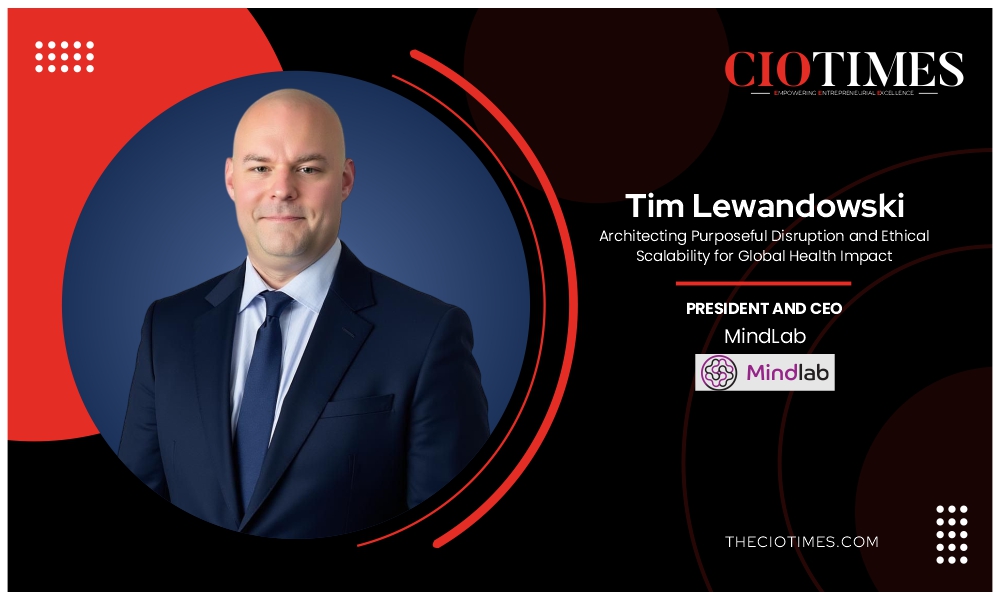
They focus on delivering solutions that are more accessible, affordable, and personalized than ever before, using consumer-focused strategies to improve quality of life and lower the financial burdens of traditional healthcare globally. Tim Lewandowski, President and CEO, Mindlab, is the epitome of such clinical integrity. Disruptive innovation is fundamentally reshaping health and wellness, moving us from reactive “sick-care” to proactive “well-care.” This revolution is driven by technologies like telemedicine, which offer easy remote consultations, and wearable devices that provide real-time personal health monitoring.
Principled by Nature
A true believer in Simon Sinek’s quote, “Start with why”, Tim describes his two-decade journey at the intersection of clinical science, digital health, and global innovation as one shaped directly by the intensity of patient care. His shift from hands-on clinical practice to becoming a globally recognized health-tech strategist wasn’t a departure from medicine, but a deeper understanding that lasting patient impact comes from strengthening the entire care system, not just improving individual treatments.
One of his most defining experiences emerged in the early 2000s while working in physical medicine and rehabilitation. He saw the human-machine interface transform as mobility devices evolved from simple stabilizers into systems powered by pattern recognition and microprocessor control, capable of re-training lost biomechanical functions. For him, this was not incremental progress it was functional restoration at scale.
Those clinical years taught him a foundational principle: technology has no place in care unless it reliably improves an outcome or restores a function. Technical brilliance means little unless it fits naturally into a clinician’s workflow and delivers measurable clinical value. That disciplined, outcome-first mindset continues to guide every innovation he evaluates.
Another turning point came as he moved into clinical leadership and took responsibility for financial, operational, and organizational metrics. He realized that gaining support from senior clinicians is often the easy part; true friction arises in execution. Innovation succeeds only when product design, clinical protocols, reimbursement pathways, and commercial feasibility align. Without this alignment, even the most promising technologies fail to reach the patients who depend on them.
These experiences clarified his long-term purpose: modern medicine needs leaders who can bridge clinical insight with operational strategy, ensuring innovations are not only groundbreaking but accessible and scalable. Tim’s career evolved from treating patients individually to architecting systems and strategies that deliver high-impact technologies to millions, an evolution that defines his role today as a global health-tech strategist committed to scaling clinical integrity through systemic innovation.
Purposeful Disruption
When discussing the impetus behind Mindlab, a company that has quickly emerged as a forefront player in health and wellness technology, Tim and his co-founders, Mark Salazar and Steph Wong, realized that impact and sustainability in mental health required a fundamentally new model. They identified a critical gap: many clinically effective technologies fail to achieve global scale and democratization because they lack a robust, commercially viable engine.
The mission, “Disruptive innovation to drive health and wellness. For good,” serves as Tim’s strategic response and is deeply aligned with his personal philosophy. The founding of Mindlab was catalyzed by acquiring the sleep wellness app, Pocket Kado. It became clear to Tim that its B2C subscriber strategy alone would never democratize global access, leaving it a niche tool inaccessible to underserved communities and nations.
Mindlab’s vision was to create a purpose-built commercial entity capable of breaking through geographical and governmental barriers. This required strategic access, designing Go-to-Market strategies that leverage B2B, enterprise, and global partnerships to ensure scale and democratization. It also demanded financial fortitude, building a company whose commercial success is directly tied to its ability to sustain and expand its social mission.
The “For good” in Mindlab’s mission is not a philanthropic afterthought; it is its core business model and ethical North Star. Tim recognized that their long-time partner, the Mental Health Association of San Francisco (MHASF), faced increasing instability from geopolitical funding threats. Mindlab serves as the ethical solution to this unstable funding paradigm.
Tim shares, “Our commercial success directly fuels the legacy of MHASF, restoring and maintaining access to critical community services in California.”
Mindlab’s commercial success directly fuels the legacy of MHASF, restoring and maintaining access to critical community services in California. This is his philosophy in action: proving that one does not have to choose between profitability and purpose, pioneering a framework where commercial success is the engine for global health equity.
Strategic Operations
Mindlab Apex Consulting guides CEOs and founders toward operational clarity and scalability because, as Tim observed, brilliant innovators often become CEOs by necessity, not by training. These visionary leaders, excellent at science or technology, quickly become overwhelmed by the operational chaos of a scaling business, losing the headspace needed for critical innovation. Tim strongly believes that strengthening the innovator accelerates the innovation itself.
Apex is a strategic partnership that fuses disruptive leadership coaching with battle-tested operational frameworks to help leaders unlock efficiency and expand management bandwidth.
Apex focuses on three critical shifts:
- Decisive Leadership: Equipping leaders with mental models to confidently handle high-stakes decisions and reclaim focus.
- Organizational Alignment: Assessing the structure to ensure it supports, not hinders, mission-critical execution.
- High-Stakes Team Cohesion: Turning C-suites into high-performance units that debate, commit, and execute with velocity.
Ultimately, Apex provides the roadmap to ensure a founder’s genius can scale globally, transforming the industry.
Global Methodology
With his extensive global exposure across over 12 countries, Tim realized that building globally scalable digital health solutions requires moving past local product development toward universal methodological design. He saw that the true challenge isn’t creating the tech, but adapting it to local economic and infrastructure realities. Tim argues we must deconstruct the Western idea of “innovation.”
His methodology centers on finding the Minimum Viable Impact (MVI) for each region. This means innovation might be defined by cost-reduction, low-bandwidth capability, or simply overcoming cultural stigma, depending on the local constraints.
Mindlab acts as a hyper-localized strategic partner, never exporting a rigid solution. Instead, they align their mission with local partners, adapting the technology for maximum implementation speed, whether that involves basic user interface simplicity to handle literacy barriers, or utilizing local versus cloud data storage. This ensures the solutions they build are geopolitically agnostic and resilient, making them economically and culturally viable everywhere they go.
Impact Architect CEO
As President & CEO of Mindlab Corporation, Tim’s current leadership role is not simply to manage operations; he serves as the Chief Architect of Scalable Social Impact. He leads a dynamic team, focusing on maintaining a successful balance across three critical domains that define Mindlab’s growth trajectory:
- Financial Solvency & Ethical Stewardship: Ensuring robust business operations and working capital management, guaranteeing that commercial growth remains steadfastly aligned with the company’s ethical foundation.
- Strategic Business & Partnership Development: Forging the high-value, global collaborations essential for democratization and rapid market penetration.
- Visionary Product & Strategic Roadmapping: Defining the future value proposition of the technology platform and its evolution across the health ecosystem.
He adds, “Mindlab is currently at a powerful strategic inflection point: we possess the agility and drive of a startup, yet we have a commercially proven, award-winning flagship product in Pocket Kado.”
While navigating this high-growth stage, Tim’s roadmap is not about fast money but purposeful acceleration.
Strategic Roadmap: Two-Pronged Approach
- The Short-Term Roadmap: Unlocking Platform Value The primary initiative is the rapid, purposeful adoption of Pocket Kado across global markets. In the final weeks of 2025, they are launching exciting premium features and subscription models that move beyond basic tracking to deliver personalized, prescriptive health behavior change. This expansion is crucial as it allows Mindlab to offer an increasingly unique and indispensable value proposition to strategic partners in public health, education, and behavioral health.
- The Long-Term Vision: The Ecosystem of Wellness Intelligence Tim’s long-term vision positions Mindlab as the global standard for applied wellness intelligence. They believe sleep is just the tip of the iceberg, and the core behavioral and physiological data foundation built allows them to move across the wellness lifecycle. Their unique selling proposition is being a deeply valued and clinically integrated partner. They build clinical expertise and strategic advisory resources first, ensuring every expansion maintains their commitment to efficacy and integrity. This success ultimately fuels Mindlab Apex Consulting, which fulfills Tim’s personal commitment to cultivate and share the operational playbooks of scaling health innovation ethically, empowering the next generation of leaders.
Ethical Scalability
Tim’s operational leadership at the Mental Health Association of San Francisco (MHASF), especially overseeing nearly half a million annual patient contacts through the peer-run Warm Line, provided the most critical operational education of his career. This experience taught him that in mental health, scalability is not just about technology; it is about preserving trust and human fidelity while simultaneously achieving financial viability.
The Toughest Operational Challenge: The Efficiency Paradox
The most challenging operational hurdle Tim faced was managing the “Efficiency Paradox”: how to drastically reduce the cost per client engagement when the highest value attribute of the service is a non-scalable, authentic human connection. With service demand peaking and funding stability bottoming out, he was placed at the intersection of desperation and innovation, needing a solution that avoided the default tech answer. Any technologist could suggest AI to supplement call capacity, but the Warm Line’s efficacy lies in its foundation of anonymity, trust, and connection with a peer counselor who has “been there before.” Substituting that human core with opaque AI could catastrophically destroy the service’s very value proposition.
This challenge fundamentally changed Tim’s approach to health-tech scalability, reinforcing two key principles he now applies at Mindlab:
- Innovation Must Protect the Core Value: Scalable technology in behavioral health cannot be a substitute for the core human interaction; it must be an unseen force multiplier for the counselor. The focus must be on leveraging AI for tasks like intake efficiency, documentation, and reporting—the necessary workflows—to allow peer counselors to operate at the absolute top of their ability and dedicate 100% of their time to the human connection.
- Viability is a Collaborative Mandate: This is a critical juncture where providers (like MHASF) and infrastructure partners must innovate together. They must demand that technology is responsible and transparent in its deployment, ensuring it drives down costs without ever compromising quality or ethical standards.
This time in operational leadership was Tim’s proving ground, instilling in him the strategic discipline to build Mindlab’s technologies to serve as an ethical, outcomes-driven infrastructure for humanity, not just a standalone product.
Shaping the Future
The health-tech landscape will fundamentally change over the next five years due to the convergence of two trends, moving past simple data into prescriptive action.
First, the democratization of real-time objective health data requires true interoperability, forcing clinical and wellness data to flow securely across providers and personal devices. The critical shift is from reactive care to prescriptive wellness. The future state sees continuous data seamlessly integrated with an evidence-based intervention engine, meaning the system doesn’t just inform, but actively prescribes and delivers the necessary intervention (like CBT-I in Pocket Kado) right when it’s needed, driving proactive health outcomes.
Second, the sophisticated application of AI is shifting from diagnostic AI to behavioral AI, the key to unlocking true scalability. This will manifest through:
- Ambient Monitoring: Non-intrusive remote diagnostics identifying subtle health deviations before they become clinical issues.
- Hyper-Personalized Interventions: Behavioral AI delivering timely, contextual “health nudges” that feel less like a tool and more like an invisible co-pilot.
At Mindlab, they focus on this balance: creating data integration that directly triggers proven, evidence-based interventions, transitioning from “data as a metric” to “data as the trigger for health action.”
Strategic Blind Spots
When founders struggle with operational chaos, Tim sees it as a single strategic blind spot: the Fiduciary Trap. Founders become so focused on immediate duties (like hiring and cash flow) that they lose the bandwidth to act as the company’s Chief Visionary. They become adequate operators but ineffective architects of the future.
From his advisory work at Mindlab Apex, Tim highlights two core failings:
- Blind Spot 1: The Tactical Misalignment. Founders spend too much time on minutiae instead of their unique, high-value tasks (like defining the ten-year vision). The fix: a time audit to re-align their capacity to the 10x tasks only they can perform.
- Blind Spot 2: The Unscalable Culture. They mistake constant activity for productivity and rely on tribal knowledge. The fix: master delegation by implementing predictable frameworks for accountability and decision-making that transform tribal knowledge into scalable governance.
Tim advises leaders to engage a neutral third party for a strategic intervention. The goal is to implement an operating system that frees the founder to focus on being the Chief Architect of the Future, tying the company’s momentum to its purpose, not their personal effort.
Executing for Global Impact
Mindlab’s culture is the deliberate fusion of ethical purpose and high-velocity execution. Tim emphasizes that global impact is the primary driver of every decision, not just an outcome.
Their values demand: Tech for Good, Global by Design, Radical Collaboration, and Decisiveness over Perfection.
Leadership Principles
- Fiduciary Purpose: Tim instills the belief that their responsibility includes the global community. Every employee understands how their role directly impacts a patient. Impact is the ultimate KPI, ensuring zero tolerance for inefficient solutions.
- Globalized Trust: To support a Global by Design organization, hierarchy is replaced with trust. Team members get immediate authority to make decisions within their domain expertise, enabling Radical Collaboration. Tim defines the boundaries of the decision, not the decision itself, accelerating global scale.
- Decisiveness over Perfection: This embraces rapid, transparent iteration. Failure is viewed as an investment in learning. Tim leads by openly pivoting when data demands it, fostering a risk-tolerant environment focused on achieving Minimum Viable Impact (MVI) rapidly.
This approach ensures Mindlab’s culture is agile and singularly focused on transforming mental health at scale.