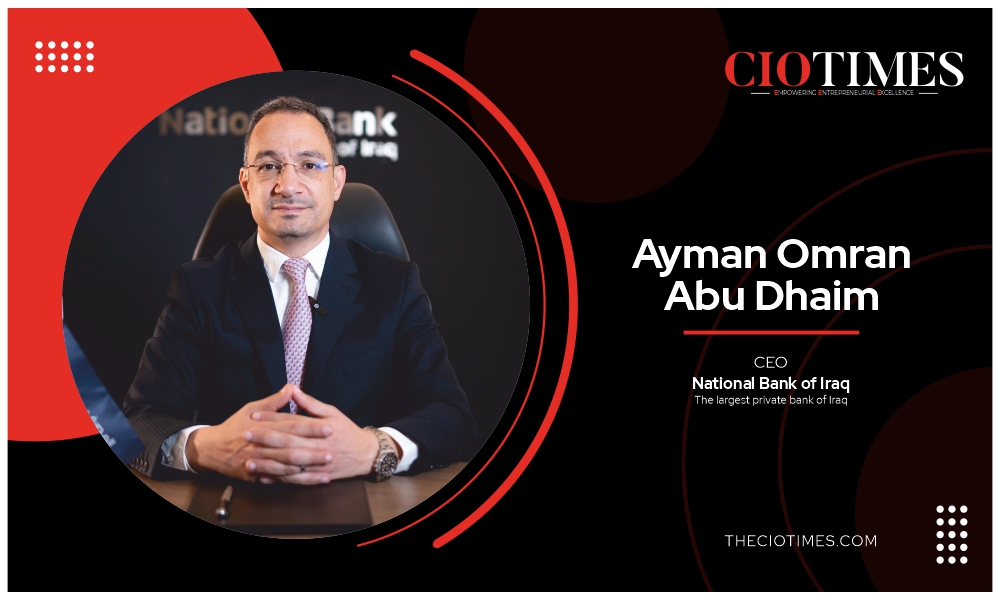
Ayman began his professional journey in finance and investments more than 30 years ago, gaining solid experience in auditing, investment management, and financial control. He is a Certified Public Accountant (CPA) and Certified Management Accountant (CMA). After completing his undergraduate degree in accounting at the University of Jordan and a graduate degree at the University of Southampton, he held senior leadership roles at PWC, Arab Bank Group, the Social Security Investment Fund in Jordan and later at Capital Bank of Jordan, including Chief Financial Officer and Chief Regional Management Officer. Today, Ayman serves as the Chief Executive Officer (CEO) of the National Bank of Iraq, leading the institution’s strategic growth and regional expansion.
He shares,” These roles required rigorous financial discipline, risk assessment, regulatory compliance, and strategic financial planning.”
In April 2018, Ayman became Chief Executive Officer of the National Bank of Iraq, drawing on his extensive experience in institutional investment and banking operations to guide NBI. His career across audit, investment management, and banking operations has shaped a leadership style rooted in solid governance, measurable performance, prudent capital allocation, and a balanced growth strategy that carefully considers both opportunity and risk.
Strategic Balance
Ayman prioritizes investments by assessing the strategic returns and risk mitigation potential of each area, striving to balance technology, physical presence, and human capacity. Technology is often prioritized when it offers scalability, cost efficiency, and new revenue opportunities; digital banking platforms and payment systems are key examples of where technology investments deliver significant benefits.
At the same time, branch expansion is undertaken selectively, focusing on locations where physical presence remains important for customer acquisition, financial inclusion, government salary distributions, or where client trust necessitates in-person services. Investment in human capital supports both approaches: training, risk management, compliance, analytics, and customer service are critical to ensure technology and branch networks are utilized effectively.
In practice, this means that while he approves large-scale technology projects and digital transformation initiatives, he also ensures adequate resources are allocated to staff development, regulatory compliance, and operational risk management.
Modern Banking Transformation
He has overseen significant investments in modernizing the bank’s core banking infrastructure, enhancing customer-facing digital platforms, and expanding its branch and ATM network to improve service coverage.
He adds,” Replacing legacy systems with more agile, resilient core banking software has been essential in enabling faster transaction processing and better operational scalability.”
At the same time, digital front ends, including mobile banking applications and online banking, have been upgraded to enhance user experience, security, and responsiveness. Physical infrastructure has also been developed in selected areas to support service delivery, particularly where digital adoption is limited. These capital expenditure initiatives ensure that while he drives innovation, the core banking framework remains reliable, secure, and accessible throughout Iraq.
Ideal Capital Management
Ayman guides NBI’s financial planning and capital allocation through a multi-year strategic framework. Regulatory requirements, such as those set by the Central Bank of Iraq, establish baseline levels for capital, liquidity, and risk buffers, while internal reserves are maintained above these minimums to safeguard stability. Capital is first directed toward projects and operations that ensure compliance, resilience, and robust foundational systems; next, growth initiatives with clear profitability potential and reasonable payback periods are funded; finally, capacity is reserved for innovation and strategic optionality.
He highlights it by saying,” This ensures short-term financial performance is maintained without undermining long-term strength, especially in the context of economic volatility.”
Market Insights
His background in investment management has made him highly attuned to underserved markets and structural shifts. In Iraq’s evolving economy, opportunities are emerging in SME financing, trade finance, and modernization of payment systems. The bank focuses on offering tailored financial products to SMEs, facilitating trade flows, and leveraging digital channels. Regional relationships, particularly through Capital Bank of Jordan, enable close monitoring of and engagement with cross-border market trends. Macroeconomic and regulatory changes, including government policies supporting reconstruction, infrastructure investment, oil and gas services, and non-oil sectors, are carefully evaluated to align product offerings and risk frameworks with areas of strategic growth potential.
Investor Confidence
Ayman has emphasized transparency, governance, and regulatory compliance to ensure investor confidence in the bank’s financial disclosures. NBI is listed on the Iraq Stock Exchange under the ticker BNOI, signaling accountability and enabling participation from regional and international equity investors.
He highlights it by saying, “We regularly publish audited financial statements, adhere to disclosure standards, and maintain a strong ownership structure. For example, Capital Bank of Jordan holds a majority share.”
Engagement with institutional investors across the region ensures alignment with best international practices. While public data on foreign direct participation is limited, ownership diversity and strategic investor relationships support the attraction of capital from beyond Iraq’s borders.
Diversified Financing
He supports economic diversification by expanding NBI’s credit to non-oil sectors, including commerce, services, industry, and small and medium enterprises. The bank develops financing products tailored to smaller firms, providing working capital, trade finance, and project finance for non-oil infrastructure. Risk assessment frameworks are carefully adapted to these sectors, considering their specific cash flow cycles, collateral realities, and vulnerabilities. Simultaneously, a strong focus on transparency, regulatory compliance, and governance helps rebuild investor confidence by demonstrating that financing is conducted responsibly and in sectors capable of generating sustainable economic value.
Risk Governance
Ayman ensures that the bank maintains rigorous internal risk management and compliance functions alongside its innovation agenda. Whenever new technologies or product lines are introduced, they are reviewed through the lens of regulatory compliance, both local and, where relevant, regional or international cybersecurity, and operational risk.
He shares,”We employ internal audit, external audit, and independent risk oversight structures as part of the three-lines-of-defense model. ”
Capital reserves, liquidity buffers, and provisioning practices are designed to absorb shocks, whether from market volatility, regulatory changes, or emerging technology risks. Innovation is encouraged but structured to preserve the stability and trust expected by customers, regulators, and investors.
Transformational Digital Banking
He has led NBI’s commitment to modernizing its digital banking platforms, launching upgraded mobile and online banking services to offer customers easier access and an improved user experience. Significant investments have been made in upgrading core banking systems to enhance transaction speed, reliability, and security. In the field of AI, the bank is identifying options to deploy analytical tools to support fraud detection, risk management, and customer insights, with many initiatives remaining internal and proprietary. Regarding blockchain, the bank is also exploring potential applications, particularly in trade finance, identity verification, and KYC (know your customer) systems.
Cross-border
Ayman positions NBI as a bridge institution connecting Iraq to regional markets through its affiliation with Capital Bank of Jordan and international banking arrangements.
About the financial organization Ayman shares, “We facilitate trade flows, remittances, and corporate cross-border transactions.”
By developing strong correspondent banking partnerships, enhancing compliance and risk standards, and maintaining efficient payment systems, NBI makes cross-border banking seamless. Its presence allows clients operating across Iraq, Jordan, KSA and other MENA markets to access services under one umbrella, reducing friction, costs, and risk. This role is increasingly vital as Iraq seeks deeper regional economic integration and expanded opportunities for foreign investment and trade.
Banking with Resilience
He ensures that NBI’s risk management frameworks are designed to address economic and geopolitical volatility in Iraq and the region, focusing on capital adequacy, strong liquidity management, diversified funding sources, and stress-testing. Internal capital reserves are maintained above the regulatory minimums set by the Central Bank of Iraq, with scenario planning conducted to test resilience under adverse conditions. Governance structures include risk committees, internal audit, and compliance functions to ensure that credit risk, market risk, operational risk, and liquidity risk are actively measured, monitored, and mitigated in management decisions. This approach ensures that, despite economic or political headwinds, the bank remains financially sound and capable of serving its clients.
Risk Outlook
Ayman recognizes that over the next decade, the main risks for Iraqi banks include geopolitical instability, fluctuations in oil revenues, currency volatility, pressure on correspondent banking relationships, rising cybersecurity threats, and regulatory unpredictability. Conversely, significant opportunities exist in formalizing the informal economy, digital payments and fintech, SME growth, infrastructure and housing finance, and expanded trade with regional neighbors.
NBI is preparing by investing in risk analytics, compliance, and technology, diversifying income streams from fee-based to interest fee– and service-based revenues, strengthening capital buffers, and building internal resilience, enabling the bank to pivot quickly when opportunities arise.
Performance Metrics
He ensures that NBI measures the ROI of capital expenditures by projecting expected financial returns upfront and tracking key performance indicators after implementation. For traditional banking operations, metrics such as cost-to-income ratio, operational expenses per branch, incremental deposits and loans originated, branch profitability, and staff productivity are closely monitored. For digital transformation initiatives, metrics include active user numbers, transaction volumes via digital channels, percentage of straight-through-processing transactions, error or failure rates, time-to-market for new features, cybersecurity incidents prevented, cost per transaction, and margin improvements from reduced manual processing.
About these metrics Ayman adds,” These metrics allow us to assess both financial payback and strategic value in terms of customer satisfaction, resilience, and competitive positioning.”
Empowering Financial Impact
His belief that financial management is not only about balance sheets and profits but also about enabling businesses to thrive. He engages teams by linking financial goals to tangible outcomes: how financing supports entrepreneurs, how payment systems facilitate commerce, and how jobs are preserved or created when SMEs succeed.
Investment in training, fostering ownership of results across business units and support functions, and regular communication of both successes and lessons learned are central to his approach. Cultural values of service, resilience, and national development are also emphasized, helping staff understand that their work contributes beyond the bank to economic inclusion, rebuilding trust, and stability in Iraq.
Visionary Banking Leadership
Ayman’s vision is for NBI to become Iraq’s leading universal bank in both domestic reach and regional connectivity, with digital banking as a central pillar. He aims for NBI to be the preferred partner for Iraq-based individuals and companies conducting business across the Middle East, particularly through relationships with Jordan, Saudi Arabia, and other Gulf states. He envisions the bank being recognized for strong governance, compliance, and transparency, while helping attract foreign investment into Iraq. Domestically, Ayman seeks to deepen financial inclusion, enabling more Iraqis to access formal banking services, credit, and digital payments. On a regional and global level, he aspires for NBI to actively participate in capital flows, correspondent banking networks, and trade-finance corridors, fostering greater integration of Iraq into the global financial system.
Visit the digital edition now: Top 5 CEOs to Watch in 2026