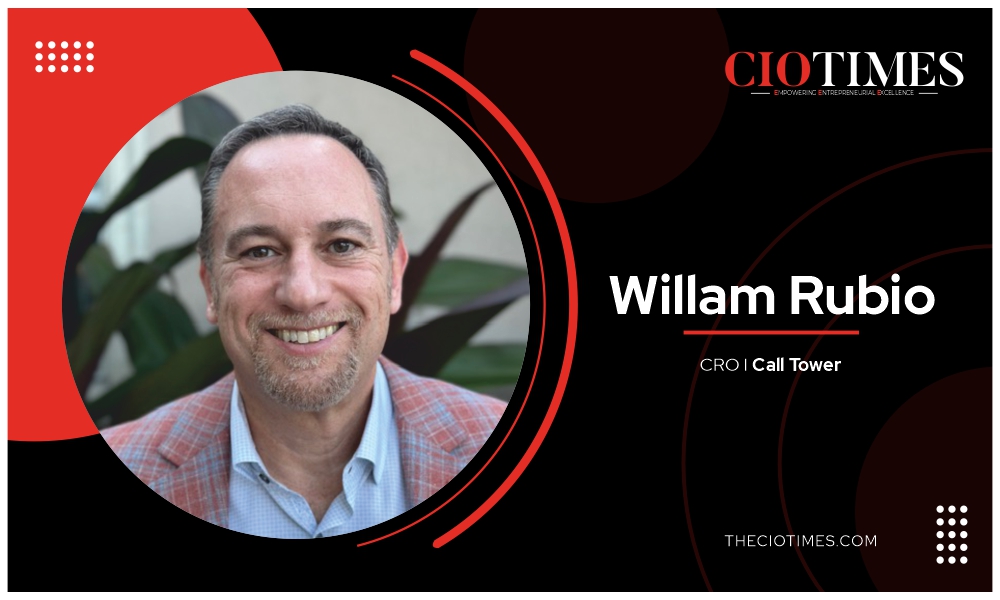
Chief Revenue Officers have been a crucial part of the corporate realm. As the business landscape becomes more competitive and more data-driven, they act as a reliable source for making vital decisions for achieving higher benefits. Their expertise, knowledge, and sheer excellence make them indispensable. A similar maestro is William Rubio, Chief Revenue Officer at CallTower, Florida. His career path reflects a clear belief that industry transformation is driven more by preparation than prediction. As the sector began shifting from traditional telecom to cloud-driven communication models, he recognized early that legacy systems, while reliable, lacked the scalability and flexibility required for the future.
He adds, “I made a deliberate decision to immerse myself in cloud technology and data-driven communication platforms before the market demanded it.”
This deliberate choice to embrace cloud adoption and UCaaS early became the most pivotal decision of his career. It enabled him to align with emerging trends rather than react to them after the fact.
This forward-looking mindset positioned William to play a key role in CallTower’s transformation from a strong telecom provider into a global leader in integrated UCaaS and CCaaS solutions. His ability to forecast industry direction, adapt with clarity, and execute around platforms such as Microsoft Teams, Cisco, and Zoom has been central to sustaining growth and strengthening the company’s competitive edge in an evolving communications landscape.
Leadership Evolution
The transition from Area Manager to Chief Revenue Officer required him to cultivate skills that extended far beyond core sales expertise. In response to the question about which essential capabilities were necessary to move into executive leadership, he highlights that the shift demanded a new way of leading, one rooted in vision rather than solely in metrics. As an Area Manager, performance was defined by clear, measurable outcomes such as closed deals and revenue targets. In an executive role, however, the scope expanded to orchestrating growth across people, processes, and technology.
To operate effectively at this level, he developed a more sophisticated understanding of financial strategy, organization
al psychology, and global operational dynamics. Recognizing that no leader can execute every function with equal depth, he embraced the importance of strategic delegation. He built a leadership team composed of individuals with strong operational precision, enabling him to focus on long-range planning, partner alignment, and enterprise-wide growth initiatives.
This leadership evolution reinforced a key insight: empowering others to lead not only scales the business but also strengthens loyalty, accountability, and innovation across the organization.
Role in CallTower
As CallTower’s Chief Revenue Officer, William takes great pride in leading a team that is reshaping the future of global communications. The company’s evolution from pioneering Operator Connect to expanding secure GCC High solutions and introducing the Ascend Teams Contact Center demonstrates a consistent commitment to innovation, strategic partnership, and customer success.
Each milestone reflects his core belief that technology should strengthen human connection rather than complicate it. This philosophy defines the CallTower difference and continues to guide the organization’s next chapter of growth.
Strategies Across Markets
His experience across both established and emerging regions has shown him that each requires distinctly different market-penetration and sales strategies. In established markets, trust, consistency, and scale are the primary drivers. In mature regions such as North America, the focus is on expanding value through advanced integrations like Operator Connect, GCC High, and CT Cloud Contact Center to deliver compliance-ready global voice solutions.
Emerging markets, however, depend on education, accessibility, and cultural adaptability. Across EMEA and APAC, success is shaped by strong local partnerships and the ability to tailor offerings to regional infrastructure and
regulatory requirements. Collaborating with distribution partners such as Nuvias UC enabled more precise alignment with market needs.
The clearest distinction is pacing: established markets benefit from optimization, while emerging markets reward speed and innovation.
Alliance Strategy
His philosophy for alliances is that they must create shared, long-term value rather than be purely transactional. He builds relationships that strengthen market presence through Microsoft, Cisco, Zoom, and partners like Nuvias UC, enhancing CallTower’s visibility, credibility, and delivery capacity.
As CRO, he leverages these partnerships through joint go-to-market initiatives, co-branded campaigns, and partner enablement programs, ensuring collaboration remains dynamic and mutually beneficial.
He shares, “My role is to ensure our alliances remain dynamic and mutually beneficial.”
This approach positions CallTower as a trusted, innovative leader in global markets.
Competitive Edge
William’s approach to leveraging “unfair advantages” centers on moving faster than the market while maintaining enterprise-grade reliability. He focuses on anticipating partner needs, regulatory shifts, and technological inflection points so new ventures can enter competitive spaces with immediate strength.
A clear example of this strategy is CallTower’s early preparation for Microsoft Operator Connect. While many providers were still assessing how to
operationalize the offering, CallTower had already built the supporting infrastructure, compliance framework, and partner ecosystem. As competitors began planning their entry, the company was already scaling across North America and EMEA.
This level of proactive readiness enabled CallTower to establish itself as a trusted Operator Connect provider with strong reliability and global reach.
Foresight-driven Strategy
His approach to forecasting industry trends is rooted in recognizing patterns where technology, regulation, and customer expectations converge. He integrates this foresight directly into CallTower’s operational strategy by ensuring that executive and product teams work in close alignment.
This collaboration enables early, well-timed investment in technologies that will shape future demand. One example is CallTower’s early commitment to GCC High to serve the government and defense sectors, anticipating the growing need for secure cloud communications.
Similarly, the company prioritized AI-driven analytics, compliance recording, and 1-click failover long before these became market norms. By investing ahead of peak demand, CallTower reduces operational risk while positioning itself to capitalize on industry shifts.
Looking at the broader landscape, he sees several emerging technologies beyond Unified Communications that will significantly transform enterprise IT over the next three to five years.
William adds, “AI will continue to evolve from a productivity tool into a strategic advisor—integrating context and intent into communication.”
Edge computing will enhance performance
by decentralizing processing, improving both latency and security. Data sovereignty, especially across EMEA and APAC, will reshape global compliance requirements and influence how providers architect their platforms. His focus is on building adaptable frameworks that meet these emerging demands while maintaining a seamless user experience across regions.
Empowered Teams
His approach to talent management is grounded in the belief that agility and motivation come from empowerment, accountability, and continuous development. At CallTower, he structures business development teams to emphasize collaboration
rather than internal competition. Regional and vertical teams operate with autonomy but remain aligned through shared KPIs that reinforce collective success.
A key priority is upskilling. He ensures teams are trained on emerging technologies such as AI-assisted customer analytics, Operator Connect provisioning, and global compliance frameworks so their capabilities remain future-proof. Internal growth is strongly encouraged, with promotions from within and consistent recognition of innovative contributions at every level.
For him, a high-performing team is built through purpose and progress, not pressure.
Translating Tech Value
His method for translating complex technological value into a clear business case begins with understanding the audience. He listens closely to client priorities, language, and operational challenges, ensuring that communication connects technology to real business impact. For technical teams, he emphasizes integration, reliability, and interoperability. For C-suite executives, the focus shifts to measurable outcomes such as efficiency improvements, cost reduction, and competitive differentiation.
He shares, “It’s about turning features into tangible outcomes that resonate with every layer of the organization.”
Within CallTower, William often reinforces this approach through real-world examples, such as demonstrating how a global enterprise achieved regulatory compliance and reduced communication costs by 30% through the combined use of Operator Connect and CT Cloud Voice.
Media Leverage
William’s perspective on media visibility is that it should serve the organization rather than elevate the individual. When his insights appear on major platforms such as NBC, he uses that visibility to reinforce CallTower’s brand authority by highlighting the company’s vision for global communication, its technological advancements, and the strategic partnerships that enable its growth.
Public thought-leadership positions CallTower as a forward-thinking player in unified communications, demonstrating that the
- leadership team actively shapes industry dialogue rather than reacting to it.
- He says, “It demonstrates that our leadership team isn’t just reactive; we’re driving the conversation in unified communications.”
- This external credibility strengthens trust among customers and partners, ultimately supporting the company’s broader growth objectives and expanding opportunities across key markets.
- Evolving Value
- His view of “value” in the UCaaS space reflects a significant evolution over the past decade. Where clients once defined value primarily through price and
- uptime, they now look for partnership, adaptability, and long-term alignment with their business
ecosystem. Modern expectations center on providers who can anticipate needs, integrate seamlessly with existing platforms, and evolve in step with organizational change.
To meet these expectations, sales executives must transition from transactional selling to a truly consultative approach.
William says, “At CallTower, we position ourselves not as vendors but as strategic partners who align communication solutions with business outcomes.”
The focus has shifted toward integration, security, and flexibility, acknowledging that in an environment of rapid technological change, real value lies not only in what is delivered today but in how effectively clients are prepared for tomorrow.
Strategic Growth Drivers
William identifies CallTower’s most critical recent strategic investment as the global expansion of its Operator Connect infrastructure alongside the advancement of the Ascend Teams Contact Center platform. These two initiatives form the core of the company’s next major revenue wave.
He shares, “Operator Connect allows us to deliver direct-to-carrier connectivity for Microsoft Teams users with unmatched reliability and control.”
Complementing this, the Ascend platform delivers a fully native contact center experience with
in Teams, combining operational simplicity with robust functionality.
Together, these investments position CallTower to deliver scalable, enterprise-grade voice and contact center capabilities to organizations of all sizes and across all regions, creating a strong foundation for sustained growth.
Consistency Builds Resilience
William’s most resilient habit in moments when a major deal slows or a market forecast shifts is a disciplined return to fundamentals: maintaining calm, staying connected to stakeholders, and approaching the situation with creativity. He views unexpected challenges as opportunities to strengthen relationships, refine strategic direction, or introduce new solutions rather than as setbacks.
The core tenet he relies on is consistency. Even when external momentum softens, he believes integrity and persistence
must remain constant. Market conditions may fluctuate, but trust both internal and external conditions. At CallTower, that trust serves as a stabilizing force and a key driver of long-term growth.