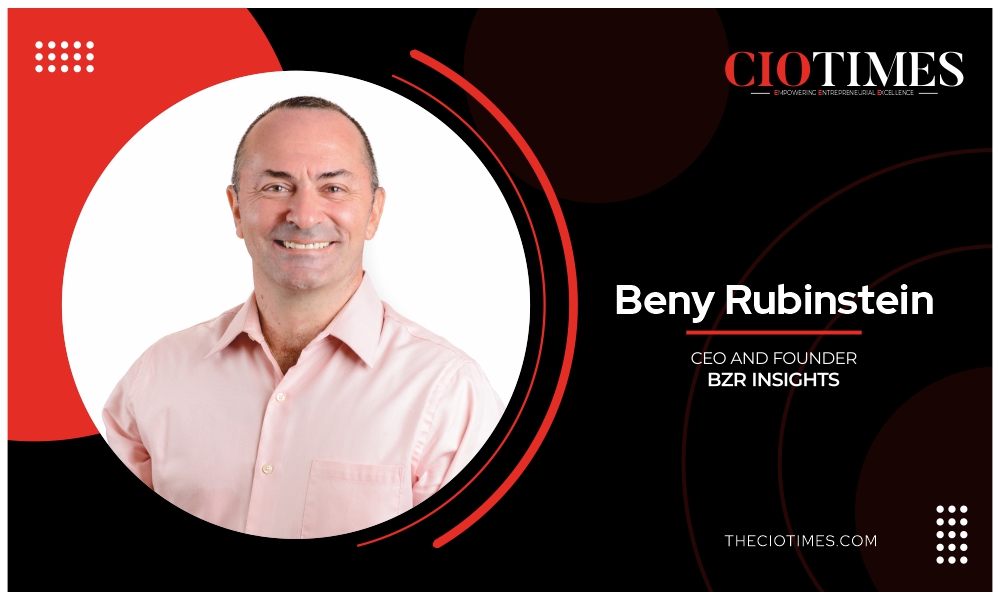
In a packed meeting room in London, as Beny Rubinstein and his team prepared to launch Microsoft HealthVault in the UK, he realized there was no playbook for what they were about to attempt. “The stakes were high: entrenched systems, skeptical stakeholders, and a vision that challenged the definition of patient empowerment,” Beny recalls. “That moment crystallized for me what true business reinvention demands: not just technology, but trust, resilience, and the courage to start from scratch.”
This lesson has guided Beny’s journey ever since; he has learned that real transformation is always about people, systems, and the willingness to reimagine what is possible. In a world being reshaped by AI and global complexity, the need for leaders who can bridge technological innovation and humanity has never been greater.
Bridging Complexity with Empathy
Business leaders who combine strategic insights with technological depth shape the future of modern enterprises. Beny Rubinstein, CEO and Founder at BZR Insights, is one such leader. His decisions are grounded in data but are guided by empathy and purpose. By anticipating trends, modernizing operations, and nurturing digitally confident teams, he steers organizations through rapid change.
Beny’s experience across global enterprises such as Microsoft, IBM, and Amdocs, combined with his work in accelerators, venture funds, and startups, has shaped a leadership approach that places people and systems at the center of innovation. He has experienced how large organizations require careful navigation of conflicting interests and internal politics, while early-stage ventures must rely heavily on trust, shared purpose, and disciplined execution to keep fragile ideas alive.
His focus is on empowering pioneers willing to co-create new possibilities and reimagine complex systems in the absence of a blueprint. Guided by Uri Levine’s belief in “falling in love with the problem,” Beny champions creativity, resilience, and the courage to try, fail, and persist until breakthrough solutions emerge.
Adapting to Diverse Cultures
Beny’s experience leading teams across the U.S., EMEA, and Latin America has shaped a leadership style rooted in cultural awareness and adaptive collaboration. He has learned that transformation succeeds only when the local context is genuinely understood.
A communication style considered efficient in the U.S. or Nordics may feel abrupt in parts of Latin America, where relationship building is seen as an essential step before discussing the strategy. Similarly, in the Middle East and Africa, he observed how meaning often comes through tone, pauses, or nonverbal cues, elements that can easily be missed without cultural sensitivity.
“Sometimes, the most important messages are never spoken aloud,” Beny reflects – a reminder that leadership is as much about listening for what is unsaid as it is about setting direction.
These insights showed him that global programs fail when they overlook regional realities, even if the strategy is sound. What works in one geography rarely applies “as is” to another. Senior leaders often demand transformation frameworks customized to local market pressures, regulatory constraints, and team dynamics. Conversely, younger teams value leaders who take the time to understand their environment rather than those who impose a one-size-fits-all approach.
Over time, Beny adopted a leadership ethos built on deep listening, collaborative problem solving, and genuine respect for local expertise. He actively seeks local champions who can translate global vision into practical execution and ensure that change feels relevant and is not forced. These cross-cultural lessons have made him more flexible, more anticipatory of differences, and more effective in delivering transformations that are both globally aligned and locally meaningful.
AI Leadership: Beyond Technical Fluency
Beny believes that leadership in the age of AI requires far more than technical fluency. Tomorrow’s leaders must be system thinkers who understand how technology affects people, teams, organizations, and society. They need humility to recognize what machines do best and discernment to understand the uniquely human contributions of empathy, ethical judgment, and nuanced decision-making.
Adaptability is crucial, including the courage to unlearn and relearn as the landscape shifts. Leaders must create environments where experimentation is safe, diverse perspectives are valued, and “failure is seen as success in progress,” as Albert Einstein said.
Above all, trust is the foundation of leadership in the era of AI. Transparent communication regarding risks, ethical considerations, and human impact is essential. For Beny, thriving leaders orchestrate collaboration between humans and AI, inspiring teams to co-create outcomes that are efficient, responsible, and meaningful. This perspective is especially valuable for boards seeking to balance innovation with risk management, governance, and stakeholder trust.
Entrepreneurial Mindset Insights
Beny sees the distinction between an entrepreneur and an intrapreneur less as a matter of location and more about how one navigates complexity and ambiguity. Entrepreneurs create something from nothing, relying on faith, conviction, resilience, and willingness to take personal risks. They must articulate a compelling vision, assemble strong teams, and persuade others that their solutions matter. The rewards and stakes are deeply personal.
In contrast, intrapreneurs operate within established organizations, where resources exist, but constraints, politics, and legacy systems pose unique challenges to innovation. Success requires coalition building, navigating entrenched interests, and aligning incentives to drive meaningful change. Adaptability, curiosity, and rapid learning through experimentation and observation are essential skills.
“What unites both roles is relentless curiosity and the ability to inspire others to join you on a journey where the outcome remains uncertain.” Beny notes.
Intrapreneurs add the skill of translating innovation to scale and enabling teams to co-create solutions that work in both startups and large organizations.
Evolving Innovation
Over the years, Beny’s views have broadened considerably. He now sees innovation as less about technological novelty and more about reimagining the systems, incentives, and relationships that enable meaningful change. For him, disruption has evolved from simply challenging incumbents to reshaping deeply rooted structures, untangling outdated practices, and creating trust-driven ecosystems in which new forms of shared value can be created. In highly regulated industries, he believes that the real breakthrough often comes from aligning stakeholders and redesigning the flow of incentives. This enables collaboration, which was previously considered impossible.
Beny emphasizes that innovation should never be reduced to “breaking things” for the sake of momentum or launching the next trendy product. Nor should it be confined to efficiency gains. Instead, he sees the future of disruption as grounded in sustainable, human-centered transformation that embeds agreed-upon values, holds all participants accountable, and genuinely improves the way people live and work. Achieving this requires a multidimensional understanding of technology, science, economics, psychology, education, ethics, communication, and even spirituality.
According to Beny, the next era of innovation demands depth, integrity, and purpose. This calls for a vision of disruption anchored in social justice, meritocracy, respect for diversity, and elevation of human potential. In his view, technology should never be the master; it should be the enabler, freeing people to focus on what truly matters, not only for themselves but also for the future of their communities, industries, and society as a whole.
Vision, Vulnerability, and Growth
When discussing the recurring challenges seen among today’s startup leaders and the methods for helping them navigate those inflection points, Beny highlights a recurring paradoxical challenge: the inherent tension between vision and vulnerability. Founders are routinely lauded for their boldness and drive. However, beneath that public-facing success, many secretly contend with profound doubt, loneliness, and the fear that their original entrepreneurial spark will inevitably be diluted or lost as the company grows. The true inflection points that define a company’s success are rarely just about the product or the market; they are fundamentally about identity, trust, and the leader’s willingness to release control so that a more mature and robust organization can emerge.
He often reminds founders that scaling a startup should be viewed less as a straightforward climb up a ladder and more as crossing a series of suspension bridges, with each crossing demanding a distinct blend of courage, humility, and adaptability. The initial bridge requires conviction – the daring act of believing in something that does not yet exist. The next crucial step involves building a team and culture resilient enough to withstand operational storms. However, the most challenging crossings occur when leaders must successfully evolve from being the “chief doer” to the “chief enabler.” This means strategically realigning incentives, fully empowering key personnel, and developing sufficient trust in the systems they have built to carry their company’s core vision forward.
During these pivotal moments, Beny’s role shifts from providing prescriptive answers to posing catalytic questions: “What are you afraid to let go of?” “Who do you need to become for your company’s next chapter?” and “How can you build trust and shared purpose so that growth becomes sustainable?”
Leaders are also strongly encouraged to embrace the inherent discomfort of unlearning, recognizing that the strategies that secured their initial success may not be the ones that carry them to the next stage of development. Often, the bravest action a leader can take is to step back, listen deeply, and invite others to co-create their future. In certain circumstances, this guidance also involves preparing them for the realization that a rapidly scaling company may eventually require a new CEO, prompting the leader to transition into a new, vital role, such as chairman, board member, or advisor.
In a business world hyper-focused on speed and scale, Beny helps leaders slow down enough to assess the entire system, nurture the organizational “soul,” and ensure that growth is not just fast but also fundamentally sustainable and meaningful. Ultimately, the greatest inflection points in a startup’s journey are not just about business strategy; they are about human transformation, which is where the real magic and enduring challenge of leadership reside. The HealthVault launch was not without setbacks; Beny and his team faced resistance and unexpected obstacles, but by adapting quickly and listening deeply, they turned challenges into opportunities for trust-building and innovation.
“Beny helped us bring HealthVault to the UK. Clever and politically aware, he did not put a foot wrong.” said John Coulthard former General Manager for Healthcare at Microsoft UK.
What Clients Say
Beny’s impact as a mentor, coach, and advisor is best captured in the words of those he has helped:
- “Beny gets between the lines, quickly going into the deeper meaning and layers of a bigger problem rather than surfacing the discussed issue… It was not just an expert consultation but a ‘mensch’-mentor dialogue.” — Anton Schneerson
- “He asked simple but deep questions and had immediate, accurate, and actionable insights and suggestions. If you want a true expert—someone who has seen hundreds of scenarios, and can absorb, filter, and match in real time with deep enduring value, Beny should be a top choice for you.” — Richard Janezic
- “I found tremendous value in his dual expertise in AI strategy and healthcare GTM approaches… I came away from the conversation with clear and actionable next steps.” — Jon Hargreaves
- “Working with Beny Rubinstein was transformative. As an academic, I had a concept but needed direction. Beny helped me think like an entrepreneur and turn ideas into action. His personalized “homework” was built step by step into a clear, practical plan. He truly connected with me, understood my perspective, and guided me with structure and empathy. I now have the roadmap I needed to bring my vision to life.” – Dr. Danielle Thompson
Data Intuition: A Leadership Dialogue
Beny sees data and intuition not as conflicting rivals, but as complementary elements, each essential yet incomplete. His perspective is profoundly influenced by the work of behavioral scientists such as Daniel Kahneman and Dan Ariely. He notes that Kahneman’s concept of the fast, intuitive “System 1” and the slower, analytical “System 2” are highly relevant to business decision-making. In many organizations, there is an over-reliance on System 2, the analytical side, with a tendency to over-index data and rationality, under the assumption that the right answer will emerge from enough dashboards. However, as Kahneman emphasizes, “No one ever decided because of a number. They need a story.” The narrative behind the data is often as critical as the figures.
Beny recalls his tenure at Microsoft EMEA, where managing e-commerce across over 100 markets required grappling with massive dashboards and often struggling to extract the real story from the fluctuations.
He has observed this dynamic firsthand: sometimes the data clearly signals “go,” yet his “gut feeling,” honed by years of pattern recognition and hard-won experience, prompts him to “wait.” At other times, his intuition sparks a crucial question that the existing data have not yet contemplated.
“I treat data as my map, but intuition as my radar,” he says, adding that he believes AI plays a critical role, not just as a compliant assistant but as a deliberate challenger. In his latest scientific publication, Beny cited a paper arguing that the true value of AI lies not in confirming what is already known (“obeying”) but in surfacing the things leaders do not yet know they do not know (“challenging”). The key takeaway is that AI’s greatest contribution to leaders is to help question assumptions, expose blind spots, and frame new questions, essentially acting as a growth partner rather than a passive analyst.
This approach deeply resonates with the wisdom of Rabbi Lord Jonathan Sacks, who wrote, “Faith is not certainty; it is the courage to live with uncertainty.” In both leadership and life, perfect information is rarely available for future prediction. Faith in the team, the mission, and sometimes in one’s own well-developed judgment provides the momentum to move forward despite ambiguity. Embracing this uncertainty is not a weakness but a source of strength and creativity.
The Inspirational Guiding Principle
Ralph Waldo Emerson’s line, “To know even one life has breathed easier because you have lived,” is more than an inspirational saying for Beny; it acts as a core compass for his leadership approach. He views this quote as a constant reminder that true leadership is fundamentally about service and impact, moving beyond the pursuit of titles and accolades to serve the community. When he builds teams, his primary focus is on establishing an environment where individuals feel secure enough to take intelligent risks, grow professionally, and consistently bring their entire selves to work.
He actively celebrates ‘quiet wins’ with the founders and executives he coaches: those moments when an individual musters the courage to attempt something new or manages to find a deeper sense of purpose and meaning in their daily work.
Ultimately, he defines success not just by the sheer scale of his own professional achievements but by the ripple effect of making life slightly better, more meaningful, or impactful for those around him.
Reinvention Culture
When asked what distinguishes companies that genuinely evolve from those that only digitize the status quo in digital transformation, Beny, drawing on his experience building Microsoft’s digital transformation team in the Middle East and Africa, notes a key error: companies often treat this shift as a mere technology upgrade. This results in new tools being layered onto old, broken processes, which yield minimal impact.
He asserts that genuine business reinvention demands far more than IT projects; it requires a cultural and strategic journey. It involves a willingness to fundamentally rethink workflows, challenge the status quo, and realign incentives.
“True reinvention is messy, political, and deeply human,” he adds.
His work across diverse cultures shows that true transformation is not about automating yesterday’s processes but about imagining tomorrow’s possibilities. It requires building a culture of trust and having the courage to write a new playbook focusing on new things to start doing, not just doing the same things differently.
Responsible AI Leadership
Addressing what executives still get wrong about implementing AI responsibly, Beny, who advises corporations on AI, cyber, and innovation, points out a systemic failure: most leaders treat AI as a mere technology project to be checked off the list. The core issue is the underestimation of the human and organizational dimensions. Executives focus on algorithms while neglecting data quality, governance, and the need for cross-functional collaboration. They treat AI as a black box, failing to redesign their organizations or retrain their teams.
“Responsible AI is not just about transparency or compliance; it’s about values, trust, and stewardship,” he stresses.
This requires the involvement of diverse voices and the anticipation of unintended consequences. Successful companies view AI not as an efficiency shortcut but as a catalyst for reimagining the collaboration between people and technology. Ultimately, responsible implementation is less about the code and more about the courage to ask difficult questions and put people first.
Scaling Trust
Addressing the patterns he sees in ventures that successfully scale versus those that stall, Beny, drawing on his experience in both corporate venture capital and startup ecosystems, notes that the ventures that achieve true scale are those that master the essential art of building trust internally with their teams and externally with partners, customers, and investors.
He emphasizes that scaling is more than simply adding resources or pursuing growth at any cost; it is about aligning incentives, evolving the culture, and creating systems that empower people to take ownership and adapt as organizational complexity increases, based on common values.
Beny has witnessed promising startups stall, not due to a lack of funding or talent, but because they fail to cultivate “covenantal relationships” in their go-to-market strategy. These are deep, trust-based partnerships that facilitate honest feedback, shared risks, and mutual growth.
Conversely, the most successful ventures he has supported were led by founders willing to set aside their egos, invite others to participate in the journey, and build organizations capable of learning and reinventing themselves at every stage.
Ultimately, scaling is a transformational challenge.
“It is about moving from a founder-driven story to a collective endeavor, where everyone feels invested in the outcome,” he says.
For boards, Beny’s approach ensures that scaling is not just about growth, but about building resilient organizations with strong governance and aligned incentives.
HealthVault Resilience Lesson
Reflecting on the international launch of Microsoft HealthVault in the UK, Beny shares, “There was no blueprint-just a vision and a belief that empowering individuals with their own health data could transform lives.” The execution was challenging and non-linear, requiring constant adaptation, deep listening, and support from pioneers within the NHS and partner organizations.
This experience taught Beny that resilience extends beyond persistence; it requires humility, a willingness to rethink assumptions, realign incentives, and celebrate small but meaningful victories.
Global Empathy
When discussing how his multilingual, multicultural lens enhances his ability to navigate global innovation ecosystems and build trust across borders, Beny emphasizes that his fluency in languages such as Portuguese, Spanish, English, and Hebrew, along with a basic grasp of Italian and French, offers far more than mere communication tools; they are gateways to understanding different worldviews. Each language, he notes, carries its own inherent logic, values, and cultural nuances. Learning to transition between these linguistic frameworks has made him significantly more adaptable, empathetic, and attuned to the subtle drivers of human behavior.
Currently, Beny is embracing the challenge of learning Mandarin – not just as another language, but as a way to understand how Chinese people think, negotiate, and build relationships.
“It’s a humbling reminder that true cross-cultural competence is about curiosity and respect, not just fluency,” he says.
Picturing Future Leadership
As the founder of BZR Insights, Beny focuses on helping leaders adapt to an AI-driven world: “As AI reshapes our world, the leaders who will matter most are those who help us become more human, not less. My mission is to ensure that technology amplifies our agency, our empathy, and our shared sense of purpose.”
As the world moves toward a future where robots and humanoids work alongside humans, the leaders who will truly shape the world are those who help people regain, not surrender, their agency and consciousness. They will champion a culture in which technology amplifies humanity rather than diminishing it. The ultimate mindset shift, in Beny’s view, is to lead not just for efficiency, but for awakening: ensuring that in the age of AI, humanity does not lose itself but instead becomes more fully alive, aware, and connected.
A Values-Driven Close
In the age of AI, Beny believes that the greatest responsibility of leadership is not just to drive results, but to awaken agency, courage, and conscience in those around us. This is the legacy he strives for and the future he aims to help shape. Beny refers to a quote by Rabbi Lord Jonathan Sacks: “Good leaders create followers. Great leaders create leaders.” This kind of values-driven leadership is a key driver of Beny’s commitment to coaching the next generation of business leaders. His commitment to these principles makes him an invaluable asset for any board seeking to navigate transformation, innovation, and risk with integrity, vision, and a human touch.