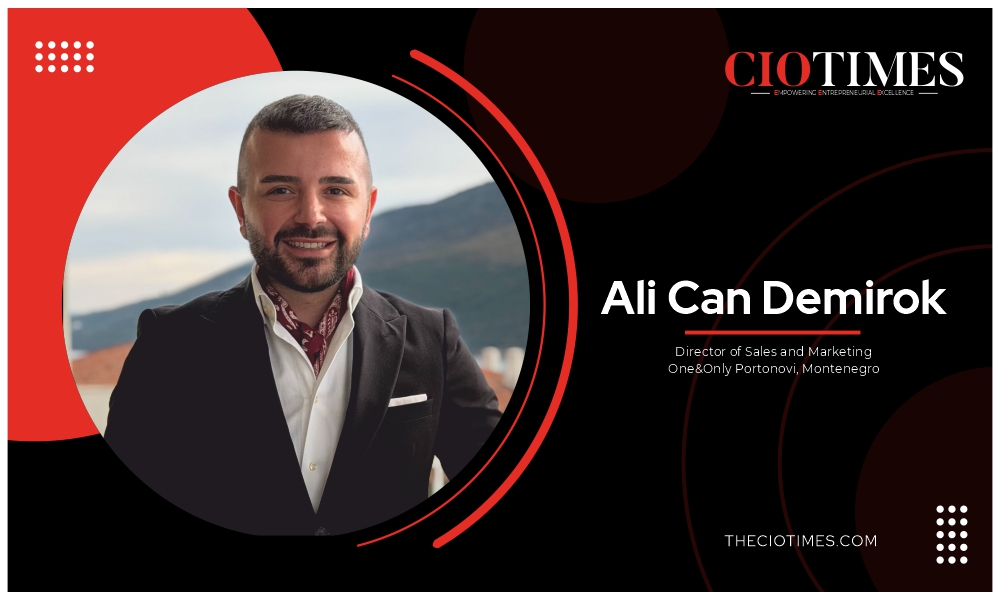
The luxury hotel business is changing in meaningful ways, driven by how travelers want to feel, not just where they want to stay. Leaders across the industry are rethinking service by blending thoughtful innovation with genuine care, personal touches, and smarter ways of operating that make every experience feel more intuitive. Speaking of it, we cannot miss out on a name which is Ali Can Demirok, Director of Sales and Marketing, One&Only Portonovi, Montenegro. Visionary leaders are moving beyond traditional notions of luxury, focusing instead on creating memorable, emotionally rich stays. In the luxury hotel space, this shift is especially visible. By embracing technology that enhances comfort, prioritizing sustainability, and empowering their teams to deliver heartfelt service, they are redefining what exceptional hospitality truly means.
The Luxury Journey
Ali’s career spans some of the world’s most iconic luxury brands, including One&Only, The Ritz-Carlton, Park Hyatt, and The Luxury Collection, across Europe, the Middle East, and beyond. He views his journey not as a straight path of titles, but as an ongoing process of understanding luxury in practice. Each brand and destination offered distinct lessons, shaping his perspective on guests, value, and leadership.
Early in his career, Ali worked in environments with uncompromising standards, which instilled a deep respect for brand integrity. He learned that luxury is defined not by discounts, slogans, or design alone, but by consistency, emotional intelligence, and discipline. As he progressed into senior commercial roles, he came to see that protecting a brand is inseparable from safeguarding its long-term commercial health.
Several milestones stand out. Leading commercial repositioning projects in competitive markets taught him to focus on sustainable demand creation over short-term performance.
Several milestones stand out. Leading commercial repositioning projects in competitive markets taught him to focus on sustainable demand creation over short-term performance. Participating in hotel openings and post-opening stabilization reinforced patience and humility, showing that brand equity is built day by day. Managing properties with diverse demand from ultra-high-end leisure to diplomatic and protocol business sharpened his ability to balance exclusivity with scale.
Working across Europe and the Middle East exposed him to varying leadership styles, guest expectations, and economic cycles. These experiences taught him adaptability without compromising the ability to respect local realities while maintaining global brand values, a balance central to his evolution as a commercial leader.
Empowered Leadership
Ali is widely recognized as a mentor and team builder whose leadership approach is grounded in trust, accountability, and continuous development. He prioritizes hiring for attitude and long-term potential, believing skills can be built while mindset defines performance. By investing in coaching and creating clarity around expectations, he empowers teams to take ownership and perform with confidence. In high-pressure environments, he focuses on building resilience by fostering a culture where people feel valued, supported, and recognized for their contributions.
Strategic Luxury
As Director of Sales & Marketing at One&Only Portonovi in Montenegro, his commercial priorities are centered on revenue quality rather than revenue volume. In today’s highly competitive luxury market, he believes topline growth alone is insufficient; what truly matters is understanding who the guests are, why they choose the resort, and whether their experience strengthens the brand’s long-term desirability.
He positions One&Only Portonovi as a distinctly differentiated luxury destination, one that does not compete on volume or follow short-term trends. His focus is on expressing the One&Only philosophy authentically within the unique context of Montenegro and the Adriatic, an emerging destination still shaping its place in the global luxury landscape. This requires a disciplined, confident approach to brand expression, grounded in clarity rather than compromise.
He says, “From a commercial standpoint, aligning brand positioning with performance means ensuring that pricing reflects experiential value, not market pressure.”
He places strong emphasis on rate integrity, particularly during softer demand periods, recognizing that discounting erodes brand perception and guest trust far beyond its immediate financial impact. The commercial strategy prioritizes attracting guests who genuinely value privacy, space, cultural depth, and refined experiences, rather than transactional luxury.
Central to this approach is close alignment between sales, marketing, and revenue management. Ali ensures that brand storytelling is supported by intelligent distribution and that marketing campaigns are reinforced by yield decisions. When these functions operate cohesively, luxury remains consistent and credible, resulting not only in stronger financial outcomes but also in a more compelling and enduring brand presence.
Core Fundamentals
Ali’s consistent success in delivering strong ADR and RevPAR growth across diverse destinations is guided by a disciplined yet deeply human approach to yield management and revenue optimization. In luxury hospitality, he views yield management as far more than rate movement or short-term reactions to market shifts; it begins with a nuanced understanding of demand, including the emotional and behavioral factors that influence why guests choose to book.
A core principle that defines his approach is rate integrity. Protecting ADR remains non-negotiable, even during challenging market conditions. In softer periods, the pressure to drive demand through pricing can be intense, but he recognizes that in the luxury segment, perceived value is delicate. Once that perception is diluted, rebuilding trust and brand strength takes far longer than any short-term revenue uplift can justify.
Another guiding principle is segmentation clarity. He is clear that not all demand carries the same long-term value, and not every segment should be approached with identical pricing or distribution strategies. By identifying segments that contribute through loyalty, advocacy, or seasonal balance, he is able to make more thoughtful yield decisions. Channel mix also plays a critical role, as the source of demand is just as important as the rate it delivers.
In emerging markets, yield management often requires an educational mindset. Developing the destination, shaping expectations, and helping partners and guests understand the true value of the offering becomes part of the strategy. In mature markets, the focus shifts toward compression, demand displacement, and tactical flexibility.
Ultimately, he believes revenue optimization is not about chasing short-lived peaks, but about building a stable, sustainable performance curve that protects the brand over time.
Customized Market Strategy
Having led commercial functions across cities such as Vienna, Istanbul, Budapest, Muscat, and Montenegro, Ali approaches sales and marketing adaptation with a simple starting point: listening. He believes every market has its own rhythm, and understanding it begins by listening closely to local teams, partners, guests, and the wider socio-economic environment. In his view, assumptions are the greatest risk in international leadership, while curiosity remains its strongest asset.
He recognizes that cultural context shapes everything from how luxury is defined to how relationships are formed. In some markets, trust is built through long-term partnerships and personal presence; in others, through data-driven decisions, efficiency, and consistency. By respecting these differences, sales and marketing strategies feel authentic and grounded, rather than externally imposed.
Economic conditions further influence how markets respond to global shifts, requiring flexibility in messaging, pacing, and segmentation. While these elements may adapt, Ali is firm on one principle: brand standards must remain intact. He believes global brands should never dilute their core identity in the name of localization. Instead, thoughtful localization should enhance relevance while preserving the brand’s essence.
Central to this approach is empowering local teams. He values their insights as irreplaceable, often capturing nuances no report or dashboard can reflect. His role is to provide structure, clarity, and strategic direction, while ensuring that local expertise has a meaningful impact on execution.
Striking the Right Balance
Ali’s experience across transient, leisure, MICE, catering, and high-profile protocol segments, including royal families, has shaped a disciplined approach to balancing exclusivity, personalization, and profitability. He views each demand stream as having its own value proposition, where success depends not only on revenue potential but also on how each segment influences brand perception and operational flow.
He adds, “High-profile and protocol business demands absolute discretion, flawless execution, and deep personalization.”
While profitability in these segments may not always be immediate or easily quantified, their reputational impact can be substantial and long-lasting. By contrast, MICE and catering require a different lens, one centered on efficiency, scale, and structured pricing to ensure margins remain protected without compromising service quality.
Across all segments, Ali defines clear, non-negotiable brand standards while allowing flexibility in how experiences are delivered. Personalization, in his view, should elevate perceived value rather than dilute it. Through careful prioritization, he ensures that each segment contributes meaningfully financially, reputationally, or both to a balanced and sustainable commercial ecosystem.
Integrated Leadership
As EAM Commercial and Hotel Manager at Matild Palace, Ali’s dual responsibility fundamentally reshaped his approach to leadership and decision-making. Holding both roles reinforced a simple but powerful reality: commercial strategies are only as effective as their operational feasibility. Decisions around pricing, segmentation, and volume were no longer abstract exercises; they had immediate and visible effects on service quality, team morale, and the guest experience.
This experience strengthened his conviction that sustainable performance is achieved only when operational excellence and commercial objectives are fully aligned. Rather than viewing them as competing priorities, he came to see them as shared goals that must move in step to deliver consistent results for both the business and its people.
Aligned Forecasting
Ali approaches forecasting as much a people-driven process as a numerical one, recognizing that accuracy, agility, and stakeholder alignment depend on clear communication as much as robust data. He relies on structured methodologies that blend historical performance, real-time market intelligence, and forward-looking indicators, using scenario planning to remain responsive as conditions evolve while maintaining confidence in the numbers.
He asserts, “I focus on explaining assumptions, risks, and strategic implications – not just presenting figures.”
Equally important to him is transparency. By doing so, he ensures ownership and leadership teams remain aligned, informed, and able to make timely, well-grounded decisions.
An Insightful Story
Market expansion and penetration have been defining elements of Ali’s career, particularly in identifying untapped market opportunities that align naturally with a property’s positioning. Across several destinations, he recognized underdeveloped long-haul leisure and lifestyle-driven markets that closely matched the experiential promise of the product. Rather than pursuing volume, the focus was on attracting the right guests with a genuine affinity for the brand.
By refining distribution strategies, deepening relationships with luxury travel advisors, and shaping messaging specifically for these audiences, Ali helped unlock meaningful ADR growth while improving seasonality balance. The approach was thoughtful and deliberate, centered on long-term value rather than short-term demand capture.
He adds, “These initiatives reduced reliance on traditional feeder markets and created more resilient demand structures.”
Tech-aligned Emotion
In Ali’s view, the role of a Director of Sales & Marketing in luxury hospitality has evolved significantly over the past decade. Where success was once driven largely by personal relationships and instinct, today it requires a far more balanced and multidimensional approach. Relationships still matter deeply, but they are now reinforced by data, technology, and long-term strategic thinking.
Modern commercial leadership calls for the ability to interpret analytics, navigate increasingly complex distribution channels, and turn guest insights into clear, actionable strategies.
Ali asserts, “Digital channels, CRM systems, and experience analytics have reshaped how we understand and engage with guests.”
At the same time, he emphasizes that technology must never overshadow emotion in luxury hospitality. The true differentiator lies in blending analytical precision with storytelling, empathy, and genuine human connection, ensuring that data informs decisions without diluting the soul of the guest experience.
Experience Molds
Ali believes the operations he tackled taught him empathy, which included understanding service flow, guest emotions, and the realities teams face daily. It acted as a foundation that ensured commercial strategies remain grounded, realistic, and guest-centric.
Furthermore, about nurturing cross-functional alignment, he highlights shared objectives, regular communication, and transparency as key.
He asserts, “When teams understand how their roles connect to guest satisfaction and commercial success, alignment becomes natural rather than forced.”
Forecasting the Future
In the luxury hospitality sector, the luxury aspect will become more values-driven and more emotionally intelligent, according to Ali. He also highlights aspects like personalisation through data, the growing influence of luxury travel advisors, experiential pricing, sustainability, and stronger direct-to-consumer relationships, which will define the future, according to him.
He adds, “Professionally, I aim to continue shaping transformative commercial strategies within leading luxury brands while mentoring future leaders.”
He remains committed to learning, adaptability, and balance. His ultimate goal is to contribute to a more integrated, thoughtful, and sustainable future for luxury hospitality.