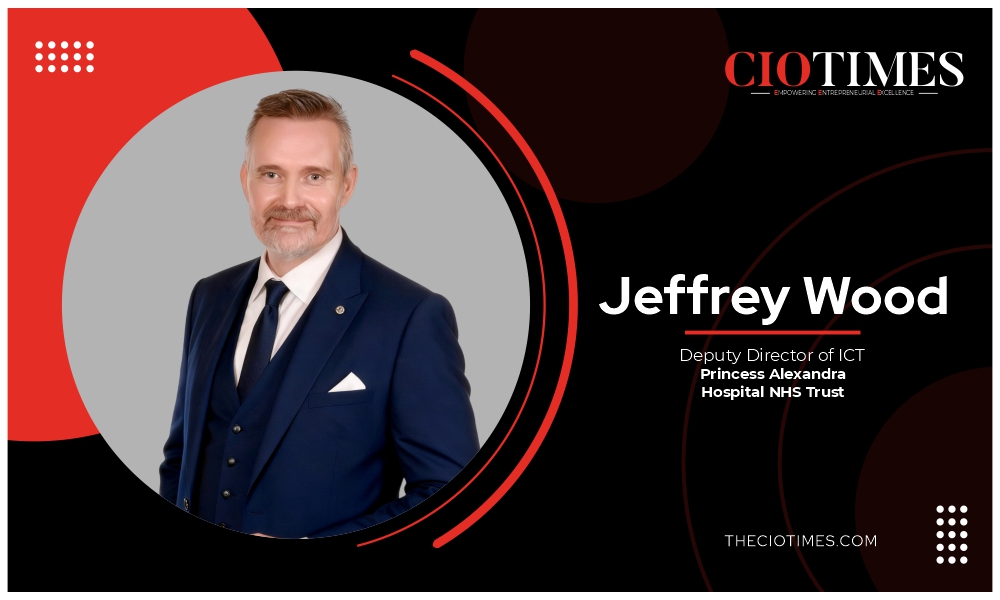
Information and Communications Technology (ICT) has been the backbone lately of the digital realm. It enables smarter operations, connected systems, and data-driven decision-making across every industry. The ICT leaders play a crucial role in the transformation, steering organisations through rapid technological shifts. They bridge the gap between innovation and real-world application. A maestro in this sphere is Jeffrey Wood, Deputy Director of ICT at Princess Alexandra Hospital NHS Trust.
His career has been shaped by a blend of technology, leadership, and influential mentorship spanning the Royal Navy, financial services, local government, and ultimately the NHS. He began his professional journey in the Royal Navy at a time when ICT roles did not formally exist. What he did acquire, however, was a strong foundation in organisation, discipline, and resilience capabilities that later became central to his leadership style. His move into the financial services sector coincided with the early evolution of computing.
Jeffrey adds, “Drawn into project after project, I soon realised that ICT was not just a tool but a career path, and I chose to specialise.”
This realisation prompted him to specialise.
Jeffrey’s work across commercial organisations, both large and small, and across varied market sectors further broadened his understanding of how technology enables business performance. A significant turning point emerged when he joined his local authority. After previously contracting for an outsourced ICT service, the authority required an internal technology client representative. Stepping into that role, he benefited from the guidance of a highly strategic leader whose mentorship sharpened his long-term thinking and strengthened his ability to translate business priorities into technology direction.
His progression continued at Essex County Council, where he worked under a CIO who was both highly capable and openly committed to developing his team. Several departmental restructures, typical of the public sector, eventually led to Jeffrey assuming responsibility for ICT strategy and stakeholder relationships across Education and Social Care. It was a vast and complex remit, requiring a balance of technical understanding, diplomacy, and the ability to navigate politically sensitive environments.
The next chapter of his career led him to the NHS. His wife had long cautioned him about the challenges of NHS ICT, and she was right. Entering the sector felt, in many respects, like stepping back in time technologically. Yet again, Jeffrey was fortunate to work with a Director and, later, a CIO whose expertise and mentorship were instrumental. They provided deep insight not only into ICT but also into the softer skills and political nuance required to lead effectively within one of the most complex public-service ecosystems in the UK.
Collaborative Leadership
Jeffrey’s leadership philosophy in outsourcing and strategic partnerships is grounded in the belief that meaningful value is created through genuine collaboration rather than transactional supplier relationships. While traditional supplier–customer dynamics may be adequate for commodity services, he maintains that critical hospital operations demand a deeper, partnership-driven approach. For him, contracts must deliver mutual benefit: cost-effective, certainly, but equally designed to foster trust, resilience, and shared accountability.
He asserts, “A strong relationship is not contrary to value for money—it is the very thing that enables it.”
He places great importance on working with partners who stand alongside the organisation, especially in moments of pressure. If an issue arises within the hospital, regardless of the hour, Jeffrey expects to have a trusted individual who will respond immediately and work collaboratively with his team until the problem is resolved. He often notes that such commitment cannot be fully captured in contractual wording; it is cultivated through respect, consistency, and a shared sense of purpose. In return, he is intentional about championing his partners, highlighting their strengths and contributions at every opportunity. This reciprocity reinforces a cycle of trust, motivating suppliers to deliver exceptional support both in routine operations and during critical incidents.
While he rigorously scrutinises every contract to ensure organisational needs are met, Jeffrey is clear that the document itself should not be the mechanism for enforcing performance. Suppose he finds himself relying on contractual clauses to drive delivery. In that case, he considers the partnership to have faltered, prompting honest reflection on whether the shortfall lies with the supplier or within his own leadership. Each challenge becomes a learning opportunity, refining his approach to future collaborations.
At the heart of his philosophy is a singular guiding principle: outsourcing and partnerships must ultimately give time back to clinicians, enabling them to devote more attention to patient care. Any supplier who meets contractual obligations on paper but introduces operational friction in practice undermines this goal. Conversely, a true partner helps remove obstacles, strengthen resilience, and create efficiencies that directly benefit frontline teams.
For Jeffrey, this is the true measure of successful partnerships that not only function well operationally but also meaningfully contribute to the delivery of safe, efficient, and compassionate care.
Stable Progress
Jeffrey believes that balancing rapid digital innovation with the stability required in public services is one of the sector’s most demanding challenges. Unlike private organisations, public bodies work within short political cycles, shifting priorities, and funding models that often require initiatives to be delivered within a single financial year. While this ensures visible progress, it can make longer-term innovation, especially efforts needing ongoing investment, seem difficult to justify.
He recognises that governance frameworks, though vital for public accountability, can slow momentum. Earlier in his career, he found these processes restrictive, but over time, he learnt to work with them rather than view them as obstacles. They now serve as guide rails that help him balance ambition with responsible risk management.
He adds, “My solution has been to rely on proof‑of‑concept initiatives.”
By testing ideas in controlled environments across departments or locations, he creates room for innovation without jeopardising core services. In healthcare settings, such pilots may appear cutting-edge, yet many are built on technologies already proven in other industries. By adapting these established solutions to the public sector, he ensures innovation feels modern but remains grounded in reliability.
This method allows him to drive meaningful modernisation while strengthening public trust. For Jeffrey, responsible transformation means respecting governance, aligning initiatives with funding realities, and grounding innovation in evidence. In critical sectors such as health and social care, achieving this balance is not only desirable, it is essential for delivering progress that is both ambitious and sustainable.
Strategic Public Value
Jeffrey’s leadership in the overlap of ICT, digital business, and the public sector is defined by his ability to combine commercial discipline with a strong sense of public purpose. His early experience in the private sector taught him the value of rigorous negotiation and careful spending skills that have proved especially impactful in public services, where budgets are tightly scrutinised. In his first year within the NHS, he delivered savings of more than a quarter of a million pounds through strategic contract negotiations, securing ongoing value without compromising quality.
Yet, for him, effective leadership is not solely about financial stewardship. He believes that every investment and innovation must demonstrate meaningful benefits, not only on paper but in real human terms. His insistence on the “so what?” behind every business case ensures that efficiency gains are translated into tangible outcomes for patients, clinicians, and end users.
A clear example of this is his focus on giving time back to frontline staff. By streamlining digital systems and reducing administrative burdens, he helps clinicians spend less time navigating processes and more time with patients. For him, these moments where technology creates space for genuine human connection represent the true impact of digital transformation.
This balance of commercial sharpness and public-sector empathy shapes Jeffrey’s leadership approach. He views technology not as an end in itself, but as a practical tool for strengthening trust, improving resilience, and enhancing everyday experiences. By grounding innovation in both financial sustainability and human value, he keeps the focus on what matters most: better care, better service, and more time where it counts.
People Driven
He remains motivated by progression, not personal advancement, but the steady improvement of ICT services and the experience they enable. Within healthcare, he anchors this to a simple principle: technology should give time back to clinicians so they can focus on patient care. Any improvement, whether preventative maintenance, faster issue resolution, or streamlined processes, is measured against its ability to reduce friction for staff and enhance the quality of care delivered.
This mindset directly shapes how he leads and develops his team. He sees the department as central to every innovation, process, and policy he introduces. For him, the strength of any ICT function lies in the people who power it. Early in his career, he focused on coaching individuals to help them grow; today, his emphasis is on developing the next generation of leaders, those equipped not only with technical expertise but with the confidence, resilience, and strategic awareness required in complex environments.
He asserts, “Technology may be the enabler, but it is people who deliver the impact.”
He takes genuine pride in seeing former colleagues excel, particularly when they advance beyond him. To Jeffrey, this is the true mark of leadership: not how far one progresses personally, but how many others are supported along the way. Knowing he has played even a small part in someone’s development is one of the most rewarding aspects of his work.
Strategic Leap
When Jeffrey joined Princess Alexandra Hospital NHS Trust, one of his earliest and most pressing challenges was an outdated telephony system still operating on technology from 1988. It was unreliable, fragile, and patched together through years of temporary fixes, far from suitable for a hospital where seamless communication is essential.
Instead of opting for a like-for-like replacement, he saw an opportunity to take a significant step forward by introducing cloud telephony through 8×8. The scale of change was considerable, and concerns among staff and leadership were entirely understandable. Yet the vision remained firm: the Trust needed modern, flexible infrastructure that could evolve with future demands. As the first NHS Trust to adopt cloud telephony, the learning curve was steep. But when COVID hit, the value of that bold decision became clear. Remote working and flexible communication were enabled almost instantly, demonstrating what true digital capability could look like. The system continues to adapt and improve, reflecting the long-term benefit of that strategic leap.
Delivering this project successfully was essential for building confidence in his broader digital roadmap. It also highlighted a deeper issue: every critical system from telephony to clinical communications and patient records depended on network resilience. Recognising this, he partnered with Freshwave to deploy internal 4G and private 5G across all hospital sites and administrative buildings.
What began as a resilience initiative quickly grew into something much more transformative. Staff gained secure BYOD capability, improving agility. Patients and visitors benefitted from new possibilities such as wayfinding, appointment alerts, and the option to wait comfortably off-site while staying connected. Future enhancements, including parking alerts, are already being explored. A technical safeguard evolved into a foundation for improving the wider patient and visitor experience.
The leadership challenge went beyond replacing obsolete systems; it required building trust, reassuring teams, and demonstrating that innovation can be both safe and transformative. Through clear vision, careful risk management, and genuine engagement, Jeffrey turned a failing telephony platform into the catalyst for a broader digital shift that continues to deliver value today.
Impactful Automation
Jeffrey is quick to clarify that he does not see himself as an AI or Big Data expert. Instead, he views his strength as the ability to recognise where these technologies can deliver real, practical value for ICT teams and the wider organisation.
He states, “My role is not to chase hype, but to ensure that innovation is applied in ways that enhance patient care, and to build the capability of my team so they can use these tools responsibly and effectively.”
Whether through automation, AI-driven tools, or advanced analytics within cyber security, infrastructure, or service support, he works with one guiding principle: AI must be ethical, safe, and firmly anchored in improving outcomes for staff and patients.
This approach is already producing tangible benefits. Proof-of-concept work with Copilot has automated agendas, minutes, and action logs for meeting tasks that previously required a dedicated note-taker or diverted a team member away from contributing fully. Now, these outputs can be generated automatically and simply reviewed, freeing up capacity and improving accuracy.
His team has also created an AI-assisted recruitment tool to support shortlisting. For roles that attract more than 100 applications, the workload for hiring managers was substantial. The new tool provides a clear, transparent report outlining recommended candidates, why they meet the criteria, and why others do not. This saves time, improves fairness, and brings welcome consistency to the process.
Jeffrey sees significant promise in analytics, too. While predictive analytics receives much attention, he believes prescriptive analytics offers even greater value for public services. Just as tools like Freshworks and Aternity automatically resolve digital issues before users notice them, prescriptive analytics could enable proactive healthcare interventions. For example, if a major fire is reported locally, the system could not only predict a rise in respiratory cases but also prompt patients or GPs to take preventative action, helping reduce hospital attendances and easing pressure on services.
For him, the immediate value of AI and analytics lies in their ability to remove friction, automate routine tasks, and free staff to focus on what matters most. Every administrative hour saved becomes time returned to clinicians. Every proactive alert has the potential to prevent unnecessary care. He views these technologies not as abstract innovations, but as practical tools for delivering time, trust, and better patient experiences.
Critical Vigilance
Jeffrey believes the most significant strategic risk facing organisations today is complacency. In cyber security, the absence of incidents is often mistaken for safety, yet he stresses that silence can create a dangerous sense of confidence. Organisations must be alert at all times, while defenders need to be successful every day, an attacker only needs one opportunity.
In modern healthcare, the risk is magnified by the sheer complexity of interconnected systems, applications, and external partners. Contracts and support arrangements must be robust enough to meet today’s demands while remaining flexible to adapt to new threats and legislative change. He is acutely aware that cyber incidents carry real-world consequences; the case of a German hospital where a cyber attack led to system failure and a patient’s death stands as a stark reminder that cyber risk is not purely technical; it is a clinical risk.
When he joined Princess Alexandra Hospital, he was initially concerned to discover that cybersecurity was handled by only two members of the infrastructure team. After taking time to observe, he realised their deep integration of security into daily operations meant systems were secure by design. Their diligence convinced him to invest in expanding this model, broadening training across the infrastructure team, and supporting requests for more advanced tools.
One such tool was Armis, an AI-driven cyber exposure management platform. Its proof of concept revealed the true breadth of the organisation’s attack surface, uncovering everything from electric vehicles connected to public networks to legacy medical equipment running unsupported software. The experience was humbling, reinforcing the need for continuous visibility.
He shares, “Armis now proactively identifies and mitigates risks, remediates vulnerabilities, and helps us protect the entire attack surface.”
For Jeffrey, the lesson is clear: this is not a “cyber risk” issue, it is organisational risk, operational risk, and ultimately human risk. If medical devices fail, patient safety is compromised. If check-in systems or door scanners stop working, the hospital’s ability to function is affected. Every technical failure has a direct clinical impact.
His philosophy is to embed security into the fabric of infrastructure, invest in people, and build resilient systems that protect not just data and devices, but the lives that depend on them.
The Leadership Mindset
Jeffrey believes that thriving as a strategic leader in ICT and digital business today demands far more than technical expertise. While a solid grounding in technology is essential, it must be paired with ethical judgment, emotional intelligence, and the ability to navigate uncertainty with integrity and foresight, especially in an era shaped by AI, cyber risk, and rapid technological change. For him, clarity of purpose is equally important.
He shares, “Every ICT leader must understand the core offer of their organisation—the vision that defines why it exists—and ensure that every decision contributes to that mission.”
In healthcare, this means looking beyond the hospital setting and considering the wider ecosystem GPs, mental health services, social care, charities, and community providers. Strategic ICT leadership, he notes, must support prevention as well as treatment, connecting services and enabling care to happen wherever it is most effective.
This broader view changes how technology is applied. Digital tools can reduce isolation, prevent anxiety, or help redirect straightforward services such as blood tests or administrative tasks outside hospital buildings to free up space and reduce pressure on clinical teams. For Jeffrey, these examples highlight how ICT, when aligned to purpose, can deliver tangible benefits far beyond traditional system support.
He sees modern ICT leaders as business leaders in their own right, individuals who challenge assumptions, broaden perspectives, and ensure technology serves people, not the other way around. Leadership, in his view, is not about hierarchy but about creating a culture where professionals feel empowered to contribute ideas that improve both ICT and the wider organisation.
Ultimately, he believes the essential skills for today’s ICT leaders lie in combining technical understanding with vision, ethics, and empathy, ensuring every innovation strengthens services, supports communities, and gives more time back to the people delivering care.
Efficiency Breakthrough
Jeffrey highlights a transformational achievement that reshaped ICT operations to deliver both efficiency and resilience. He views continual service improvement not as a technical buzzword, but as a principle that removes friction for users and frees frontline teams to focus on what matters most.
During his time at PAHT, he led two major initiatives that now work in tandem to elevate the user experience. The first was replacing an outdated service-management system with Freshworks. Previously, users relied on phone calls to log issues, creating bottlenecks and pulling clinicians away from patient care. Freshworks introduced a self-service portal where staff could log and track requests instantly, while AI tools automated routine tasks and supplied quick, knowledge-based answers. Phone lines were preserved for urgent matters, and real-time dashboards improved transparency and performance oversight.
Alongside this, he implemented Riverbed Aternity Digital Experience Monitoring, which offered deep insight into device and application performance. The system automatically resolved around 10,000 issues each month, often before users or ICT teams even knew there was a problem. Daily ward-walks by Customer Relationship Officers complemented this, ensuring issues were proactively addressed at the point of use. The result was a more stable, predictable, and user-centred environment.
The outcomes were striking. SLA breaches fell from 629 to single digits. Nearly 950 hours a month were recovered from blue-screen failures alone, and unsuitable hardware models were identified and replaced. While these improvements did not generate traditional “cashable” savings, they delivered something more valuable: time restored, frustration reduced, and a far more reliable digital ecosystem for clinical teams.
He adds, “For me, this achievement embodies what leadership in ICT should deliver: not just efficiency for its own sake, but efficiency that empowers staff, strengthens resilience, and enhances patient care.”
It shows how strategic technology decisions can create impact that reaches far beyond the ICT function itself.
Strategic Communication
Jeffrey’s experience writing for leading publications has shaped the way he communicates technical value within his organisation. When he first joined the NHS, he noticed how rarely neighbouring trusts spoke to one another. Early conversations sometimes met with genuine surprise revealed how isolated teams had become. This realisation strengthened his belief that meaningful progress begins with open dialogue.
As the culture gradually evolved, Jeffrey used editorial writing to go a step further. By sharing practical examples of innovation, he was able to show colleagues across the sector what was possible, what had already been achieved, and what others could adapt or improve. These articles helped raise the organisation’s profile, attracting partners interested in testing new concepts within the NHS.
Internally, this approach fostered a sense of purpose and ambition. His team could see their work contributing to a wider movement of digital improvement rather than existing solely within hospital boundaries. Writing for external audiences also broadened Jeffrey’s own network, connecting him with organisations whose ideas and practices could inform future strategy.
This experience has directly influenced how he communicates technical value. He has learnt that effective communication must focus on outcomes and human impact rather than technical detail alone. By turning complex ICT work into accessible stories, he ensures clinicians, leaders, and patients understand how innovation supports better care and gives staff more time where it matters most.
Words of Wisdom
Jeffrey believes that genuine benefits realisation begins with honesty. He has often seen public-sector business cases built on overly optimistic projections or overlooking long-term cost approaches that may secure approval initially but inevitably create challenges later. For him, leaders must be clear about the true purpose of any transformation. If the financial case is weak, the justification should be anchored in other priorities: staying current with technology, strengthening security, improving operational efficiency, or, most importantly, enhancing patient experience and reducing the risk of harm.
He stresses that clarity of purpose must be paired with clarity of measurement. Benefits need to be benchmarked before and after implementation, or monitored against defined outcomes. Without structured measurement, benefits remain aspirational rather than tangible.
He also highlights that transformation does not end at go-live. Real value emerges when new systems and processes are embedded into everyday practice. This requires ongoing training, continual optimisation, and close attention to both unexpected gains and unforeseen challenges throughout the contract lifecycle.
For him, every efficiency achieved, every smoother process, every more resilient system translates into more time for patient care. That, he believes, is the ultimate measure of success. Digital transformation is not about technology alone, but about embedding innovation that delivers long-lasting value for the organisation and the people it serves.
The Extended Vision
His long-term vision centres on maintaining the operational grounding that shaped his early career while strengthening a customer-centric approach that ensures technology genuinely serves people. His passion for technology has always been clear, but one of his earliest leadership lessons was learning to step back from day-to-day tasks. Instead of solving problems himself, he had to set clear outcomes, trust his teams, and give them the space to grow, an essential shift from being the fixer to becoming the enabler.
As his leadership matured, he continued to distance himself from daily operations without losing sight of their reality. Regular back-to-floor sessions help him stay connected, not to audit but to listen. These conversations offer insight into frustrations, opportunities, and ideas for improvement, fuel for better decision-making. When he noticed that colleagues still turned to him to resolve issues, he leaned back into mentoring and coaching, helping them build confidence in their own solutions while keeping his door open for support.
He shares, “Customer centricity has always been part of my DNA.”
Today, his focus is on ensuring that every leader across ICT carries the same mindset. Technical excellence matters, but its true value lies in the positive effect it has on clinicians and, ultimately, on patient care. When leaders internalise that purpose, customer centricity becomes a lived practice rather than a principle.
Looking ahead, Jeffrey sees his evolution as a continuous journey of learning. He intends to keep refining his weaker areas while expanding his strengths across a broader leadership spectrum. For him, balancing operational roots with customer-centred strategy is not a fixed state but an ongoing process, one that ensures technology remains a meaningful enabler, creating more time for clinicians and better outcomes for patients.
In a casual chat, Jeffrey was kind enough to share some tidbits:
- About books:
Jeffrey usually reads two or three books at a time. One is always light, often something from the Star Wars universe, his way of unwinding as a lifelong ICT enthusiast. Alongside that, he focuses on leadership development. He is currently reading Turn the Ship Around by L. David Marquet, which explores how to create leaders at every level, and Simon Sinek’s Start with Why, reinforcing his belief in purpose-driven work.
He is also completing a course in Self-harm and Suicide Awareness and Prevention, a subject he feels strongly about, given the burnout and depression he has witnessed, especially among men. He hopes this understanding will help him support both clinical and non-clinical colleagues across the NHS.
- Biggest Leadership Lesson:
Jeffrey’s biggest leadership lesson is recognising that success is never down to one person. A team’s performance reflects how it is supported and guided, and he sees his role as developing and protecting his people so they can deliver the standard of service patients deserve. Mistakes, he believes, are part of being human. What truly matters and what he considers non-negotiable is the collective enthusiasm and determination to be the strongest team they can be.
- Best Professional Advice:
Jeffrey’s best advice came from former CIO David Wilde, who taught him that decision-making depends on context. For some decisions, like mapping, waiting for perfect information only slows progress 70% is often enough. But for high-risk areas, such as releasing a drug, near-certainty is essential.
The lesson stayed with him: many leaders lose momentum by waiting too long. Strategy doesn’t mature by sitting still; moving forward with 70% clarity is often far better than chasing perfection that never arrives.
- A Single Word Describing Jeffrey:
Curious
- Favorite Quote:
“Bring your best self every day,” Phil Holland, an ex-CIO