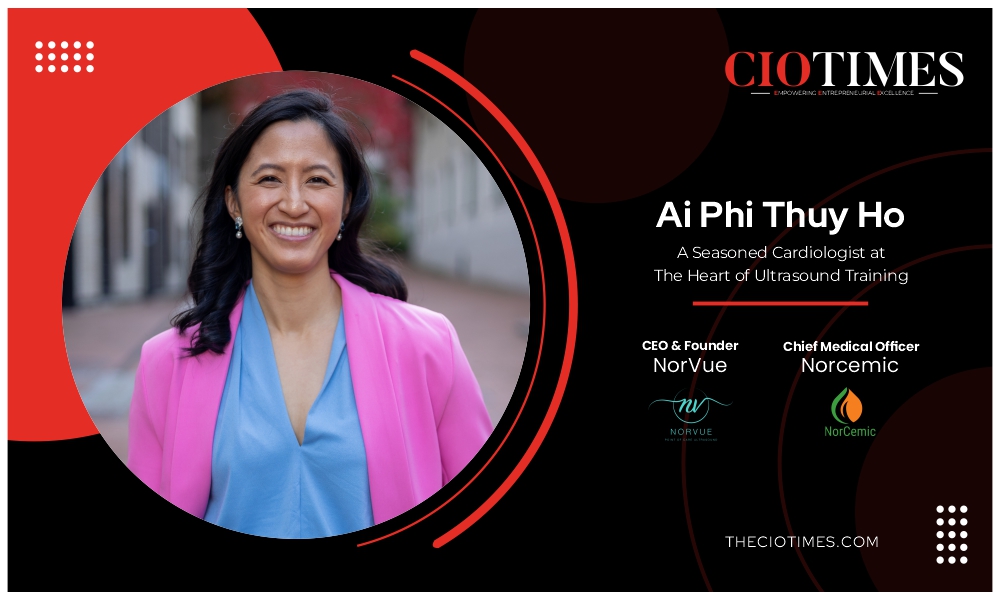
The importance of medical advisors has been crucial in recent years. They bridge clinical expertise and executive strategy, ensuring patient care remains at the heart of every crucial decision. Also, working professionals have been prioritizing health lately. Regular medical check-ups integrated by organizations and voluntary periodic clinic visits by the public in general have saved a lot of health hazards among people. Speaking of health, there’s a name we cannot afford to miss out on, which is Ai Phi Thuy Ho, CEO & Founder at NorVue. Being a Cardiologist, Entrepreneur, and an Agent of Change, she trains aspiring ultrasound professionals to master the skill.
An Uplifting Journey
She is a joyous person who sees the positive side in any given situation. Graduated from medical school in 2015, her professional journey hasn’t been a cakewalk. Feeling alone and different due to the chosen career path, traveling the world, initiating her fellowship in cardiology, stepping into the business zone, and becoming a successful cardiologist have shaped her into the dedicated professional she is today. Her mother’s advice to go for an ultrasound has been a life-changing opportunity for Ai Phi.
Her work includes two complementary frontiers: empowering medical professionals through NorVue while also enabling consistent, non-invasive metabolic monitoring through Norcemic. Initially, both may come across as different, as one is focused on educating clinicians in ultrasound, while the other focuses on wearable health technology. For her, the belief for both is the same: Healthcare becomes better when we understand what is happening earlier, and in real life, not only inside hospitals.
NorVue was not simply a company; it was born from the quiet tension of unanswered questions in the exam room. It grew out of those moments every physician knows too well when conversations are thorough, tests are ordered, images are reviewed, and yet clarity feels just out of reach.
Bedside ultrasound shifted that uncertainty into insight. With real-time views of the heart, lungs, kidneys, gallbladder, major vessels, and deep veins, decisions could be made with confidence in the very moment they mattered most. In critical situations, that immediacy can mean the difference between delay and decisive care.
Still, her vision stretches beyond urgent intervention. She believes medicine should not wait for illness to declare itself. It should help people understand their bodies long before warning signs appear. That belief gave rise to Norcemic.
At the heart of her work lies a simple conviction: healthcare often captures isolated snapshots, while the body speaks in rhythms and patterns. NorVue brings clarity to what is happening in front of the clinician. Norcemic uncovers what unfolds quietly between visits.
More than a glucose monitor, the platform is evolving into a continuous, non-invasive lens into daily physiology tracing glucose trends, lactate as a signal of metabolic stress and recovery, sleep depth, cardiovascular rhythms, and markers essential to women’s health and hormonal transitions.
Glucose is only the beginning. The true ambition is to make the invisible visible early enough to encourage prevention, strengthen safety, and nurture lasting, resilient health.
Bringing Ease to Patients
At Norcemic, the philosophy remains: monitoring should be painless, continuous, and clinically meaningful. Ai Phi also highlights trust as the key in healthcare. She acknowledges the concern about persistent blood sampling needles and constant friction in daily monitoring. Integrating solutions like painless monitoring and non-invasive procedures lowers a tangible barrier. But, only this much comfort doesn’t do the job.
Her team builds authority by being principled about the core: accuracy, clinical relevance, and interpretation over time. Accumulating data, then converting it into practical insights, is the crucial part.
She shares, “We prioritise validated measurements, focus on trends rather than isolated values, and avoid unnecessary alarms and complexity. Technology should support clinical judgment – not compete with it.”
The organization prioritizes engaging medical experts during initial design phases. As practitioners grasp a tool’s internal logic, inherent constraints, and operational integration, professional confidence strengthens spontaneously.
A Triumph Story
Ai Phi was humble enough to share a story with us as she faced a critical situation when in the ICU. A patient’s health kept deteriorating despite the scenario being ideal. Blood tests and X-rays were done to try to fill the gap. Via ultrasound, a massive fluid around the patient´s heart (pericardial effusion), causing cardiac tamponade, a life-threatening condition, was diagnosed. The emergency room went into an eerie silence, but she also got an insight immediately.
She insisted on draining the liquid to save the patient’s life. On this incident, she adds,
“It taught me that technology should be a bedside partner to clinical judgment. Not a replacement, but a tool that helps us see what we otherwise cannot see – especially when time matters.”
Humility was another lesson for her. Strategizing in the right way while being engrossed in the moment fully to find an adequate solution is what she suggests.
Parents’ Advice Always Works
Long before NorVue became a platform, it was a promise. A quiet exchange with her mother planted the seed of a reminder that life-saving knowledge should never belong to a select few. When asked how that deeply human insight evolved into a scalable, standardized, and clinically rigorous education model, Ai Phi smiles at the simplicity of its origin.
Her mother had said, “It’s wonderful that you saved her with an ultrasound. But everyone should know ultrasound.”
Those words lingered. They carried both pride and responsibility. Translating them into NorVue meant shaping empathy into a method. The curriculum guides clinicians through ultrasound step by step, from anatomy and probe handling to common pitfalls, always tying findings back to real clinical decisions. The goal is not to replace comprehensive imaging, but to answer focused bedside questions with clarity and confidence.
She also understood that accessibility would determine impact. Doctors work nights, weekends, and unpredictable shifts. Learning must meet them where they are. Digital education allows repetition, flexibility, and steady confidence-building over time.
For her, the principle remains beautifully simple: if knowledge can protect lives, it must be shared thoughtfully, structured with care, delivered responsibly, and made available to many.
Beyond The Snapshot
As Norcemic steps away from medicine’s traditional “snapshot” model and into the realm of continuous, real-world physiological awareness, Ai Phi views the shift as something profoundly personal. When reflecting on how moving from episodic measurements to ongoing understanding could redefine prevention, diagnosis, and patient behavior in the coming decade, she returns to one word: perspective.
So much of healthcare today relies on single moments: one blood pressure value, one laboratory result, one ECG tracing. Important, certainly. Yet life does not unfold in isolated frames. Continuous insight invites more meaningful questions:
- What does baseline truly look like for this unique individual?
- How does the body adapt to pressure, rest, nourishment, sickness, and movement across days and weeks?
- At what point did quiet deviations first begin?
In prevention, this awareness is game-changing. Subtle signs of metabolic strain, emerging insulin resistance, inadequate recovery, or fractured sleep can be recognized well before illness takes shape.
For diagnosis, it brings clarity. A short consultation cannot always capture lived reality. Longitudinal data reveals rhythms and irregularities that brief encounters may miss.
And when it comes to behavior, understanding fosters agency. Seeing personal patterns unfold often inspires healthier choices not from alarm, but from insight.
For her, the deeper aim is clear: extending healthspan, enriching how well life is lived, not simply how long.
Ideal Enlightenment
Conventional medical training is dependent on hierarchical, slow-moving models of skill acquisition. A lack of structured training exists, while clinicians are expected to integrate point-of-care diagnostics. The teaching depends on factors like individual supervisors, local culture, and time availability. Due to a streak to gain knowledge, Many end up learning in fragmented ways through short courses, random videos, or trial and error.
At NorVue, the team offers a controlled and repeatable learning path. It is organised by organ systems and clinical use cases, and it is available at any time. Responsible use is also proportionately prioritized. Diagnostic imaging requires direction from physical indicators and medical logic, and practitioners ought not employ such equipment for scanning purposes without a background.
Ai Phi reimagines the stethoscope’s legacy through point-of-care ultrasound, questioning how this modern lens accelerates diagnostic precision and clinical conviction. For Ai Phi, the magic lies in obtaining immediate answers to bedside inquiries. This velocity transforms triage, smoothing treatment paths and patient transitions.
Seeing is believing, and for her, visibility breeds confidence. Directly observing cardiac rhythms or pulmonary congestion turns abstract data into undeniable clarity. Yet, she remains grounded; digital tools never fully displace legacy instruments. Sometimes, a traditional chest piece still whispers what a screen might overlook. Optimal healing requires blending high-tech visuals with sharp medical intuition.
She shares, “My work with the Rural Health Foundation in Ghana also reinforced this. In low-resource settings, basic tools remain essential, but handheld ultrasound can dramatically improve diagnostic capability because it is portable and practical.”
Building the Ultrasound Ecosystem
For Ai Phi, the soul of NorVue wasn’t born in a sterile office or a pitch deck; it lives in the quiet, exhausted moments between hospital rounds. When she talks about balancing the adrenaline of cardiology with the slow build of a new company, she isn’t just practicing medicine, she’s staying human. At Hospital Østfold Hospital Trust Kalnes, she isn’t just a founder looking at data; she is a doctor looking into the eyes of a person waiting for answers.
On any given shift, you’ll find her huddled over a screen with a medical fellow, guiding their hands as they learn the language of a beating heart. She sees the exact moment their confidence wavers, the frustration of a blurry image, and that beautiful, silent “aha!” moment when a difficult concept finally makes sense. These bedside struggles are the real blueprints for NorVue. She isn’t designing for a faceless user; she’s building a lifeline for the tired resident she just shared a quick, hallway coffee with, making sure the tech feels like a supportive friend rather than another cold chore.
Her dream is a world where this digital sight isn’t a rare superpower for the few, but as common and comforting as a doctor’s touch. She imagines a future where, whether you’re in a frantic ER, a small-town GP’s office, or the quiet room of a care home, clarity is always within reach. What keeps her going through the 14-hour days isn’t the code, it’s the visible relief on a patient’s face when a fast, certain decision changes their entire story. NorVue is the tool, but the mission is making sure no one is left waiting in the dark when they are at their most vulnerable.
Patient Persistence
Walking those sterile, high-pressure hospital hallways, Ai Phi quickly realized that the biggest hurdle wasn’t the software, but the human heart of the system. When she looks back on the mountain she climbed to launch her digital-first ultrasound platform, she doesn’t describe a wall of no, but rather a heavy, protective blanket of institutional caution. Medicine is built on the sacred do no harm, and that often makes the new feel like a risk rather than a rescue.
In those early days, the weight of being a young innovator felt real. To seasoned leaders, she was an unmapped territory, and her digital dreams were constantly fighting for a few minutes of oxygen against the crushing reality of clinical burnout. She learned quickly that you can’t just demand a doctor’s time; you have to earn their heartbeat.
Her secret wasn’t a loud, flashy overhaul. It was a quiet, relentless showing up. She stayed in her niche, learning and teaching at the bedside, until the ripples of her work became impossible to ignore. Slowly, that cold skepticism began to thaw, turning into a deep, hard-won professional bond.
Perhaps her most beautiful shift was internal. She stopped seeing the pushback as a personal sting and started seeing it as just the way big systems breathe. This change of perspective was her true North Star. She realized that while the gears of healthcare move with a frustrating, heavy slowness, they aren’t stuck forever. They can be moved, but only by someone with the rare, gentle soul of a marathon runner. The digital revolution isn’t about code; it’s about the human grit it takes to keep the lights on until everyone else sees the vision too.
Moving the Needle Right
The high-wire act of modern medicine isn’t about choosing between a fast answer and a right one; it’s about making sure this digital stethoscope never loses its clinical soul. When Ai Phi was asked how NorVue balances the raw speed of a handheld tool with the heavy responsibility of medical rigor, her answer isn’t found in a manual; it’s found in the messy, frantic reality of the bedside. She isn’t building for a polished boardroom presentation; she’s building for the exhausted doctor in the middle of a twelve-hour shift who needs a tool that speaks the same language as a healer.
She says, “For me, this means starting with how clinicians actually think at the bedside – not how a platform looks on paper.”
Her philosophy is built on four sturdy pillars that keep her innovation from drifting into tech for tech’s sake.
- First, she refuses to teach mere button-pushing. To her, a scan without the heartbeat of clinical reasoning is just expensive noise, so NorVue focuses deeply on the “why” behind every flickering gray image.
- Second, she leans into the comfort of structure using familiar maps of anatomy and decision pathways to guide a shaky hand toward a confident diagnosis.
- Third, she is radically honest about the technology’s own boundaries. She ensures every user knows exactly when to set the device down and call in the heavy-duty specialists.
- Finally, she designs for the beautiful, chaotic rhythm of a clinician’s life. Instead of long, daunting lectures that sit gathering dust on a shelf, she’s broken the curriculum into bite-sized, repeatable modules that fit into those rare, quiet gaps between patients.
This isn’t about taking shortcuts; it’s about making the right way the most natural way to work. For her, scaling NorVue isn’t just about reaching more hospitals; it’s about moving the needle on safety, one precise heartbeat at a time. It’s about making sure that when a doctor reaches for an answer in the dark, they find one they can truly lean on.
Healthcare Equity
Through her work with the Rural Health Foundation, Ai Phi has experienced healthcare at its rawest and unfiltered, small clinics humming with determination, clinicians improvising with what little they have, families waiting patiently despite uncertainty. It is in these spaces that her understanding of equity has deepened. So when asked how NorVue and Norcemic together could reshape the economics and fairness of global healthcare delivery, she answers from the heart.
In underserved settings, innovation cannot be flashy. It has to belong. It must respect constraints, support local workflows, and endure long after outside support fades. For her, education is the most powerful equalizer. NorVue equips clinicians with practical ultrasound skills that remain embedded in the community. When visiting specialists leave, the competence does not disappear. Confidence stays. Care becomes stronger from within.
Norcemiс builds on that foundation by shifting attention earlier to the quiet signals the body gives before illness becomes visible.
She shares, “Continuous, non-invasive monitoring can reduce late-stage complications and unnecessary hospital admissions, which is critical for both high- and low-resource systems.”
Fewer emergency transfers mean fewer families uprooted, fewer savings drained, fewer stories marked by avoidable crisis.
Together, these tools gently rebalance the system. They shorten the distance between patient and diagnosis, reduce unnecessary referrals, and make quality care possible closer to home.
For her, true equity is simple and profound: no matter where someone is born, they deserve timely insight, skilled hands, and the chance to live well.
Future Predictions
When Ai Phi talks about the next decade, she isn’t dreaming of cold algorithms or shiny gadgets; she’s dreaming of a world where healthcare finally learns to meet us where we actually live. To her, the big architectural shift isn’t about blueprints or bigger buildings, but about breaking down the walls that make medicine feel so out of reach. She sees a future where the power to understand what’s wrong isn’t a destination you have to journey toward, but a quiet, helping hand that’s already there in the back of a bumping ambulance, a local GP’s cozy office, or a nursing home where someone’s grandmother is resting.
In her heart, the medicine of tomorrow is a bridge built from two ends. On one side, she’s using NorVue to give doctors the eyes to see inside a patient the moment they feel a pang of pain. On the other hand, she’s pouring her soul into Norcemic, making it a silent, steady companion that stays with people between their checkups. It listens to the body’s whispers, the way we sleep, our sugar levels, and those vital signals in women’s health that so often go unheard. It’s about making sure the story of a person’s life doesn’t have blank pages just because they aren’t sitting on an exam table.
But Ai Phi is the first to tell you that data without a soul is just more noise. To her, the secret sauce isn’t the code; it’s making sure the technology gets out of the way so the human connection can breathe. It has to feel as natural as a conversation, filtering out the digital clutter so a doctor can look into a patient’s eyes instead of at a screen. It’s about protecting that ancient, sacred bond of trust that has always been the real heart of healing. If we get this right, she believes healthcare won’t just be smarter, it will be kinder, fairer, and there for us before a crisis even starts. For her, it’s about a world where tech is a silent, supportive shadow, keeping us safe while never losing the warmth of the human touch.