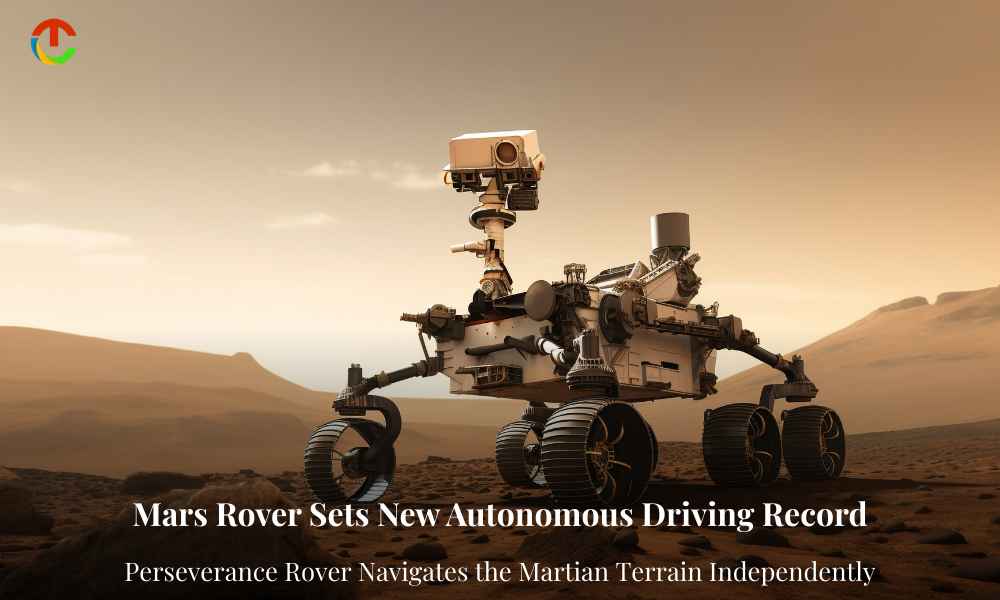
This accomplishment pushes the limits of autonomous capabilities in deep-space conditions and contributes to the legacy of legendary missions like the rovers Perseverance Rover and Opportunity Rover operated by Jet Propulsion Laboratory (JPL).
A New Era of Mars’s Self-Driving Robots
The present system can do the following, in contrast to previous rovers that mostly relied on Earth-based instructions transmitted from mission control after each drive:
Real-time terrain analysis
Identify impediments such as rocks and craters.
Create a safe route map
Instantaneously change its course without waiting for messages from Earth.
Make more progress each Martian day (sol).
This is made feasible by enhanced technological capabilities that surpass those of previous rovers, particularly Opportunity and Curiosity, enabling the rover to explore Mars more independently and effectively.
How Persistence Outperforms Previous Rovers
1. Advanced Hazard Detection & Computer Vision
The rover can observe obstacles far more clearly than its predecessors thanks to high-resolution Navcams and Hazcams.
2. Quicker Onboard Processing
Perseverance can process navigation images 20× faster thanks to a specialized vision processor, which is essential for autonomous decision-making.
3. Improved Wheel Design
In order to prevent the punctures that previous rovers encountered, the rover’s wheels were rebuilt for durability.
4. Path Planning Using AI
Hours of waiting for Earth-to-Mars command cycles are eliminated by its AutoNav system, which makes autonomous route determinations.
An Important Development in Planetary Science and Robotics
A significant change in how robots can function in remote settings is indicated by the rover’s independent performance. Since Mars is millions of kilometers away, real-time control is not possible due to communication lags of five to twenty minutes. This reliance is lessened with autonomous navigation, which makes it possible for:
Quicker scientific processes
Longer daily commute
Making better use of mission time
The rover’s increased safety
The future of robotic design is likewise being shaped by this innovation. For next-generation space robotics with improved mobility, artificial intelligence, and modular scientific equipment, many researchers who “research types of rovers and then describe how would you like yours to look like” point to Mars rover technology.
Perseverance Rover: Images, Updates, and History
Perseverance is carrying on the history of taking high-resolution pictures of the Jezero Crater panorama, boulders, dust storms, and the surface of Mars. These images support the long-term goal of finding evidence of past microbial life and aid scientists in deciphering Mars’ ancient past.
Why This Is Important for Exploration in the Future
Sample-return missions in the future
Robotic helpers for human teams
Self-sufficient supply rovers
Construction of pre-mission habitat
In order to create machines that can understand and act on their own, robotics, artificial intelligence, and planetary science are combining. This is a necessary step before humans ever set foot on Mars.