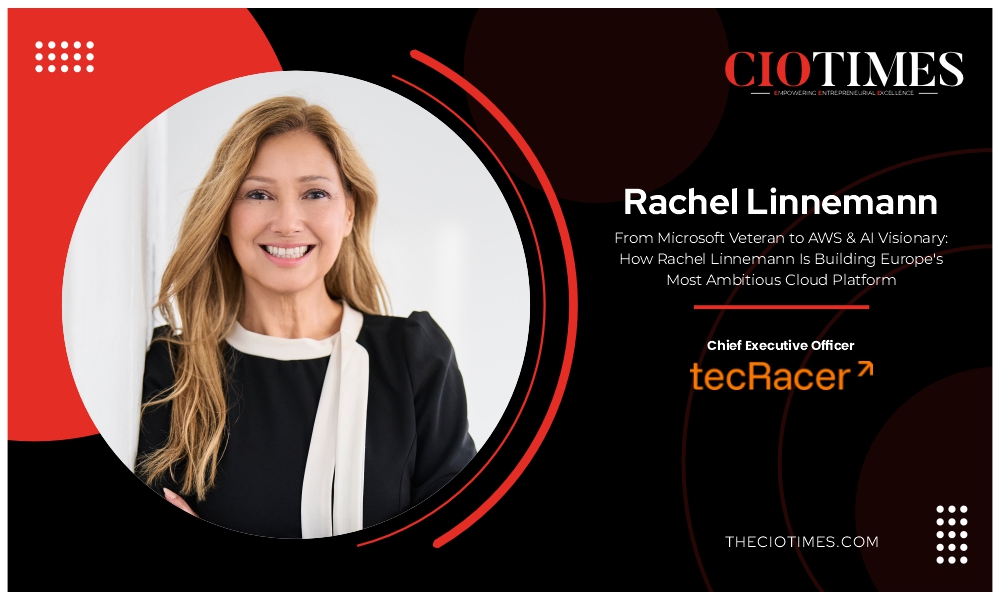
How Rachel Linnemann is turning generative AI and cloud into Europe’s most powerful and ambitious AWS platform — one acquisition, one partnership, and one bold vision at a time.
There is a phrase Rachel Linnemann keeps returning to — a personal tagline that doubles as a life philosophy: “Always dream of being part of something bigger.” For a CEO who spent 21 years at Microsoft spanning 55 countries, then led global hyperscaler partnerships at T-Systems before taking the helm at tecRacer, it is not a hollow mantra. It is the throughline of a career defined by the conviction that technology, when done right, changes the competitive architecture of entire economies.
Today, as CEO of tecRacer, she is executing on that conviction at scale. Her mission: to build Europe’s foremost AWS pure-play platform — combining generative AI, cloud engineering, digital sovereignty, and e-commerce performance into a single, scalable, end-to-end partner for enterprises across Germany, Austria, Switzerland, Portugal, and beyond.
Rachel cares deeply about the role Europe can play in shaping its own digital future. She is a vocal advocate for European digital sovereignty, a frequent voice on AI leadership, and a champion for women in technology leadership. But at the core of her thinking is a quiet, firm belief: Europe does not have to play catch-up to stay competitive. The real opportunity lies in building world-class expertise at home — and she is building it.
We sat down with Rachel for this exclusive profile to explore how she thinks about cloud strategy, leadership, European sovereignty, and the road ahead.
“Each acquisition adds a specialized competency to our portfolio — this is our path to becoming the European AWS Thought Leader.”
TECHNOLOGY & VALUE CREATION
Over your career you have witnessed several waves of technological transformation. Which structural shifts have most fundamentally changed how enterprises think about value creation through technology?
The most profound shift I have witnessed is the move from technology as infrastructure to technology as strategy. When I started my career, IT was the department that kept the lights on. Today, cloud architecture is a boardroom conversation because it determines how fast you can innovate, how quickly you can enter a new market, and whether you can comply with a regulation without a two-year migration programme.
Three shifts stand out. First, the democratisation of computing power through public cloud: companies that would once have spent years and tens of millions building a data centre can now access elastic, enterprise-grade infrastructure on demand. Second, the emergence of data as a genuine competitive asset — not just a by-product of operations, but something to be designed for and monetised. And third, generative AI — which I believe is the most structurally disruptive of the three. It is not merely restructuring the cost curve of knowledge work; it is rewriting the rules of competitive advantage in real time. Organisations that treat genAI as a productivity tool are already behind. The ones that treat it as a strategic architecture decision — determining how their business model generates value — are the ones we are building for at tecRacer.
What unites these shifts is speed. Enterprises that used to plan technology in three-to-five-year cycles now need to make bets in quarters. That changes everything about how you organise, partner, and lead.
STRATEGIC ECOSYSTEMS
What distinguishes a transactional partnership from a truly strategic ecosystem relationship that drives long-term innovation and market differentiation?
A transactional partnership is built on a contract. A strategic ecosystem relationship is built on a shared vision of what the market could become.
I have had the rare vantage point of working deeply inside three of the world’s largest technology ecosystems. At Microsoft for 21 years, I saw how platform dominance is built from the inside — through developer ecosystems, enterprise agreements, and a relentless focus on productivity software becoming infrastructure. At T-Systems, as Vice President of Global Hyperscaler, I held strategic relationships with all three major clouds simultaneously: Azure, Google Cloud, and AWS. That position gave me something most people never get — a truly comparative view of how each hyperscaler thinks, invests, and partners.
What I found was this: each cloud has genuine areas of excellence. But when I looked at where the most ambitious, technically deep, and commercially transformative work was happening for European enterprises — in cloud-native architecture, in generative AI, in sovereign cloud, in contact centre intelligence — AWS was consistently leading the field. Not in every category, but in the categories that matter most to the clients I care about.
That comparative experience is precisely why my decision to go all-in on AWS at tecRacer was not a default or an accident of circumstance. It was a deliberate, informed bet. When you have seen all three platforms from the inside, you stop being agnostic out of habit and start making choices on conviction. AWS’s depth of services, its engineering culture of customer obsession, its partner co-investment model, and its European sovereign cloud commitment gave me the confidence to place a focused wager rather than spread across all three.
The partners who grow with hyperscalers are the ones who co-invest in building capability, not just reselling it. They contribute to roadmaps. They bring customer problems to engineering teams early enough to shape solutions. They show up not just as a sales channel but as a force multiplier. Breadth of hyperscaler coverage can actually work against this — you cannot be a deep co-innovator on three platforms simultaneously. Specialisation is the price of genuine partnership.
At tecRacer, our relationship with AWS is built on exactly this principle. We are not certified resellers who happen to carry the AWS badge. We are co-innovators in sovereign cloud architecture, generative AI deployment for regulated industries, and contact centre transformation through Amazon Connect. That depth of collaboration — built on the conscious choice to go deep rather than wide — is what creates differentiation that no price comparison can dissolve.
“The partners who grow with hyperscalers are the ones who co-invest in building capability, not just reselling it.”
MULTI-HYPERSCALER STRATEGY
Beyond flexibility, what deeper strategic advantages can a multi-hyperscaler approach unlock for enterprises at scale?
Flexibility is the obvious answer, but the deeper advantage is negotiating leverage and architecture independence. When you are genuinely capable across multiple hyperscalers, you make better technology decisions — because you are choosing the right tool for the right job rather than rationalising a sunk investment.
My time leading hyperscaler partnerships at T-Systems, where I was responsible for relationships with AWS, Google Cloud, and Azure simultaneously, taught me that each platform has genuine areas of superiority. The organisations that extract the most value are those that build the internal capability to evaluate these differences honestly and architect accordingly.
There is also a talent dimension: multi-hyperscaler teams build broader, deeper engineers. And there is a resilience dimension: concentration risk in a single provider is a real operational and commercial risk that sophisticated boards are increasingly scrutinising.
But here is the critical nuance: while enterprises may legitimately operate across multiple clouds, the partners they rely on must go deep, not wide. You cannot be a genuine co-innovation partner on three platforms simultaneously. The organisations I have seen extract the most value from multi-cloud are those that choose specialised partners for each platform — partners with the engineering density and ecosystem intimacy that only comes from full commitment. That conviction is at the core of tecRacer’s 100% AWS focus.
DIGITAL SOVEREIGNTY & INFRASTRUCTURE
Public cloud, sovereign cloud, and AI-driven platforms are reshaping digital infrastructure. How do you see these forces interacting to redefine how organisations architect their future technology environments?
Sovereignty is no longer a compliance checkbox — it is a strategic design principle. In Europe especially, where GDPR, the EU AI Act, and data localisation requirements create a complex regulatory landscape, organisations cannot afford to treat sovereignty as an afterthought bolted onto an existing cloud architecture.
What I see emerging is a three-layer model: a global public cloud layer for scale and speed, a sovereign cloud layer for regulated workloads and sensitive data, and an AI platform layer that must operate within the constraints of both. These layers need to be designed to interact coherently, not exist as three separate silos managed by three separate teams.
At tecRacer, digital sovereignty is one of our core pillars. With the AWS European Sovereign Cloud now generally available — fully designed, built, and operated within the EU, physically and logically separated from existing AWS regions — we are among the first partners helping enterprises architect for full EU-resident data processing. We work with these capabilities to help clients, particularly in public sector and regulated industries, capture the full power of cloud innovation without making sovereignty compromises. This is genuinely hard to do well, and it is a significant source of differentiation for us in the DACH market.
“Sovereignty is no longer a compliance checkbox — it is a strategic design principle.”
CLOUD-LED TRANSFORMATION & BUSINESS VALUE
How do you ensure that cloud-led transformation initiatives translate into measurable business value rather than remaining purely technology-driven agendas?
The single most important discipline is starting with the business outcome, not the technology. It sounds obvious, but the graveyard of failed cloud transformations is littered with architecturally elegant projects that could not answer the question: what business metric does this move?
At tecRacer, we have structured our entire delivery methodology around this. Every engagement begins with a value mapping exercise — identifying the specific operational, commercial, or customer experience outcomes the client is trying to achieve, and building the architecture to serve those outcomes. We then instrument those outcomes from day one so that value is visible, measurable, and attributable.
The other discipline is ruthless prioritisation of adoption. Technology only creates value when it is used. Many organisations invest in migration but underinvest in change management, training, and the cultural shifts that allow people to actually work differently. Our Amazon Connect practice, for example, generates its biggest gains not from the technology itself but from the operating model redesign that it enables.
ORGANISATIONAL BARRIERS TO CLOUD ADOPTION
What are the deeper organisational or cultural barriers that prevent companies from realising the full potential of cloud adoption?
The deepest barrier is almost always identity, not capability. Legacy technology organisations — and many have been extraordinarily successful for decades — have built their self-image, their career ladders, and their internal power structures around specific ways of doing things. Cloud transformation threatens all of that, and the resistance is rarely explicit. It manifests as process delays, procurement complexity, and a thousand small decisions that slow velocity without anyone formally objecting.
The second barrier is leadership confidence. Cloud transformation requires business leaders — not just IT leaders — to make decisions about architecture, vendor relationships, and operating models they have historically delegated entirely to technical specialists. When business leaders do not feel confident enough to engage, transformations either stall or drift into purely technical territory, disconnected from commercial reality.
The third is a talent paradox: the organisations that most need transformation are often the ones least able to attract the cloud-native talent to drive it. This is a structural market challenge, and it is one reason partners like tecRacer play such a critical role. We bring the talent density that most enterprise organisations simply cannot build on their own balance sheet. This is also why tecRacer uniquely combines its status as AWS Premier Tier Services Partner with our designation as Advanced Tier Training Partner — the only partner in the DACH region to hold both. We don’t just build the architecture; we equip the people who operate it.
LEADERSHIP & STAKEHOLDER ALIGNMENT
What leadership approaches are most effective in aligning complex stakeholder networks — hyperscalers, clients, and internal teams — toward shared outcomes?
Radical clarity about what winning looks like for each party. In a complex ecosystem, misalignment almost always traces back to different definitions of success that nobody made explicit. I invest significant time at the start of any significant relationship — internal or external — in building a shared scorecard: what does success look like in 90 days, in one year, in three years, and how will we know?
The second principle is presence. You cannot lead a distributed stakeholder network through email and dashboards alone. The relationships that create real alignment are built in rooms — workshops, strategy sessions, shared problem-solving. My background spanning 55 countries taught me that trust is built in person and maintained digitally, not the other way around.
The third is consistency of character under pressure. In any partnership, there will be moments where short-term commercial interests diverge from long-term relationship value. How you navigate those moments defines the quality and durability of the alliance. I have walked away from revenue when the terms would have compromised the integrity of a relationship I valued more.
CO-INNOVATION WITH HYPERSCALERS
How can organisations move beyond standard service delivery to build truly collaborative innovation frameworks with their cloud partners?
Co-innovation requires skin in the game from both sides. The hyperscaler needs to see that you are investing in building genuine capability — not just packaging their services — and the partner needs to see that the hyperscaler is prepared to share roadmap visibility and go-to-market resource in return.
The mechanism that works best in my experience is joint solution development anchored to specific customer problems. Rather than abstract innovation programmes, identify two or three clients with a well-defined, unsolved problem that sits at the intersection of your capabilities and the hyperscaler’s platform roadmap. Build a solution together, with joint engineering resources and shared IP. Then productise it. This creates something real: a referenceable solution, a co-developed architecture pattern, and a go-to-market story that neither party could have built alone.
tecRacer’s “eCommerce Performance on AWS” offering — developed in part through our acquisition of KaWa commerce — is a direct example of this principle applied to our own growth strategy.
This approach reflects a deliberate strategic shift at tecRacer — from purely project-based consulting toward scalable, productised solutions that combine our deep AWS expertise with repeatable architecture patterns. Offerings like eCommerce Performance on AWS, our Amazon Connect practice, and our Bedrock-based generative AI solutions are designed to be deployed faster, scaled more efficiently, and deliver measurable value from day one.
“Co-innovation requires skin in the game from both sides.”
LEADERSHIP IN AN AI-DRIVEN ERA
How do you see the role of human leadership evolving as technology becomes increasingly autonomous and data-driven?
Leadership becomes more important, not less. As AI handles more of the analytical and operational work, the distinctly human contributions — judgment under uncertainty, ethical navigation, the ability to inspire and unite people around a vision, the courage to make decisions that data cannot fully resolve — become the scarce and differentiating resource.
What changes is the nature of the work. Leaders who spend most of their time processing information and managing execution will find those activities automated first. The leaders who thrive in an AI-abundant environment are those who excel at setting direction, building culture, and making the calls that require human wisdom and accountability.
I am deeply committed to being a practitioner, not just a commentator, on this transformation. I hold AWS certifications and actively work with Amazon Bedrock and agentic AI architectures — both in my own workflow and in shaping our client delivery methodology. I cannot credibly lead a company whose mission is cloud and AI transformation if I am not personally engaged with the technology. It also keeps me honest about the gap between the marketing narrative and the operational reality of deploying AI at scale.
GEOPOLITICS & CLOUD STRATEGY
How do geopolitical, regulatory, and data sovereignty considerations influence global cloud strategy design and execution today?
Profoundly and increasingly. When I was leading hyperscaler strategy at T-Systems, geopolitics was a consideration at the margins — something that occasionally affected procurement decisions in specific markets. Today it is a central design variable for any enterprise with operations across multiple jurisdictions.
The GDPR established a template that other regions are following. The EU AI Act adds another layer of compliance architecture for AI deployments. Data localisation requirements in various markets mean that what looks like a unified global cloud architecture on paper can be operationally fragmented in practice. And the broader trajectory of digital sovereignty — Europe asserting the right to process its data under European law, on European infrastructure — is reshaping the competitive landscape for cloud providers and their partners alike.
For tecRacer, this is a tailwind. Our focus on European markets, our expertise in AWS sovereign cloud capabilities, and our understanding of DACH regulatory requirements position us well to serve enterprises that are navigating exactly this complexity. Digital sovereignty is not a constraint we work around — it is a value proposition we lead with.
THE DECADE AHEAD
Which emerging shifts will most profoundly reshape the cloud services landscape over the next decade?
Three shifts will define the next decade. First, the full industrialisation of AI — the transition from AI as an experimental capability to AI as a standard component of every enterprise architecture. This will compress differentiation timelines dramatically: the advantage from an AI implementation will be shorter-lived, which means the organisations that win will be those with the operational discipline to continuously adopt and integrate new capabilities.
Second, the consolidation of cloud from infrastructure utility to platform ecosystem. The hyperscalers are becoming the operating systems of the enterprise — providing not just compute and storage but the entire stack from data architecture to AI models to business applications. Partners that can operate at this full-stack level, across the entire customer lifecycle, will capture disproportionate value.
Third — and I believe this is underappreciated — the rise of sovereign and federated cloud as a mainstream architecture model. As geopolitical fragmentation continues, the dream of a single, borderless cloud will give way to a more complex, federated reality. The organisations and partners who have built expertise in navigating that complexity will be extraordinarily well positioned.
A CLOSER LOOK
Beyond the boardroom — a glimpse into the person behind the portfolio.
Currently reading: A rotating stack of books — right now a mix of AI ethics, European economic history, and a novel that has nothing to do with technology.
One word for your personality: Relentless.
Most important lesson learned: Speed matters, but direction matters more. Moving fast in the wrong direction just gets you lost faster.
Best professional advice received: “Build your next role by being indispensable in your current one — but never so indispensable that they can’t afford to promote you.”
Favourite quote: “Always dream of being part of something bigger.” — My own personal north star, and the lens through which I evaluate every major decision.
ABOUT RACHEL LINNEMANN
Rachel Linnemann is the CEO of tecRacer, a German AWS pure-play consultancy on a mission to become Europe’s leading AWS Thought Leader. An AWS Certified Solutions Architect and Generative AI practitioner, Rachel is one of Europe’s most credible voices at the intersection of cloud strategy and enterprise AI. She brings over two decades of technology leadership to the role — including 21 years at Microsoft spanning 55 countries, and four years as Vice President, Global Hyperscaler at T-Systems, where she led strategic partnerships with AWS, Google Cloud, and Azure.
Backed by IT Capital Partners, tecRacer is pursuing a European buy-and-build strategy to become the continent’s leading AWS platform. Rachel is expanding the company’s capabilities in cloud engineering, data and AI, security, Amazon Connect, and e-commerce performance — increasingly through scalable, productised solution offerings that complement its consulting and training expertise. She leads a growing team of approximately 150 professionals across Germany, Austria, Switzerland and Portugal.
Rachel is a vocal advocate for European digital sovereignty, a frequent voice on AI leadership, and a champion for women in technology leadership. She believes that Europe’s best response to the global technology race is to build world-class expertise at home — and she is building it.
tecRacer GmbH · Hannover, Germany · www.tecracer.com