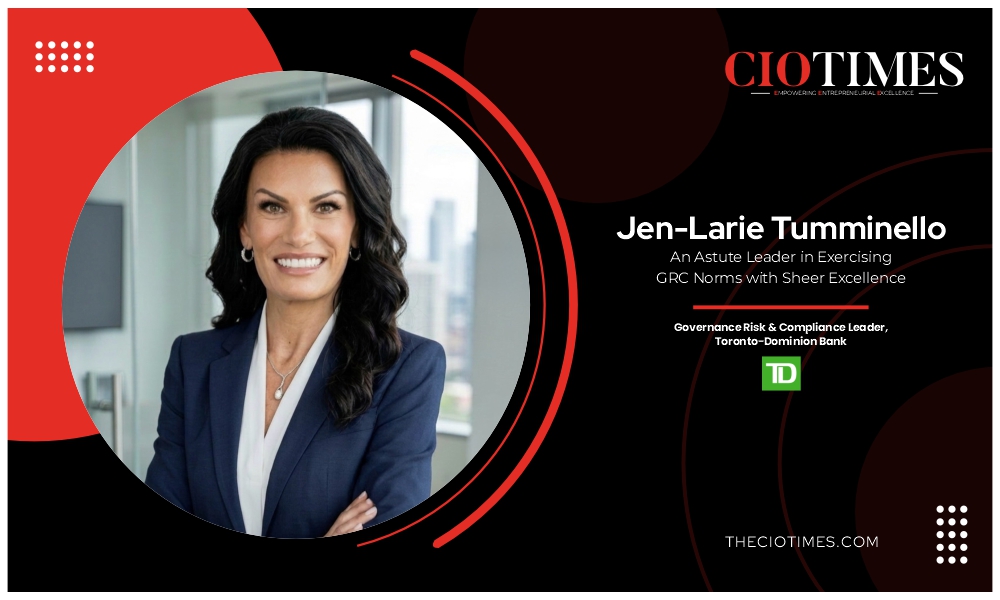
Assurance in a business is a magnetic pull for any business owner. Each business owner aspires to operate a business with integrity, authority, and respect. To keep up with this, Governance, Risk, and Compliance (GRC) was established to help entrepreneurs or founders be more focused on their core work. GRC executives take on the responsibility to keep the business away from toxic work culture, potential technical threats, and unexpected happenings like data breaches or cyberattacks. These professionals are the backbone of seamless harmony prevailing in a business organization. A name we cannot miss out on when speaking of such maestros is Jen-Larie Tumminello, Governance Risk & Compliance Leader, Toronto-Dominion Bank. Her rich 25-year experience has shaped her perspective in accommodating innovation and nurturing result-oriented teams with excellence.
An Extraordinary Journey
Her tactical leadership approach with an inclination towards multifunctional partnerships has surged her career prowess. Her rising designations in Governance Risk & Compliance, Financial Services, Consulting, Regulatory Risk, and large-scale transformation goals have set a benchmark. Her forte is tactical development and execution of risk-based compliance controls. A passionate professional and leader with the skills to inspire people to craft and preserve standards in compliance and ethical standards. She is a high-stakes problem solver at the intersection of regulatory authority and strategic risk management. With over 25years of experience at the Federal Reserve Bank of New York, she served as a Regulatory Risk Leader for the G-SIB portfolio, as well as other notable roles of increasing responsibility, in Payments, Operations, and Bank Supervision, navigating the complexities of LISCC firms, enterprise risk, and enforcement action remediation.
After leaving the Fed, she assumed a Director role at PwC, she advises the world’s largest financial institutions and FinTechs on their most critical challenges from large-scale remediation and consent orders to regulatory strategy and reporting. Her unique perspective, gained from years within the Fed’s National Office, allows her to transform complex regulatory mandates into resilient operational realities.
Beyond the balance sheet, she is a dedicated advocate for the next generation of leaders. As an active member of the Women’s Bond Club and Access Your Potential, she mentored students across the U.S., helping bridge the gap between education and executive leadership.
Core Expertise:
- G-SIB & LISCC Oversight: Deep experience in FRBNY standards and global systemic risk.
- Remediation & Strategy: Resolving consent orders and strengthening enterprise risk governance.
- Operational Leadership: Former Director of Currency Distribution & Payments, leading system-wide FedCash transformations.
Holistic Approach to Governance
Jen-Larie Tumminello has served in both the Federal Reserve and global systemically important banks. Having served within the Federal Reserve’s LISCC program in the G-SIBs portfolio and later leading first-line governance risk and compliance inside a global bank, she has seen both the intent and the operational friction of regulation.
From the supervisory side, she learned that regulators are fundamentally assessing the credibility of data, governance routines, escalation culture, and institutional self-awareness. From the institutional side, she saw how governance can either enable clarity or create fatigue.
She adds, “My philosophy is that governance must be operationally embedded. It cannot exist as documentation alone.”
Supervisors evaluate whether governance frameworks produce consistent outcomes under stress. Therefore, she designs governance to be measurable, transparent, holistic, and decision-oriented, not performative.
System Reform
Jen-Larie Tumminello believes that remediation only becomes meaningful when it grows into genuine institutional reform. For her, the turning point is when behavior changes, not just when documentation is updated. Within the Federal Reserve, examiners review firms under enforcement actions and heightened supervisory scrutiny, and she has seen firsthand that the organizations making real progress share a few common traits. They strengthen first-line ownership, ensuring accountability rests with those closest to the work. They clarify decision rights, removing confusion about who holds authority. And they embed leadership metrics into daily routines, so reform is measured and reinforced in practice rather than left as theory.
For her, the shift from closing an issue to strengthening a system marks the essence of reform. It is not about checking boxes or updating manuals; it is about building resilience into the institution itself. That requires steady governance routines, incentives that reward the right behaviors, and cultural reinforcement that sustains progress long after the initial fixes. In her view, reform is alive; it is a system that reshapes how organizations operate, endure, and ultimately thrive.
Performance Governance
Jen-Larie Tumminello often explains that governance only drives performance when it is anchored in the right practices and lived out in daily routines. She has seen that effective governance consistently reflects three defining characteristics:
- Clear accountability anchored in the first line, where responsibility is owned by those closest to the work rather than pushed upward.
- Operational metrics tied to the health of the business itself, not just compliance with policy, so leaders can see how governance impacts outcomes.
- Leadership engagement in governance discussions, ensuring that oversight is not a formality but a meaningful part of decision-making.
When she led the Global Finance Central Policy Office and first line Risk under the COO & CFO, she worked to enhance the target operating model and introduced executive-level KRIs that measured policy and compliance health in a way leadership could act upon. For her, governance becomes truly performance-driven when leaders use it to inform business decisions, rather than treating it as evidence for audits. In her view, governance is not paperwork; it is a living system that shapes how organizations operate, adapt, and succeed.
Clarity Translation
Jen-Larie Tumminello often says the real art of governance lies in translation, taking lofty regulatory expectations and turning them into something that actually works on the ground. At the Federal Reserve, she saw how principle-based rules were always tied to outcomes, and later at PwC, she helped institutions bridge that gap by mapping requirements directly to operational controls.
In her experience, organizations keep themselves moving forward when they focus on the risks that truly matter, when they design control mapping that feels practical instead of theoretical, and when they use dashboards not as noise machines but as tools to uncover root causes. The regulatory alignment should never feel like bureaucracy for its own sake. It should bring clarity, helping leaders see how compliance strengthens the business rather than slowing it down. In her words, translation is less about paperwork and more about making governance a living system that informs decisions, builds resilience, and keeps institutions thriving.
Clarity is Key
Jen-Larie Tumminello affirms that financial institutions are facing technical issues like digital transformations, cyber threats, regulatory intensity, and reputational risk.
To avoid this, she suggests, “Executives should focus first on governance architecture.”
Even before looking over technology and digital transformation, there are some key aspects that she shares that need attention. These are:
- Clear decision rights.
- Escalation transparency.
- Reliable risk data.
- Executive-level metrics.
In her work and in the roles she has held, from leading risk and quality management at the Federal Reserve Bank of New York to shaping strategy in Global Finance at Morgan Stanley, Jen-Larie has always found that sustainable resilience begins with governance clarity. For her, clarity is not just about structure on paper; it is about creating a shared understanding that empowers leaders, strengthens accountability, and builds a culture where resilience is lived out every day.
Clearing the Air
Some misinterpretations are believed to be true. Among these, Jen-Larie shares one.
She highlights, “The most misunderstood dimension is that first-line accountability is not about control execution — it’s about risk ownership.”
Furthermore, she says that in supervisory environments, regulators are on the lookout for evidence that business leaders understand their risk profile. They can also articulate mitigation strategies depending on this. She often describes first-line accountability as more than just a compliance term to her; it means truly owning the narrative, the metrics, and the outcomes. It is about taking responsibility at the source, rather than deferring to the second line for interpretation or explanation. In her view, accountability at the front line is what gives governance its credibility, because it ensures that those closest to the work are also closest to the truth. That kind of ownership not only strengthens transparency but also builds trust, creating a culture where resilience is grounded in clarity and responsibility.
Resilient Innovation Governance
Jen-Larie often talks about how institutions need to shift their culture if they want to move from reactive compliance to proactive resilience. She’s seen that this isn’t about small tweaks, it’s about changing the way organizations think and act. That means moving from issue response to genuine risk anticipation, shifting from regulatory fear to regulatory fluency, and evolving from siloed controls to enterprise-wide transparency. In her time working with G-SIBs, she noticed that the firms making the biggest strides were led by people who weren’t afraid to admit weaknesses and who invested in infrastructure before regulators demanded it. For her, that kind of openness is what resilience really looks like.
She also believes that governance frameworks must grow alongside innovation, rather than holding it back. Governance should be modular and dynamic, designed to flex with new ideas while keeping integrity intact. That means embedding real-time regulatory intelligence, aligning taxonomies so everyone speaks the same language, and ensuring control traceability so accountability never slips through the cracks. In her view, innovation should never bypass governance; instead, governance should be the system that makes innovation sustainable. By combining resilience with adaptability, she sees institutions creating cultures where compliance is not a burden but a foundation for growth and trust.
Jen-Larie Tumminello: Establishing Credibility
To maintain an executive presence, she believes it comes from preparation and composure. According to her previous experiences, she has learned three things:
In high-stakes environments, credibility is built not by volume or jargon but through clarity and calm. Over the years, she has cultivated a strong executive presence by preparing with discipline and maintaining composure even under pressure. In supervisory and executive forums, she discovered the power of speaking in outcomes rather than technical language, grounding her commentary in credible data, and always pairing risks or issues with a practical path forward. When presenting quality metrics and emerging risks to senior leaders, she saw how trust was earned not through complexity but through steadiness. Clarity and calm are more than presentation techniques; they are the qualities that reassure people, inspire confidence, and make leadership feel both human and dependable.
She says, “In high-stakes environments, credibility comes from being measured, solution-oriented, and grounded in facts—not from reacting emotionally or over explaining.”
From her outlook, sustained transformation has the following aspects:
- Defined ownership.
- Measurable milestones.
- Executive visibility.
- Embedded governance routines.
- Is it mandated by Regulators?
The Speak Up Strength
Jen-Larie Tumminello has watched the risk profession evolve in remarkable ways. Today’s rising leaders aren’t just compliance experts; they’re fluent in data, technology, and culture. They bring analytics, systems thinking, and DE&I awareness into governance, shifting risk from a back-office function to a driver of strategy. Through mentoring and industry forums, she’s seen them break down silos and embrace transparency, moving from reactive oversight to proactive resilience.
For Jen-Larie Tumminello, one truth has become clear: risk shows up through people before it ever appears in metrics or losses. That’s why she believes psychological safety is the foundation of a strong speak up culture. When employees feel safe to raise concerns without fear of retaliation, organizations gain early visibility into emerging risks, control gaps, and ethical challenges.
She often points out that a healthy speak-up culture is a leading indicator of institutional strength. Leaders who create psychological safety invite candid escalation, open debate, and honest reflection on failures. Without it, employees self-censor, especially in high-pressure environments, and risks remain hidden until they become costly exposures.
Psychological safety also changes the way teams own risk. Instead of defensiveness, there’s problem-solving. Leaders get to the real root causes, not sanitized reports, and governance forums can focus on decisions and outcomes rather than rehearsed issue management.
Jen-Larie emphasizes that in moments of disruption or scrutiny, organizations with open dialogue adapt faster and respond more credibly. Speaking up isn’t dissent, it’s stewardship, trust, and resilience. In high-stakes regulatory settings, silence itself becomes the greatest risk.
The concept of psychological safety, advanced by Amy Edmondson, is about creating an environment where people can admit mistakes, challenge assumptions, and voice concerns without fear. Regulators notice this too; they look beyond hotlines and assess whether leaders genuinely encourage transparency.
Jen-Larie believes psychologically safe leaders do three things especially well:
- Respond constructively to bad news. Curiosity accelerates escalation; defensiveness slows it.
- Invite dissent and challenge. Silence is rarely agreement; it’s often apprehension.
- Separate accountability from punishment. High standards can coexist with empathy, encouraging disclosure without fear.
For her, the difference is simple: without psychological safety, governance becomes theater. With it, governance becomes prevention.
Effectivity is Key
Jen-Larie’s career includes multiple factors like financial services operations, enforcement oversight, and enterprise risk. What continues to be an intellectual challenge for her is the intersection of regulation and innovation. She keeps her focus on how institutions can evolve, adopt new technologies, and transform operating models. Simultaneously, she still fulfils supervisory expectations and preserves control integrity. Organizational silos are one of the main causes of barriers to effective governance, she reminds.
She adds, “In large institutions, risk, compliance, operations, audit, technology, and business units often operate with parallel processes and inconsistent data sets. Each function may perform well independently, yet collectively the organization lacks a unified risk narrative.”
From supervisory oversight and institutional leadership roles, she has seen how silos undermine governance in three ways:
- Inconsistent Risk Narratives
Executives cannot make informed decisions if risk metrics differ across divisions. Regulators quickly detect when institutions cannot articulate a coherent enterprise-wide view.
- Duplicative Controls and Gaps
Fragmented taxonomies create overlap in some areas and blind spots in others. Without traceability from regulatory obligation to control to outcome, credibility erodes.
- Delayed Escalation and Diffused Ownership
Silos obscure accountability. Issues move horizontally without resolution. Decision rights become ambiguous.
She adds, “Breaking down silos requires more than restructuring. It demands shared taxonomies, integrated dashboards, and cross-functional governance forums. When transparency increases, resilience strengthens.”
Mindset Shift to Focus On
Upon asking about what the governance mindset shift she would focus on, she shares:
- How quickly can we identify risk?
- How clearly can we articulate ownership?
- How confidently can we respond under stress?
- Governance must be forward-looking
Also Read:- Cio Times For More Information