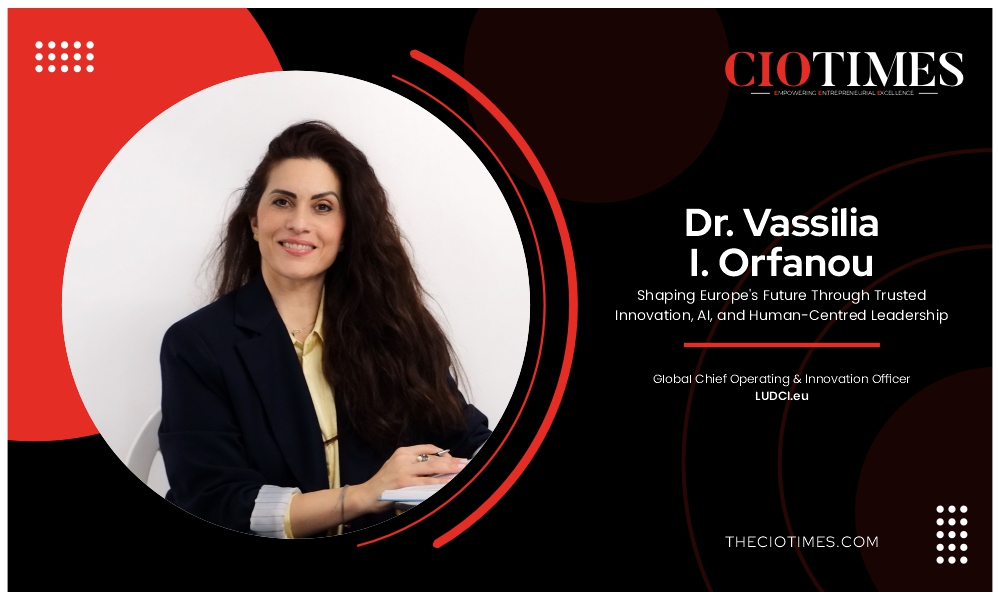
As artificial intelligence reshapes industries and regulation becomes central to business, organizations can no longer afford to treat policy, innovation, and commercial growth as separate conversations. Dr. Vassilia I. Orfanou believes the real competitive edge lies in connecting all three. Working across EU policy, strategic communications, and emerging technologies, she brings a perspective grounded in translating complexity into strategic direction.
Her work explores how businesses can navigate evolving regulatory frameworks, harness AI responsibly, and build commercially resilient models in rapidly changing markets. At a time when uncertainty defines the global landscape, she argues that clarity, adaptability, and informed decision-making are becoming the true drivers of long-term business advantage. Her work revolves around strategic marcom, business model restructuring, commercial strategy, EU Policy, and AI transformation. These sectors constantly shift as they evolve. She highlights that the organizations that will lead the next decade are the ones that can create coherence between regulation, technology, and commercial execution.
Throughout her career, whether working with EU institutions, the European Investment Bank, Gaia-X, multinational technology ecosystems, or large-scale transformation programmes, she has observed: fragmentation destroys momentum. Many organizations still operate with policy teams, innovation units, and commercial units, and commercial functions working in isolation, often guided by very different priorities. The result is usually the same: slower decision-making, disconnected execution, and missed growth opportunities.
She believes the solution lies in breaking down these silos. Rather than treating marcom, digital transformation, policy, AI optimisation, and commercial strategy as separate disciplines, she sees them as deeply connected systems that should work together from the outset. In her view, policy creates the foundation of trust, AI unlocks new capabilities, and commercial strategy turns both into meaningful business value.
She believes organisations become far more resilient and forward-looking when these elements are aligned early. Instead of constantly reacting to disruption, they can shape markets and influence the direction of change themselves.
This perspective was central to her work with Gaia-X, where the objective extended beyond conversations around cloud infrastructure or data governance. The initiative focused on helping build a European framework for digital trust and sovereignty, bringing together more than 350 members and multiple national hubs. For Dr. Vassilia I. Orfanou, the real challenge was not only technological complexity but ensuring alignment between technical innovation, policy objectives, and commercial scalability.
To create that alignment, she applies what she calls “strategic translation layers.” Every initiative, she explains, should be viewed through four essential perspectives: regulatory legitimacy, technological feasibility, commercial scalability, and societal relevance. When one of these dimensions is overlooked, transformation efforts often lose stability and long-term impact.
Dr. Vassilia I. Orfanou also believes that competitive advantage today is no longer driven solely by products or services. Increasingly, it comes from organisational intelligence, which is the ability to anticipate change, adopt emerging technologies responsibly, and move quickly without losing public trust.
She sees Europe as particularly well-positioned in this evolving landscape. While some regions prioritise speed above all else, she believes Europe can lead by building trusted innovation ecosystems where credibility and trust become long-term economic strengths.
For younger professionals entering this space, her advice is simple: avoid thinking in silos. She encourages individuals to build knowledge across technology, governance, economics, and emotional intelligence, believing that the next generation of leaders will not be defined by expertise in a single field, but by their ability to connect disciplines, people, and ideas.
Leading Through Policy
Several organizations still approach regulation with a defensive mindset, asking how they can comply rather than how they can lead. She believes the conversation needs to shift. In her view, policy is not simply about restrictions or legal obligations, and this is something that one of her mentors, Antonis Politis of LABOR SA has explained and defended quite eloquently. Particularly in Europe, it increasingly acts as a signal of where markets, investments, and innovation are heading. Organizations that recognize this early are often the ones best positioned to grow with confidence.
She points to sustainability as a strong example of this transformation. ESG frameworks were once seen mainly as reporting requirements, yet today they influence investment decisions, procurement strategies, customer trust, and overall brand value. Dr. Orfanou believes AI governance and data sovereignty are now following the same path.
Drawing from her experience across EU-funded ecosystems and institutional environments, she observed that the organisations most prepared for long-term success were rarely the ones waiting for regulatory certainty before acting – a level of clarity that she learned and practiced throughout her tenure at European Dynamics. There, Konstantinos Velentzas, taught her that in order to navigate successfully in this area, it is key to build responsible, future-ready governance models early, before these standards became mandatory.
“The organisations that will lead the future are not the ones treating policy as bureaucracy, but the ones recognising it as a source of strategic insight, trust, and long-term resilience”.
This proactive approach creates several lasting advantages. First, it strengthens credibility. Organisations that align early with principles such as transparency, ethical AI, and digital sovereignty are more likely to build trust with governments, institutions, and international stakeholders – a different mentor of hers, Dominik Rohrmus taught her while at Gaia-X. Second, it improves market positioning, especially as policy priorities increasingly influence funding, procurement opportunities, and strategic partnerships. Finally, it creates operational resilience, allowing organisations to adapt with greater confidence instead of constantly reacting to regulatory pressure.
At LABOR S.A., for example, she sees compliance excellence as far more than a legal responsibility. The organisation leaves and breaths processes, but they also self-criticise and try to amend things while they have the momentum. Indeed, for her, it is a strategic asset that strengthens market confidence, supports international partnerships, and reinforces the company’s reputation within highly regulated sectors.
This is why Dr. Vassilia I. Orfanou encourages organisations to integrate policy intelligence into the core of their decision-making. She believes policy should not sit in isolation within legal departments, but should actively inform strategy, innovation, and long-term business planning – another key point that another mentor, Bror Salmelin, European Commission taught her over the years.
While Europe’s regulatory environment is often criticised for being complex, she believes that complexity can also create opportunity. Organisations capable of understanding and navigating these frameworks effectively are often able to build trusted, defensible positions that competitors struggle to replicate.
Championing Leadership
Dr. Vassilia I. Orfanou believes that in complex ecosystems, true alignment is not about achieving complete agreement. Different stakeholders inevitably bring diverse priorities, institutional cultures, and expectations to the table and in most cases, these are entirely conflicting from one-another. What matters most is creating a shared direction strong enough to sustain collaboration despite those differences.
This perspective was shaped during her time at the European Investment Bank, where she oversaw communications, digital transformation, and stakeholder coordination initiatives involving more than 150 contributors across institutional bodies, contractors, and multinational partners.
This notable experience involved contributing to the leadership and successful delivery of an €11 million project alongside consortium leaders, consulting firms, European Commission stakeholders, technical experts, and communications teams. In such a multifaceted environment, alignment had to function operationally, not just strategically. Dr. Orfanou helped establish shared KPIs, structured governance frameworks, and transparent communication systems that kept all parties connected and accountable.
She adds, “True alignment is not built on agreement alone, but on trust, structure, and a shared commitment to progress.”
For her, the foundation of lasting collaboration is operational trust. Every stakeholder must clearly understand their role, responsibilities, escalation pathways, and how their work contributes to broader objectives. That experience reinforced her belief that alignment is sustained through governance clarity, measurable accountability, and disciplined communication.
Dr. Orfanou identifies four essential elements behind successful ecosystem leadership: a shared purpose, clear governance, communication discipline, and measurable outcomes. She believes trust is earned through consistency, particularly during periods of pressure and change.
In today’s interconnected world, she sees leadership evolving beyond hierarchy and control. Modern leaders must act as orchestrators, bringing together diverse actors, balancing competing interests, and creating environments where productive collaboration can thrive.
Being AI-ready
Dr. Vassilia I. Orfanou believes one of the biggest misunderstandings around AI adoption is that organizations struggle with the technology itself. In reality, she feels the real challenge is readiness. Many companies are eager to experiment with AI tools, yet their structures, leadership models, and workplace cultures are often not prepared for the deeper transformation AI requires.
From her experience leading digital transformation initiatives, she has seen that sustainable AI adoption depends on far more than technical capability alone. For AI to create meaningful enterprise-wide value, several human and organizational conditions must exist:
1.Leadership Clarity –
Leaders must clearly communicate why AI matters, what purpose it serves, and how success will be measured across the organisation.
2. Cultural Readiness –
Employees need transparency, inclusion, and reassurance. Fear of replacement or uncertainty can slow transformation if people do not feel supported through change.
3. Strong Governance –
Ethical standards, accountability, cybersecurity, and responsible oversight are essential for long-term trust in AI systems.
4. Operational Integration –
AI creates real impact only when it becomes part of everyday workflows, decision-making, and long-term strategy rather than isolated experimentation.
She shares, “AI transformation is not just about adopting new technology – it is about preparing people, cultures, and organizations to evolve together.”
She believes the most successful transformations happen when organisations remember that innovation is ultimately about people. For her, AI should enhance human capability, not diminish or replace human value. She sees adaptability, collaboration, and continuous learning as some of the most important qualities future leaders and professionals will need in an increasingly AI-driven world.
Human-focused Transformation
From Dr. Vassilia I. Orfanou’s perspective, the greatest friction between policy design and real-world execution rarely comes from the policy angle itself. The real challenge begins when organisations attempt to turn complex strategies into practical, everyday action. Policies are often designed at a high strategic level, but businesses must implement them through people, systems, timelines, and operational realities. Somewhere between vision and execution, uncertainty and disconnect can easily emerge.
Over the years, she has observed that many organisations become heavily focused on compliance, technology, and operational efficiency while unintentionally overlooking the human side of transformation. Whether implementing AI governance, cybersecurity frameworks, or enterprise-wide digital initiatives, she believes long-term success depends just as much on emotional readiness and cultural alignment as it does on technical capability.
She adds,“Real transformation happens when people feel supported through change rather than pressured by it.”
In her experience, people need clarity, trust, and a sense of purpose during periods of significant change. Without that foundation, even the strongest strategies can struggle to gain traction. Large organisations often face additional challenges because departments operate with different priorities, a series of political agendas, creating silos from the inside, truly making execution fragmented and difficult to sustain. Through her work across complex multinational and institutional environments, she learned that effective leadership is ultimately about simplifying complexity and helping people understand not only what is changing, but why it matters and how they can be part of the change.
For her, leadership today is less about authority and more about guidance, alignment, and trust. Strong leaders create stability during uncertainty and help teams move forward together with confidence rather than fear.
Dr. Vassilia I. Orfanou believes organisations must embrace three important shifts moving forward:
1. Broader Leadership Thinking –
Modern leaders must connect technology, governance, operations, and human behaviour rather than operate within isolated expertise.
2. Adaptive Governance Models –
Organisations need flexible systems capable of evolving alongside AI, cybersecurity, and rapidly shifting global risks.
3. Human-Centered Leadership Development –
Future leaders must combine strategic thinking with emotional intelligence, adaptability, and ethical judgment.
She believes transformation becomes truly sustainable when organisations place people at the center of change, but still directs, retrains and reskills them, while challenging them daily in a positive way to bring solutions, rather than excuses. It is completely incorrect to think that people should only be empowered, and because of that they will eventually get the job done. People need to see leaders that are hands on and get the job done themselves.
Architecting Sustainable Performance
She believes the real difference between a well-managed organization and a truly well-architected one comes down to its ability to handle change, complexity, and growth without losing direction. Most companies lose direction, vision and end up being entirely disconnected from their people and eventually from the market. In her view, management helps organizations function day to day, but performance architecture determines whether they can evolve, adapt, and sustain success over time.
For her, performance architecture is not simply about processes or operational structure. It is about intentionally creating an environment where people, systems, communication, leadership, and decision-making work together in a way that allows organizations to move forward with clarity and resilience, even during uncertainty.
Throughout her experience leading large-scale programmes across multinational and highly regulated environments, she witnessed how quickly complexity can overwhelm organizations that rely too heavily on improvisation. During her work with European Dynamics, where she managed communications, PMO advisory, and strategic EU-funded initiatives across multiple European sectors, she learned that sustainable execution requires far more than strong management alone. It requires systems capable of creating consistency across teams, countries, stakeholders, and constantly changing operational demands.
Over time, she came to believe that many organisations unknowingly depend on what she describes as “heroic management”, where a small number of individuals continuously compensate for structural weaknesses and ‘weak experts’ that tend to manoeuvre behind the scenes, as in principle, they seriously lack structure, education, cultivation and at some point the C-levels trusted them with their vulnerabilities. While this may temporarily keep operations moving, it often creates delays, exhaustion, inefficiency, and long-term instability.
In contrast, she believes well-architected organisations create clarity rather than confusion, but they would still need to accept senior capacity to change their mindset that is usually part of the problem. The seniors accepted should be content in their own skin and able to align strategy with execution, reduce friction between departments, strengthen accountability, encourage collaboration, and help teams adapt without losing focus or momentum. They cannot be seeking validation by demeaning their own resources, nor being afraid to speak to their team leader in fear that they will get fired or scolded for speaking the truth.
For her, one of the most important responsibilities of leadership is building systems that allow people to succeed together rather than relying on constant individual intervention. She believes strong organisations are not sustained by a few indispensable people, or specifically politically oriented people that push the agenda backwards or forwards, but by cultures, structures, and communication models that continue to function effectively even during periods of rapid change, where challenges may be the only constant but clearly create the actual opportunities to reinvent the status quo.
In today’s AI-driven and fast-evolving business environment, Dr. Orfanou feels this kind of organisational resilience has become more important than ever. Sustainable performance, in her view, comes not from speed alone, but from the ability to build intelligent, adaptable, and deeply connected systems that place both people and execution at the center of transformation.
Metrics-backed Transformations
Successful organizations work on perfectly aligned strategies, she mentions. Across several industries, sectors, and institutional environments, Dr. Orfanou has consistently observed several recurring patterns in organizations capable of transforming strategic ambition into measurable and repeatable results. The patterns are as follows:
1. Clarity
High-performing organisations understand exactly what they are trying to achieve and why it matters. Strategic ambiguity creates operational confusion that leads to small but consistent operational death traps.
2. Disciplined execution
Vision without operational discipline becomes organisational theatre rather than transformation. Strong organisations translate strategy into priorities, deliverables into accountability structures, and actions into measurable outcomes.
3. Leadership consistency
Employees observe leadership behaviour more carefully than leadership messaging. When leaders demonstrate alignment between words, decisions, and actions, trust increases, and organisations become more resilient.
4. Intelligent measurement
What is not measured cannot improve sustainably. However, measurement must remain strategically relevant. Too many organisations create KPI overload without operational value and bringing no result or a sustainable impact in the long run.
5. Adaptability
The strongest organisations maintain strategic direction while adapting operational methods. In today’s environment, rigidity creates vulnerability and eventually this will lead to additional vulnerabilities that will kill any strategy.
6. Investment in people
Technology matters enormously, but human capability remains decisive. One of the most rewarding aspects of leadership is helping people recognise potential they did not initially see in themselves.
A concrete example she shares from her role at Costa Navarino – one of the most stunning hospitality destinations in the EU. There, she led the communications and media relations strategy across multiple European markets. The strategic objective was clear: reposition the destination internationally and significantly increase visibility and market influence across Europe. However, achieving this required disciplined execution, not simply a re-branding activity across different markets.
The team revamped the media strategy across ten major PR offices in countries including Germany, France, Sweden, Italy, Russia, and Greece, while coordinating more than 120 press conferences and over 200 journalist engagements. By aligning communications, stakeholder outreach, and market positioning under one strategic framework, the organisation increased its press value from €11 million to €45 million within two years.
The consistency between strategy, operational execution, stakeholder coordination, and measurable outcomes made the transformation successful. Throughout her career, the most successful teams were always those where people felt empowered, trusted, and connected to purpose.
She asserts, “I strongly believe younger generations today need leaders who invest not only in performance, but also in growth, confidence, opportunity, and human development. The organisations that thrive long term are the ones that combine ambition with humanity.”
Balancing Framework with Adaptability
Dr. Vassilia I. Orfanou mentions that there is no concrete formula for transformation. Yet, she mentions some principles for standardization:
- Governance discipline
- Agile methodologies
- KPI frameworks
- Stakeholder mapping
- Data governance
- Risk management structures
- Communication frameworks
- Operational accountability
However, the transformation itself always remains contextual. Every organisation operates within a unique combination of culture, leadership maturity, regulatory exposure, market conditions, institutional history, geopolitical realities, and workforce dynamics.
A transformation framework that succeeds in fintech may fail within healthcare, public administration, defence, or manufacturing if contextual realities are ignored. She highlights the fact that organizations import methods without adapting them internally.
She states,“Transformation is not a copy-and-paste process; it requires strategic tailoring based on the specific gaps at hand. The first step is to understand those gaps, acknowledge them honestly, and assemble the right people to address them effectively.”
She believes that in many transformation efforts, the challenge is not only systems or processes, but sometimes even the leadership structures themselves. In some cases, she notes, resistance at the C-suite or board level can unintentionally become part of the very gap organisations are trying to close.
This is why she places such importance on listening as a core leadership skill. In her view, effective transformation leaders don’t begin with fixed solutions; they take time to understand how an organisation truly works before deciding what needs to change.
Across her career in highly regulated and institutional environments, Dr. Orfanou has learned that successful transformation always depends on balance. Structure is essential to provide direction, but flexibility is equally important so organisations can respond to complexity, uncertainty, and human behavior. Without this balance, change often becomes superficial rather than lasting.
During her time at Ecorys, she worked across policy and operational areas, such as sustainability, justice, employment, and energy efficiency linked to the European Commission. One significant experience involved developing a detailed stakeholder engagement and communications strategy for a sustainability initiative focused on public awareness.
Although established frameworks were already in place, she quickly realised that success required more than applying a standard model. It depended on adapting messaging, governance, and engagement approaches to suit public-sector sensitivities and cross-country coordination.
All of this reinforced a simple but important lesson: “frameworks are useful, but transformation only works when they are shaped by context, culture, and real-world complexity, let alone – the appropriate leadership that promotes other leaders.”
Accountable Digitalization
Dr. Vassilia I. Orfanou highlights the fact that AI will be significantly involved in the decision-making process, but it should not replace human responsibility. This distinction is fundamental. Algorithms can process scale, identify patterns, accelerate analysis, and generate predictive insights far beyond human capacity. However, leadership involves dimensions AI cannot fully replicate ethical reasoning, contextual understanding, empathy, accountability, societal awareness, and moral judgment.
The danger is not AI itself. The danger is uncritical dependence. Leaders must avoid two extremes. One extreme is resisting AI entirely out of fear. The other is surrendering strategic judgment completely to automation.
Balancing innovation with governance became central to her team during her tenure at Luxembourg Diplomacy & Communications Institute (LUDCI.eu). She has played multiple roles from Lobbying expert to Chief Comms, and from Chief AI Officer to Chief Operating Officer quite seamlessly, while fully integrating her blueprint and that of her team as an external C-level partner to enable, restructure and optimise various organisations to-date.
She believes that as AI capabilities began to accelerate, organizations can no longer afford to treat it as just another digital tool. In her work, she has seen AI gradually woven into communications, digital operations, editorial thinking, and strategic planning. But very early on, she also realized something important: “without governance, and disciplined leadership, AI doesn’t only improve efficiency, it can also introduce operational and reputational risks that are easy to ignore until they grow and can bring a company to its knees.”
This understanding shaped how she works with public administrations, organizations and companies today. Instead of positioning AI as a standalone solution, she developed a grounded four-stage approach for clients, bringing together ethical oversight, project management, content validation, strategic supervision, and clear human accountability across every AI-supported workflow. The intention has always been simple for her: “AI should support people in thinking better and working smarter, while decision-making and responsibility remain firmly human. AI is and should remain an assistant, not replace people or workforce. And what key companies are doing today trying to replace or fire their workforce finds me completely and ethically against.”
She often says that AI governance cannot stay confined to frameworks or policy documents. It must live inside the organization, involved in daily decisions, leadership behaviour, and the way teams work together.
Dr. Vassilia I. Orfanou also believes that the future of AI depends on maintaining a real balance between human judgment and machine capability. She often describes this through three guiding principles:
1. Explainability –
People should be able to clearly understand how AI systems arrive at their outputs and influence decisions, without ambiguity or opacity.
2. Accountability –
Responsibility must always remain with people. In her view, it should never be diluted or hidden behind algorithms, automated systems or leadership talks. Everyone should be held accountable for the work that they do, but they should also be given the necessary brief as to the expectations first and foremost.
3. Proportionality –
Not every process requires the same level of automation. High-stakes sectors, such as healthcare, finance, manufacturing, engineering, defence, and public governance need stronger human oversight and carefully calibrated use of AI.
This work has also reshaped how she sees leadership itself. It is becoming less about technical certainty and more about clarity of thinking, ethical grounding, and the ability to take responsibility in uncertain environments. And she often reflects that the real risk in the AI era is not the technology moving too fast, but leadership moving ahead without fully understanding what it is guiding and what they are doing.
Systemic Leadership
Dr. Vassilia I. Orfanou believes that in today’s world, shaped by constant geopolitical change and accelerating technology, the role of a transformation leader is evolving. It is about becoming something much broader, almost like being a systems architect who must see how everything connects.
She often points out that leadership used to be more straightforward. Environments were relatively stable, and the focus was on efficiency and execution. But now, leaders are navigating many moving parts simultaneously. These are AI disruption, cybersecurity risks, regulatory pressure, sustainability expectations, economic uncertainty, and changing social expectations. None of these sits in isolation anymore; they all overlap and influence each other.
For her, this is where leadership truly changes shape. It is less about directing from the top and more about bringing different worlds into alignment: governments, institutions, investors, academia, technology partners, internal teams, and wider stakeholders. Many of them are not naturally in sync but still need to move in a shared direction.
During her time at THEON International and EFA Group, she experienced this complexity very directly while working across global marketing, communications, and stakeholder engagement. It was never just about messaging. It was about constantly balancing different expectations, sensitive markets, leadership priorities, and geopolitical realities that could shift without warning.
She often says that in such environments, everything is connected. Reputation affects trust, trust affects regulation, regulation affects strategy, and all of it is happening at the same time. Because of that, leadership becomes less about isolated decisions and more about holding coherence in a system that is always under pressure.
This experience shaped how she sees transformational leaders today. These are not just operators anymore, they are people who need to think in systems, not silos. She believes this kind of leadership demands a blend of capabilities that are as human as they are strategic:
- Strategic vision
- Technological literacy
- Policy awareness
- Commercial understanding
- Human empathy
- Crisis resilience
- Systems thinking
- Ethical judgment
Beyond all of this, she often returns to something simpler: “Leadership today is about steadiness. She states, People don’t expect leaders to have every answer. They look for someone who can bring clarity when things come across as scattered, and a sense of direction when everything feels uncertain.”
She continues,“Technology without accountability creates instability. Technology with accountability creates progress and stability.”
Courage is a big part of that, too, as she sees it. Not dramatic or visible courage, but the quieter kind, making decisions when outcomes are unclear, challenging outdated ways of working, choosing long-term value over short-term ease, and staying grounded in ethics even when pressure builds.
In the end, she sees transformational leadership as something that has moved far beyond operations. It is deeply interconnected now, and in many ways, it shapes not just organisations but the world around them.
Strategic Continuity
Dr. Vassilia I. Orfanou believes that one of the most underestimated leadership challenges is translating strategy effectively across the board, executive, and operational layers. In her experience, many strategies fail not because they are flawed, but because they lose clarity and coherence as they move through different parts of an organisation. While boards tend to think strategically and operational teams focus on execution, executives are often responsible for bridging both realities. For her, leadership is ultimately about preserving continuity, clarity, and momentum across these layers.
To achieve this, she consistently relies on several mechanisms. They are mentioned below:
1. Narrative alignment
She believes every transformation initiative needs a clear strategic narrative that people across the organisation can understand and connect with. In her view, complexity should be managed internally by leadership rather than passed down to teams unnecessarily.
2. Measurable translation
Strategic priorities, according to her, must be translated into operational KPIs, defined responsibilities, deliverables, timelines, and accountability mechanisms so that execution remains aligned with the original intent.
3. Governance cadence
She emphasises the importance of consistent reporting structures, review cycles, and escalation mechanisms to maintain visibility, accountability, and organisational momentum over time.
4. Transparency
Dr. Vassilia I. Orfanou believes teams should understand not only successes, but also the risks, trade-offs, dependencies, and reasoning behind strategic decisions. She sees transparency as essential for building trust, reducing resistance, and strengthening collaboration.
5. Communication accessibility
In her perspective, one of the most common leadership mistakes is overcomplicating communication. She believes simplicity creates alignment and allows teams to move with greater confidence and focus.
During her time at Marco Agency, where she directed EU Affairs and Bid Management operations, maintaining clarity between executive leadership, operational teams, and external institutional stakeholders became especially important while launching the Brussels office and expanding project acquisition capabilities.
One significant example involved securing six major EU institutional projects valued at €6 million within a relatively short period. Delivering these outcomes required close alignment between commercial strategy, operational delivery, financial forecasting, stakeholder management, and contractual execution across multiple organisational layers.
To maintain momentum, she introduced structured KPI frameworks, governance cadences, reporting mechanisms, and communication processes that ensured strategic intent was consistently translated into operational priorities and measurable outcomes. This approach helped prevent strategic fragmentation while enabling teams to move quickly without compromising consistency, accountability, or execution quality under pressure.
Managing multiple concurrent projects further reinforced a principle that continues to shape her leadership approach: communication discipline is a critical driver of execution quality. Dr. Orfanou believes teams perform at their best when expectations are clear, priorities remain stable, and leadership remains visible and consistent. For her, sustained momentum is built through consistency, not constant reinvention.
Trust Through Innovation
Dr. Vassilia I. Orfanou elieves Europe’s future competitive advantage will not come from policy fluency, technological depth, or execution precision alone, but from the ability to bring all three together in a meaningful and balanced way.
She says, “policy fluency without execution often leads to bureaucracy, technological depth without ethics creates instability, and execution without long-term strategic thinking results in short-termism.” The real opportunity for Europe, she believes, lies in building what she describes as “trusted innovation.”
While Europe may not always move as aggressively as other global markets, it sees one distinct strength that continues to set the region apart: “institutional credibility.” She believes that if Europe can successfully combine AI capability, regulatory leadership, industrial transformation, sustainability, and digital trust, it can shape a globally differentiated model for the future economy.
At the same time, she believes this shift will require leaders to rethink how they operate. Policy, technology, and business can no longer exist as separate conversations, she mentions. Future-ready leaders must become integrators capable of connecting innovation, governance, strategy, and execution into one cohesive vision.
This philosophy is strongly reflected in her current representation of LABOR S.A. Operating in highly regulated sectors where compliance, certification, quality assurance, and EU standards are central to credibility and growth, the organisation recognises that long-term success today depends on far more than compliance alone.
At LABOR, she is focused on aligning strategic positioning, digital transformation, AI-driven optimisation, commercial expansion, and regulatory excellence simultaneously, all while disrupting their marketing presence to accelerate their positioning across the EU. By combining operational discipline with innovation and institutional trust, the organisation continues to strengthen both its resilience, digital footprint and international growth potential. Despite being a small company, and comparatively to others that she has represented, she feels positive that its future is very bright and to a much different level.
This reflects the broader direction Europe itself must take, one where policy fluency, technological capability, and execution precision work together rather than independently. She believes this synthesis is where sustainable competitive advantage will emerge over the next decade.
Looking ahead, she believes future leadership will increasingly require:
- Continuous learning
- Cross-disciplinary thinking
- Ethical accountability
- Systems leadership
- Human-centric innovation
- Long-term strategic thinking
- Execution discipline
Most importantly, however, Dr. Vassilia I. Orfanou believes leaders must never lose sight of the human dimension of transformation. Again, LABOR SA is a best practice example in this direction. With an amazing leader at the helmet, human at heart, but clearly knowledgeable and hands on, it is certain that it will lead way in so many ways that other leaders will not be able to do so. Transformation alone, she says, does not build resilient societies; actual leaders with the necessary combination of heart, mind and stamina do.
Throughout her career, whether leading institutional ecosystems, AI-driven transformation programmes, commercial innovation strategies, or international communications platforms, she has come to value one principle above all: “Sustainable success is not created through urgency or fear alone. It is built through trust, clarity of vision, disciplined execution, and a sense of purpose strong enough to outlast short-term pressures.”
Reflecting on younger generations entering an increasingly complex world, she encourages them not to fear complexity but to learn how to navigate it with curiosity and adaptability. In her view, relevance today is earned through continuous learning rather than titles or tenure.
She gives a powerful reminder, “The world does not need more noise, faster opinions, or louder certainty. It needs thoughtful builders. It needs grounded leaders. It needs people who can connect ambition with responsibility, innovation with ethics, and progress with humanity. That is not just leadership in the modern world – it is its responsibility.”
She believes the world does not need louder certainty or faster opinions. It needs thoughtful builders, grounded leaders, and people with a heart and mind capable of connecting ambition with responsibility, innovation with ethics, and progress with humanity. To her, that is what modern leadership truly means.
And while the challenges ahead are complex, she remains optimistic. Every meaningful advancement begins with individuals willing to think deeply, act intentionally, and lead with both courage and conscience. Her mission is not simply to contribute to the future, but to help shape one that is more intelligent, equitable, and sustainable for generations to come. Because lasting impact is not measured by how much influence one accumulates, but by how many opportunities one creates, how much trust one earns, and how many lives one helps improve along the way.
Also Read :- CIO Times Magazine for More information