Every growth plan clears the boardroom looking unstoppable. Numbers are modeled, timelines are set, and everyone nods that the target is right. Then it meets the business as it actually operates. A sales team keeps working its own pipeline.
Marketing keeps its campaign calendar running. Somewhere in the gap between the two, the ambition quietly stalls, and it is rarely clear whose job it was to close it. Few gaps in modern business are as familiar, or as costly, as this one. The real gap is rarely ambition. It is whether the business has made the choices, built the capability, and changed the way people work enough to turn that ambition into sustained growth.
Closing that gap is the premise behind Magnus Consulting, a B2B growth consultancy founded in 2018. Rather than handing over a strategy and stepping back, the firm works from the position that a plan only earns its place once it changes what people actually do.
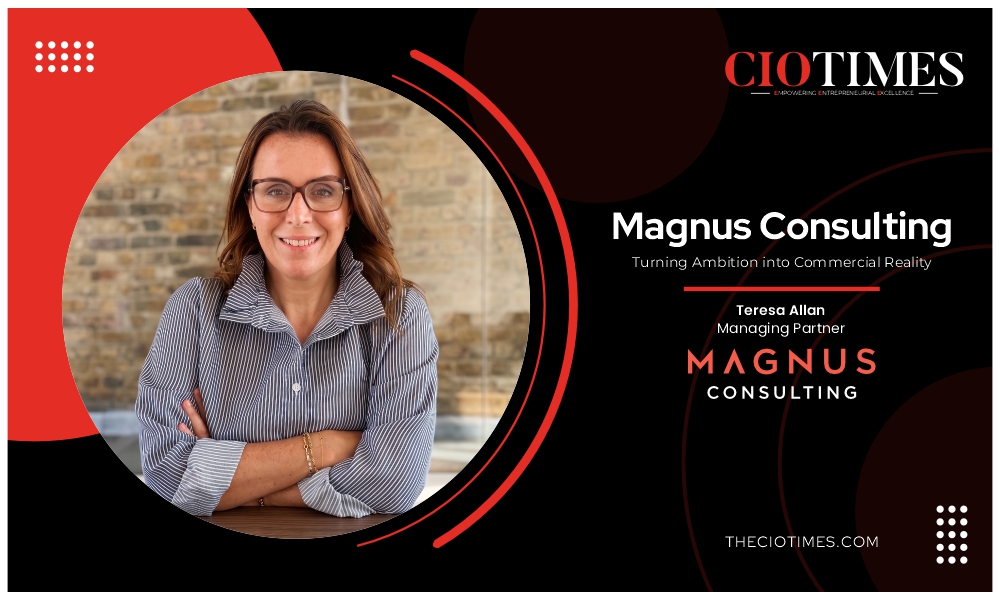
At the head of that approach is Teresa Allan, Magnus Consulting’s Managing Partner, whose years in board-level marketing, sitting at the point where a company’s ambitions meet a customer’s willingness to buy, taught her a lesson she returns to often: without alignment among the people, process and investment behind it, even a well-designed strategy stalls.
Teresa puts the underlying diagnosis directly: “A strategy should make choices that change how resources are used. If everyone agrees with it but then carries on exactly as before, it probably leaves too much unresolved.”
As artificial intelligence makes research and analysis faster and more accessible, she argues, clients are increasingly equipped to test a consultant’s assumptions themselves, and that shifts where the real value of consulting sits: the hard calls a firm helps a leader make, and the capability it leaves behind.
The profession, she believes, has to take on more responsibility for making sure change actually lands inside a client’s business rather than simply handing over recommendations and stepping back, backed by people who understand the commercial consequences and stay involved as the organization puts a plan into practice.
For Magnus Consulting , whose focus is B2B commercial growth, that means treating a CIO’s technology questions and a CEO’s growth questions as one conversation instead of two, connecting decisions about markets and customers to how commercial teams operate, and bringing technology into that work from the outset.
Teresa of the Magnus Consulting also draws a line many consultancies leave blurred: “We can own the quality of our advice and delivery, but leadership must retain responsibility for strategic choices. An effective partnership makes those responsibilities explicit and gives both sides evidence of progress.”
Building Strategy Together
Magnus Consulting treats strategy, commercial performance and behavioral change as parts of one system rather than three separate work streams, and Teresa is candid about what happens when they come apart. She breaks the model down simply: “Strategy gives people a shared direction. Commercial performance shows whether that direction is creating value. Behavioural change makes it part of how the business operates.” Skip that connection, she warns, and “strategy becomes a deck, commercial performance becomes a dashboard, and behavioural change becomes another side project that people never really buy into.”
For Magnus Consulting , integration starts earlier than most firms are comfortable with, at the point where the strategy itself gets built, together with the client’s own people. That means walking teams through the choices being made and the trade-offs behind them in the open, rather than presenting a finished plan for sign-off. The payoff goes beyond buy-in, Teresa says. Bringing people into the process tends to produce a sharper strategy in the first place, since it draws on the judgment of the employees closest to customers and delivery.
Ownership by itself will not sustain the change. People also need to feel a commercial upside quickly enough to want to keep working the new way, whether through stronger customer conversations, better conversion, more valuable accounts, or simply less time lost to competing priorities, and leadership has to back that shift with matching expectations, incentives and recognition, or the motivation for it quietly disappears.
Handled well, Teresa calls the outcome “a reinforcing cycle: shared strategy gives teams clarity, commercial progress builds confidence, and that confidence helps new behaviours take hold.” What teams learn along the way feeds back into the strategy itself, and that loop is what she means by lasting transformation: a team that understands the reasoning behind a plan well enough to keep applying it on its own. Magnus works alongside clients on live challenges specifically so that capability develops through the work itself, leaving the business something it can sustain and adapt as its priorities evolve.
Strategy also has to hold up over time. A clear direction still matters, but where to play and how to win cannot be answered once and then treated as fixed. Customer priorities shift, sectors move and competitors change, so assumptions that were sound when the strategy was approved can become less reliable.
“Our view of go-to-market as an operating system starts with that distinction,” Teresa says. In practice, that means combining regular operational reviews with deeper reviews of the assumptions underneath the strategy, so meaningful changes can influence decisions before performance forces the issue.
Where Growth Plans Break Down?
Teresa is precise about where she thinks the real fault line sits: “The biggest gap I see is between the growth leaders commit to and the commercial capability they fund and organise to deliver it.” A revised target can land in a business without a corresponding decision about customer focus, delivery capacity, or the work the organization will actually stop doing.
Magnus Consulting’s own research points to the scale of that gap. Teresa cites the firm’s most recent study: “Our GTM Confidence Index FY26 surveyed 108 senior B2B commercial leaders across North America, Europe and global markets.
Only 9% were highly confident of meeting their growth targets, although 54% described their organisations as aggressively pursuing growth.” She is careful to flag its scope: “That is a broader B2B sample, but it raises a very relevant question for UK leadership teams: what gives us confidence in our own plan?”
Where Magnus Consulting comes in, in Teresa’s telling, is testing those assumptions before a shortfall forces the conversation into the open: asking where the additional revenue will actually come from, whether existing conversion rates and resources can support it, and what capability still needs to be built.
Leadership then needs a response that is prioritized and funded, whether that means fresh investment, fewer markets, or a more realistic sequence. Teresa calls the aim simple: “to make ambition executable and give teams a plan they can believe in.”
Post-acquisition growth makes the pattern especially visible. Teresa has seen it firsthand: “A combined business may complete a systems migration while sellers continue using legacy propositions and customer definitions. The integration programme has progressed, but the revenue synergies still need a commercial plan, account ownership and people equipped to sell the combined value.”
A board may sign off on ambitious growth, but marketing keeps working to its campaign calendar, sales keeps chasing immediate opportunities, and customer teams stay focused on renewals, each function hitting its own targets while the business as a whole misses the result it actually needed.
The Missing Element: Behavioral Change
Even a well-designed transformation program can stall for a simple reason, according to Teresa: “Behavioural change is often missing because programmes describe a future state without considering what it will take for people to work differently under everyday pressure.”
Any team excited about a new direction can fall into that same trap, describing where the business wants to end up while skipping the part where someone explains what people are supposed to do differently on an ordinary Tuesday.
The friction is often structural rather than personal, Teresa points out: “If a salesperson is rewarded for individual bookings, asking them to invest time in a shared account plan creates a trade-off.” And a team that has already lived through a string of abandoned initiatives will understandably bring less enthusiasm to the next one.
Her prescription pairs clear expectations with changes to the working environment itself: stripping out unnecessary steps, giving people real support, and making the desired behavior genuinely useful in a live situation, reinforced by what managers ask about, recognize, and reward.
To describe what that kind of trust looks like in practice, Teresa reaches for an example outside the office: “I have written about my netball team as experience of high performance. We know our roles, trust each other and can recover from mistakes together.” Those same conditions, she believes, matter just as much at work: people need enough confidence in the people around them to name a problem before it turns into a failure.
Teresa measures whether any of this is actually landing by watching behavior, not attendance. She asks: “Are teams using shared account plans? Does customer feedback alter decisions? Are leaders following the same priorities they have asked others to follow?” Those observations, she adds, “tell us much more about adoption than attendance at a launch or training session.”
Turning Data and AI into Decisions
Teresa’s starting position on artificial intelligence is just as direct: “AI should change both how leaders assess opportunity and how commercial work gets done.” But speed alone is becoming less distinctive as more organisations gain access to similar tools and models. The bigger question is whether AI is improving the quality of commercial decisions and making the business more effective.
That depends heavily on context. AI can generate convincing account views, recommendations, propositions and campaign directions, but without the right customer knowledge, account history, market intelligence, sales evidence and institutional learning behind them, those outputs can still miss what matters. The advantage increasingly comes from connecting AI to what the organisation already knows and making that knowledge available at the point a decision is being made.
For CEOs and CIOs, that means starting with the work rather than the technology. Choose a workflow with a measurable constraint, understand the data, process and decisions behind it, and decide where AI should lead, where human judgement should remain and what controls need to sit around both. The operating model has to develop alongside the technology, otherwise AI simply accelerates an existing process without improving the outcome.
Rolling AI out everywhere at once tends to produce a lot of activity and very little a leadership team can actually point to. Progress should then be judged through adoption, quality and commercial outcomes, not time saved alone, and buyers need clarity on where their own data and workflows actually live once a tool is in place.
That approach is reflected in Magnus Consulting’s recent work with a $2.5bn+ global commerce and payments business, where we helped redesign how marketing could operate with AI embedded into the function. We mapped the processes, data and systems behind marketing delivery, identified 11 quick-win automation opportunities, and separately designed the intelligence and agent architecture needed to support a more scalable model. Agents were then built and deployed into live campaign environments, creating practical evidence of where AI could take on repeatable work, where human judgement still needed to lead and what was required to scale the approach across the organisation.
At enterprise level, the challenge is ensuring that data and organisational knowledge actually reach the decisions they are supposed to improve. As Teresa puts it: “The difference is whether the information changes a commercial decision. Extensive data can make an organisation very good at describing what happened while leaving it uncertain about what to do next.” Her fix starts with the decision itself, then works backwards to the evidence, market and competitor research, conversion, retention, feedback and cost-to-serve information that would actually inform it.
The further step is organizational memory: recording the reasoning behind a decision and the conditions in which it worked, then revisiting it on a set schedule so old lessons do not calcify into unquestioned assumptions. Done consistently, she says, that builds the business “a more useful asset than a growing collection of reports: knowledge it can apply.”
Proof, Recognition, and Purpose
Magnus Consulting points to its own delivery record as evidence the model works, though Teresa is careful about what the record actually shows: “In our published work with a global logistics provider, a 12-week account growth programme identified £451 million in new revenue opportunities.” She is quick to add the caveat that matters: “That was opportunity pipeline, with conversion still to be achieved.” It’s an important distinction: pipeline signals opportunity rather than revenue actually booked, and the two get confused more often than they should.
The number that matters more to her, longer term, is whether the work outlasts the engagement. Her test: “The longer-term test is whether the approach becomes repeatable. Can the team apply it to another account? Does it keep the intelligence current? Can a new colleague understand the decisions and continue the work?”
Measurement has to reflect both horizons at once, she argues: evidence of revenue, margin, retention and conversion, set against whether the organization is actually getting better at execution, weighed against the investment it took to get there.
The combination has been building since the firm’s founding, and recognition has followed. As Teresa tells it: “Magnus Consulting has been pursuing that ambition since we started in 2018. Recognition in the Financial Times’ UK leading management consultancy lists in 2025 and 2026 has been a meaningful milestone for the team.” How that growth gets built matters to her as much as whether it gets built at all: “We are a certified B Corp, and I believe businesses have a responsibility to consider the people and communities affected by their decisions.”
A Different Kind of Growth
Looking further out, Teresa expects the most effective UK consultancies over the next three to five years to combine deep commercial expertise with the ability to implement and learn, firms that understand a client’s market well enough to challenge its assumptions and then work credibly with the people responsible for delivery.
AI capability will be part of that bar, though not in the way many firms currently present it, she says: “Being able to demonstrate a functioning workflow will carry more weight than a broad claim about being AI-enabled.”
Change leadership and commercial transparency will matter just as much, alongside a firm’s willingness to keep developing its own people as the work itself changes. She closes that thought with where she wants Magnus Consulting to sit inside the shift: “For Magnus Consulting , the opportunity is to keep bringing strategy, behavioural understanding and AI expertise together around the specific growth problems we are equipped to solve.”
Teresa’s ambition for the wider industry extends beyond any single client engagement: “I would like UK businesses to give the design of growth the same sustained leadership attention they give financial control and operations.” That shift starts, she says, with understanding the customer, making clear choices about where to compete, and organizing the business to deliver on those choices.
For Magnus Consulting , that means bringing commercial strategy, implementation and AI together rather than treating them as separate transformation agendas. The starting point is making clear choices about where to compete and how to win; the harder work is embedding those choices into the behaviours, capabilities, processes and systems that allow the business to keep delivering against them.
Teresa’s measure of success is ultimately whether that capability remains once the engagement ends: leadership teams making better growth decisions, commercial teams able to act together, and organisations retaining what they learn. “That is how we can help build businesses with the confidence and capability to keep progressing.”
Also Read ;- CIO Times Magazine for More information