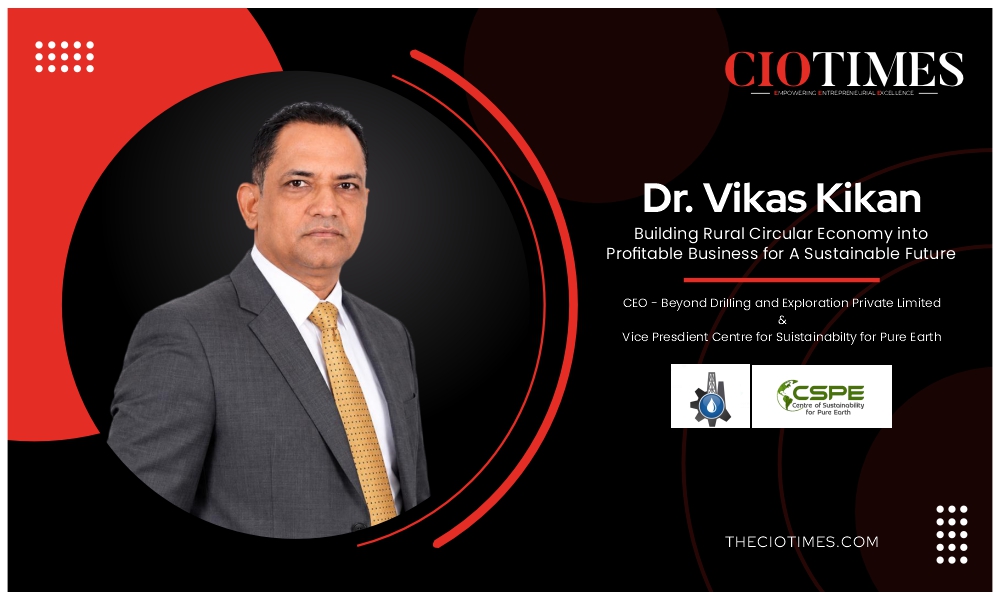
To thrive in a competitive business environment, many organizations focus only on the profitability aspect of business, ignoring environmental consequences. They think sustainability and profitability cannot go hand in hand. But pioneering leader Dr. Vikas Kikan, the Founder and CEO of Beyond Drilling and Exploration Private Limited, has built a successful business by solving environmental challenges. Widely recognized as “Pellet Man of India,” he has driven sustainability by transforming agricultural crop residue into clean, renewable biomass energy. He is contributing to solving northern India’s severe air pollution crisis by converting farm waste and crop stubble into valuable fuel instead of burning it in the fields and entire rural ecosystem is benefiting out of it.
Remaining competitive by building trust
Dr Vikas Kikan possesses diverse experience across multiple fields like maintenance engineering, after-sales service, sales leadership, international business, institutional markets, renewable energy, and nearly three decades of extensive experience with modern agricultural machinery and mechanization technologies. His long association with advanced agricultural equipment has given him a deep understanding of farm-level operations, machinery performance, evolving agricultural practices, and the practical needs of farmers and contractors. Together, these experiences broadened his understanding of competitive advantage. He learnt that advantage is rarely a result of one department or product. It emerges when technical capability, customer understanding, operational discipline, commercial judgment, agricultural know-how, and long-term strategy work together.
His formative experience in engineering and maintenance established the importance of operational performance. Understanding machines, processes, reliability, and the realities of operations taught him that a product creates value only when it performs consistently in actual working conditions. His subsequent experience in after-sales responsibilities reinforced his belief that the customer relationship does not end with the sale. Timely service, availability of spare parts, technical support, and responsiveness are equally important in trust-building. His three decades of engagement with modern agricultural machinery further strengthened this understanding, as agricultural equipment must perform reliably under demanding field conditions while delivering productivity, efficiency, and economic value to farmers. International business broadened this perspective further, exposing him to different markets, cultures, regulations, technologies, and decision-making styles. It emphasized the importance of adapting global standards and modern technologies to local conditions.
His experience in institutional business taught him the importance of governance, compliance, documentation, stakeholder management, and disciplined execution. Large and complex contracts, often extending over longer periods, demand more than competitive pricing or ambitious commitments. They require an organization to consistently deliver on what it promises.
Today, these experiences converge in the renewable-energy and biomass sector. Transforming crop residue into a dependable industrial fuel requires much more than manufacturing biomass pellets. It demands an integrated ecosystem covering agricultural-residue collection, modern agricultural machinery and mechanization, biomass processing technology, logistics, policy understanding, and farmer participation. His nearly three decades of experience with agricultural machinery provides a critical bridge between the farm and the energy industry, enabling him to understand the complete journey of crop residue—from its generation and mechanized collection in the field to its processing and eventual utilization as a sustainable industrial fuel.
Evolving through critical transformations
A veteran in the industry, Dr Vikas Kikan has spent three decades in the tractor and agricultural equipment field. He is familiar with cyclical and structural changes of the industry. Monsoon performance, crop prices, and interest rates drive several economic cycles. He shares an example of tractor and equipment sales. Typically, a favorable monsoon lays the groundwork for a strong harvest. This results in higher minimum support prices and thereby improves tractor and equipment sales; on the other hand, weak rainfall results in lower farm income and rising fuel costs, temporarily affecting farmers’ purchasing decisions.
Dr Vikas Kikan throws light on significant changes that have fundamentally altered the economics and competitive structure of the industry. The first is the gradual shift from viewing agricultural machinery as an asset of ownership to treating it as a service for productivity. Marginalized farmers may not always afford expensive equipment, but they increasingly access tractors, harvesters, and other implements through contractors, cooperatives, and rural entrepreneurs. This has altered the customer profile and created demand for machines with higher utilization, better reliability, and lower operating costs.
The second structural change is the growing importance of complete solutions rather than standalone machines. While making buying decisions, customers are focusing on various important aspects like productivity per acre, turnaround time, maintenance cost, financing, resale value, and service availability. This has changed the dynamics of competition. Along with horsepower and purchase power, manufacturer’s ability to deliver lifecycle value is also influencing competition.
Another major structural shift is the diversification of mechanization beyond conventional land preparation. Increasingly, farming machines are being used for other parts of farming like Crop-residue management, baling, biomass collection and other applications. With growing environmental awareness, new rules and regulations are being imposed. The need to reduce stubble burning is creating a new agricultural-equipment economy in which crop residue is treated as industrial raw material for biomass pellets, bioenergy, and other value-added products, not merely as waste.
As per Dr. Vikas’s viewpoint, monsoons, crop prices, interest rates, and rural liquidity will continue to create cycles. However, service-based mechanization, digitalization, specialized equipment, and customer sophistication, represent permanent changes. Reflecting on the future, he says, “The future advantage will belong to organizations that combine robust technology, affordable ownership or access models, dependable after-sales support, and a deep understanding of local farming conditions.”
Building sales strategy by identifying value and risk
Dr Vikas Kikan doesn’t remain dependent on a single person to make the final purchase decision. For his multiple businesses, he follows an interconnected ecosystem. From the dealer to the end user, everyone’s expectations and level of influence are valued. He identifies every stakeholder involved and understands key aspects like their role and authority, the value they expect, and the risk they perceive. For a farmer, aspects like productivity, fuel efficiency, and affordability will be focus points while making a purchase decision; a dealer may prioritize inventory movement, margins, and working capital; a financier will examine repayment capacity and asset risk and so on.
Depending on this roadmap, he ensures addressing the entire chain of value and risk. A technically superior product can seem valuable, but lack of funds and weak after-sales- support can diminish its demeanor. Similarly, customers’ uncertainty about reliability, regulatory compliance, or long-term service can backfire a competitively priced proposal.
This comprehensive approach also influences the way he measures sales performance. Along with volumes, he focuses on various areas like customer retention, product utilization, dealer profitability, payment cycles and the strength of stakeholder relationships. Together, they indicate whether the business is creating genuine value or merely achieving temporary dispatch numbers.
“The strongest sales strategy identifies where value is created, where risk is concentrated, who can influence progress, and what may prevent implementation.”
Managing these factors carefully leads to predictable and sustainable sales. The main objective extends beyond closing transactions. It is about building a profitable ecosystem in which every stakeholder has a meaningful role to play in driving long-term growth.
Strengthening business health by prioritizing quality
Dr Vikas Kikan believes in tangible results. He believes numbers bring discipline and accountability to business decisions. At the same time, he recognizes that a sole focus on numbers can be insufficient. Revenue, market share, and growth rates are essential indicators; however, they do not always reveal the complete health of an organization.
Revenue, for instance, can grow rapidly even when payment cycles are deteriorating, margins are weakening, or customer concentration is becoming a risk. Market share may increase because of aggressive pricing, extended credit, or commercially unsustainable commitments. Similarly, reducing expenditure on maintenance, employee development, product improvement, quality control, or customer service can improve short-term profitability while quietly weakening the business for the future.
Customer behavior is another important indicator. Repeat orders, contract renewals, complaint frequency, service response time, product utilization, and customer referrals can offer a clearer picture of the business than monthly sales figures alone. For Dr Vikas Kikan, customer trust is particularly significant. As he puts it, “When customers continue to engage with the organization even during difficult periods, it reflects trust—and trust is one of the most valuable assets on a balance sheet, even though it is not formally recorded there.”
To acquire a comprehensive understanding of business health, Dr Vikas Kikan monitors operational indicators such as rejection rates, quality variations, and equipment downtime. He is aware that ignoring small negative movements in these areas can lead to serious financial problems.
A synergy between corporate strategy and local execution
Dr Vikas Kikan has managed large territories and extensive dealer and sales networks. Such practical experience offered him a distinctive understanding of the functioning of the corporate field and markets. He learnt that creating a strategy at the corporate level and executing it in decentralized, relationship-driven markets are two very different challenges. A corporate strategy can shape the direction, priorities, products, pricing and financial targets. However, the possibility of success depends on effective implementation and interpretation of strategy at the local level.
At the corporate level, data, trends, forecasts, and aggregated performance indicators shape the understanding of markets. However, every territory functions considering its own economic conditions, cropping patterns, customer preferences, language, culture, and established relationships. A strategy that seems practical in a boardroom discussion may not always work due to external factors.
He also learnt that a balance between strategic consistency and local flexibility is needed for effective execution. Organizations should possess clarity about preserving crucial factors like brand values, product quality, commercial discipline, ethical conduct, and customer-service standards. At the same time, regional teams and dealers must adapt customer engagement, demonstrations, promotional activities, and market-development initiatives according to local realities. If a company is chasing volume by continuously loading inventory onto dealers without ignoring retail demand, working-capital pressures, or service capacity, growth will not be sustainable. Therefore, Dr Vikas Kikan considers dealer profitability and inventory quality as important as wholesale billing.
For him, communication is another critical factor. People must understand why a particular direction has been chosen, how it benefits customers and channel partners, and what their individual role is in achieving it. Conducting regular field visits, dealer discussions, customer meetings, and performance reviews helps to transform a corporate goal into locally meaningful action.
Dr Vikas Kikan shares contrasting learnings about relationships and performance. He believes that relationships cannot replace performance, but performance without relationships may not create lasting loyalty. In decentralized markets, consistent behavior shapes trust-building. Honouring commitments, resolving complaints quickly, providing spare parts, supporting dealers during difficult periods, and remaining accessible after the sale creates a pathway for building reliable relationships.
His other important lesson is that field intelligence must travel upward as effectively as strategy travels downward. Frontline employees and dealers are familiar with market circumstances. They often identify changes in customer behaviour, competitor activity, financing availability, and product requirements before these trends become visible in corporate reports. Leadership must create strong systems that use this knowledge to achieve business results.
For him, a synergy between corporate strategy and local execution is crucial. As he puts it, “Ultimately, corporate strategy provides the compass, but local execution determines the journey. Success comes when a clear central vision is supported by empowered regional leadership, commercially healthy dealers, responsive service systems, and continuous feedback from the market.”
Leading with strategic vision and commercial discipline
Dr. Vikas Kikan’s move into biomass and renewable energy strengthened the significance of evaluating an emerging opportunity through both planned vision and commercial discipline. The viability of a business is not dependent only on the compelling long-term potential of a sector. Considering the development capability of its surrounding ecosystem is also important to turn that opportunity into a scalable and bankable model.
He begins by examining the underlying problem the opportunity is expected to solve. In the biomass industry, the problem is multidimensional. As the environmental concerns of the nation is growing, Dr Vikas Kikan suggests India must reduce stubble burning, provide farmers with an economic alternative for crop residue, reduce dependence on fossil fuels, and support thermal power plants in meeting biomass co-firing obligations. He believes a capability to resolve enduring national priorities simultaneously makes an opportunity relevant for a longer period of time. However, he is aware of the fact that policy support and environmental benefits cannot substitute for commercial viability. Therefore, he evaluates the complete value chain- from raw-material availability to processing technology, storage, logistics, product quality, and customer acceptance. A biomass-pellet plant may seem attractive on paper, but its profitability can be affected by a short harvesting window, moisture variation, or delayed payments from institutional customers.
For Dr Vikas Kikan, distinguishing between market demand and executable demand is important as it is more viable. Market potential can be understood with aspects like announced targets, policy mandates, and tendered quantities, but executable demand depends on regular plant consumption, realistic technical specifications, dependable purchase orders, timely payments. Before promising substantial capital, he evaluates the customer’s readiness to use the product consistently.
A careful evaluation of policy risk is important for Dr Vikas Kikan. He recognizes the significance of Government direction in renewable energy, but does not believe in depending entirely on one subsidy, regulation, or temporary incentive. From his perspective, a strong opportunity should have a fundamental economic and environmental logic that remains relevant even if policies, specifications, or incentive structures change.
He believes in entering with conviction but scaling in stages for emerging sectors. Before making larger commitments, small-scale initiatives like pilot projects, controlled investments, continuous data collection, and close customer engagement help validate assumptions.
Pilot projects, controlled investments, continuous data collection, and close customer engagement help validate assumptions before larger commitments are made. He also emphasizes partnerships and aligning with farmers, aggregators, equipment manufacturers, and financiers.
Finally, he evaluates an organization’s capability to win by focusing on factors like technical understanding, execution capability, access to raw materials, and the patience to develop the market.
Dr Vikas Kikan elaborates on his unique approach, saying, “It is to identify the irreversible long-term trend, understand the risks honestly, build the missing links in the value chain, and scale only when operational evidence supports the vision. Emerging opportunities reward foresight, but sustainable leadership comes from combining that foresight with disciplined execution.”
Scaling business by offering real value
Majorly, an alternative fuel is viewed as an environmentally attractive substitute. To make it a scalable industrial model, Dr Vikas Kikan believes, it should be a dependable part of the customer’s operations. This requires delivering the required quantity, quality, price, and service over an extended period. Dr Vikas Kikan elaborates on variables that can move an alternative-fuel business from an attractive proposition to a genuinely scalable industrial model.
Trusted access to raw material is the critical variable. Agricultural residue is seasonal, geographically dispersed, and affected by weather. Therefore, establishing long-term relationships with farmers, aggregators, and transporters can support a scalable business.
Product consistency is the second variable. As industrial customers expect every consignment to have the same quality and performance. Therefore, parameters such as calorific value, moisture, ash, volatile matter, durability, and the presence of extraneous material must remain within the agreed specifications.
Logistics also impacts the scalability of business. As biomass is a high-volume but comparatively low-value product, factors like Collection radius, transport distance, loading efficiency, vehicle availability and turnaround time can significantly affect delivered cost. Improving material density and strategically locating processing facilities are essential to building a viable model. Sustainable unit economics is the fourth variable. Revenue must be assessed against the complete delivered cost, including raw material, collection, conversion, and primary and secondary transportation.
Customer confidence is another decisive factor. Through trials, transparent test results, consistent supply, technical support, and rapid resolution of operational issues, trust can be strengthened. Policy stability and practical standards also impact scalability. Industry and government must function cohesively to establish attainable quality norms, transparent acceptance systems, dependable procurement frameworks, and timely payment mechanisms.
Finally, sharing his viewpoint, Dr Vikas Kikan says, “In my view, alternative fuels scale when environmental purpose is supported by industrial discipline. Biomass must be treated not as a supplementary waste product, but as a professionally managed fuel category.”
Establishing balance between sustainability and profitability
Dr Vikas Kikan doesn’t consider sustainability and profitability as contrasting objectives. Sound economics, disciplined execution, and measurable outcomes are essential to build durable sustainability. The biomass sector clearly demonstrates this integration. Collecting agricultural residue and then processing and converting it into fuel for thermal power plants reduces stubble burning and creates additional income and employment in rural areas. It also creates a commercially profitable value chain involving farmers, aggregators, machinery manufacturers, and transporters. However, good intentions alone are insufficient. A sustainable business must priotize commercial aspects such as maintaining strict control over costs, quality, working capital, logistics, and customer service.
Treating every sustainability initiative as automatically beneficial can result in unprofitable outcomes. Therefore, leaders should be examined for its environmental impact, commercial feasibility, scalability, and ability to survive changes in policy or incentives. Sharing thoughts on responsible leadership, Dr Vikas Kikan says, “In my view, responsible leadership is not about choosing between profit and purpose. It is about ensuring that today’s profitability does not create tomorrow’s liabilities and that long-term sustainability is converted into an economically workable model.”
Adapting Universal Principles with Local Realities
Dr Vikas Kikan has global business exposure as he has worked with customers and business stakeholders across India, SAARC, and Africa. The widespread experience of international markets has taught him that certain business principles remain universal; their application must reflect local realities. Certain business principles remain transferable across markets. Customers everywhere expect products and services that address real problems and deliver value. They also expect businesses to honour their commitments, act transparently and remain accountable beyond the initial transaction. Financial discipline, product quality, ethical conduct, responsiveness and reliable after-sales support are equally important across geographies.
His practical experience has taught him to separate the core value proposition from the market-delivery model. The underlying value whether improving productivity, reducing operating costs or providing reliable energy can remain consistent across markets. However, the product configuration, pricing, financing, distribution, service network, communication style, and partnership structure must be tailored to local conditions.
Dr Vikas Kikan, before entering and expanding in any market, focuses on understanding its institutional framework, regulatory environment, purchasing process, customer economics, cultural expectations, infrastructure, and availability of local capabilities. He recognizes the significance of customer value, saying, “International experience has made me more cautious about applying ready-made formulas. It has also made me more confident in the universal power of credibility, customer value, and disciplined execution.”
Balancing empowerment with accountability
Dr Vikas Kikan views empowerment and accountability as mutually reinforcing principles when supported by clear systems. A leader’s role is to enable capable teams to make decisions independently while remaining aligned with the organization’s strategy, values and commercial objectives.
The second mechanism is measurable accountability. Each role should be measured against clearly defined indicators that go beyond revenue and volume. Metrics should demonstrate the broad picture of business health including profitability, cash collection, product and service quality, customer satisfaction, inventory efficiency, and timely execution. This balanced approach ensures that performance is measured not simply by how much is delivered, but by how sustainably, efficiently, and responsibly it is achieved.
Another important mechanism is access to reliable information. Visibility of costs, margins, receivables, customer commitments and operational risks relevant to their responsibilities is essential to build complete empowerment.
Leading with presumption and practicality
Dr. Vikas Kikan experience, has given him two complementary perspectives on organizations. Management theory provides structured frameworks for strategy analysis, leadership, markets, consumer behaviour, finance, and organizational design. However, field experience offers him practical acknowledgement, revealing how these frameworks behave when confronted with incomplete information, conflicting interests, limited resources, time pressure, and human emotions.
The gap between theory and practice is the greatest divergence. Strategic models may reveal that an organization can evaluate all available alternatives and select the most viable one. However, in practice, decision-making happens with incomplete data, with changing regulations and negotiating with customers.
Implementation is another point of divergence. An analytically correct strategy can fail if it faces a team’s lack of understanding, misaligned incentives and ignored local conditions. For Dr Vikas Kikan, practical experience is essential but not without academic discipline. His doctoral management research reinforced his appreciation for evidence, systematic inquiry, and the need to test assumptions. It has enabled him to examine what has happened, but why it happened and whether the same result would remain valid under different conditions.
This tension has formed his leadership approach. He uses management frameworks to organize thinking, discover variables, and challenge assumptions. And then validates those conclusions through field realities customer conversations, operating data, and employee feedback. Throwing light on his leadership philosophy, he says, “My leadership philosophy is therefore based on disciplined analysis, continuous learning, practical judgment, and humility the willingness to revise a decision when new evidence or field realities prove that an original assumption was incomplete.”
Evolving through complex experiences
For Dr. Vikas Kikan, mere accomplishments have not shaped his learning, but decisions made in the worst circumstances, such as uncertain outcomes and limited resources, have taught him key lessons. One of the most difficult decisions was to leave a stable corporate career after approximately 26 years in the tractor and agricultural-equipment industry when we was at his peak. During that journey, he explored multiple business areas. He moved from maintenance engineering and after-sales service into sales leadership, institutional business, and international markets across India, SAARC, Africa, and other regions. That experience offered him professional stability and strengthened his understanding of rural markets. Moving into biomass and renewable energy meant leaving a successful path for a sector which is in its nascent stage. Dr. Vikas Kikan thinks the biomass opportunity was compelling, but building a commercially sustainable business required far more than setting up a pellet plant. It required building a complete farm-to-fuel ecosystem.
His experiences in adverse times, such as when their commitments outpaced the surrounding ecosystem, they faced fluctuations in raw-material quality, and high moisture during the rainy season, reshaped his understanding of risk. He acknowledged that mere projected revenue or the size of an order book is not sufficient for risk evaluation. Financial aspects like cash conversion, contractual balance, customer concentration, feedstock security, and storage capacity should be considered for assessing risks.
His further recognitions include:
- Times of India Founders Forum 2026 with the recognition for “Excellence in Sustainability & Rural Circular Economy.”
- FOUNDER POWERING INDIA’S BIOMASS ENERGY REVOLUTION IN 2026- Fronter Blaze
- NATION BUILDER 2026 – OUTLOOK BUSINESS SEPT 2026
- NATIONAL LEADER IN BUSINESS AWARD 2026 FOR OUTSTANDING CONTIBUTION FOR NATION BUILDING THROUGH ENVIRONMENT AND SUSTAINABILTY AUG 2026.
- THE MOST ICONIC RENEWABLE ENERGY LEADER DRIVING INDIA’S GREEN FUTURE IN 2026, Prime Today Aug 2026.
- THE PELLET MAN OF INDIA DR VIKAS KIKAN’S MISSION TO POWER A SUSTAINABLE FUTURE, CEO INDIA MAGAZINE AUG 2026.
- The Indian Icon Award 2026 as an Environment and Sustainability Leader, July 2026.
- POWERING INDIA’S BIOMASS REVOLUTION AND THE CIRCULAR ECONOMY, The Journal & Stories India July 2026.
- BUSINESS LEADER OF THE YEAR 2026 ENABLING A SUSTAINABLE BIOMASS ECOSYSTEM, Outreach June 2026.
His multifaceted experiences has taught him that entrepreneurship is not the absence of uncertainty. “It is the ability to continue building through uncertainty with purpose, evidence, resilience, and responsibility.”
Transforming businesses with distinguished leaders
Industrial businesses are adopting technological advancements such as artificial intelligence and automation. These developments are reshaping customer expectations while businesses simultaneously navigate geopolitical uncertainty, changing regulations, resource constraints and growing sustainability requirements. In such circumstances, Dr Vikas Kikan believes that leaders who merely respond to these forces will manage each one as a separate challenge. Those who truly reshape their businesses will recognize their interconnectedness and redesign their organizations, technologies, supply chains and business models accordingly.
The first distinguishing capability will be strategic foresight. Leaders must look beyond current demand and consider how technology, regulation, resource availability, climate priorities and customer economics could reshape their industries over the next five to ten years.
The second is the ability to translate technology into measurable business value. AI can support predictive maintenance, production optimization, demand forecasting, supply-chain planning and faster customer response. But technology creates lasting advantage only when it is embedded in operating processes and adopted by people who understand how to use it effectively.
This philosophy is also reflected in Dr Vikas Kikan’s efforts to strengthen the wider biomass ecosystem. Recognizing that the growth of biomass densification requires not only demand but also access to reliable, high-performing and affordable machinery, he established TRIO Renewable Engineering as a farm-to-fuel machinery manufacturing company. TRIO provides an integrated range of solutions including square balers, round balers, bale shredders, biomass pulverizing machines and ring-die pellet machines. The objective is to make proven and high-performing technology more affordable and accessible to farmers, contractors, entrepreneurs and biomass producers, thereby helping more stakeholders understand, enter and successfully operate in the biomass densification business.
His contribution to the sector also extends beyond his own businesses. As Vice President of the Centre for Sustainability for Pure Earth (CSPE), a biomass industry association, Dr Vikas Kikan works with stakeholders across the biomass value chain to highlight industry challenges, develop practical solutions and represent issues affecting the growth of the sector. Through industry engagement, policy advocacy and knowledge sharing, the association seeks to address operational, commercial, regulatory and logistical challenges while supporting the development of a stronger and more sustainable biomass ecosystem.
This principle is particularly relevant to Dr Vikas’s emerging work in biochar. He and his team are developing machines and reactors designed to convert crop residues into biochar, an increasingly relevant material in efforts to improve soil health and the long-term productivity of agricultural land. Apart from agricultural advantages, properly produced and independently verified biochar may also create an additional revenue stream through carbon credits. That opportunity, however, depends on credibility and verifiability. The entire system therefore needs to be automated, traceable and data-driven.
Dr. Vikas Kikan believes future-ready companies will build cross-functional teams, shorten decision cycles, empower capable people and create cultures in which established assumptions can be questioned. His own approach—from developing the biomass pellet business and creating a farm-to-fuel machinery ecosystem through TRIO to working collectively with the industry through CSPE—reflects his belief that sustainable transformation is achieved when technology, entrepreneurship, industry collaboration and environmental responsibility move together.
Sharing his thoughts on winning leaders, he says, “The winners will combine technological understanding, commercial discipline, operational execution, environmental responsibility, and the courage to invest before the opportunity becomes obvious to everyone.”
Also Read :- CIO Times Magazine For More Information