In technology circles, “legacy” rarely functions as a compliment. It gets used to describe systems that are old, resistant to change, and presumably counting down to replacement—tools kept alive only because no one has found the budget or the nerve to rip them out. There is another way to read the word, though. It could be interpreted as inheritance, and as decades of hard-won business logic too valuable to discard just because something newer exists.
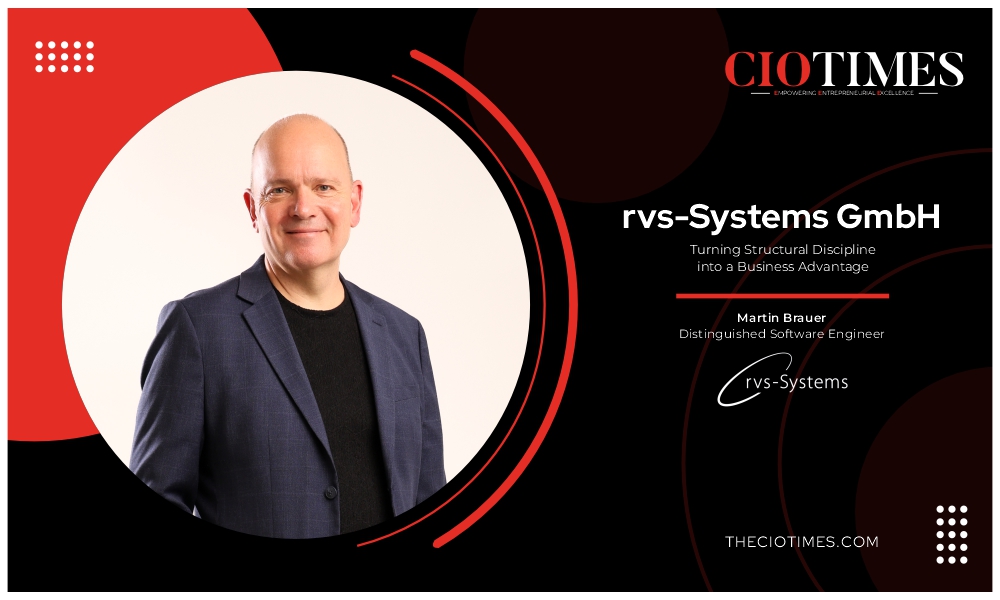
That second reading defines the work of Martin Brauer, Distinguished Software Engineer at rvs-Systems GmbH. Martin’s career has unfolded almost entirely inside the systems the rest of the industry learned to call obsolete. His central objective is to bridge the mainframe and the open world—perfectly illustrated by the company’s flagship product, the Rapid zKafka Connector (RzK), which architects a native and direct path from the mainframe to Kafka without any additional software dependencies.
The Case for the Mainframe
For Martin and rvs-Systems GmbH the mainframe is not a relic being managed toward retirement. It is the platform still running some of the world’s most consequential transactions, and the one best positioned for what comes next. When asked why a company should not simply migrate everything to a distributed cloud environment, Martin’s answer bypasses marketing trends and focuses strictly on architecture. The mainframe remains unmatched in its exceptional I/O capabilities. In enterprise environments like banking, insurance, and the public sector, systems are subjected to immense bursts of high-volume, concurrent transactions.
Distributed architectures often choke on the I/O bottleneck when forced to handle this kind of load. The IBM Z architecture, however, is explicitly designed for extreme transactional performance and low-latency throughput. There is a concrete, architectural reason why all major global banks continue to drive their core business through mainframes.
This is what rvs-Systems means by “legacy”: the business processes a client has built over decades are a legacy of immense value, and those processes are what differentiate that client from its competitors.
Instead of shutting down a business-process ecosystem built over the last decades, rvs-Systems argues it should be extended with modern environments. Paired with IBM’s stated 99.99999% availability, system stability, and quantum-safe cryptographic foundations, the mainframe is the ideal heavy-lifting engine. Technologies like Kafka, which shares the mainframe’s defining attributes of stability and scalability, serve as a natural counterpart for real-time data streaming.
The Price of Replacement
Many organizations are spending heavily in attempts to move core business applications off the mainframe, and there has long been enthusiasm for replacing mainframe systems with newly built private-cloud or distributed environments. However, the available evidence suggests these migrations are more complex than promotional claims imply. Cost comparisons frequently understate the true total cost of ownership by omitting the massive effort required for application refactoring, data migration, systems integration, testing, security redesign, operational staffing, and performance engineering. Reproducing mainframe levels of reliability in a distributed environment is incredibly expensive.
In addition, organizations increasingly need tools that work without adding a heavy administrative burden, especially as cost pressures push teams to do more with fewer specialists. Standard middleware solutions often introduce a maze of twists, turns, and heavy architectural complexity.
rvs-Systems GmbH traces a lot of failed technology adoption to a single gap: a clear read on where real needs and genuine benefit actually sit. Too often, business application architects are asked to make platform decisions without the end-to-end expertise spanning from open-world systems all the way up to the mainframe. Without that range, rvs-Systems argues, the industry is left struggling to separate buzzwords from proven technology.
Trust as the Product
rvs-Systems GmbH’ answer to that gap rests on principles that stay constant, regardless of how quickly the technology changes. The first is a customer-first approach rooted in total integrity: the company will always recommend what is best for the client, even if it means losing a sale.
The second is a commitment to delivering absolute operational simplicity through highly sophisticated engineering. The Rapid zKafka Connector (RzK) stands as the prime proof of this mindset. While the technology required to achieve seamless, native z/OS integration is immensely complex, the result for the user is a clean and straightforward product. RzK gives any mainframe application direct, bi-directional access to Kafka data, and is designed to integrate as smoothly as possible into any program, written in any language. It integrates natively into z/OS subsystems like CICS, IMS, or DB2, and can even be utilized directly from JCL without requiring a single program change. By keeping this complexity hidden from the user, rvs-Systems eliminates lengthy development cycles, allowing teams to deploy modern streaming workloads immediately.
Guarding the Legacy Code
Simplicity, however, must never come at the expense of security—and nowhere is that tension sharper than with AI. The growth of AI has added further pressure to modernize, but connecting AI systems to proprietary code or operational pipelines creates severe risks involving data leakage, compliance, and intellectual property. These risks warrant case-specific assessment rather than broad assumptions about cloud migration. As Martin asks directly: “How much of your intellectual property do you want to share with AI?”
Cybersecurity and responsible AI use shape how rvs-Systems works every day, and the company describes clear guardrails around where AI is allowed to touch its business. AI currently supports documentation, the development of internal tools, communication, and analysis, acting as a sparring partner for conceptual work that helps the team challenge its own thinking.
Agentic AI, however, is not permitted inside rvs-Systems’ infrastructure. The company is candid about why: it cannot yet fully understand where autonomous agents might reach, what they could access, or how they could go wrong. In the company’s view, protecting the sensitive, decades-old source code entrusted to them by clients takes absolute priority over adopting every new trend.
The Discipline of the Trenches
None of this is theory for Martin. He traces his leadership philosophy to a specific kind of pressure: “My leadership philosophy was forged in the trenches of legacy system maintenance,” he recalls. Early in his career, he was tasked with maintaining massive, monolithic Assembler programs, some spanning tens of thousands of lines of code, in an environment where maintenance felt nearly impossible. Undocumented side effects from old programming errors had quietly become features the system relied on, meaning a few lines of corrective code could unpredictably alter the behavior of the entire system, and these deep-seated vulnerabilities often surfaced only during the highest-stress periods, such as year-end processing or critical tax runs.
Those high-stakes years reshaped how he approaches software architecture. Out of necessity, he began developing isolated, plug-in modules that could be integrated without risking new side effects, and, more importantly, he brought High-Level Language principles into the rigorous, system-near world of Assembler, years before IBM itself named its new assembler High-Level Assembler (HLASM).
The insight came early. “Heavily influenced by my early IT education and the philosophies of Niklaus Wirth—the creator of Pascal, Modula, and Oberon—I realized that the lowest-level code still requires the highest level of structural discipline.”
Today, that discipline defines how he leads: “I teach my teams that complexity is the enemy of stability.” His teams architect solutions by keeping routines small and comprehensible, adhering strictly to the principle of never repeating code. For Martin, “true technical leadership is not just about adopting the newest trend; it is about instilling a culture of architectural purity and systemic resilience, ensuring that the software we build today will not become a maintenance nightmare for the engineers of tomorrow.”
Martin is candid that this approach is not an easy sell industry-wide. The move from a “code-and-fix” mentality to true “architectured coding” demands more upfront time to design, code, and test, but in his account, a layered architecture allows individual, small routines to be rigorously tested, leading to virtually zero errors post-release.
Monolithic code, by contrast, is nearly impossible to test across all its branches, which shifts the cost of catching errors onto the customer’s live environment, and many management teams, he notes, focus solely on short-term time and cost efficiency. “I am incredibly fortunate that rvs-Systems GmbH champions the architectural approach,” he reflects. “This shared philosophy ensures our software—despite being highly complex and deeply system-near—remains highly maintainable and structurally sound.”
Passing the Torch
Inside the company, this same instinct for support and open sharing shapes the team. Working in Assembler requires absolute structural discipline, but a strict technical environment still requires human leadership. When asked about the culture that drives this level of engineering, Martin offers a grounded perspective. “I agree with the saying that ‘a team is not a family’, but it certainly involves many of the same social interactions and functions. The role of a good leader—much like that of parents—is not only to criticize or demand but to encourage talent and provide the necessary creative freedom. Only in this way can motivation remain high and results be exceptional.”
That environment, he says, is why his legacy extends far beyond the codebase itself. Throughout his career, he has spent significant time teaching new technologies, algorithms, and architectural design patterns, and he is realistic that developers respond differently to those rigorous standards. Some prefer the “quick and dirty” path to simply get the job done, but there are always those who lean in, ask deeper questions, and show a genuine hunger for doing things right. Identifying and mentoring those individuals, who already carry the foundational mindset for true architectural rigor, has become his mission.
When Martin considers how future colleagues and industry peers might reflect on his career, he hopes they remember more than the systems he helped build. His wish is a simple one: “I want the developers I’ve mentored to remember me as a kind-hearted teacher who helped shape their technical capabilities and professional integrity.” He credits his own start in the field with the same gratitude, saying, “I look back at my own IT teacher—who laid the groundwork for my entire career—with profound gratitude.”
As he sums it up, “If my colleagues and friends remember me in that same light, knowing I successfully passed the torch of disciplined software development to the next generation, that will be my greatest contribution.”
It is the same instinct that runs through rvs-Systems GmbH as a whole: treating what came before as an inheritance worth protecting, not a burden waiting to be replaced, and integrating it seamlessly into new technologies.
Also Read :- CIO Times Magazine For More information