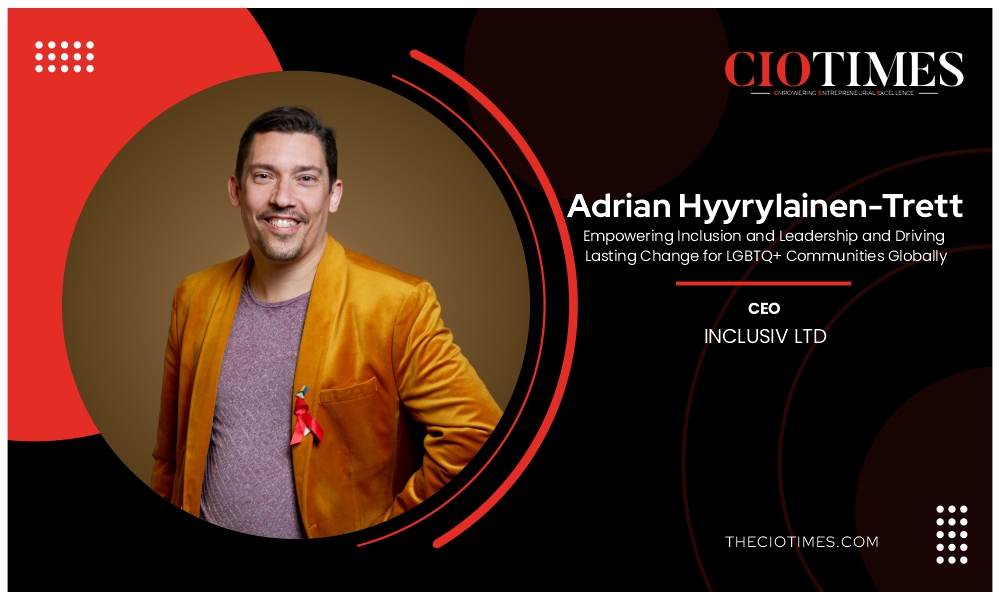
We often witness foresighted leaders in the Diversity, Equity, and Inclusion sector who go beyond policies and pledges. They shape cultures where people genuinely feel seen, heard, and valued. They understand that inclusion is not a side initiative but a business imperative that fuels innovation, trust, and sustainable growth. With empathy as their compass, these leaders challenge outdated norms, listen with intent, and act with courage. Such a leader is Adrian Hyyrylainen-Trett, CEO at Inclusiv Ltd. He creates spaces where different perspectives thrive, talent flourishes, and opportunity is fair. By aligning purpose with performance, visionary DE&I leaders like him build organisations that are not only more representative but also more resilient, relevant, and ready for the future.
His journey across political activism, global DEI leadership, advisory roles, and transformative consultancy work has been shaped by a deeply rooted commitment to equality, fairness, and universal human rights. His evolution into one of the UK’s most influential advocates for Inclusion, Diversity & Belonging began with a defining realisation: equality must apply to everyone without exception.
That conviction took shape when he recognised that civil partnerships did not carry the same legal standing as marriage. For him, this was not a technical oversight but a fundamental injustice denying LGBTQ+ couples equal recognition under the law. Challenging this disparity became his first purposeful campaign and marked the beginning of his activism and inclusive leadership.
Over the past two decades, he has consistently fought for the rights of marginalised communities, including LGBTQ+ refugees and asylum seekers, as well as trans, non-binary, and intersex people. At the heart of his work lies a simple principle: every human being deserves equal treatment, dignity, and protection under the law.
He adds, “Every human person deserves to be treated equally by the law, and ensuring this principle is key to my global DEI leadership and advocacy.”
These defining experiences form the foundation of Adrian’s global DEI leadership and advocacy today. Grounded in lived activism, his work focuses on translating human rights into lasting, systemic change, ensuring inclusion is not symbolic, but legally and socially realised.
We are more than elated to honor Mr. Adrian Hyyrylainen-Trett at our Global Excellence & Leadership Awards, Dubai, as we celebrate visionaries and disruptive minds like him who are making the world a better place to exist in.
Evidence Matters
In his work supporting more than 400 UK and global organisations on their inclusion journeys, Adrian repeatedly sees the same gaps emerge within corporate DEI strategies. The most significant challenge is the absence of empirical evidence and data to underpin the sustainable and meaningful progress organisations aim to achieve.
He stresses the importance of measurable data, supported by a focused programme of communication and internal branding. A key part of his work involves ensuring C-suite leaders understand what meaningful progress requires, particularly in smaller organisations where DEI is often deprioritised due to limited expertise, resources, or competing business demands.
Global Inclusion Intelligence
Adrian’s vision behind the Global Knowledge Bank at ENEI, now Onvero, was shaped by a clear recognition that organisations lacked accessible, comparable information on constitutional protections, cultural practices, and workplace norms across countries. He identified how this gap created challenges for employees relocating internationally and for DEI teams developing global strategies across multi-office organisations.
The initiative was designed to enable easy, accurate comparisons while remaining continuously updated in near real time, as new laws and legislative amendments emerged. By drawing on discrimination and legal intelligence resources such as lexicology, the platform ensured global leaders had reliable, current insights to support informed, inclusive decision-making worldwide.
Policy with Purpose
At the heart of Adrian’s work, drafting trans and non-binary policies for major global corporations, lies a commitment to upholding the law as it was written and intended under the Equality Act 2010. He believes organisations must ensure that trans and non-binary employees are genuinely listened to, feel safe within their working environments, and are truly valued rather than simply acknowledged.
He adds, “The policies can’t just be written, left on the intranet and expected to be followed.”
For those less familiar with the realities of trans and non-binary lives, education becomes essential, creating space for understanding and appreciation through structured learning. Adrian emphasises that policies cannot simply exist on an intranet; they require real organisational engagement, visible senior leadership support, and active participation through training, workshops, and open conversations where lived experiences can be shared, sometimes with external voices when internal readiness and confidence are still evolving.
Resilient Purpose
Operating at the intersection of global DEI, human rights, and deeply sensitive issues has often tested Adrian’s emotional strength and sense of purpose. There are moments when the work feels heavy, particularly in the current climate, where even Western nations such as the UK and the US are increasingly influenced by right-wing ideologies that seek to roll back the rights of trans and non-binary people, restrict inclusion in areas like sport, and weaken international human rights principles. These challenges exist alongside harsher realities in countries where homosexuality remains criminalised and cultural or religious resistance to equality is deeply embedded.
Balancing these extremes has become part of Adrian’s personal mantra. After nearly twenty uninterrupted years of campaigning, his ethos and principles remain unchanged. Yet he is open about the emotional toll this work takes. There are times when stepping back is necessary, not as a retreat, but as an act of self-preservation to protect his mental health and continue the work with integrity and resilience.
Trusted Data
In his work as a consultant specialising in GDDR, Adrian approaches the challenge of responsible diversity data collection with a strong focus on trust, ethics, and lived experience. A central priority is ensuring surveys are designed to protect anonymity, with data stored securely and access limited to a minimal number of trusted HR colleagues.
He shares, “Even where confidential conversations have occurred to engage people with the survey and work, those answers must be kept separate from the one-to-one conversations.”
These individuals are responsible only for sharing aggregated insights, with no visibility of individual responses. Even where confidential conversations are used to encourage participation, he ensures those discussions remain entirely separate from survey data.
Equally important is safeguarding individuals who could be identifiable, particularly those from intersectional and underrepresented groups. Their data is deliberately absorbed into broader pools to protect privacy and ethical integrity. Adrian recognises that trust is essential if people are to feel safe self-identifying characteristics such as ethnicity, disability, sexuality, or gender identity. Only with this confidence can organisations build robust data foundations and develop DEI strategies that genuinely reflect and respond to their full diversity.
Courage Under Fire
Adrian’s public-facing leadership in politics, including becoming the UK’s first openly HIV-positive parliamentary candidate, has profoundly shaped his courage, resilience, and commitment to driving equality at scale. These experiences revealed how difficult openness and honesty can be in political life, particularly in the face of hostility from sections of the media, especially right-wing outlets that often fuel cruelty towards those who speak candidly about their lived realities. While this visibility has strengthened resilience, he acknowledges how fragile that resilience can be, with many individuals experiencing serious mental health breakdowns under sustained pressure, even as they continue to champion fairness and human rights.
For Adrian, the journey has been a rollercoaster, and not always a positive one. He has faced criticism both from within and outside the LGBTQ+ community, largely for speaking openly about challenges some preferred to keep hidden. Conversations around chemsex, mental health breakdowns, and a diagnosis of post-traumatic stress disorder have brought lasting consequences, including daily flashbacks, heightened anxiety, and moments of reactive anger. These experiences have reshaped his self-awareness and deepened his understanding of the personal cost of visibility, while reinforcing his resolve to pursue equality with honesty and integrity.
Empowering ERG Impact
Throughout their career, they have empowered Employee Resource Groups and designed strategic cultural frameworks. They believe that a truly effective ERG must have a clear mandate, with defined aims and objectives, and terms of reference outlining its role within the organisation. Whether structured nationally, regionally, or globally, and supported by dedicated funding either specific to ERGs or from broader HR budgets, the framework must enable meaningful initiatives, from projects to events.
Equally important is how ERGs are organised: intersectional collaboration across gender, sexuality, disability, ethnicity, age, caring responsibilities, and socio-economic backgrounds is essential, rather than operating in silos. Such alignment ensures employees with multiple protected characteristics can fully engage. Beyond performative inclusion, ERGs can drive business development while serving as spaces for inclusive learning and development, supported by company-wide engagement and leadership sponsorship.
Inclusive Leadership
Their consultancy work with Inclusiv Ltd often operates at the intersection of politics, culture, business, and identity. They recognise that maintaining a diplomatic approach can be challenging, particularly when “identity” politics collide with personal views and principles. Ensuring that inclusion and belonging remain central even when divergent opinions test intellectual foundations is paramount.
Providing global leaders with comprehensive, relevant insight, which Inclusiv is uniquely positioned to offer, is critical. The values of inclusion and belonging are core to the Inclusiv brand, and any consultancy engagement must align with both the client organisation’s ethics and its own principles.
He adds, “This can provide a challenge because I will not consult for companies where their ethics or behaviour undermines those fundamental values.”
They refrain from advising companies whose practices undermine these fundamental values.
Sporting Inclusion
He shares, “Sport should be an essential part of society, which means that everyone can participate, achieve their personal best, and be a place where inclusion is at its heart.”
They view sport as an essential societal pillar, where everyone should have the opportunity to participate, achieve their personal best, and experience environments with inclusion at their core.
The FGG principles reflect the importance of advancing worldwide acceptance of LGBTQ+ individuals in sport, a historically challenging arena, as they personally experienced during their school and teenage years, when embracing sport was often delayed by one’s journey of self-discovery. By promoting social change and LGBTQ+ participation, sport becomes a platform for broader global acceptance.
In their role, they particularly championed trans and non-binary participation and sought to extend outreach to countries with lower engagement, bringing the Gay Games to new locations such as Hong Kong and Mexico to spread the message of inclusivity beyond the US and Western Europe.
Practical Inclusion
They recognise that translating DEI intentions into tangible, lived experiences is among the most challenging aspects for organisations. Policies can be well-written, with clear definitions and explanations, but ensuring they are understood and enacted by employees requires concise, sustained training. Many organisations mistakenly believe that a one-off session for senior leaders, paired with a tick-box exercise for staff, is sufficient, but this falls short.
They advocate for thoughtfully designed programmes that bridge knowledge and practical impact, using “lived experience” as a foundation to make training meaningful. Such programmes should be measurable, incorporating feedback and follow-up, and structured with graduated complexity from basic facts to deeper concepts of psychological safety and conscious inclusion delivered over multiple sessions with annual refreshers for all employees.
Authentic Allyship
As a Pride 365 Champion advocating against pinkwashing, they emphasise that companies have a responsibility to develop comprehensive strategies that demonstrate a genuine commitment to LGBTQ+ inclusion. This requires engagement across the organisation, with Champions supported by senior leaders to embed initiatives throughout all levels of the Senior Management Team, ensuring that accusations of pinkwashing are addressed.
It goes beyond one-off events or training, encompassing ongoing learning and education. Companies that merely “tick a box” during Pride Month or adjust their branding superficially without meaningful education fall short. As a Pride 365 Champion, they champion inclusion year-round, reflecting the core values and purpose of the Pride 365 community.
Community Commitment
Their lifelong dedication to public service is reflected in voluntary roles ranging from Co-Vice-Chair of the Metropolitan Police LGBT Advisory Group to Equalities Advisor for the House of Lords Liberal Democrats. They are motivated by a commitment to ensuring that the lived experiences of LGBTQ+ individuals are heard and not overlooked. Despite not holding elected office, they have consistently championed the rights of minorities, drawing on their own community perspective.
He shares, “Lived experience can never be replicated by being an ally.”
Recognising that lived experience cannot be replicated by allies alone, they use their voluntary positions to support organisations struggling with trust or representation, particularly for trans and non-binary individuals, investing significant time and energy to ensure underrepresented voices are acknowledged and acted upon.
Sustained Advocacy
They hope that their ongoing activism, whether in politics, sport, or global human rights, continues to have a lasting impact, particularly at a time when rights and freedoms are being challenged by groups whose views conflict with fundamental human rights. Through consultancy, they aim to support LGBTQ+ individuals in seeking safety, compassion, and dignity, enabling them to live peacefully and free from harm.
Aware that progress made over the past two to three decades, especially in the UK, faces potential setbacks, they see it as essential that consultancies like Inclusiv remain proactive, supporting organisations across all areas to safeguard the rights and well-being of future generations.