As the famous proverb by Steve Jobs says, “Innovation is the ability to see change as an opportunity, not a threat”.
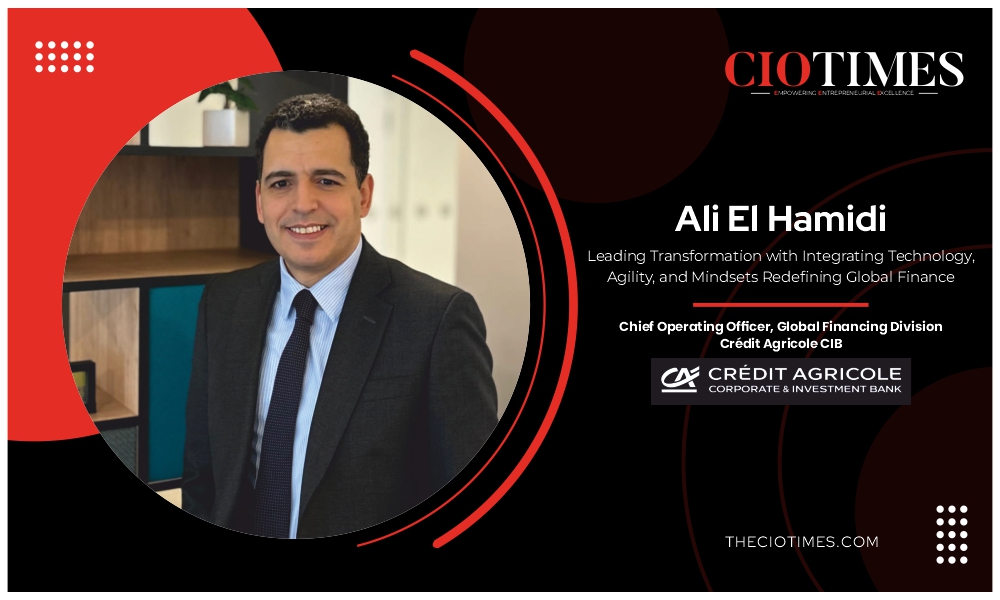
Ali El Hamidi, Chief Operating Officer, Global Financing Division, at Crédit Agricole CIB, truly embodies this statement. In the FinTech arena, money functions have expanded. How it grows, moves, and enhances economies in this digitally connected world is beyond imagination. FinTech leaders like him are opening doors for this shift through bold risk-taking, well-scrutinized decision-making, and channelizing disruptive models that challenge conventional financial norms.
Spanning more than two decades, his professional journey reflects an evolution from deep technical expertise to shaping enterprise-wide growth and transformation on a global scale. Early roles in quantitative research laid the foundation, but it was his instinct to look beyond models and metrics that defined his trajectory. Each position became a blank canvas, an opportunity to rethink purpose, redesign strategy, integrate technology more intelligently, and elevate how teams create value across the bank. He treated every mandate like a founder would a growing venture, examining every lever that could sharpen competitiveness. This builder’s mindset, consistently applied, allowed him to move fluidly across disciplines and assume leadership roles that demanded both precision and vision.
Growth Through Transformation
In leading business development and transformation across Crédit Agricole CIB’s Global Financing Division, spanning corporate finance, leveraged finance, and specialized lending, he approaches growth and structural change as inseparable forces.
Ali adds, “When disconnected from concrete objectives, a transformation without a clear goal becomes a theoretical concept, a source of frustration for managers, leadership, and all employees.”
Ideas are designed with execution in mind, ensuring they move seamlessly from strategy to impact. At the same time, change is never pursued as an abstract exercise; it is grounded in measurable objectives that resonate across leadership and teams alike. This integrated approach creates a virtuous cycle, where commercial progress fuels transformation, and structural evolution, in turn, accelerates sustainable growth.
Evolving Capital
Drawing on years of oversight across primary capital markets, spanning debt capital markets and strategic equity transactions, he observes a clear shift in how investors approach capital structuring in today’s macroeconomic climate. Real-money investors are no longer content with traditional, liquid instruments alone. Instead, they are displaying greater sophistication, actively seeking diversification through private assets that demand deeper analysis and a higher tolerance for complexity.
In some cases, this evolution goes even further, with investors building their own origination capabilities. The result is a reshaped capital markets landscape, where the boundaries between buy-side and sell-side roles are increasingly fluid, and expectations are defined by insight, access, and strategic agility rather than convention.
Informed Judgment
His deep roots in credit risk modeling and portfolio risk management carry a distinctly analytical lens into every strategic decision he makes today. Years spent navigating quantitative frameworks taught him that modern financial decision-making involves balancing countless risk variables far more than the human mind can process on instinct alone.
Models, in his view, are not answers but tools: a way to distill complexity, reveal meaningful relationships, and identify the metrics that truly matter. Yet numbers never replace judgment. While data informs the path forward, he believes accountability ultimately sits with people, not algorithms, a reminder that even in the most quantitative disciplines, leadership remains a deeply human responsibility.
Systemic Resilience
Ali’s experience spans debt capital markets, securitization, and secondary credit markets, which have given him a front-row view of how risk is created, shared, and sustained across the global financial system. Even as the system has grown more complex, he sees a more mature and better-prepared ecosystem than it was two decades ago, one where regulators, investors, market infrastructures, and advisors operate with sharper insight and greater accountability. At the center of this interconnected framework lies trust, a currency no institution can afford to compromise.
For him, resilience begins at the point of origination. Banks play a defining role in ensuring the quality of risk embedded in the assets they create. Only then can that risk be responsibly distributed to participants equipped to understand and absorb it.
He shares, “I believe the resilience of the global financial system depends on the successful execution of these two steps.”
Quantum Advantage
As sponsor of Crédit Agricole CIB’s quantum computing initiative, he has focused on moving the technology beyond theory and into practical financial use. His perspective on where quantum computing can deliver early value is shaped by a clear distinction between analog and digital quantum systems.
He adds, “Unlike digital quantum computers, which still require several years of development before they can be used for concrete industrial problems, analog quantum computers can already offer value for a very specific class of real-world problems: finding a minimum or maximum value for a cost function.”
These systems excel at identifying minimum or maximum outcomes within complex cost functions, a capability that aligns naturally with key problems in quantitative finance. From model calibration and capital or liquidity optimization to intelligent asset selection and portfolio construction, he sees quantum technology as an emerging tool for making better decisions under constraints. In his view, the first real breakthroughs will come where complexity is highest, and optimization truly matters.
Tech Synergy
Deep tech initiatives often meet with skepticism in traditional financial institutions, where risk awareness and regulatory frameworks dominate every decision. For him, the challenge wasn’t merely navigating the regulated environment itself; his team had the autonomy to choose internal processes and manage risk as they saw fit. The real hurdle lay in convincing management to allocate resources to R&D for technologies still in their infancy.
Ali approaches this challenge with a clear-eyed realism: when venturing into frontier technologies, the initial visions of the technical team and management rarely align perfectly. Recognizing this misalignment isn’t a setback; it’s a necessary first step toward success. From there, building internal alignment requires a consensus-driven approach, one that gradually bridges differing priorities while fostering shared understanding.
His method is as precise as the technologies he champions. Before requesting any investment, his team dives deep, mastering the subject fully and leveraging the expertise of stakeholders within the French quantum ecosystem. This careful preparation ensures that when the proposal reaches management, it’s not just a concept, it’s a well-understood, strategically applicable opportunity, both technically and operationally.
His strategy doesn’t stop at technical readiness.
He asserts, “We also adopted a holistic approach, seeking all possible extractable value, both in terms of applications for our algorithms and in terms of positive side effects such as promoting the bank’s attractiveness to our target recruitment pools by communicating on the innovative aspects of our company.”
This includes algorithmic applications, yes, but also the broader benefits: boosting the bank’s appeal to top talent, signaling innovation, and demonstrating a forward-thinking culture. It’s an approach that blends rigor with imagination, showing that in the world of high-stakes finance, pioneering technologies can gain both credibility and momentum when guided by thoughtful leadership.
Banking Beyond Geographical Boundaries
Ali has spent his career navigating both global markets and the intricate world of corporate banking, giving him a front-row view of an evolving financial landscape. He sees a clear convergence emerging between Corporate Banking and Capital Markets, an evolution that will take a few more years to fully unfold but is already visible in certain regions. In the United States, often a step ahead in this shift, banks are gradually integrating activities across these traditionally separate divisions, or at the very least fostering closer collaboration.
Securitization has been a major driver of this transformation. Once applied primarily to financial instruments, it now extends to physical assets, such as real estate, aircraft, ships, infrastructure, and even renewable energy projects, turning them into more liquid, tradable assets on the capital markets. This liquidity, combined with a growing appetite from traditional capital market investors for corporate banking assets, is reshaping the contours of global investment banking.
He shares, “Technological development is the other catalyst for this convergence, as technology brings greater transparency, greater efficiency, and ultimately more opportunities to a growing number of players across the ecosystem.”
Alongside his executive roles, he has also immersed himself in academia as a lecturer in credit risk management, a pursuit that has left a profound mark on his leadership philosophy. Teaching, he believes, demands a continuously evolving mindset. Engaging with students and researchers forces him to question assumptions, challenge habits, and consider perspectives beyond immediate applicability. It’s his responsibility to translate these reflections into practical strategies for the corporate world.
The academic arena also offers a fertile ground for talent development. He has personally recruited several of his former students, recognizing the potential in those who challenge convention and bring fresh ideas to the table. This bridge between learning and practice allows him to nurture the next generation of financial leaders while continuously refining his own approach to knowledge transfer, leadership, and innovation.
Risk Mastery
His career has been defined by navigating the fine line between innovation and oversight, particularly during periods of heightened regulatory and market scrutiny. His experience in developing and managing portfolio models during these intense periods taught him lessons that extend far beyond the numbers. For Ali, regulatory and supervisory authorities have been more than watchdogs; they have been catalysts for improvement, pushing banks to raise the bar in model accuracy, prudence, data quality, validation, benchmarking, back-testing, and stress-testing.
This scrutiny, he notes, brought a broader benefit: industry-wide comparability. By creating a shared framework for evaluation, regulators helped strengthen the resilience of the financial sector as a whole. But perhaps the most enduring impact was on culture. Through these rigorous processes, risk awareness evolved from being a concern isolated within risk management divisions to a mindset embedded across all areas of the bank. For him, the experience reinforced the importance of model governance, transparency, and accountability not as abstract ideals, but as practical tools that shape decisions, safeguard institutions, and cultivate trust across the financial ecosystem.
Aligned Change
Ali believes that transformation programs often fail not because of technical limitations, but due to cultural resistance. For him, sustainable change requires a dual approach: working bottom-up and top-down. Transformation must make sense to the employees involved, explaining clearly, seeking feedback, and remaining open to refining ideas when better proposals emerge. While no initiative can satisfy everyone’s expectations, careful iteration brings the approach closer to collective alignment.
At the same time, transformation must align with management’s strategic objectives. A legitimate change, he insists, can be easily explained. Beyond strategy and culture, success comes down to meticulous execution in both substance and form.
Future Leaders
Ali, whose experience spans R&D, advisory, quantitative analytics, and senior leadership, sees the skills defining the next generation of leaders in global finance as less about finance itself and more about adaptability. The world, he notes, is evolving at an unprecedented pace driven by technology, cross-sector interconnections, shifting consumer habits, and global trends. Leaders today must navigate these forces to deliver the products and services their global clientele expects.
The leaders of tomorrow will naturally align with the new generation of employees and customers: more technically fluent, more connected, more mobile, and increasingly demanding. Success, he believes, will hinge on understanding these dynamics and integrating them seamlessly into decision-making, strategy, and leadership.
Quantum Finance
He sees the next decade of global finance as a period of profound transformation, driven by emerging technologies that promise to redefine capital markets, risk modeling, and the very foundations of the industry. Artificial intelligence, he notes, is no longer just a tool; it is already reshaping decision-making and will play an even greater role in the years ahead.
Beyond AI, blockchain technologies are poised to move past their cryptocurrency origins. For Ali, their real value lies in creating secure, trustworthy connections between actors who must collaborate across complex networks. And on the horizon, quantum technologies hint at another revolution, offering unprecedented computing speed that could transform the mechanics of finance itself.
While no one can predict exactly how these trends will unfold, he believes the critical differentiator will be agility. Institutions and leaders who can rapidly adapt and transform in response to these upheavals will define the next era of global finance.