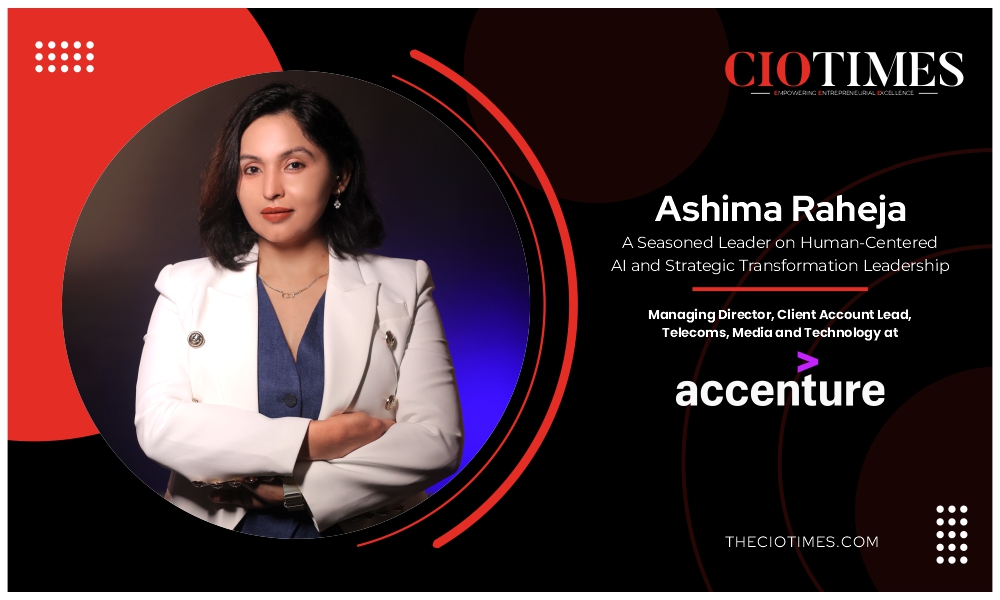
Women leaders today are goal-oriented. They know the path towards a particular goal. There’s no sector of work left where we do not see women working with seamless operational excellence. They’re dreamers of success and can very well achieve the same. The very concept of male-oriented sectors is diminishing lately. Women not only bring a balance, but also leave a lasting impact on their work. One such woman leader is Ashima Raheja, Executive Managing Director in Telecoms, Media and Technology sector at Accenture. Her more than two decades of experience across Oracle, SAP, and now Accenture have significantly shaped her career.
A Journey Worth Exploring
Over the past two decades, the emergence of technology and business has been immense. In those times, information technology (IT) was looked upon as backend work, while the main focus was on driving the core business and the decisions for it. Leadership was carried on by hierarchy, intuition, and experience. Technology-supported operations were not included in shaping the strategy. Strategic decisions on mergers, acquisitions, new investments, and expansions were made by executive and finance leaders. Technology heads were not at the decision table, but instead given mandates to carry out operational execution.
The 2010s were a time when the shift accelerated that brought business closer to technology. The emergence of cloud computing and social media allowed customers to voice their demands and also engage in real-time engagement. Ashima, too, engaged in technologies like Blockchain and cloud computing, as she was convinced that it was going to mould the upcoming future of business investments.
Currently, technology has taken the front seat.
She adds, “All business decisions are made with CIOs at the table. Technology dictates new dimensions of business growth. Covid played a pivotal role in that massive overnight transformation.”
The boundaries between the CFO, CEO, and CIO are increasingly blurred. Technology leaders are no longer just implementing plans; they are actively shaping the strategy itself.
Chasing the Ideal Use of AI
Upon asking about AI adoption for ERP and the private cloud sector, Ashima calls it her ‘pet peeve’ but also understands it as a harsh reality. The ‘Race to adopt AI’, in her experience, should not be a race where employees and senior leaders are compelled to bring out productive or tangible results from it. ERP focuses on B2B businesses.
She shares, “When such large landscapes and traditional solutions are involved, diligent thought should be given to where AI can bring the maximum. value. During the ERP wave, most projects often failed due to poor change management, cultural resistance, and misaligned processes.”
The majority of work components are the same, since the advent of AI, she highlights. It can’t majorly transform an organization by integrating itself. The ideal process would be to rethink workflows, decision rights, and end-to-end accountability. Setting relevant standards while adopting AI, the private cloud is dependent on customization, personalized upgrades, and migration windows.
Ashima often works with organizations that hesitate to embrace the cloud, worried about losing grip over their code, custom builds, and deeply embedded core processes. That same hesitation follows them into AI. When data sits in silos and systems don’t speak to each other, meaningful outcomes feel out of reach. AI doesn’t fix what’s broken, it magnifies it.
If the foundation is messy, the results will be too. She believes AI cannot live in an innovation lab alone; it requires leadership alignment and cultural commitment. Like past ERP and cloud journeys, real value comes not from speed, but from steady, thoughtful integration.
Strategic Balance Works
Ashima has led global customer engagement and large-scale private cloud initiatives. She has noticed a difference between organizations that leverage the available technology correctly. Simultaneously, she also mentions CIOs who were forced to move towards private cloud due to external or internal entities. These professionals tried their best for private-cloud implementations after long cycles of due diligence. Both faced some pros and cons, but a common aspect was initiating diligent planning before starting with it.
This is where the reality check comes head-on. Cloud is synonymous with standard processes. When a company depends on third-party entities to handle the cloud component while it continues with its daily operations seamlessly, it gives no value. Minimal efficiency.
She shares, “This is something I observed in many organizations, where I had to sit down with CIOs and explain how their thinking and that of their IT teams needed to evolve in terms of mindset, behavior, and process design.”
On the other side, Ashima was also impressed by the bold decisions that some organizations took when they decided to do large-scale private cloud implementations. They vowed to Clean Core by cleaning up all customizations and not introducing new ones. They, in fact, appointed a Customization Champion who would review every single code/process customization request to ensure zero customizations and 100% standardization. Those are the suite of organizations that achieved the highest value in terms of costs, scale, and profits. That money was invested in new expansions.
Reliable Scaling
As a Managing Director at the helm of Telecoms, Media, and Technology, Ashima explores what it truly means to scale technology responsibly within complex, fast-moving industries. For telecom giants like Deutsche Telekom, responsible scaling requires building redundancy before expansion and stress-testing architectures like 5G, as outages disrupt entire economies. Media leaders like Netflix thrive on personalization, demanding transparent data usage and ethical algorithms. Meanwhile, tech titans like NVIDIA must prioritize governance and human override mechanisms before AI errors scale instantly.
Resilience is non-negotiable in these hyper-connected ecosystems. Because a single vulnerability cascades across the supply chain, responsible scaling requires:
- Vendor diversification
- Crisis simulation at executive levels
- Resilience embedded in architecture
- Scenario planning for geopolitical shifts
In this high-stakes sector, growth multiplies impact. Consequently, both technology and cultural nuances must be harmonized for truly responsible scaling.
Crafting AI for Short-term
Efficiency and automation are crucial parts when AI is discussed. Ashima wholeheartedly believes that value extraction from it should be the priority rather than leveraging it for impact on the P&L statement. She expects questions from leaders like ‘how to design AI?’ The aim should be long-term rather than short-term gains. All of us have witnessed the emergence of the social media boom. Social media like Facebook was leveraged for engagement, and society is still dealing with the consequences.
She highlights that AI leaders should plan differently with trust drivers like:
- Clear accountability frameworks
- Transparent AI usage policies
- Explainable models in critical decisions
For Ashima, making workforce reinvention a core strategy isn’t just a professional stance it is deeply personal. It reflects her own lifelong commitment to constantly evolving through the quiet power of unlearning and fresh learning. In this AI era, she believes unlearning is no longer optional; it requires the genuine courage to release familiar habits and outdated ways of working. Reinvention, she feels, must be embedded by leaders as a shared philosophy never reduced to alarming headlines like “AI will eliminate 20% of roles.” When electricity first arrived, it did far more than lower the cost of candles; it sparked entirely new industries and human possibilities.
She hopes today’s leaders will anchor their AI conversations around meaningful questions such as:
- Does it reduce our carbon footprint?
- Does it enhance financial inclusion for the underserved?
- Does it improve access to education and healthcare?
From her lived experience, the real competitive advantage won’t go to those who automate the fastest. Instead, it will belong to those who elevate people the best strengthening our thinking, widening our opportunities, and empowering continuous reinvention in a rapidly changing world.
Rigor Fuels Innovation
Standing at the crossroads of P&L, delivery, and leadership, Ashima reflects on the delicate dance between keeping the lights on and chasing the new. She often thinks back to her days in Dubai, living right across from the silent Ain wheel. Despite nightly tests, it never turned for guests; the engineers weren’t just fixing a ride, they were reimagining its soul. This sparked a profound realization for her: operational excellence is the engine that funds innovation, while innovation is the shield that protects operational relevance. For her, rigor ensures the stability to dream, while creativity provides the strategic edge to survive.
In deep dialogues with semiconductor and energy giants regarding cloud transformation, one human truth always sat on the table: operations cannot break. Chasing instant financial ROI is a hollow recipe for disaster. Expecting the same weary teams to master flawless SLAs while experimenting aggressively will shatter an enterprise faster than one can imagine. Consequently, her seasoned advice centers on:
- Creating controlled innovation sandboxes and PoCs.
- Maintaining a disciplined approach to protect operational KPIs.
- Defining measurable, realistic milestones for every innovation.
At the end of the day, clients buy outcomes, not abstract dreams. By demonstrating a tangible, messy path to the real journey of ups and downs, she earns immediate trust. Her promise is grounded: “We will improve your reliability and costs,” she offers, before adding the visionary hook, “and we will future-proof your heart against disruption.” This ties quiet credibility to bold, humanized innovation.
Adapting According to Markets
Ashima recalled an interview where she was asked about her leadership style needing to adapt according to diverse regions and cultures globally. She has a strong opinion on this, especially in the post-COVID era. Everything was in the cloud in terms of technology, as the world had become one global space. Internet, social media, and hyperscalers were skyrocketing. COVID hit, and every person was at home.
She shares, “What has been transpiring after 2020, geopolitically around the world, has forced countries and organizations to look inside and fortify themselves by reducing dependencies on other nations. This has only strengthened my belief and experience of having worked in geographies of Asia, Europe, and the Middle East closely.”
In the European region, being a saturated one where technology is governed by GDPR, she was focused on a planned, disciplined, and long-term vision rather than agility and quick wins. Winning over people’s trust was an imperative for an execution plan. Her client interactions would revolve around statements like ‘we will need to brainstorm and plan with a 2-3 year vision.’
Across the globe, Ashima’s journey as a leader has been carved by the unique, living pulse of every land she has touched. She feels that Asia breathes a restless, infectious ambition. It is a place of high dreams, rapid movement, and a refreshingly honest focus on getting things done. In those boardrooms, being agile isn’t a badge of honor; it is simply the air everyone breathes. You earn your seat at the table through pure momentum. The conversations there get straight to the point: Show us the path forward. When do we start? Watching this part of the world over the last five years, she has seen that hunger for speed reshape entire industries overnight. It is an environment that rewards the bold, the clear-eyed, and those with the heart to move fast.
The Middle East, she found, pulses with a very different kind of courage. It is a landscape defined by massive dreams, endless horizons, and a deep hunger for outcomes that truly matter. Here, the hurdle is rarely the budget; it is the magnitude of the impact. People don’t fall in love with the gears of technology; they value the change it brings to their lives. They care less about the magic behind the curtain and more about the tangible difference left behind. Yet, the region has also grown more discerning, challenging partners to prove their worth through real-world value, fiscal discipline, and a commitment to the planet. Growth has been lightning-fast, but it always carries the weight of responsibility.
For her, finding her footing among such diverse souls and cultures has been a deeply humbling, life-changing experience. She often compares it to balancing a delicate house of cards, one misread look, or a misplaced word, and the connection could slip away. She grew through her stumbles just as much as her wins. Sometimes her voice grew softer; other times, it found a sharper edge. Her style shifted. Her plans bent. Even the way she shared a meal or a conversation evolved. Every new border asked her to listen with more than just her ears. In the end, she realized that growth isn’t just about businesses getting bigger, it’s about a leader’s own spirit expanding to meet them, filled with wonder and a quiet, steady joy.
Befriending Change Management
Change management is a constant aspect in her career. Ashima calls it a topic close to her heart, and an underrated one. One of her ex-employers leveraged it too often. Whether a technological change or an organizational change, she believes we’re in a people business where integrating change takes time. Jokingly, she says AI hasn’t replaced humans completely yet. In her experience, each planning thought should be initiated from the basic questions like what, how, and why. She believes the said change should be communicated to the people who will be affected by it. It helps people connect to it and feel a part of the same rather than just bearing it as a surprise and news item each time.
To her, change management has never been a corporate ritual; it has been a responsibility she carries with intention. Whenever she stepped into a new mandate, she built a 30-60-90-day plan, but not as a polished presentation to impress. It was her way of grounding herself and signaling direction. She shared it openly across the organization, from leadership corridors to operational teams, believing that clarity reduces speculation. Then she listened, truly listened. Feedback shaped the plan. Questions reshaped priorities. Regular updates kept the momentum honest. Over time, that transparency turned hesitation into belief. Her people did not just witness the change; they became part of it.
Now, in the age of digital transformation, where AI is often cast as the disruptor, she feels this human-centered approach matters even more. Fear rarely comes from technology itself; it grows in the absence of understanding. When leaders step forward to explain the purpose, the possibilities, and the place employees hold within the shift, something powerful happens. The narrative changes.
She has seen that when change is led with empathy and clarity, three outcomes consistently unfold:
- Elimination of fear amongst and resistance from employees
- Collaboration with and support from the employees
- Realization of Short, mid, and long-term wins.
People’s Spirit is Key
The three T’s: talent, technology, and trust are interlinked to each other. As Satya Nadella has positioned his quote, which goes like, “I learn faster than the system changes.” She highlights that no one fully understands the systems they are deploying.
She believes future technology leaders must stay open to exploration and be willing to evolve their thinking publicly, while remaining steady and confident in their direction. Even amid the AI excitement, enterprise boards continue to focus on margin resilience, revenue growth, risk exposure, and capital allocation. In her view, an economically sustainable strategy cannot be separated from technology evolution they now move together.
She also emphasizes that data ethics and governance frameworks are becoming essential for technology leaders to truly understand and embrace, especially as regulatory landscapes continue to shift and demand greater accountability.
She adds, “Focus on people and their morale in these times of Tech inflection must be an underlying skill in most tech leaders if they want to survive.”
She stresses the fact that credibility will belong to leaders who can align intelligence, economics, and ethics – without sacrificing any of the three.
Architecting Intelligence
Ashima feels a genuine spark when she thinks about intelligence becoming our new shared foundation. Over the last decade, she has watched the bones of business evolve from rigid hardware and virtual machines into something much more fluid and alive. Now, with the rise of AI, she sees intelligence itself woven into the very fabric of how we build. Decision-making is starting to feel like something we can consciously design. What used to take layers of manual guesswork can now be architected with a sense of real intention and massive scale.
Reinvention, she feels, is the heartbeat of this entire shift. While the Cloud helped us move things faster, AI is helping us think faster, pushing all of us to bravely unlearn the old and embrace the new. Strategy cycles are shrinking, and the way we test new ideas is moving at a breathtaking pace. In her eyes, the mix of Cloud, AI, Data, and deep partnerships creates a kind of compounding magic that no organization can afford to ignore.
She sees strategic partnerships, in particular, as the true force multipliers of our time. They aren’t just dry, transactional vendor deals anymore; they are vital alliances rooted in building something great together. These connections across the industry remind us that the best innovations today aren’t born in a vacuum; they are grown in a community.
The moments where she believes leaders must pause and breathe are:
- Ethical velocity – Ashima often remembers a seasoned colleague who once simply said, “because I can” when asked why a certain path was taken. That mindset deeply worries her. We shouldn’t let automation be driven by sheer capability alone. AI bias can spread much faster than we can catch it, and misinformation can easily outrun our best rules.
- Partnership Dependency – While these bonds are powerful, leaning too hard on one friend can create hidden risks. She believes we must balance our excitement with clear exit options, growing our own inner strengths, and exploring multiple models.
- Talent displacement Narratives – Fear has a way of spreading fast. But she insists that experience doesn’t just vanish; it evolves. The story we tell must be about transforming alongside our people, never leaving them behind in the dust.
Ultimately, she is moved by AI not because it automates the world we have today, but because it gives us the tools to reshape the world of tomorrow with a thoughtful heart and steady discipline, rather than just raw speed.