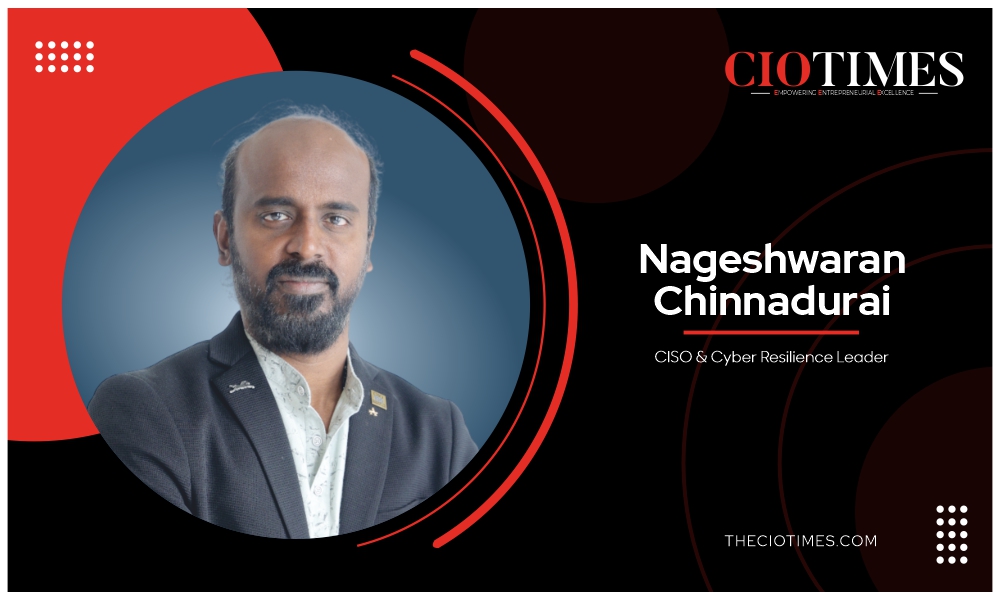
Digital trust needs a redefinition for sure, especially in today’s times. As we enter 2026, we are witnessing cybersecurity leaders who have disruptive solutions that act as a shield for a person’s or organization’s crucial data. No longer confined to the back office, these leaders are now at the forefront of strategic decision-making, ensuring that organizations remain secure, compliant, and resilient in an increasingly complex cyber landscape. Speaking of such business leaders, we cannot miss out on a name, Nageshwaran C., CISO & Cyber Resilience Leader, at TVS Motor Group. His role goes beyond technology; it is about safeguarding reputation, continuity, and customer confidence.
Headship Ideology
With more than two decades spanning enterprise cybersecurity, operational technology, and large-scale IT infrastructure, his journey reflects how defining experiences steadily shape a modern CISO’s leadership approach. His perspective has been forged not in isolation, but at the intersection of technology, business continuity, and people, where security decisions have real-world consequences.
Early in his career, his deep involvement in OT security within manufacturing environments became a turning point. Working with legacy, real-time systems where downtime was simply not an option, he learned the critical importance of managing east–west traffic and limiting lateral movement without disrupting operations. This phase influenced his adoption of a Zero Trust mindset, one rooted in visibility, segmentation, and control, but always balanced with operational realities. For him, resilience was never theoretical; it was about keeping production lines running while staying secure.
As his responsibilities expanded to enterprise-scale IT environments, he led security programs across complex global estates. He played a key role in orchestrating XDR platforms, strengthening endpoint protection through integrated DLP and proxy controls, and simplifying deeply technical cyber risks for board-level conversations. In doing so, compliance gradually shifted from being a checklist exercise to a strategic driver of trust, credibility, and business growth.
He shares, “These experiences have shaped my leadership style, balancing technical rigor with emotional intelligence.”
Whether steering teams through high-pressure incidents or championing AI-driven security capabilities, he focuses on empowering people and enabling innovation. For Nageshwaran, cybersecurity is not a barrier, but a catalyst, especially in fast-moving, non-IT-led sectors such as manufacturing, healthcare, and product-driven organizations.
Striking the Right Technical Balance
Having led cybersecurity for some of India’s most complex manufacturing and mobility ecosystems, Nageshwaran’s work sits at the delicate intersection of operational continuity and digital agility. The question of how to balance the unique demands of OT security with fast-evolving risks across cloud, applications, and enterprise IT is not theoretical for him; it is a daily leadership reality.
Across healthcare, manufacturing, and mobility environments, he approaches this challenge through a unified, XDR-led security framework that brings consistency to converged IT–OT landscapes. The objective is clear: enforce Zero Trust without compromising the real-time reliability that OT environments demand. In OT-heavy manufacturing setups, uninterrupted operations remain non-negotiable. His focus has been on carefully segmenting east–west traffic within legacy PLC and SCADA networks using air-gapped gateways, protocol proxies, and virtual patching, thereby protecting vulnerable systems while minimizing disruption to production. This pragmatic strategy acknowledges the realities of aging infrastructure prevalent in Indian factories, aligns with IEC 62443 requirements, and addresses the rising ransomware threats targeting the manufacturing sector.
On the IT and cloud side, where threat vectors evolve at a rapid pace, Nageshwaran strengthens resilience through endpoint-centric DLP, secure web and application proxies, and behavioral analytics embedded within the XDR platform.
He asserts, “This enables early detection of anomalies arising from IT-OT convergence, one of the most significant risk vectors in India’s industrial landscape.”
In mobility environments, including connected fleets, the emphasis shifts to embedding endpoint security into core operations, ensuring inspection and policy enforcement happen seamlessly, without latency or operational impact.
At the heart of his leadership philosophy lies risk-based prioritization, aligning OT uptime metrics with IT scalability and broader business growth goals. By leveraging AI-driven threat hunting, targeted vulnerability management, and practical automation, he builds security programs that factor in talent constraints and supply-chain exposure, while still enabling secure, scalable innovation across India’s healthcare, manufacturing, and mobility ecosystems.
Creative Engineering
Having designed and implemented enterprise-wide security architectures across AWS, Azure, GCP, and OCI, he has learned that building scalable and resilient cloud security frameworks demands a fundamental shift in thinking. When organizations ask what architectural priorities truly matter in a multi-cloud world, his answer centers on consistency. The real challenge is not capability, but maintaining a unified security posture across platforms that differ in tools, terminology, and APIs. To scale securely, cloud silos must be dismantled in favor of a cloud-agnostic control framework applied uniformly across environments.
At the core of this approach is identity-led security backed by automation.
He shares, “With the traditional perimeter dissolved, identity becomes the primary control plane, enforced through centralized authentication, federated access, and just-in-time privilege management.”
Security guardrails are embedded directly into infrastructure-as-code pipelines, ensuring protection is enforced at deployment, not retrofitted later. A centralized cloud security posture management layer then provides a single, authoritative view of risk, compliance, and asset visibility across all cloud platforms.
Resilience is achieved through zero-trust networking and robust data protection. Microsegmentation and private connectivity reduce lateral movement, while encryption, customer-managed keys, and cross-cloud backups ensure data remains secure and available even during large-scale provider disruptions, supporting business agility without compromising risk discipline.
Strategic Shifts
The question of how to secure critical manufacturing operations while preserving operational continuity has become central to his leadership narrative. In industrial environments, he recognizes that cybersecurity cannot be driven by traditional IT priorities alone. Availability and safety are non-negotiable, and every control must be designed to protect production without introducing disruption.
His approach is rooted in aligning cybersecurity tightly with operational requirements. The starting point is architectural isolation combined with deep visibility. By applying frameworks such as the Purdue Enterprise Reference Architecture, IT and OT networks are clearly segmented, industrial DMZs are enforced, and production lines are microsegmented to contain threats. Passive monitoring and behavioral baselining are used to detect anomalies early, offering visibility without impacting fragile industrial assets.
Vulnerability management and remote access are shaped around on-ground realities. Legacy systems that cannot be patched are safeguarded through virtual patching, while updates are scheduled strictly during planned maintenance windows. Remote access for vendors and engineers follows zero-trust principles, with just-in-time, role-based permissions and protocol isolation. Together, these measures ensure secure, resilient manufacturing operations while maintaining uninterrupted business continuity.
Compliance as Advantage
With extensive exposure to global frameworks such as ISO 27001, NIST CSF, GDPR, CIS Controls, and IEC 62443, Nageshwaran’s perspective on compliance goes well beyond the question of audits and certifications. When enterprises ask how compliance can be elevated into a competitive advantage rather than remaining a checklist exercise, his answer lies in intent and integration. Compliance delivers real value when it is embedded into strategic decision-making and day-to-day operations, guiding risk-aware choices, reinforcing customer trust, and enabling innovation with confidence.
In his experience, the real shift happens when controls are aligned with business priorities. Instead of implementing requirements in isolation, compliance obligations are mapped directly to critical assets, core processes, and customer expectations. GDPR, for instance, is not treated merely as a regulatory mandate, but as an opportunity to demonstrate respect for customer data and an assurance that can clearly differentiate an organization in the market. In the same vein, IEC 62443 is applied to design resilient OT environments that reduce downtime and operational risk, enabling faster and safer production outcomes.
Compliance truly matures when it is operationalized. Continuous monitoring, automated reporting, and metrics-driven governance turn static controls into living programs. When leadership teams clearly see how compliance protects revenue, reduces risk, and strengthens brand credibility, it naturally evolves into a strategic enabler of measurable business value.
Secure Transformation
His approach answers a critical question many organizations face today: how can security evolve seamlessly alongside rapid digital transformation? For him, the answer lies in integration. Cybersecurity must move in lockstep with transformation initiatives, built into their design and execution rather than added as an afterthought. The objective is to enable innovation confidently, without losing sight of risk or control.
His philosophy is anchored in a clear “security by design” mindset. From day one, controls are embedded into architecture, automation pipelines, and cloud environments. Whether rolling out new virtualization platforms or modernizing endpoints, identity management, network segmentation, and threat detection are treated as core components of deployment, not retrofitted fixes. By standardizing policies, monitoring, and response mechanisms across both legacy and modern systems, friction is reduced for IT teams and end users alike.
Equally vital is continuous alignment through adaptive governance.
He says, “Security must be flexible enough to support rapid adoption of new technologies, whether cloud services, SaaS applications, or IoT devices, while maintaining visibility into risk and compliance posture.”
By combining forward-looking architecture, intelligent automation, and continuous monitoring, Nageshwaran ensures organizations can move fast without compromising security, positioning cybersecurity as an enabler of transformation, not a barrier.
Holistic Approach in Security
His past expertise includes tackling SOC operations, incident response, forensics, and threat intelligence programs. Nageshwaran has seen clearly what separates a cyber-resilient organization from one that is merely “security compliant.” When leaders ask what truly makes the difference, his answer consistently points to mindset, culture, and operational maturity. Compliance may satisfy regulatory expectations and reassure auditors that controls are in place, but resilience determines whether an organization can absorb shocks, respond effectively, and recover with minimal business disruption.
In cyber-resilient organizations, security is woven into everyday business operations rather than treated as an external mandate. These organizations operate with an “assume breach” mindset, investing deliberately in detection, response, and recovery capabilities. Decisions are guided by business impact, critical assets and core processes are prioritized, and risk is actively managed rather than narrowly avoided to meet a prescribed standard.
Culture and shared accountability play an equally defining role. Security is not owned by the SOC alone, but shared across leadership and operational teams. Threat intelligence is actively used, and lessons from incidents are quickly folded back into controls and processes. In essence, resilience is dynamic and proactive, while compliance remains static and reactive. Organizations that build true resilience can sustain trust and continue operations under pressure, while compliance-only organizations often falter the moment real threats exceed baseline requirements.
Dependability with Expertise
Having led multidisciplinary teams across network engineering, server management, and security operations, he believes the qualities that define high-performing cybersecurity teams today go well beyond technology alone. When the question turns to what truly distinguishes such teams, his experience points clearly toward mindset, collaboration, and adaptability.
He shares, “The most effective teams combine deep technical expertise with strong communication skills, allowing them to translate complex risks into actionable guidance for the business.”
High-performing teams operate with shared ownership and accountability. Security is not confined to one function; it is embedded across roles, with every individual understanding how their contribution impacts the wider organization. Teams that invest in cross-training, continuous learning, and practical use of threat intelligence are far better prepared to respond quickly and decisively as threats evolve.
Resilience and agility are the final differentiators. The best teams anticipate incidents, build repeatable response processes, and continuously strengthen defenses based on real-world lessons. In a fast-paced environment, this combination enables teams not just to protect the organization, but to support secure innovation.
Ready with Shields
As organizations embrace digital transformation, the cyber threat landscape continues to evolve rapidly. Among the emerging areas of concern, he hints at those that extend beyond direct organizational control: mobile endpoints, software supply chains, and third-party vendors. Mobile devices increasingly blur the line between personal and corporate networks, while supply chain vulnerabilities can introduce weaknesses long before software reaches production. Third-party dependencies create blind spots that can be exploited, making proactive risk management essential.
Addressing these challenges requires a focus on visibility, governance, and risk-based controls. Vendor management involves rigorous onboarding, continuous monitoring, and clearly defined contractual security obligations. For software supply chains, secure development practices, thorough dependency scanning, and provenance verification help prevent vulnerabilities from entering production.
He shares, “Mobile and endpoint security is reinforced through zero-trust access, device hygiene policies, and behavior-based monitoring that detects anomalies early.”
Integrating these measures with continuous monitoring, automation, and cross-functional collaboration strengthens organizational resilience. This approach reduces exposure to emerging threats while enabling businesses to innovate and grow without compromising security. By embedding security into operations and decision-making, he demonstrates that a robust cyber posture is not just a technical necessity but a strategic enabler for sustainable business growth.
Resourceful Morality
His leadership philosophy has been shaped by a career spanning diverse roles, from technical assistant positions to senior administration and now the helm of cybersecurity as a CISO. Reflecting on the question of which career lessons and turning points most strongly influence his approach today, it becomes clear that his philosophy is grounded in both hands-on technical experience and strategic executive insight.
Early in his journey, he recognized that technical expertise alone is insufficient. Its true value emerges when complex risks can be translated into clear, business-relevant decisions. This realization instilled a focus on bridging technology and strategy, a perspective that continues to inform his approach to organizational security.
A defining moment came while leading cross-functional teams during high-pressure incidents.
He asserts, “I realized that effective leadership isn’t about directing every action; it’s about enabling teams to make confident decisions, fostering accountability, and creating a culture where people feel empowered to act quickly and responsibly.”
Fostering accountability and nurturing a culture where individuals feel enabled to act decisively proved far more impactful than relying on rigid rules or hierarchical structures.
These lessons now guide him in building resilient, high-performing teams that align security initiatives with broader organizational objectives. His approach emphasizes continuous learning, proactive problem-solving, and ensuring that every security decision supports both risk management and sustainable business growth.
Boardroom Cyber Alignment
He approaches boardroom conversations with a clear focus on business relevance. When addressing the question of how to communicate cyber risk, investment needs, and readiness to executive leadership, he emphasizes translating technical threats into tangible business impact. Cybersecurity discussions, in his view, are most effective when framed around financial exposure, operational disruption, and reputational risk rather than technical detail.
By quantifying risk and outlining the value of security investments, he positions cybersecurity as a measurable business priority rather than a cost center. Structured risk models and outcome-driven metrics help leadership understand where investments reduce exposure and strengthen resilience. Scenario-based narratives further bring risks to life, demonstrating potential impacts on revenue, customer trust, and business continuity.
Nageshwaran adds, “Tailoring communication to each stakeholder, CFO, CEO, or COO, ensures that the discussion resonates with their priorities, from financial oversight to strategic growth and operational resilience.”
Clear dashboards, risk heat maps, and readiness indicators offer executives a concise view of current posture and improvement areas. Communication is tailored to stakeholder priorities, aligning financial oversight, strategic growth, and operational stability. Through transparency and regular engagement, he ensures cybersecurity remains aligned with broader business objectives, enabling informed decisions that protect brand value and support sustained growth.
Cyber Leadership
He views the CISO role as entering a decisive new phase. Reflecting on how the position will evolve over the next decade, he believes it will move well beyond technical stewardship to become a core pillar of business leadership. The future CISO will no longer function as a gatekeeper, but as an enterprise risk advisor who translates cyber threats into the language of financial exposure, regulatory resilience, and stakeholder confidence. In an era of accelerated digital transformation, security will serve as a foundation for growth rather than a constraint on innovation.
The rapid maturation of AI and automation is central to this shift. Routine detection, triage, and response will increasingly be handled by autonomous systems, enabling security teams to move away from manual alert management. With AI-driven security operations and integrated visibility across cloud environments, the focus shifts toward strategic risk management, governance, and anticipation of emerging threats. In this context, the CISO’s role expands to include ethical oversight of autonomous technologies and the coordination of hybrid human–AI operating models.
Over time, the CISO emerges as an architect of enterprise resilience. The mandate extends beyond infrastructure to encompass cross-functional governance, data integrity, and the secure adoption of new technologies. By working closely with business leaders on cloud-native scale and automated operations, the CISO ensures cybersecurity is embedded into the organization’s fabric, protecting both innovation velocity and brand trust.
Wisdom Pearls
He often reflects on what guidance truly matters for the next generation of security leaders. When considering the question of how upcoming professionals can strengthen both technical depth and business acumen, his perspective is shaped by the realities of working across vastly different operating environments.
At the foundation, he believes technical mastery remains non-negotiable. A strong understanding of system architecture, threat landscapes, incident response, and emerging technologies such as AI, cloud-native security, and automation builds credibility and enables sound decision-making. However, technical expertise alone is not enough. The real impact of security leadership emerges when complex risks are translated into clear business terms—financial exposure, operational continuity, and brand reputation—allowing executives to take informed, timely decisions.
Equally important is cross-sector exposure and adaptability. Each industry presents distinct challenges: gaming demands real-time threat detection and privacy protection, manufacturing prioritizes operational technology safety, education focuses on data protection and compliance, while mobility introduces risks linked to connected devices and IoT. Navigating these environments fosters a flexible mindset and the ability to transfer best practices across domains while anticipating emerging threats.
Beyond technology, Nageshwaran emphasizes the value of relationships and communication. Security, in his view, is as much about people and process as it is about tools. Building strong partnerships with business leaders, IT teams, and stakeholders ensures security initiatives align with organizational goals. Through mentorship, continuous learning, and a focus on governance and strategy, aspiring leaders can evolve into trusted advisors who protect both the organization and its growth journey.