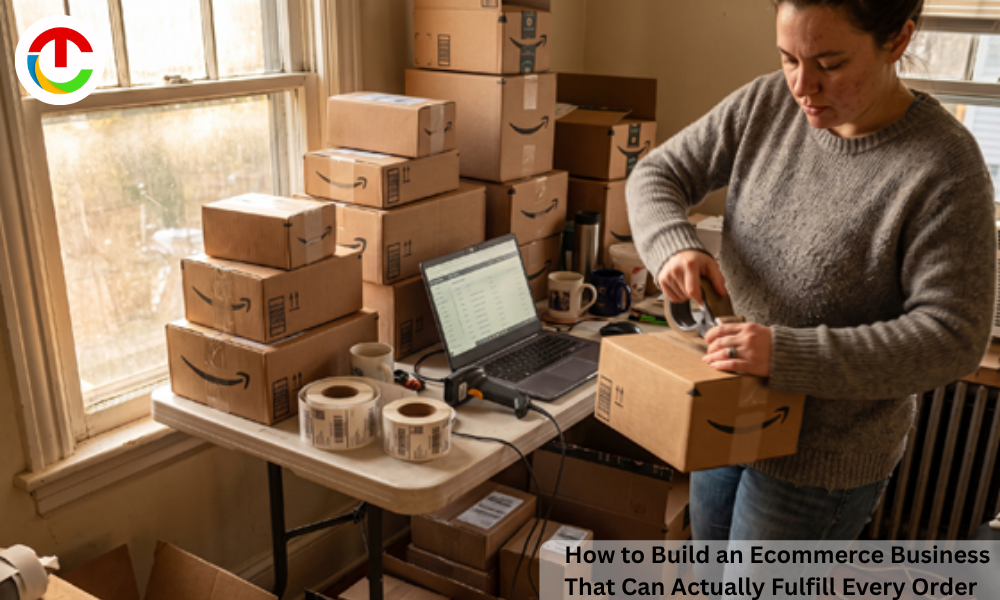
A growing brand’s order volume can outpace a founder’s ability to pick, pack, and ship every unit by hand.
Most “how to start an ecommerce business” advice stops at launch. Pick a niche, build the store, run some ads, and the rest supposedly takes care of itself. It doesn’t. The part that actually decides whether a brand survives its own growth is the operational engine behind it: getting the right product to the right customer, accurately, on time, and handling what comes back when it isn’t right. This piece skips the niche-selection and store-design conversation entirely and goes straight to the fulfillment layer, because that’s usually where growing brands quietly start to fail.
The Operational Bottleneck Growth Marketing Won’t Fix
The pattern shows up in almost every founder’s story, and it rarely gets told this way. A new brand launches, orders trickle in, and the founder packs them at the kitchen table or a spare room between calls. It works fine at ten orders a day. It starts to crack at fifty. Mis-picks creep in. Ship dates slip. A single viral TikTok or a good ad week turns into a backlog instead of a win, because there’s no capacity buffer for a spike.
This isn’t a marketing problem, and more ad spend won’t solve it. It’s an infrastructure problem.
This is exactly the gap a partner like The Fulfillment Lab is built to close. Rather than leaving a founder to scale a garage operation past its breaking point, a 3PL like this one offers same-day fulfillment and a multi-warehouse network, so orders ship from a location closer to the customer and capacity doesn’t collapse the first time demand spikes. The goal isn’t to hand off control. It’s to stop the operational side of the business from capping how fast the rest of it can grow.
3PL vs In-House Fulfillment: A Decision Framework
Choosing between in-house fulfillment and a 3PL isn’t a philosophical question, even though it often gets treated like one. It’s a math problem with a few concrete inputs.
Consider these factors before deciding:
- Order volume. Below a few hundred orders a month, the fixed costs of warehouse space, labor, and software rarely pencil out against a 3PL’s per-order fees.
- SKU complexity. A brand with three SKUs has very different storage and pick-pack needs than one running twenty variants across multiple bundles.
- Available capital. Warehouse leases, packing stations, and hourly labor all require cash up front that a 3PL model defers.
- Brand experience requirements. Custom unboxing and kitting are possible through either model, but they take more coordination with a third party.
- Seasonality. A brand with a sharp holiday spike needs flexible capacity more than it needs the lowest per-unit cost.
Fulfillment costs typically run 10-15% of revenue for direct-to-consumer brands, according to Digital Applied’s 2026 ecommerce fulfillment guide. That same research notes that 3PL-negotiated carrier rates can save a brand 15-40% compared to the rates an individual merchant gets shipping on their own. At low volume, that gap barely matters. At higher volume, it’s often the difference between a healthy margin and a thin one.
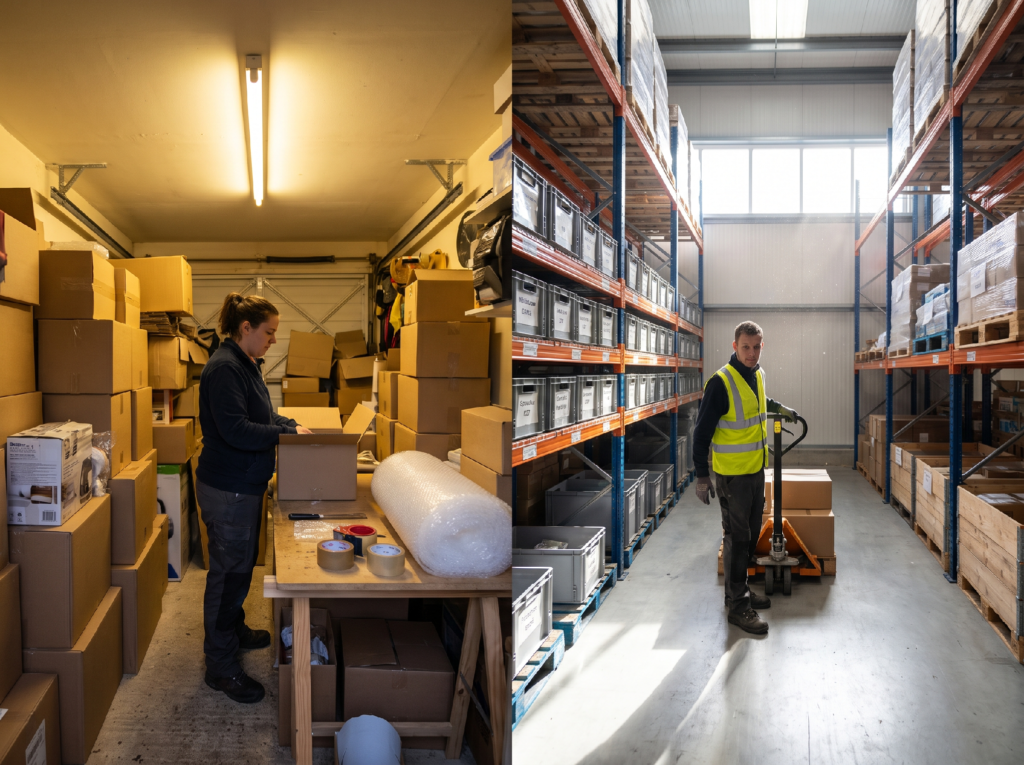
Order volume, not preference, should drive the choice between in-house and outsourced fulfillment.
None of this has to be permanent. Plenty of brands start in-house, outgrow it, and transition to a 3PL once volume justifies it. The mistake isn’t choosing in-house at launch. It’s refusing to revisit the decision once the order volume that made in-house sensible no longer applies.
Inventory Accuracy: The Metric That Quietly Controls Your Margins
Marketing spend gets most of a founder’s attention. Inventory accuracy deserves more of it. IHL Group’s 2025 research puts the annual cost of inventory distortion, meaning stockouts and overstock combined, at an estimated $1.7 trillion across retail. The same research found that 58% of retailers operate below 80% inventory accuracy. That’s not a rounding error; it’s a majority of retailers routinely selling products they don’t have or sitting on stock they can’t move fast enough.
The failure modes are specific and avoidable:
- Overselling. A product shows as in stock on the storefront when the warehouse is actually empty, and the order comes in anyway.
- Phantom inventory. Units are marked as available in the system but are damaged, misplaced, or sitting in the wrong bin.
- Manual reconciliation drag. Staff spend hours each week counting shelves and correcting spreadsheets instead of doing anything that grows the business.
None of these problems are dramatic on their own. Together, they erode margin quietly, order after order, in a way that doesn’t show up until a founder finally audits the numbers and finds out how much has leaked out through cancelled orders, refunds, and rush reshipments.
Order Visibility and Exception Handling In Ecommerce Business
Accurate inventory only solves half the problem. The other half is knowing what’s actually happening to an order once it leaves the warehouse. Did it clear customs on time? Did a carrier scan skip a package for two days? Is a shipment sitting in a regional hub with no update, while a customer emails support asking where their order is?
This is where visibility tooling earns its place in the stack, not as a nice-to-have dashboard but as the system that catches a problem before a customer has to report it. A platform like sensos.io uses AI-driven tracking and automated exception workflows to flag delays, damage, or mis-ships in real time, so a support team can act on a shipment issue before it turns into a one-star review or a refund request. Paired with accurate inventory data, that visibility turns fulfillment from a black box into something a small operations team can actually manage.
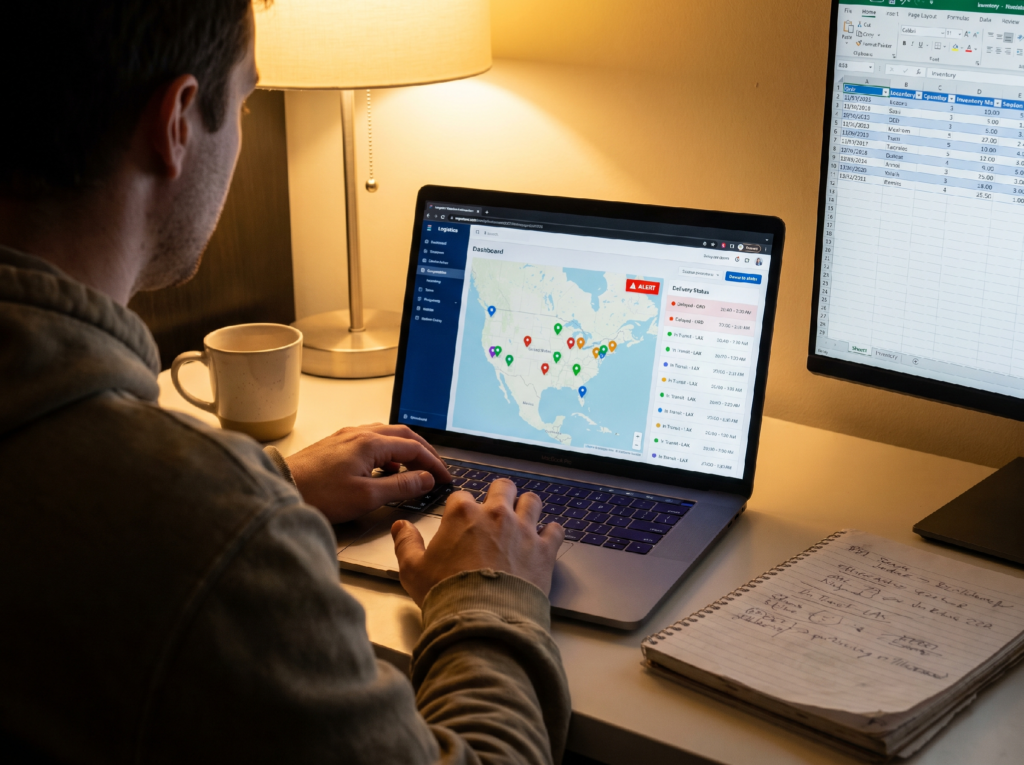
Real-time order and inventory visibility lets teams catch fulfillment exceptions before they become customer complaints.
Brands that skip this step usually don’t find out something went wrong until the customer tells them, which is the most expensive and least forgiving way to learn about a fulfillment failure.
Designing a Returns Process That Protects Margin of Ecommerce Business
Returns aren’t a footnote. They’re a core part of the fulfillment system, and treating them as an afterthought is one of the more expensive mistakes a growing brand can make. According to the NRF and Happy Returns “2025 Retail Returns Landscape” report, an estimated 19.3% of online sales were returned in 2025, compared to 15.8% across retail overall, totaling $849.9 billion in merchandise returns nationally. The same report found that 82% of consumers say free or easy returns are a major factor in their purchase decision, up from 76% the year before. It also found that 9% of all returns are fraudulent, which is a real cost that has to be underwritten by an actual process rather than an honor system.
A returns process that protects margin needs three defined stages, not an ad hoc pile of boxes in the corner of a warehouse:
- Inspect. Every returned item gets checked against a consistent standard before it’s touched again.
- Restock or dispose. Decide quickly whether the item goes back into sellable inventory, gets marked down, or gets written off.
- Refund or exchange. Process the customer-facing side fast enough that it doesn’t become a second support ticket.
Return data is also a demand signal, not just a cost center. A spike in returns for a specific SKU often points to a sizing problem, a description mismatch, or a quality issue that’s worth fixing at the source rather than absorbing at the warehouse
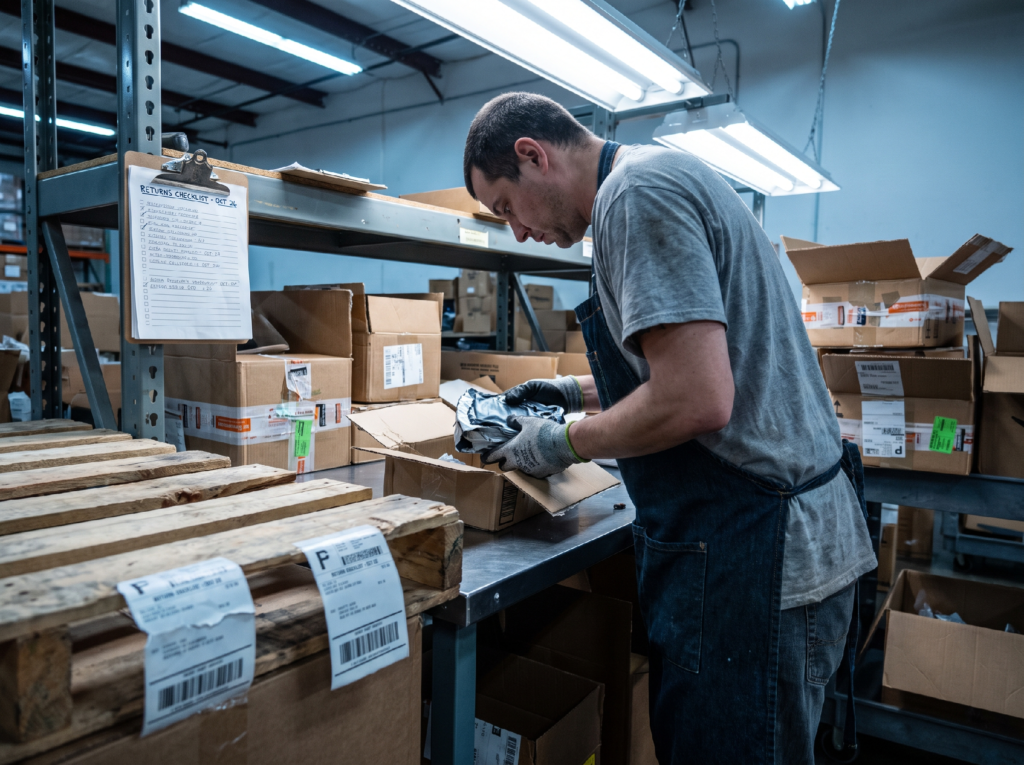
A defined returns workflow turns inspection and restocking into a controlled process instead of a backlog.
Scaling Fulfillment Without Breaking It
Most brands move through the same rough progression: self-fulfillment, then a hybrid setup, then full 3PL reliance once volume and complexity justify it. The Ecommerce Business operational checklist worth revisiting at each stage is short but easy to ignore under the pressure of daily order volume.
Reorder points and safety stock levels need updating as sales velocity changes, not once a year during a planning meeting. Peak-season capacity deserves particular attention. Ecommerce brands typically see 40-60% of their annual order volume concentrated in the fourth quarter, based on data cited across multiple 2026 3PL industry guides, which means flexible capacity, not just low cost, becomes the deciding factor once a brand is big enough to feel a Q4 spike. Multi-channel inventory sync matters just as much. A brand selling on its own site, Amazon, and a wholesale channel simultaneously needs one accurate source of truth across all three, or it will oversell on at least one of them eventually.
Fulfillment infrastructure, not ad spend, is usually the real ceiling on how fast a brand can scale. A founder can buy more traffic in an afternoon. Fixing a broken fulfillment system under pressure, during a peak season, with orders already backing up, is a much harder problem to solve on short notice.
Building the Part of the Ecommerce Business Customers Actually Feel
A store’s design and a brand’s marketing get customers to click “buy.” What happens after that click is what determines whether they come back. Fulfillment, inventory accuracy, order visibility, and a real returns process aren’t glamorous parts of building an ecommerce business, but they’re the parts a customer actually experiences every time an order ships.
Founders who treat this operational layer as core infrastructure, worth planning for before it breaks, are the ones who make it past their first real growth spurt instead of getting buried by it. The brands stuck reworking their fulfillment strategy mid-crisis are usually the ones who assumed it would sort itself out. It won’t. Build it on purpose, before volume forces the issue.
Also Read :- Is Joining a Chamber of Commerce Worth It for Businesses?