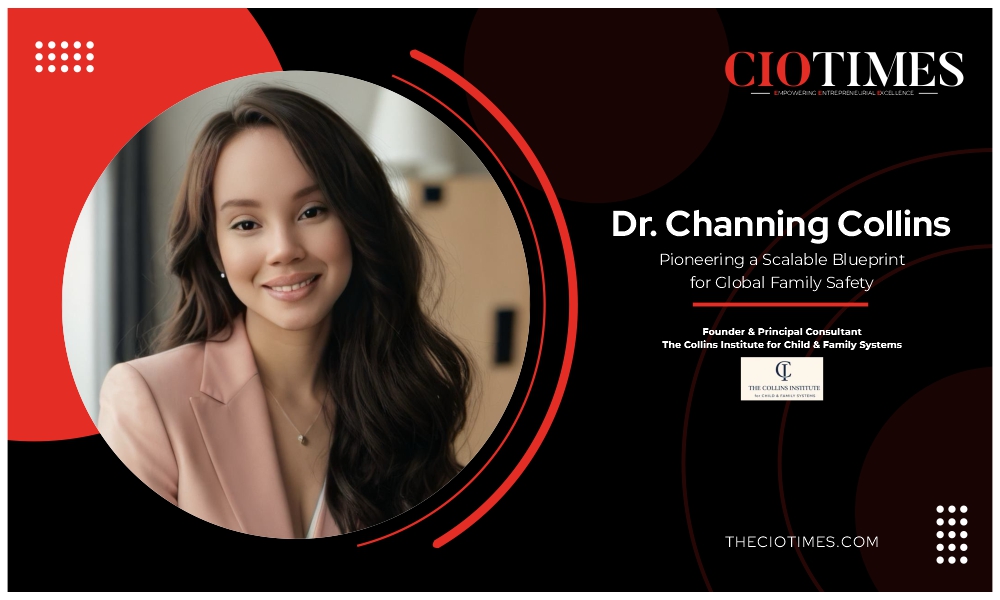
Women in business are lately looked upon as redefining what impact truly means. These women are innovators, founders, advocates, and visionaries who lead with strength and empathy. They break barriers not for recognition alone, but to create lasting change for those who follow. In this edition titled, ‘America’s Top 10 Women of Distinction, 2026,’ we are elated to introduce you to Dr. Channing Collins, Founder & Principal Consultant at The Collins Institute for Child & Family Systems. More than titles or achievements, what sets her apart is her commitment to progress, integrity, and empowering others to rise alongside them.
Systemic Resilience
Her career spans frontline case management, executive administration, and policy reform. When asked how navigating each layer shaped her view of structural change, she reflects on a journey from the ground up. Her work began on the frontline, moving from permanency into investigations. These roles exposed her to the full system lifecycle: from initial hotline reports to long-term case outcomes.
She also served on Indiana’s Critical Incident Response Team (CIRT), providing peer support after traumatic events like child fatalities or the death of a colleague. Conducting debriefings during these destabilizing moments fundamentally shaped her understanding of reform. She notes that policy discussions often overlook the emotional toll of high-profile cases and public scrutiny on staff.
Having sat with workers immediately after the tragedy, before the press releases and legislative hearings, she insists that structural reform cannot ignore this reality. If systems fail to build trauma-responsive infrastructure for staff, they lose seasoned professionals and vital institutional wisdom. Navigating frontline permanency, investigative decision-making, and executive roles clarified one truth: reform must align operational structure, workforce sustainability, and public accountability simultaneously. Anything less is a cosmetic change rather than a structural transformation.
Structural Reform
Across multiple child welfare systems, Dr. Collins observed a consistent institutional gap: jurisdictions were investing in reform language without investing in reform design.
Federal shifts such as the Family First Prevention Services Act created a historic opportunity. Yet many agencies attempted to layer prevention services onto infrastructure still structurally organized around investigation, surveillance, and removal. The result was implementation strain rather than transformation.
She saw talented leaders constrained by legacy workflows. She saw frontline staff expected to execute policy shifts without recalibrated decision thresholds, staffing models, or risk stratification tools. She saw compliance dashboards mistaken for systemic progress.
The Collins Institute for Child & Family Systems was founded to address that implementation architecture gap.
The institute does not operate as a traditional advisory body producing conceptual recommendations. It functions as a systems design and pilot lab focusing on decision-point recalibration, tiered case complexity alignment, mediation integration at critical junctures, and workforce stabilization as a safety strategy.
The timing is not incidental. Workforce attrition, fiscal constraint, and public scrutiny are converging nationally. Systems cannot afford reform that is rhetorical. They require models that can be piloted, measured, and sustained.
In an era where technology vendors are often positioned as reform leaders, she distinguishes between digitizing workflow and redesigning decision architecture. Technology can optimize processes, but only research-grounded systems analysis can correct structural misalignment.
Founding the institute was not about launching a consultancy. It was about creating structural space to test what agencies often know must change but lack the internal capacity to prototype safely.
Creating an Impact
Her upcoming article titled, “Framing Mothers, Shaping Policy: Media Portrayals of African American Women Accused of Filicide and Implications for Child Welfare Practice”, is published in the Journal of Public Child Welfare. She has co-authored it with her former dissertation chair, Dr. Marisa Bryant.
The article talks about how media framing of African American mothers accused of filicide influences public perception, judicial discretion, and ultimately policy responses in child welfare systems. It analyzes how narrative construction shapes empathy, legitimacy, and risk interpretation and how those narratives can reinforce or disrupt systemic inequities in decision-making. This magazine feature and the article publication are a testament to her hard work. It only strengthens the connection between her doctoral research and the broader systems reform work highlighted.
You can read the article here: https://www.tandfonline.com/doi/full/10.1080/15548732.2026.2633417
Structural Equity
Eliminating bias begins with redistributing discretion at the structural level. She believes awareness alone is not enough; equity must be built into how decisions are made.
Training sessions and policy statements can elevate understanding, but they do not recalibrate real-time judgment. Bias persists when thresholds for removal, substantiation, and service allocation remain opaque and unevenly applied.
Operationalizing equity, in her view, requires leaders to examine the architecture of decision-making:
- Who holds removal authority?
- What risk thresholds trigger escalation?
- How are hotline reports triaged?
- What data is reviewed in supervision, and what is ignored?
Dr. Collins urges leaders to move beyond aspirational language and implement structured decision supports that reduce subjective escalation, introduce tiered case prioritization, and monitor disparities at each decision point, not just at entry and exit.
Equity also depends on psychological safety within the workforce. Staff must feel able to question decisions, raise concerns, and surface inconsistencies without fear of retaliation. Without internal transparency, external equity efforts risk becoming performative.
She shares, “Bias is not only attitudinal. It is embedded in workflow architecture. Eliminating it requires redesigning that workflow.”
Architecting Human Change
Systemic failure is not a product of individual apathy; rather, it is an emergent property of misaligned decision-making frameworks and flawed organizational architecture. A consistent operational gap exists where high-level policy objectives conflict with localized intake protocols. For example, while legislation may explicitly prioritize family preservation, the internal performance metrics often incentivize intake units to maintain high intervention volumes. When staffing models prioritize investigative speed over the efficacy of service coordination, the organization’s legacy behaviors naturally override new legislative intent.
Reform initiatives frequently fail because they are treated as additive components rather than structural redesigns. Frontline personnel are often assigned additional mandates without a corresponding reduction in caseload or administrative requirements, transforming intended support systems into operational burdens that contribute to workforce attrition. A significant challenge in systems reform is the temporal misalignment between different organizational layers.
To resolve these structural conflicts, Dr. Collins’ Family Systems Innovation Lab (FSIL) employs a rigorous, three-stage framework for organizational transformation. The process begins with diagnostic engagement, involving collaborative sessions with both leadership and frontline staff to isolate points of maximum systemic pressure. This ensures that reform is not an abstract mandate but a response to identified operational friction.
Following this, the methodology moves into architectural mapping. This involves auditing the decision logic, intake thresholds, and supervisory patterns to identify exactly where policy mandates diverge from reality. By visualizing these workflows, the FSIL can pinpoint the specific administrative bottlenecks that prevent successful policy execution.
The final stage involves iterative implementation through a customized pilot program. Rather than a rigid, top-down prescription, this approach tests specific decision-point adjustments in a controlled environment before a full-scale rollout. This ensures that workflow requirements, staffing levels, and data metrics all evolve in a synchronized manner. By recalibrating the internal architecture of decision-making, Dr. Collins transitions reform from a rhetorical concept into a sustainable operational reality.
Decision-point Redesign
She believes the conventional FFPSA implementation models often prioritize eligibility mapping, reimbursement optimization, and compliance alignment. While those components are necessary, they are not transformative. Her approach is different.
When the Family First Prevention Services Act (FFPSA) arrived, Dr. Collins watched as many jurisdictions tried to force modern prevention into old, rigid frames designed for investigation and removal. To her, without rethinking how we triage cases and set our intake bars, “prevention” is just another layer of bureaucracy rather than a true evolution.
She shares, “Rather than layering services onto legacy infrastructure, I advocate for decision-point redesign. This includes structured risk-based prioritization models, tiered case complexity assignments, and clearly defined criteria for diversion versus investigation.”
Establishing Equal Reforms
Long before a gavel ever hits the sound block, Dr. Collins believes a family’s fate is often already written by the stories we tell. In her deeply personal doctoral research, she pulled back the curtain on a haunting double standard: she found that Black mothers caught in the system’s crosshairs are frequently stripped of their humanity, their lives reduced to criminalized snapshots, mugshots, past mistakes, and a cold language of pathology. Meanwhile, white mothers facing similar crises are often granted the grace of context, their actions framed through the softer lens of mental health struggles, past trauma, or the crushing weight of their environment.
These narratives are the invisible air that judges, attorneys, and policymakers breathe. Dr. Collins argues that judicial discretion doesn’t happen in a vacuum; it’s shaped by a cultural ecosystem that treats some parents as dangerous and others as merely struggling. When that threshold for empathy shifts, everything else follows: how quickly a child is removed, how easily a parent’s rights are terminated, and how severely a sentence is handed down.
She warns that even our laws can become reactionary weapons. When a high-profile tragedy is framed as a singular moral failure rather than a systemic gap, it births punitive rules instead of the healing investment of prevention. This bias isn’t always loud; it’s a quiet, subtle shadow seen in how we interpret risk or how much room for error we allow a mother. True equity means we must do more than just rewrite the law; we must interrogate the very architecture of the stories that tell us who is worthy of a second chance.
Leveraging Advocacy
Mediation is central when moments of escalation arise. In child welfare, escalations are swift. An investigation becomes adversarial, a placement disruption becomes a permanency delay, or an interagency disagreement becomes litigation. When a position becomes tough, options narrow.
Here are four primary inflection points where mediation alters the trajectory, according to Dr. Channing:
- Initial investigation – before removal decisions are finalized. Structured dialogue can surface safety planning alternatives that are not apparent in adversarial exchanges.
- Placement disruption – particularly in kinship or foster settings. Facilitated communication can stabilize placements that might otherwise dissolve.
- Permanency planning milestones – when reunification timelines intersect with judicial pressure. Mediation can clarify expectations and reduce reactive filings.
- Interagency conflict – including disagreements between child welfare, schools, service providers, or courts regarding responsibility or funding.
She shares, “Mediation does not eliminate accountability. It reorganizes communication. When conflict is structured rather than reactive, families experience greater clarity, workers experience less burnout, and courts receive more cohesive case trajectories.”
Precision Through Calibration
In the high-stakes world of child welfare, Dr. Collins sees a heartbreaking flaw: the system often treats every case as if it were the same on paper. Child welfare should be no different. She argues that a green, inexperienced worker should never walk into a fatality investigation without a safety net of veteran oversight. When we mismatch a case’s complexity with a worker’s skill level, the system’s accountability crumbles, and the trauma only deepens.
She advocates for a tiered approach as a way to balance the scales. By aligning the difficulty of a case with a worker’s specific specialization and the intensity of their supervision, the foggy reactive overload of the job clears. Decisions become defensible, and expectations finally make sense. This isn’t just about efficiency; it’s about keeping the workforce alive. This job is an emotional gauntlet, yet many agencies hire based on who can fill a seat rather than who is truly built for the role. In too many places, a simple interview is the only gatekeeper for a job that demands removal decisions and courtroom battles.
She shares, “When complexity, expertise, training, and supervision are intentionally aligned, systems become more accountable and more humane.”
She is pushing for a hiring evolution that moves beyond the resume to include stress-tested simulations and competency checks. To her, tiered design isn’t about creating a rigid hierarchy; it’s about the precision of care. When training, supervision, and expertise are intentionally woven together, the system finally becomes what it was always meant to be.
Misalignment is the Obstacle
In the world of child welfare, Dr. Collins sees a persistent, painful gap: the artificial wall between what we know and how we actually work. Research often lives in one stream of academic journals, policy reports, and federal guidance, while the daily grind operates in another: crushing caseloads, court deadlines, staffing shortages, and compliance checks. To her, these two are treated as parallel tracks rather than one integrated system. As a result, agencies function like turbulent watercourses, reactive and driven by crisis when they should be a coordinated current with aligned decisions, staffing, and supervision.
That mix allows her to approach reform not as isolated scholarship or management, but as cohesive systems architecture. She believes that until research and operational design are treated as one continuous stream, policy will continue to promise intentions that the infrastructure simply cannot sustain.
Design for Humanity
Looking ahead, she envisions a future where The Collins Institute, through its Family Systems Innovation Lab (FSIL), proves that rethinking the “bones” of a system leads to real, lasting change for families and workers alike. She built FSIL not as a standard advisory group, but as a hands-on workshop for system design. While other platforms might focus on software or compliance, she focuses on the moments where life-altering decisions are actually made. To her, the distinction is vital: simply digitizing a broken workflow doesn’t fix a lopsided risk threshold, and watching for compliance doesn’t stop an unnecessary removal.
She is seeking partners in jurisdictions ready to test-drive real structural shifts, things like risk-based intake, matching case difficulty to staff experience, and redesigning supervision to actually support prevention. She isn’t interested in working in a vacuum; she believes that when the “decision architecture” is fixed first, technology can then step in to scale those improvements. FSIL’s goal is to ensure the foundation is structurally sound before it’s ever digitized, complementing national technical efforts rather than competing with them.
Her eyes are on the data: reducing low-risk investigations, cutting racial disparities in removals, and keeping both children and the workforce stable. What truly sets her apart is a pilot before prescribing philosophy, prototyping changes in the real world, and refining them with live data. Ultimately, she is building a scalable proof of concept to show that when we align staffing and decision-making, we create a safer, more humane world for everyone involved.
She adds, “The long-term objective is not isolated reform. It is a scalable proof of concept demonstrating that when decision thresholds, staffing alignment, and conflict architecture are recalibrated simultaneously, both families and workers experience safer, more stable outcomes.”
Breaking Silence
In the high-stakes environment of child welfare, Dr. Collins identifies a pervasive institutional challenge: risk-averse leadership. She observes that under significant public pressure, administrative bodies often default to self-protection rather than pursuing substantive structural transformation.
She also notes a concerning trend where professional inquiry is treated as institutional opposition. Frontline practitioners are the primary agents of policy implementation; when systemic changes occur without their collaboration, they must evaluate the practical feasibility of these shifts. However, in many agencies, this professional curiosity is misinterpreted as insubordination. Staff members who seek to optimize their service delivery are often marginalized or labeled as non-compliant, a dynamic that effectively silences the personnel who possess the most critical insights into system performance.
She shares, “When workers are included in controlled pilot phases, their questions become assets rather than obstacles.”
This culture of restricted communication is where reform efforts typically lose momentum. When a caseworker feels it is professionally unsafe to identify a procedural flaw or a contradictory mandate, the system loses its primary source of operational intelligence. While this environment may produce technical compliance, it rarely results in sustainable systemic improvement.
She maintains that reform should not be a detached mandate issued from a central office; it must be co-constructed within the field of practice. When practitioners are brought into the design process, their professional skepticism becomes a tool for operational precision. She advocates for an organizational culture where inquiry is encouraged and where the specialized knowledge of the frontline is utilized as a vital strategic resource.
Moral Conflict
The most significant challenge in child welfare leadership involves managing the dual mandate of providing family support while exercising state authority. Systems are tasked with maintaining family integrity while simultaneously possessing the legal power to investigate, remove children, and terminate parental rights. These objectives are inherently contradictory, yet they are often discussed as if they function in total alignment. In practice, they do not. When the same entity provides social services and conducts legal surveillance, the distinction between assistance and oversight becomes indistinct. Families may perceive offered services as a precursor to legal intervention rather than a support mechanism, leaving practitioners conflicted between their clinical empathy for parents and their statutory obligations.
There is an additional tension regarding the discrepancy between the expectations placed on families and the treatment of the workforce. Agencies require high levels of transparency and accountability from parents, yet frequently fail to provide that same level of organizational honesty or psychological safety to their own staff. For her, ethical leadership is defined by modeling the same values internally that are demanded externally. It is statistically and operationally inconsistent to expect vulnerability and cooperation from parents if the organizational culture remains guarded and driven by internal pressure.
She adds, “Ethical leadership in this field is not about eliminating tension. It is about navigating it transparently and intentionally.”
Central to this issue is the national discourse regarding the intersection of socioeconomic status, race, and state power. Data indicate that systemic biases often lead to the conflation of poverty with neglect; for example, Black children are represented in the foster care system at a rate of approximately 14% of the general population but account for 22% of the foster care caseload. When a lack of financial resources is misidentified as a lack of parental care, surveillance is incorrectly used as a substitute for concrete material support. Dr. Collins argues for a candid acknowledgment that child welfare is a significant application of state power. This authority carries a profound responsibility to be exercised with precision, to encourage rigorous internal questioning, and to ensure child safety without inflicting unnecessary family separation. Ethical leadership does not seek to ignore these structural tensions but to manage them with transparency and integrity.