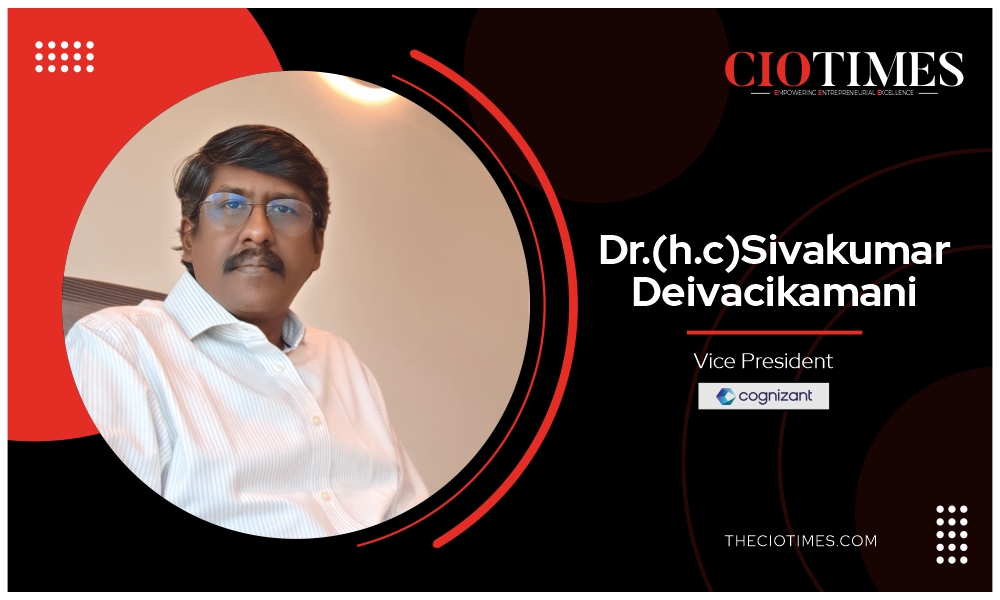
Great leaders strive for excellence. The monetary aspect is subjective for each one. Driving excellence in the job at hand while being conscious of the class of work to be delivered is what top leaders follow. In the sector of consumer goods, travel, and hospitality, the said excellence is synonymous with Dr. Sivakumar Deivacikamani, Vice President and Consumer Goods, Travel & Hospitality BU Head at Cognizant.
A seasoned, results-driven leader, they have spent their career navigating high-stakes delivery across India, North America, Europe, the UK, and Mexico. Their expertise spans diverse sectors like technology and financial services, where they specialize in making large-scale operations feel seamless. A defining achievement includes building the Tech and Ops Delivery center in Guadalajara from the ground up, turning it into a center of excellence. At their core, they blend global strategy with a practical, human-centered approach to solve complex business challenges.
An Illustrous Journey
Having worked across several geographical locations, his experience has molded his ability to lead complex, at-scale operations. Dr. Sivakumar gained a comprehensive understanding of clients’ businesses and their objectives, which enhanced his abilities and appreciation for the work. He devoted himself to the industry landscapes and remained close to the market trends.
His experience has made him seamlessly anticipate client needs and offer tailored solutions that truly add value. This has made it easier to break down even the most daunting problems into actionable steps.
He shares, “Recognizing diverse working styles and adapting to cultural differences enables teams to perform at their best and achieve success. Drawing from experiences across multinational projects, I have seen how embracing various approaches to communication and collaboration fosters creativity and harmony within a group.”
His inbuilt empathy has been his fundamental principle. Open conversations have crafted an inclusive environment where every voice is valued, ultimately leading to better outcomes and lasting professional relationships.
Value Catalyst
Having led massive delivery organizations across the outsourcing, consulting, and technology sectors, he reflects on a leadership journey that has matured as global delivery shifted from mere efficiency to deep, value-led transformation. He remains profoundly grateful for a career that began with a firm and clientele prioritizing transformation, an experience that shaped his perspective on service delivery from the very start. As he served diverse sectors spanning insurance, banking, investment, and consumer businesses across various regions, he observed how value propositions differ and learned to tailor solutions to each unique landscape. He constantly evaluates whether solutions address long-term business hurdles; when transformation is substantial, the durability of that solution is greatly enhanced.
This foundation exposed him to diverse environments and cross-functional teams, broadening his understanding of industry-specific strategies.
He shares, “Collaborating with professionals from various backgrounds enabled me to appreciate multiple viewpoints, fostering a more holistic approach to problem-solving.”
Over time, he became adept at not only identifying immediate improvements but also anticipating future shifts and potential disruptions within each sector. Through ongoing dialogue with stakeholders, he developed an ability to align service delivery with evolving market demands, ensuring outcomes were both innovative and sustainable. This journey reinforced his conviction that continuous learning and adaptability are essential for driving meaningful and lasting transformation in any organization.
Balancing Strategy & Execution
Navigating the worlds of insurance, travel, and consumer goods has taught him that driving growth is as much about intuition as it is about data. When diagnosing a business, he looks past the daily “noise” to find the real signal; if he sees problems pulling the company in too many directions at once, he knows it’s time for a structural overhaul rather than just a quick fix. However, if the issue is just a lack of focus, a few incremental tweaks often do the trick. Especially now, with AI reshaping everything, he views reinvention not as a choice, but as a necessity, though he’s quick to point out that small, steady improvements still play a vital role in keeping the engine running during a major transformation.
In his world, strategy and sales mean nothing if the delivery team can’t keep up. He’s spent years bridging the gap between big commercial ambitions and the gritty reality of execution, always keeping the trust of his investors front and center. He’s learned that you can’t lead a massive, distributed team through sheer authority; you do it through transparency. By actually explaining the “why” behind tough decisions like moving budgets or shifting priorities, he turns a workforce into a community of owners. To him, leadership isn’t just about meeting this quarter’s goals; it’s about creating an inclusive culture where everyone sees their own spark in the company’s broader vision, ensuring the success they build together actually lasts.
Being Conscious of Nuances
Picking the right anchor project is crucial for critical leadership and operational decisions. A project that aligns with both strategic objectives and stakeholder expectations leads to early wins. It depicts skill.
He shares an example, “An anchor project might be chosen based on its potential for visible impact or because it directly addresses a pain point identified by clients. Successfully delivering this project not only builds credibility but also creates momentum for future initiatives, as stakeholders become more confident in the team’s ability to execute.”
An active mindset requires constant vigilance and adaptability. It includes being prepared to identify potential roadblocks and preparing contingency plans. The teams that tackle risks and brainstorm solutions are better equipped to handle unexpected shifts in timeline or resources. Facing problems with resilience while bifurcating them into manageable tasks, seeking feedback, and staying committed is the key. This results in the organization benefiting while nurturing a sense of accomplishment within the team.
Furthermore, grasping the organizational landscape means being aware of internal dynamics, power structures, and cultural nuances when making decisions about personnel. It calls for recognizing individuals’ strengths, aspirations, and fit within the broader company vision. An example shared by him: roles are assigned based on technical skills and interpersonal compatibility within organizations. This leads to harmony in organizations with tangible result sand positive team culture. Well-thought-out personnel decisions made with transparency and empathy help maintain morale and reinforce trust throughout the organization.
Holistic Approach to Innovation
Consistent learning brings in a pool of knowledge that enhances client interactions. It also sharpens one’s ability to ideate complex business challenges. In these many years, Dr. Sivakumar and his team have developed various solutions that range from underwriter desktop platforms to the latest TravelMate and AI-enabled equipment breakdown tools, by applying design thinking methodologies. He is principled about ongoing diverse learning experiences, bringing newer perspectives, and enabling efficient problem-solving.
Furthermore, proactively participating in workshops and training sessions allows the teams to stay in line with industry trends and adopt best practices. Through collective brainstorming and prototyping exercises, the team has sustained an innovation-supporting environment.
He shares an example, “Integrating feedback from both clients and internal stakeholders has led us to refine our digital products for greater usability and impact. These diverse learning opportunities not only develop technical skills but also nurture adaptability and creative thinking, which are crucial in responding to evolving client needs and market conditions.”
By consistent improvement in the team’s culture, the team roots for delivering tailored solutions that drive value and build lasting relationships with the clients.
The Technology Benefits
Dr. Sivakumar’s diverse sectoral work experience now coincides with major technology shifts. He breaks down some sectors and their impact since the advent of technology. We’ll go through it here:
- He believes the travel sector is carrying out a critical transformation, integrating advanced technologies with legacy infrastructure and evolving from transactional service delivery to fostering meaningful customer experiences. A crucial boon for this sector due to technology access is the data at hand about clients and their key life events, which will prove increasingly valuable as the industry adopts artificial intelligence.
- In the airline, cruise, or rail arena, there’s a major shift pointed out by him. real-time and automated pricing, along with booking processes supported by agents, are becoming attainable, whereas they were only theoretical in the recent past.
- The hospitality sector is known for its influential legacy systems. It depicts huge potential for modernization, with AI providing innovative and efficient avenues for change.
- The CPG organizations have switched toward tech-driven operations. AI will dominate as these companies will be looked upon as advanced technology providers committed to delivering an enhanced experience to consumers.
The Startup Motivation
The startup population is super motivated to achieve the set goal, Dr. Sivakumar believes. Their toughness in facing both failure and success does not solely define achievement. The aligned approach is what stands out.
He states, “For entrepreneurs, small accomplishments are as meaningful as large ones, and substantial obstacles are viewed as manageable.”
Celebrating small wins is a significant mindset to imbibe. Bigger organizations that acknowledge this outlook are in favour of achieving better results. Bigger organizations can be broken down into smaller units to encourage the nurturing of startup behaviour.
Learning in Growth Cycles
- Sivakumar acknowledges that every person has a journey that shapes their perception towards life. Recognizing this allows individuals to deal with others empathetically, which enhances tangible collaboration.
- Each individual brings something new to the table, which makes them unique. As business leaders tap those abilities and leverage them, right delvers diverse value to the organization and to the individual as well.
- Lastly, keeping an ideal balance in business discussions and decisions while being able to keep emotions aside but still maintaining a human bond is a skill to practice.
Worldwide Execution with Ease
He believes that global deliveries at scale have been established with a clearly defined process that clears the air around aspects that can be standardized and which cannot. These service location decisions are primarily based on both service and client requirements. Advances in process and technology have significantly narrowed the gap between locations, though personal interaction and comfort often necessitate local support. It is advisable, stresses Dr. Sivakumar to prioritize local engagement for new clients and those outsourcing for the first time.
Purposeful Impact
While accolades such as being named among the Top Outstanding Personalities and Most Admired Global Indians reflect a career of sustained impact, he defines success through a lens that reaches far beyond growth and profitability. To him, true achievement is rooted in a quiet sense of self-satisfaction and the genuine, positive mark left on the lives of others. He finds it particularly rewarding when people maintain connections with him for over two decades without any hidden agenda; these enduring bonds serve as the most honest evidence of his character and the lasting influence he has had. He makes a habit of reflecting on his life’s purpose, recognizing that consistent, thoughtful actions toward that mission carry more weight than any corporate metric.
He shares, “Achieving a deep sense of satisfaction often stems from moments when someone expresses gratitude or shares how your guidance or support made a difference in their journey. For instance, reconnecting with an old friend who recalls a kind gesture or supportive word can be profoundly moving and further validate the importance of living with intention.”
He believes that nurturing these lifelong relationships requires a blend of empathy and flexibility, which he sees as vital for his own personal growth. This ongoing reflection on his purpose keeps him resilient and adaptable when things get tough. By constantly checking if his actions align with his core values, he stays motivated and grounded. Ultimately, he views fulfillment as an evolving, living process, enriched by both his internal peace and the deep, human connections he builds along the way.
Advice for the Future Leaders
According to Dr. Sivakumar, adaptability exists to play a significant role as diversity increases, and business flexibility gains importance. Individuals who remain aware of their environment and maintain optimism are more likely to find effective solutions to challenges; when combined with courage, this enables them to navigate complex situations. Being proactive, anticipating future developments, and preparing for uncertainties support progress toward self-defined objectives. Additionally, a strong sense of curiosity about the reasons behind change, the drivers of broader trends, global developments, and policy goals will be invaluable for emerging leaders.
Humanized Innovation
He looks at the rise of neural networks and AI not as a cold takeover, but as a long-overdue wake-up call for the consulting world. To him, this shift is stripping away the “intellectual fluff” and leaving something far more meaningful behind. As AI turns expert knowledge into a basic commodity, he believes the real value is moving back into the heart of the business, into the “context.” It’s the difference between having a map and actually knowing the terrain, the local shortcuts, and the people who live there.
Dr. Sivakumar anticipates that as machines handle the tireless, repetitive data crunching, the need for the “all-knowing” traditional consultant will naturally step aside. Instead, he sees a future where businesses look for someone who can help them weave these digital tools into the unique, human fabric of their organization.
He adds, “This shift could lead to new roles for consultants, focused on interpreting complex data, understanding industry-specific contexts, and facilitating change management.”
He envisions a new breed of partners who spend less time in spreadsheets and more time helping people navigate the uncertainty of change. Ultimately, he is convinced that the real winners won’t be the ones with the fastest software, but the ones who use that speed to make space for more human connection and deeper, customized understanding.