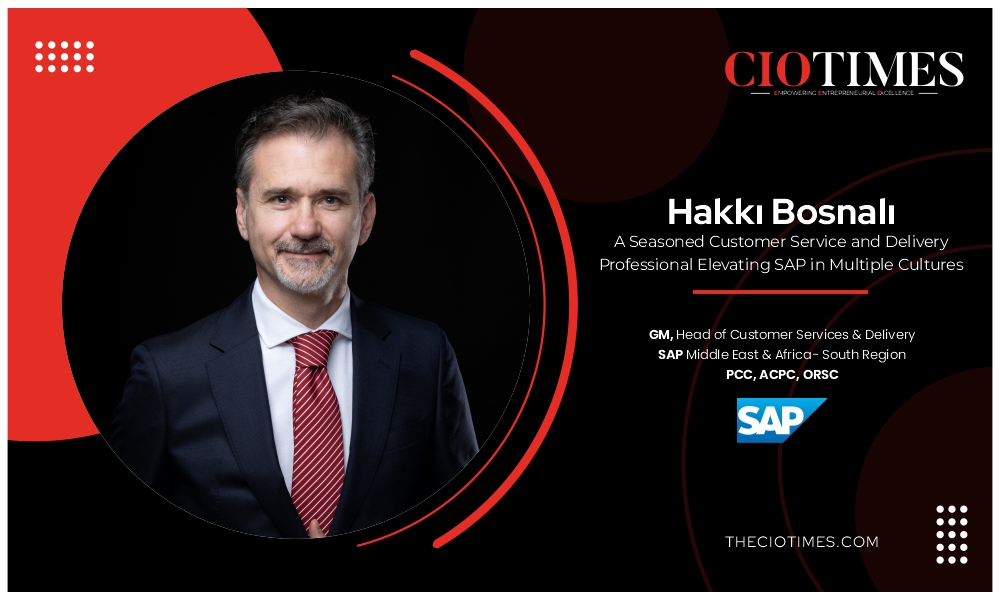
As business professionals, we’re experiencing a dynamic wave of leadership that operates beyond geographical boundaries. Today, we’re here to celebrate the iconic leaders who are visionaries when it comes to strategy, customer service, and delivery. They successfully transform how organizations operate and engage. The intent of digital acceleration and imparting the best customer experience is key to establishing trust and performance. We’re honored to feature Hakki Bosnali, GM, Head of Customer Services & Delivery, SAP Middle East & Africa – South, whose three-decade career trajectory across sectors such as consulting, sales, cloud services, and customer success is noteworthy.
A Splendid Career
His professional journey in SAP has been a thoughtful journey across the full transformational cycle. He tackled multiple aspects from hands-on delivery, to solution design, to commercial strategy, and now to end-to-end customer success and services delivery. He initiated working on SAP financial implementations at the very beginning of his career. This shaped two principles for him:
- Transformation is not an idea – it is an operating discipline.
- Value is only real when it manifests in the daily work of people.
From there, he shifted to pre-sales and business solution roles. He grasped how to translate complex technology into a clear business story. This progression became a defining moment as he defined the operating culture as a leader, rather than that of an expert. He learnt to craft the right decisions for customers and teams.
Another defining moment was when he was leading consulting and education in SAP Turkey and later took on regional responsibilities. He took on the consulting leadership role and focused on delivery excellence. The focus was: clear scope, pragmatic governance, and an obsession with making things usable. His perspective took another shape when he moved to services sales leadership across the Middle East and North Africa. This insight was: it is not enough to deliver well; we must also help customers choose the right path, invest at the right time, and build the internal capabilities that make change sustainable.
He shares, “My roles have been intentionally global and cross-cultural – from Turkey to the Middle East, and work across Africa and Southern Europe. Each move expanded my understanding of what is universal in transformation (leadership, trust, clarity, and execution) and what must be tailored (regulatory environments, industry realities, decision-making styles, and pace).”
Lately, his focus has been on business transformations with cloud technologies and AI adoption. He perceives this as a new leadership challenge in enterprise technology: speed matters, but adoption matters more; innovation matters, but value realization matters most.
The defining moments in his career path have been times where he had to accommodate worlds like technical and business, global and local, strategy and execution, while simultaneously building teams that could provide tangible results.
The Strategic Elements
Accelerating adoption is never about applying a single template; it requires clear direction with local adaptability. His approach starts with three anchors: customer value, execution discipline, and trust.
- Value Clarity
Prior to discussing features or roadmaps, Hakki’s team comes to terms with business outcomes: what has to improve, for whom, and by when. This involves converting innovation into a mutual success plan with measurable adoption and value milestones. It also includes reflecting honesty, in terms of data readiness, process standardization, skills, and change capacity.
- Industrialize execution without industrializing the customer
Across a diverse region, he believes organizations need consistent and repeatable methods, clear governance, strong enablement, practical adoption frameworks, and uncompromising delivery standards. At the same time, he recognizes the importance of honoring market realities: distinct regulatory environments, language and cultural nuances, varying levels of digital maturity, and differing expectations around speed versus certainty. His approach balances both worlds. He focuses on establishing a strong, shared backbone aligned with ways of working, measurable metrics, and rigorous quality controls while empowering local leadership to shape the how in ways that fit their markets, without ever losing sight of the why.
- Investing in an ecosystem mindset
For him, accelerating adoption at scale is about people first. It’s never just a program or a rollout; it’s a collective effort that brings together customers, SAP teams, partners, and in many markets, public stakeholders, all moving toward a common goal. He invests time early in building genuine alignment across this ecosystem, clarifying who decides what, how challenges are escalated, and what success truly looks like for everyone involved. By creating clarity and trust from the outset, he makes collaboration feel seamless, ensuring execution stays strong and steady even as complexity and expectations grow.
- The team measures value.
He believes adoption becomes visible when leading indicators are tracked, such as user enablement progress, process utilization, configuration stability, and operational readiness, not just final go-live milestones.
He adds, “When teams and customers share the same facts, we can manage reality together, correct course quickly, and keep innovation grounded in outcomes.”
Elevated Progress
Across MEA, he sees a clear change in mindset. The question is no longer, “Should we move to the cloud?” but rather, “How do we make it work the right way?” Organizations understand the promise of faster innovation, greater scalability, quicker results, but they also recognize that true transformation takes more than technology. It demands commitment, clarity, and cultural readiness.
One noticeable shift is the focus on transforming business processes, not just replacing infrastructure. Many leaders have learned that simply migrating systems without rethinking how work gets done only relocates existing complexity. The most effective cloud journeys today use the transition as an opportunity to simplify operations, standardize processes, and reshape how the business truly runs.
Another shift is the growing attention to governance, security, and data residency. Regulatory expectations and sovereign priorities across several markets are shaping cloud decisions in meaningful ways. This has led to more thoughtful architectural planning, stronger identity and access management practices, and clearer definitions of roles and responsibilities.
He also observes that expectations have evolved. Organizations now want more than successful deployment; they want measurable, ongoing value. Adoption, continuous improvement, and tangible business outcomes after go-live matter more than ever. This has elevated the importance of customer success, enablement, and change management as strategic pillars rather than afterthoughts.
Finally, the rise of AI and advanced data capabilities is adding urgency. Cloud is increasingly viewed as the foundation for intelligent operations and trusted data ecosystems. While this presents a significant opportunity, especially for emerging markets to move beyond legacy limitations, it also requires investment in skills and mindset. In his view, the human side of transformation is becoming just as important as the technology itself.
Culture as the Operating System
Coaching has been a constant in how Hakki leads. He moved from ‘driving answers’ to ‘developing capability’. This difference is key in complex, high-pressure environments where everything works on the spot and ideal solutions are limited.
His leadership is influenced in three ways. Let’s explore them:
- Improving decision-making quality
High pressure leads professionals narrow down the thought process, which brings limitations. A coaching mindset helps Hakki take a step back, separate facts from assumptions, and explore options before entrusting.
- Improving execution through ownership
He rightfully says that people execute best when they are actively involved in the process from the very start. He believes coaching conversations create the space for teams to clarify purpose, question constraints, and commit to meaningful outcomes. The result is not just stronger engagement; it is greater accountability.
- Coaching strengthens resilience and culture
Transformation work includes setbacks, ambiguity, and competing priorities. Coaching skills – deep listening, constructive challenge, and reframing – help teams stay grounded, learn from friction, and keep moving forward without losing energy or trust.
On a broader note, he views culture as the unseen force that shapes how an organization truly functions. Even the most robust technology strategy can falter when people lack the confidence to learn, collaborate, and voice their perspectives. In his experience, coaching serves as a consistent, hands-on approach to nurturing that culture each day.
Replicable Operations
Hakki starts by saying, “Leading large, multi-cultural teams is fundamentally an alignment challenge – and alignment is never achieved once; it has to be maintained through rhythm, clarity, and trust.”
He begins with a principle: make the mission easy to repeat. When multicultural teams are involved, complex strategies lose their competence at times. So the priorities are converted into shared outcomes: what customers will get, what good looks like, and how progress measurement will take place.
He believes that the right operating rhythm makes all the difference. For him, agility and accountability are built through consistent conversations, weekly check-ins to stay on track, monthly reviews to reflect on performance, and quarterly discussions that connect what’s happening locally to the broader regional vision. Decision rights are made clear from the start, and governance is treated as a way to move faster with clarity, not as red tape.
When it comes to accountability, he leans toward transparency rather than tight control. Clear metrics, shared dashboards, and open dialogue naturally create ownership. In diverse teams, where priorities can be interpreted differently, data helps everyone stay grounded in the same reality.
Agility, in his approach, starts with learning. Initiatives are broken into practical phases, feedback is invited early, and leaders closest to customers are trusted to adapt when needed. Moving fast matters, but being willing to adjust when circumstances change matters more.
He also puts real energy into culture and leadership development. Leading across cultures requires listening deeply, showing respect, and creating space where people feel safe to question ideas. One belief guides him consistently: if a team cannot operate without you, then true empowerment has not happened. Alignment and accountability grow strongest when leadership is shared, and people are enabled to step up with confidence.
A Success Story
In the Middle Eastern oil and gas sector, Hakki faced a major transformation that tested both his leadership and operational discipline. As executive sponsor, he led a program to extend a complex SAP landscape, bridging the gap between raw plant operations and core business processes while maintaining strict confidentiality for the client.
The environment was tough. Getting the right experts onto the operating site was an operational challenge, and with very little room for disruption, given production continuity, safety expectations, and compliance requirements, the stakes were incredibly high.
Rather than treating it as just another vendor project, he framed it as a shared leadership challenge. Working side-by-side with the customer’s executives, he established clear governance and a unified view of risk. He opted for a hybrid approach: technical building happened remotely, while on-site energy was saved for the high-stakes moments like validation workshops and final rehearsals where face-to-face trust mattered most.
The real win wasn’t just the technology; it was the handoff. He moved away from a reliance on external consultants by investing heavily in local talent. By coaching a dedicated network of internal super users, he ensured the team felt confident and capable of running the system long after the official launch.
The transition was smooth, resulting in a platform that genuinely sharpened data quality and visibility. More importantly, the customer team took full ownership of the result, a milestone he believes is the true hallmark of a lasting transformation.
Real-world impacts included:
- Cutting 250 manual tasks, which tightened up processes and improved data accuracy.
- Processing around 300 integration messages (IDocs) daily, giving leadership a clearer, faster view of the business.
- Syncing data from 150 production meters to create a single, trustworthy source for reporting.
- Automating truck loading, making daily logistics significantly more efficient.
Ultimately, Hakki’s experience proved that in high-pressure environments, success comes down to clarity and collaboration. As a sponsor, he sees his job as clearing the path and creating the right atmosphere for everyone to do their best work.
Holistic Leadership
Digital disruption, he believes, is about the speed of change in markets, customer expectations, and operating models. It is not only about technology now. Executives guiding organizations through this environment need a blend of strategic clarity and human leadership.
He shares notable attributes that are crucial for leaders today. They are:
– Outcome orientation: staying anchored in business value and customer impact rather than activity or hype.
– Systems thinking: understanding how processes, data, people, and governance interact, and where bottlenecks truly sit.
– Change leadership: the ability to move organizations through uncertainty, build commitment, and sustain momentum.
– Learning agility: being willing to test, learn, and adapt without losing direction.
– Coaching mindset: developing leaders and teams so the organization can scale capability, not just execute tasks.
– Trust and integrity: in a world of rapid change, trust becomes the most valuable currency.
He shares, “In short, the modern executive must be both architect and coach: designing systems that enable speed and resilience, while growing the people who will operate those systems day after day.”
Foresighted Value Creation
The sales pipeline and customer success are separate stages of a lifecycle in enterprise transformation. The sales pipeline may get fragile and short-term if the product sold isn’t generating value or isn’t easy to adapt to. Impact becomes limited if strategic growth is not taken into account.
Hakki’s approach is to connect the commercial process to value realization from the start. It shows that the team shapes opportunities around outcomes, confirms serviceability and readiness early, and ensures that the transition from ‘deal’ to ‘delivery’ is a structured handover with a shared success plan.
He also relies on customer health and adoption signals to shape pipeline decisions. When customers are clearly realizing value, growth conversations happen naturally. When they are facing challenges, the priority shifts to stabilizing and supporting them before introducing a new scope. This approach keeps the pipeline realistic and safeguards long-term relationships.
Above all, he balances immediate targets with enduring trust by staying disciplined about expectations. In every engagement, he carefully calibrates ambition to match the customer’s true capacity for change.
He shares, “A predictable transformation that builds capability will always outperform a rushed program that creates dependence or frustration. In my experience, sustainable growth comes from customers who succeed, not customers who simply sign.”
Intrigued About the Tech Transformations
Ambition and possibility are the two exciting components for Hakki in the Middle East, Africa, and other emerging markets.
He states, “Many organizations in these markets are not constrained by decades of legacy processes in the same way as more mature economies. That creates an opportunity to leapfrog – to adopt modern platforms, embed best practices, and innovate faster.”
He notices three particular exciting points.
- Cloud-enabled business standardization at scale
Modern ERP and business platforms can help organizations build resilient, transparent operations that support growth and governance.
- Surge in data and AI-driven transformation
As organizations build trusted data foundations, they can move from automation of tasks to optimization of decisions – improving forecasting, customer experience, supply chain resilience, and financial control.
- Ecosystem innovation
Across MEA, transformation is increasingly shaped by partnerships – between enterprises, technology providers, startups, and public stakeholders. This ecosystem approach can create new services, new business models, and stronger national capabilities.
He highlights, “The opportunity is significant – but it will reward leaders who treat transformation as both a technology journey and a culture journey. That is where sustainable competitiveness will come from.”
Advice for Aspiring Professionals
The path to the top of the enterprise tech world isn’t just about code; it’s about blending technical grit with a broad human perspective. A leader must master their craft, really getting their hands dirty in how value is built while also learning to speak the language of the boardroom. True range comes from stepping outside of one’s comfort zone and soaking up cross-cultural and cross-functional wisdom.
Success in this field often boils down to a few lived principles:
- Stay close to the heartbeat of the business: the customer. That’s where the real lessons in decision-making and empathy happen.
- Treat every messy project as a personal laboratory. Transformation is chaotic, but it’s the best place to practice being the calm, clear voice in a room full of ambiguity.
- Focus on people over stats. A career is measured by the people a leader helps grow, not just the contracts they sign.
- Keep the mind open. Technology moves fast; a leader’s curiosity has to move faster just to stay in the game.
There’s a powerful lesson in the idea of the extra degree, that tiny bit of added heat that turns water into steam. It’s a reminder that greatness isn’t usually a massive explosion; it’s the result of small, consistent efforts that finally break through.
In the long game, it also helps to take the Who knows what is good or bad? approach to the daily grind. Setbacks aren’t always disasters, and wins aren’t always final. By staying humble and refusing to label events too quickly, a leader keeps their balance through the highs and lows.
Finally, Hakki suggests that the ultimate goal is to become unnecessary. If a team can’t breathe without their leader, that leader hasn’t succeeded; they’ve created a cage. Real impact means giving power away, building up the people around them, and leaving a legacy that thrives long after they’ve walked out the door.