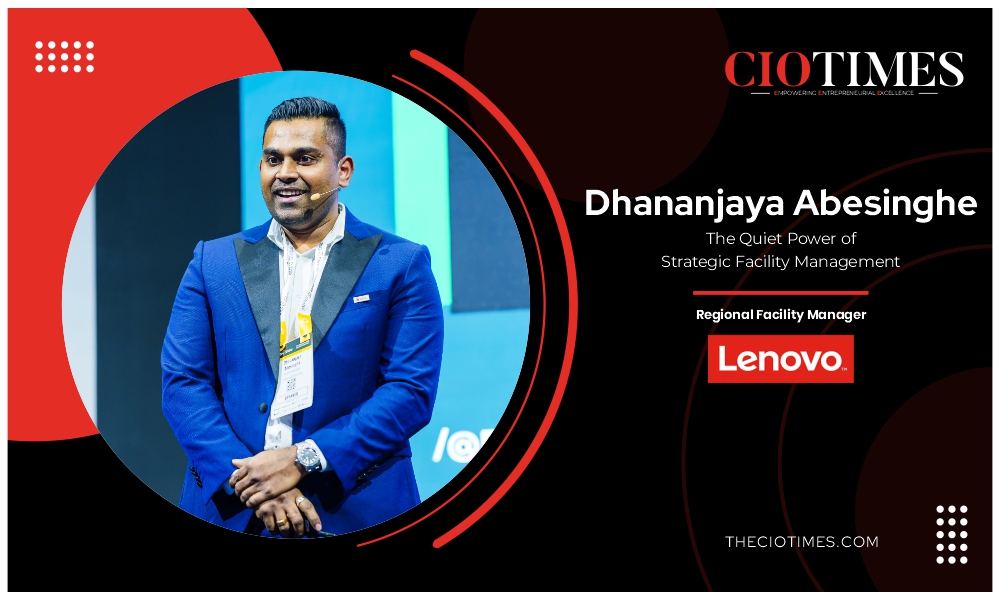
Icons of Industry: The Most Admired Business Leaders of 2026 is, at its heart, a recognition of those who lead with intention, stay grounded in their values, and make a difference that extends well beyond their organisations. In this edition, we are more than elated to feature Dhananjaya Abesinghe, a facility manager who knows his job par excellence. His dedication and hard work have made him a name in the industry. We wish him the best for his professional journey ahead!
Facility managers rarely attract attention, and when they do, it’s usually because something has failed. When buildings operate safely, systems hold, people feel supported, and work continues without interruption, it’s because someone has already solved problems before they surfaced. That quiet, preventive discipline defines the distinctive career of Dhananjaya Abesinghe.
As Regional Facility Manager at Lenovo, Abesinghe has spent 14 years working in complex, fast-moving environments where facilities are not static assets but active contributors to business performance. Daily, offices, systems, and teams feel the impact of his largely invisible work. That consistency recently earned him IFMA’s George Graves Award, making him the first recipient from outside the United States, a milestone that reflects both individual achievement and the growing maturity of the profession across the Middle East and Africa.
His recognition is built on sustained execution rather than one‑off moments. Over the years, he has received multiple internal excellence awards at Lenovo, not for showcase projects, but for delivering environments that perform reliably at scale. His career mirrors a broader shift in facility management itself, from operational oversight to strategic leadership.
Early in his career, his focus was familiar to most in the field: assets, systems, compliance, and uptime. Over time, that lens widened. As Lenovo expanded across regions, facilities could no longer be treated as containers for people. Decisions that revolved around space, technology, and infrastructure began influencing employee experience, productivity, brand perception, and sustainability outcomes. Facility management moved closer to the center of business strategy.
That shift demanded a different way of thinking. Rather than viewing buildings, people, and processes as separate concerns, Abesinghe began treating workplaces as interconnected systems. Every decision has consequences beyond the immediate task. A layout choice affects collaboration. A technology upgrade reshapes energy use. A vendor decision influences resilience. He believes the facility leader’s role is to understand those connections and align them with the organization’s goals.
He asserts, “People spend nearly 90% of their lives indoors. The average human life spans about 75 years. That means the world isn’t truly lived outside — it’s lived inside buildings.”
This systems mindset has shaped how he approaches transformation. A clear example came from a review of space utilization across several Lenovo offices in the MEA region. Occupancy data showed an imbalance many organizations recognize: some areas sat underutilized while others were constantly overburdened. Rather than defaulting to consolidation or cost-cutting, Abesinghe looked beyond the data.
For him, the issue was not square footage, but behaviour. He was always on the lookout for answers to questions like:
- How did people move through the space?
- How did they collaborate?
- Where work happened?
The response to these questions combined insight with evidence, introducing smart booking tools, reshaping layouts, and converting underused areas into collaboration zones designed around real workflows.
The results were practical and measurable. The project delivered fit-out savings, reduced lease pressure, improved the quality of workplaces, eliminated landfill waste during refurbishment, improved energy efficiency, and relied on internal talent rather than external consultants to design the space. More importantly, the offices became places people actively chose to use.
Sustainability is embedded in much of Abesinghe’s work, particularly in the UAE, where environmental responsibility is a national priority. He avoids treating sustainability as a compliance exercise or a cost trade‑off. When approached pragmatically, he believes it strengthens resilience, reduces costs, lowers long‑term risk, and improves performance. Energy‑efficient design, resource optimization, circular economy, and smart vendor partnerships are treated as fundamentals, not optional extras.
That same practicality defines his approach to technology. He sees real value in AI‑enabled buildings, predictive maintenance, and responsive systems, not as novelty features, but as tools that prevent failure before it happens. Technology, he argues, should support people, not overshadow them. Efficiency matters, but experience matters more. He reminds us that facility management influences how people work, learn, and collaborate. It is not a support function operating at the margins, but one that shapes daily human experience.
He shares, “Facility management doesn’t just manage buildings. It manages 90% of the human experience.”
Leading across the MEA region adds another layer of complexity. Regulations vary. Sustainability ambitions differ. Safety and compliance expectations are rarely uniform. What works seamlessly in one country may need reinvention in another. In this environment, strategy is never a simple replication. It requires sensitivity to local context while maintaining consistent performance.
His leadership style focuses on clarity and meaning. Standards and accountability are essential, but they only work when teams understand why they exist. Communication and transparency are central. When people see how their work connects to safety, performance, and well-being, compliance follows naturally.
Continuous learning underpins his approach. IFMA CFM, SFP, Professional certifications, and a hard-earned MBA from the Postgraduate Institute of Management (PIM) University of Sri Jayewardenepura, Sri Lanka, provide him with structure in a rapidly changing field, helping him make disciplined decisions as expectations evolve. These qualifications are tools, not status symbols.
Looking ahead, Abesinghe sees facility management becoming increasingly strategic, shaped by AI, real‑time data, and predictive systems. Buildings will move closer to self‑optimizing ecosystems supported by digital twins and advanced analytics, which enhances energy efficiency, reduce operational costs, and improve occupant comfort. Yet even as technology accelerates, he believes the profession’s core responsibility remains human.
For those entering the field, his advice is simple: be curious, find your passion around the facility management industry, embrace technology innovations, strong understanding of the business. And always keep sustainability in mind, but never lose sight of people. Facility management, he believes, has outgrown the stereotype of a back‑office function. It is now a discipline that shapes resilience, culture, and performance at scale.
In an industry where success often goes unnoticed, Dhananjaya Abeysinghe’s career stands as a powerful reminder that the most effective facility leaders are not those seeking visibility but those who quietly ensure everything works seamlessly.
He is also deeply committed to empowering the next generation of facility management professionals, encouraging them to reach their full potential, step into broader leadership roles, and become mentors and role models in the industry.
Dhananjaya serves as an inspiring example for aspiring future facility leaders.
In 2026, what it means to be a great business leader is changing in noticeable ways. It is no longer just about strong financial results or market dominance. The leaders who truly stand out today are those who combine performance with purpose and who understand the wider impact of the decisions they make. Icons of Industry: The Most Admired Business Leaders of 2026 brings together individuals who reflect this shift in leadership who are not only navigating uncertainty but quietly reshaping what meaningful success looks like.
What makes these leaders compelling is not just their vision, but how they bring it to life. They think long term, yet stay closely connected to the everyday realities of running an organisation. In a world defined by constant change from rapid technological advances to growing environmental pressures, they show an ability to adapt without losing focus. They know when to push for innovation and when to strengthen the basics, recognising that lasting progress depends on getting both right.
Their approach to people is equally telling. The most admired leaders this year understand that real transformation does not happen in isolation. It happens through teams. They invest time in developing talent, create cultures where trust and accountability matter, and make space for people to do their best work. Their leadership feels less about authority and more about enabling others to succeed.
There is also a clear sense of responsibility in how they operate. These leaders look beyond immediate business goals and think about the role they play in a larger context. Whether it is sustainability, community impact, or raising standards within their industries, they act with an awareness that their decisions ripple outward.