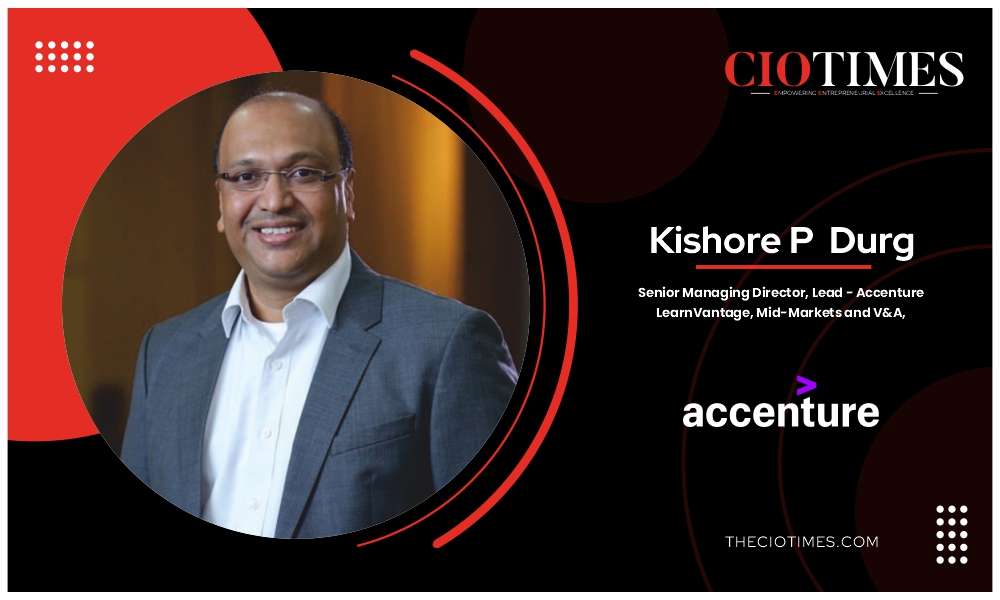
In today’s hyper-tech-dominated era, business leaders are no longer just enablers of business. They have become the architects of business transformation. Every decision is increasingly powered by insights from AI. A global leader who is a flagbearer of this transformation is Kishore Durg, Senior Managing Director, Lead Accenture LearnVantage,Mid Market and V&A. From predicting customer needs to streamlining operations, he turns complex data into real-world action. In March 2025, he was nominated to the Accenture Hall of Fame for being one of the top 10 inventors over the last three years with the most patents.
Engineering Global Impact
A positive person at heart, his professional journey spans more than 25 years in the technology industry, though its roots trace back to his early days studying Computer Science, where he graduated at the top of his class. That foundation instilled a lifelong curiosity, technical rigor, and drive to push boundaries, qualities that have guided every step of his career.
Before joining Accenture, he worked in the airlines sector, developing software for complex, safety-critical systems. Designing solutions that had to work flawlessly at scale taught him the value of precision, resilience, and the intersection of technology with human experience. His master’s program at the University of Texas at Arlington further broadened his worldview, exposing him to diverse cultures, teams, and global perspectives, a formative experience that continues to shape how he leads today.
Since joining Accenture over 21 years ago, Kishore has built and scaled multiple global businesses. From industrializing Global Testing Services and shaping Cloud First into a $10B+ growth engine, to launching Liquid Studios and redefining Accenture’s technology go-to-market programs, his work has consistently combined operational discipline with practical innovation. He has sponsored strategic acquisitions, contributed to Accenture’s patent portfolio, and developed platforms like myNav Cloud, Green Cloud Advisor, and touchless automation solutions that marry scale with sustainability.
Kishore’s love for table tennis is more than a hobby; it has shaped his mindset as a leader and builder. The sport demands agility, sharp focus, patience, and above all, a never‑say‑die attitude. Every rally is an exercise in resilience: staying calm under pressure, adjusting strategy in real time, and never giving up on a point, no matter how difficult the angle. Kishore often draws parallels between the game and his work. Just as table tennis teaches you to respond quickly and recover instantly after a missed shot, he believes setbacks in business are simply moments to recalibrate, learn, and come back stronger. This instinctive resilience has fueled his ability to build net‑new businesses from Global Testing Services and Cloud First to Supply chain platform and LearnVantage where the journey always involves unexpected challenges, pivots, and breakthroughs. For him, the discipline and persistence honed at the table are the same qualities that help him navigate complexity, inspire his teams, and push forward with optimism and conviction.
More recently, he has overseen large segments of Accenture Operations, Supply Chain, Industry X, and Network Services, helping develop the Supply chain platform, a platform that reimagines enterprise operations as intelligent, adaptive systems.
He shares, “A defining chapter has been my deep involvement in cloud and AI not just as technologies, but as catalysts for operating model change.”
Previously, as Group Operations Officer for Accenture Technology, he drews on his blend of engineering depth, innovation, and global leadership to ensure the organization operates with excellence, scales responsibly, and delivers meaningful value to clients and teams worldwide.
Purposeful Leadership
He reflects on a guiding principle: complexity is inevitable; confusion is optional.
Whether building Cloud First, or launching LearnVantage, the leadership challenge remains remarkably consistent: aligning people, platforms, and purpose. His experiences have instilled a focus on a few enduring principles.
First, clarity of intent matters more than perfection. In every transformation, Kishore invests significant energy in defining a clear “why” and a simple North Star that teams across geographies can rally around.
Second, he has learned the power of co-creation. None of these initiatives was built in isolation. Supply chain platform, for example, required close collaboration among industry experts, hyper scalers, data scientists, operations leaders, and clients. Accenture LearnVantage brought together technology, HR, academia, Ed Tech platforms and ecosystem partners. His role often involves connecting dots and creating conditions where great ideas can compound.
Third, he values disciplined experimentation. He encourages teams to take informed risks, learn quickly, and course-correct. Intelligent failures are part of progress, but they must always be anchored in accountability and outcomes.
Finally, these experiences have made him deeply people-centric. Technology transformations succeed only when people feel included, equipped, and inspired. He leads with curiosity, listens actively, and strives to create environments where teams feel safe to think boldly and execute decisively.
Across domains, his leadership approach remains consistent: clarity, collaboration, experimentation, and care. Each transformation reinforces the belief that success is not just about systems or platforms, it is about empowering people to act with purpose.
Learning Reinvented with AI
Kishore often says that Accenture LearnVantage was born not just from a market need, but from something deeply personal, his own relentless curiosity. Outside work, he spends hours diving into subjects far from technology- medicine, architecture, interior design, astrophysics, history, and more. He learns these topics not for expertise, but out of a genuine fascination for how different disciplines think, solve problems, and connect ideas. That habit of learning deeply, and learning widely, shaped his belief that people grow the most when learning is accessible, personalized, and meaningful. It also reinforced a simple insight: the world doesn’t suffer from a lack of talent, it suffers from a lack of opportunity to learn in ways that truly fit how individuals think and what organizations need. This belief eventually crystallized into Accenture LearnVantage – a bold reinvention of how organizations and individuals learn, adapt, and thrive in the AI economy. With technology cycles accelerating and the global skills gap widening, traditional learning models, static, one-size-fits-all, and disconnected from real business needs, were no longer sufficient. He and his team recognized the urgent need for a dynamic, AI-native platform capable of delivering hyper-personalized, business-aligned learning at scale.
Accenture LearnVantage was built on several core principles:
- Personalization at Scale: Leveraging an AI-powered recommendation engine, it assesses individual skill gaps and curates learning pathways tailored to each learner’s role, aspirations, and the organization’s strategic goals. This ensures that every employee, from the C-suite to the front lines, receives relevant, timely, and actionable learning experiences.
- End-to-End Skilling Ecosystem: The platform integrates domain skills assessments, immersive hands-on labs, live sandbox environments, and industry-recognized certifications. Drawing on Accenture’s deep industry expertise and a robust partner ecosystem, including leading technology companies, universities, and content providers, Accenture LearnVantage delivers best-in-class, real-world learning.
- AI-Driven Agility: AI is not just a feature; it’s the engine powering continuous adaptation. Accenture LearnVantage uses AI to predict emerging skill needs, generate custom content, and provide real-time analytics on learning impact and ROI, enabling organizations to stay ahead of market shifts and technological disruption.
- Business Outcomes Focus: Every learning journey is tied to measurable business outcomes, whether accelerating cloud adoption, enabling responsible AI, or driving operational excellence. Kishore emphasizes transforming learning from a compliance activity into a strategic lever for growth and innovation.
AI’s Transformative Role in Enterprise Learning:
Kishore believes AI is fundamentally rewriting the learning playbook. It moves learning from something reactive to something deeply proactive, from generic to truly personal. AI now anticipates what skills people will need, delivers learning in the flow of work, and ensures that knowledge isn’t just consumed but is applied. It democratizes access, making high‑quality learning available to anyone, anywhere. And it gives leaders real insight into how skills are evolving, so talent decisions are grounded in data, not assumptions.
Accenture LearnVantage has empowered clients like S&P Global and Merck to launch comprehensive Gen AI learning programs, upskilling tens of thousands of employees and accelerating digital transformation. In India, partnerships with universities have established AI Centers of Excellence and integrated cloud and full-stack academies into curricula, boosting job readiness and placement outcomes.
The future of learning is AI-powered, immersive, and deeply integrated with business strategy, he believes. Accenture LearnVantage is envisioned as a catalyst that transforms every organization into a “talent creator,” where continuous learning, experimentation, and adaptability are embedded in the culture, and every individual is empowered to master change and drive innovation.
Human Leadership
Kishore is virtuous about it being truly about holding paradoxes. You need crystal-clear strategic clarity, a vision powerful enough to inspire thousands, but also serious execution discipline with clear goals and rigorous accountability. This means balancing intellectual curiosity and adaptability, continuously learning and questioning assumptions with the decisiveness to make sound choices, even when information is imperfect.
You also need the courage to experiment, treating “smart failures” as learning opportunities. Ultimately, leaders must simplify complexity, empower their global, diverse teams, and stay deeply human. While technology changes rapidly, foundational elements like trust, continuous learning, and a shared purpose remain constant. These qualities connect strategy with performance, enabling teams to both reliably deliver and explore bravely.He adds, “Being a leader with deep empathy, one who is truly people-centric, is absolutely crucial; it builds trust, fosters inclusion, and invests in continuous skilling.”
A cornerstone of Kishore’s grounded, human-centered leadership comes from his personal life. Staying close to his family and visiting temples with them keeps him deeply rooted, reminding him of the values of humility, gratitude, and balance. These moments of reflection help him stay calm amid complexity and reinforce his belief that leadership is ultimately about people and purpose.
Operational Excellence
Kishore explains that his previous role was to ensure one of the world’s largest technology organizations operates with precision, agility, and sustained innovation.
At a practical level, this means:
- Driving operational excellence across global delivery and platform operations
- Ensuring the right capabilities, talent, and operating models are in place to support rapid growth
- Integrating innovative AI, cloud, and platforms into scalable, repeatable solutions
- Overseeing risk, compliance, and security, ensuring trust is never compromised
Strategically, his priorities were clear:
- AI-native operations – transforming internal operations using AI and automation to raise productivity and resilience
- Accelerating client value – scaling AI- and cloud-infused solutions that deliver measurable business outcomes
- Reinventing talent at scale – ensuring people continuously build future-ready skills through personalized, always-on learning
Scaled Ingenuity
Kishore explains that innovation starts with curiosity, a genuine desire to understand problems deeply and simplify them meaningfully. But innovation alone is never enough. What has always motivated him is the powerful interplay between innovation and scale, and how they reinforce each other in transformative ways.
At Accenture, scale is not just an advantage; it is a responsibility. The organization operates across industries, continents, and technologies, serving some of the world’s most complex organizations. In such an environment, the real impact of innovation is only realized when it can scale consistently, reliably, and globally. This is why innovation and scale must go hand in hand.
Patents are not about invention for its own sake; they are about solving real problems at scale. Whether it’s cloud optimization, sustainability, sovereignty, or automation, his motivation has always been to create solutions that are practical, repeatable, and impactful.
Equally, scale demands innovation. As clients grow and their challenges become more interconnected, legacy approaches are insufficient. Scale introduces new complexities like technology sprawl, data fragmentation, talent gaps, and regulatory shifts, and innovation becomes the only way to simplify, standardize, and industrialize solutions for global impact.
This is why he has always gravitated toward patent-driven, platform-led problem solving.
He asserts, “Patents reflect not just creativity, but the ability to solve real problems in ways that are unique, structured, and repeatable.”
They help capture differentiated thinking and embed it into the core of how Accenture delivers value. From myNav Cloud and Green Cloud Advisor to Sovereign Cloud Advisor and touchless automation, many of these innovations began as targeted solutions but became foundational because they could scale.
In Accenture’s context, innovation without scale is a prototype; scale without innovation is a liability. When the two come together, they become a powerful engine for reinvention, ensuring the company stays ahead of client needs, strengthens its competitive edge, and shapes entire markets.
As businesses grow, the need for differentiated IP becomes even more critical. Ultimately, he is motivated by the opportunity to build solutions that endure, ideas that start small but grow into businesses, platforms, and transformation engines that thousands of people use and benefit from. That, to him, is the true purpose of innovation at scale. And if his journey inspires others to believe they can innovate regardless of role, that is a success in itself.
Intelligent Decisions
Kishore says that the infusion of Generative AI and advanced analytics into platforms like the Supply Chain Platform is fundamentally transforming how decision-making works across complex enterprise ecosystems. He sees organizations moving from being merely data-driven to becoming truly “intelligence-driven” and highly proactive. With augmented intelligence, Gen AI delivers real-time, context-aware insights, shifting analysis from looking backward to thinking strategically forward. This evolution enables prescriptive automation, where AI can take action, often preventing issues and optimizing operations autonomously.
Risk management becomes proactive, as Gen AI simulates scenarios and identifies potential problems before they materialize. Stakeholders receive personalized recommendations, freeing them to focus on higher-level strategic thinking.
He asserts, “Ultimately, we’re building self-optimizing ecosystems where AI continuously learns and adjusts for the best outcomes. It means faster, more resilient, and much more informed strategic choices.”
Reinventing Supply Chains
Kishore explains that when he developed the Supply Chain Platform, he was really trying to tackle some persistent headaches in traditional supply chains that were often fragmented and sluggish. One main problem was the sheer lack of end-to-end visibility; data was siloed everywhere. This platform integrated all those data points to give a single, clear picture.
He also wanted to move away from reactive decision-making that always played catch-up, so he brought in advanced analytics for proactive, predictive insights. A huge frustration was inefficient manual processes, so routine tasks were automated and workflows digitized. Plus, limited collaboration between partners was a common issue, so S the platform was enabled for seamless data exchange. Finally, traditional chains were often too rigid to handle disruptions; so the platform built in resilience and dynamic adaptation using AI and digital twins. Basically, the ambition was to turn fragmented, opaque supply chains into intelligent, agile strategic assets.
Acquisitions & Partnerships
Kishore explains that acquisitions and partnerships are vital to sustaining long-term competitiveness and act as powerful accelerators for growth and innovation. They enable organizations to quickly acquire specialized talent, unique technology, and new market access, rather than building everything from scratch. They also help expand market reach, whether geographically or by tapping into new client bases. Collaborating with startups, universities, or other companies creates rich innovation ecosystems, sparking new ideas and shared R&D, particularly in fast-moving areas like Generative AI. They bring in niche expertise and diverse perspectives that would be difficult to recruit organically. In addition, they help diversify risks and revenue streams, ensuring continued relevance as technology constantly evolves.
What makes Kishore’s approach to acquisitions unique is his personal instinct as a lifelong collector. He has an avid passion for discovering and preserving anything truly one-of-a-kind—art, plane parts, aircraft windows, titanium turbine components, and other rare pieces that most people would overlook. This collector’s mindset naturally extends into how he evaluates strategic opportunities: he is always scanning the landscape for hidden gems – capabilities, talent pools, and specialized companies that others may miss, but that can unlock new business areas and propel Accenture into the next wave of growth. For Kishore, great acquisitions are like great finds: rare, distinctive, and transformative when placed in the right system.
At their core, acquisitions and partnerships empower organizations to offer a more comprehensive, integrated, and innovative suite of services, enabling them to actively shape industry trends rather than simply follow them. Even today, in his role as Global Lead of Accenture LearnVantage, Kishore has spearheaded several strategic acquisitions that have fundamentally strengthened capabilities and global reach, including Udacity, a digital education pioneer known for its practitioner-level technology courses and “human in the loop” learning approach; TalentSprint, a leader in deep tech education; and Ascendient Learning, an instructor-led training and technology certification company, among others.
Scaling Transformation
Scaling global technology and operations at Accenture presented Kishore with a defining challenge: bringing consistency and standardization to an incredibly diverse global delivery network, especially during the accelerated adoption of cloud and agile methodologies. Different regions had developed their own ways of working, which led to silos across technology standards, delivery methods, and even skill sets. This fragmentation made it difficult to execute global programs smoothly and share knowledge effectively. To address the issue, a multi-pronged approach was introduced. A shared “North Star” operational model for cloud and agile was collectively defined, a global platform for common tools and services was created, and a large-scale global skilling and certification program was launched, laying early groundwork for what would later become Accenture LearnVantage. Communities of Practice were also established to encourage continuous knowledge sharing. With strong leadership sponsorship and iterative refinement, the effort significantly improved consistency and delivery worldwide, reinforcing the idea that successful scaling blends people, process, and a shared vision.
Over time, a deeper truth emerged. No matter how technical the challenge appeared, it almost always came down to talent. Scaling cloud came back to skills. Standardizing global delivery came back to skills. Driving AI adoption came back to skills. Across Accenture and with clients, every major barrier ultimately traced to the same root issue: closing skill gaps quickly, at scale, and in ways that remain relevant as technology continues to evolve.
This recurring pattern planted the early seed for Accenture LearnVantage.
Nurturing a Learning Culture
Fostering a culture of continuous learning, experimentation, and strong accountability across large, diverse global teams is an ongoing commitment for Kishore personally. It really starts by leading by example. He shares his own learning journey and embraces vulnerability, showing that it’s okay to not know everything and to always be growing. Then, there is a heavy investment in accessible, personalized platforms like LearnVantage, making continuous skilling a natural, everyday part of work. “Safe spaces” for experimentation are consciously created, reinforcing that “intelligent failures” are learning opportunities, not mistakes.
To build accountability, autonomous teams are empowered with clear objectives and the full context they need, fostering a strong sense of ownership. Cross-pollination of ideas is encouraged through vibrant Communities of Practice. Finally, learning and feedback are embedded into performance management, with both learning milestones and innovation wins celebrated. This reinforces the belief that growth comes from success as much as from lessons learned. This holistic approach helps build adaptable, forward-thinking teams.
Responsible Technology Adoption
In an era of rapid advances in AI, cloud, and automation, ensuring that technology adoption remains responsible, secure, and aligned with business value is, for Kishore, absolutely non-negotiable. The approach begins with integrated governance, with frameworks in place from the very start of a solution’s design through deployment, covering ethical AI principles, privacy, and robust cloud standards. “Secure and privacy by design” is built into everything, embedding strong security features and data controls from day one. Every adoption undergoes rigorous business case development and KPI alignment to ensure it delivers tangible ROI. There is also a strong emphasis on proactive risk assessment, analyzing potential technical, ethical, and societal risks such as AI bias, and developing mitigation plans.
One principle has increasingly become foundational to how AI is made both trustworthy and useful: the Teach & Test methodology. Through years of building and scaling AI systems, Kishore has realized that responsible AI deployment is not just about models and data; it is about how humans guide, shape, and continuously evaluate AI. This idea was central to the theme of his article published on MIT Sloan, Want the Best Results From AI? Ask a Human, where he highlights that AI cannot be left to run unchecked and that human oversight is not optional, but essential to ensuring AI behaves responsibly, avoids learned bias, and delivers intended business outcomes.
Continuous training for people on cybersecurity, responsible AI, and data privacy remains critical. Finally, ecosystem collaboration with industry bodies helps ensure alignment with evolving global standards. This multi-layered strategy ensures that technology’s extraordinary potential is harnessed ethically, securely, and in direct service of business value.
Building Legacy
Kishore says that his greatest professional satisfaction comes from building businesses that last, from Global Testing Services to Cloud First to platform-led operations.
Accenture LearnVantage holds a special place because it combines everything he cares about: technology, scale, and human impact. Yet, it stands on the foundation of all the businesses built before it.
Ultimately, he sees his proudest contribution as helping Accenture and its clients build capability, not dependency. Whether through platforms, operations, or learning, the goal has always been the same: enabling people and organizations to adapt, grow, and lead through change. That, to him, is what it means to be a builder.
On a Lighter Note:
- Upon asking his current favorite book, he shares he is a History buff and all books by William Dalrymple are his favorite one’s.
- An important lesson he has learnt is that the outcome matters the most than the effort.
- His best professional advice received is: Always give back more than you take.
- A Favorite quote: “Success is not final, failure is not fatal: It is the courage to continue that counts.” – Winston Churchill