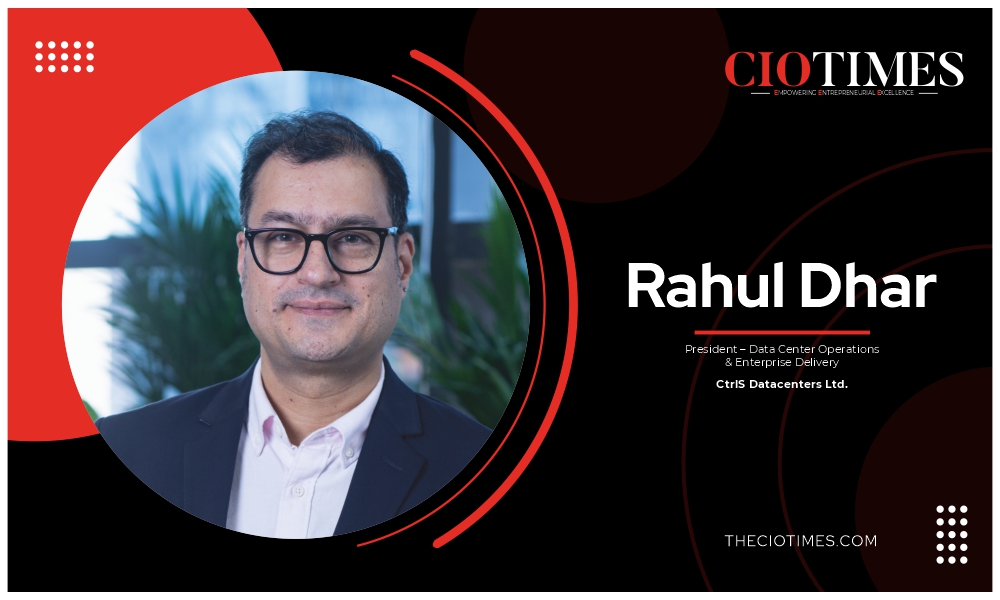
From a leader’s perspective, strong data center infrastructure isn’t just a technical asset; it’s the foundation that keeps an organization functioning with confidence. It ensures that teams can access information instantly, collaborate securely, and scale their work without disruption. For any leader, investing in this backbone isn’t optional; it’s a commitment to the organization’s future. Speaking of data center infrastructure experts, we have to mention Rahul Dhar, President – Global Data Center Operations. When backed by such maestros, a reliable infrastructure protects the company from cyber threats and unexpected outages. As digital operations become central to every department, a resilient data center becomes the quiet force behind productivity, trust, and long-term growth.
Infrastructure Leadership
Rahul’s career journey is from early telecom roles to leading global data center operations. It showcases a blend of technical expertise and strategic leadership. He began his career in telecommunications and IT project management, gaining hands-on experience with telecom infrastructure development, onsite project management, and operations at Tata Chemicals, Airtel Limited, and Vodafone Idea Cellular between 1999 and 2005. His foundation spans telecom engineering, cloud architecture, infrastructure transformation, and leadership development.
At COLT Data Centre Services in Germany and India, he served as Engineering Lead for DC Infrastructure Services, overseeing operations and long-distance fiber network monitoring across ten European countries with a 24×7 team. From 2009 to 2014, he led Northern India’s data center operations at Tata Communications, managing large-scale deployments, customer interactions, pre-sales support, and streamlining legacy contracts.
Joining Microsoft India in 2014 as Head of Data Centers, Rahul built and operated hyperscale data center campuses, supporting services like Microsoft Azure and GPU-driven AI workloads, including Microsoft Copilot. His responsibilities included strategic planning, operational resilience, capacity growth, and overall cloud infrastructure management, leading to his elevation as Country Director – Data Centers in 2020.
In September 2025, he assumed the role of President – Global Data Center Operations at CtrlS Data Centers Ltd in Hyderabad, overseeing global operations, central command visibility, process standardization, automation, enterprise colocation services, and team development for future AI growth. Rahul holds a Bachelor of Engineering in Power Electronics (1995–99), an MBA in Operations Management (2002–04), and a Master of Technology in Computing Systems & Infrastructure (2021–23).
Resilient Infrastructure
He prioritizes resilience over mere scale, designing systems with redundant power and cooling paths, active-active architectures, robust incident response, and operational patterns that maintain continuity under stress.
He adds, “Across my career, I’ve learned that scalable and resilient digital infrastructure is built on a foundation of discipline, foresight, and a people-first mindset.”
Sustainable growth, he notes, relies on automation and standardization, with telemetry-driven operations, predictive maintenance, and globally consistent SOPs to ensure repeatability. Capacity planning is grounded in data, using demand modeling, energy-density forecasting, and proactive build-ahead strategies. Safety, security, and compliance remain non-negotiable, while sustainability through renewable energy, optimized PUE/WUE, and advanced cooling technologies ensures long-term efficiency.
Rahul also highlights leadership development and team empowerment as central to operational resilience, nurturing engineers who drive innovation and make fast, informed decisions. Finally, he emphasizes flexibility for AI workloads, integrating liquid cooling, ultra-high-density power, and HPC network fabrics. These principles together create an infrastructure that is robust, scalable, energy-efficient, and ready for the next generation of cloud and AI growth.
Transformative Leadership
During his tenure at Microsoft, Rahul oversaw some of the country’s largest self-built data center campuses, a period marked by rapid cloud and AI adoption in India. One of the most transformative initiatives he led was the shift from traditional capacity planning to a hyperscale-first, AI-ready infrastructure strategy.
Rahul added, “We introduced build-ahead models, safety in design, 5S methodologies, next-generation power and cooling architectures, and site designs capable of supporting high-density GPU clusters.”
These changes fundamentally redefined how new campuses were conceived, designed, and operated, ensuring India could deliver global-grade cloud capacity with minimal latency.
Rahul also drove end-to-end standardization and automation across all operations. By deploying telemetry-driven monitoring, incident automation frameworks, predictive-maintenance models, and globally aligned SOPs and EOPs, he ensured operational consistency and scalability as Microsoft expanded its footprint in India. Sustainability was another key focus, with initiatives such as energy-efficient cooling systems, improved PUE performance, and long-term pathways for renewable-power adoption, aligning Microsoft India’s campus strategy with the company’s global carbon-neutral goals.
Equally transformational was Rahul’s emphasis on leadership development and fostering a high-performance engineering culture. Through structured competency frameworks, employee signals programs, learning portals, and entrusting emerging leaders with complex, mission-critical programs, he empowered teams to operate confidently even under the pressures of hyperscale operations.
Finally, Rahul prioritized building strong partnerships with Indian construction firms, utilities, regulators, and technology stakeholders. This collaborative approach accelerated campus delivery timelines and supported Microsoft’s broader ambition of enabling India’s cloud, AI, and digital-first economy. Together, these initiatives allowed Microsoft to operate some of the most advanced, resilient, and AI-ready data-center campuses in the region while developing strong local capabilities that will continue to benefit the industry for years to come.
AI Infrastructure
As AI and GPU-driven workloads gain prominence, Rahul has seen these technologies fundamentally reshape operational priorities at Microsoft’s data centers. Power density has become the new frontier, with racks moving from 10 kW to 80 -100 kW, driving the adoption of liquid cooling and advanced thermal architectures.
He shares, “We’re also shifting heavily to automation and telemetry-driven operations to manage the speed and scale of AI clusters for many of our customers.”
Networking, reliability, and energy efficiency now demand far greater engineering precision, prompting Rahul to focus on upskilling teams in HPC, thermal engineering, and AI-specific liquid cooling technologies. In essence, AI is redefining not only data-center design and operations but also talent development, and Rahul’s priorities have evolved to ensure Microsoft stays ahead of this curve.
Global Vision
Since moving into the role of President – Global Data Center Operations at CtrlS, Rahul has been focused on shaping a global operating model that positions the company for the next decade of growth, particularly as AI, hyperscale cloud, and high-density compute transform the data-center landscape. Strategically, he is driving the creation of a unified global operations framework and an Integrated Command Center to bring consistency, predictability, and visibility across all sites. This involves strengthening command-center capabilities, adopting globally aligned operational standards, and designing future-ready data centers with high-density, liquid-cooling, and AI-optimized infrastructure. Under his leadership, CtrlS is preparing to deliver one of the largest liquid-cooling infrastructures for a hyperscaler in Asia.
On the operational front, Rahul is steering a transformation toward automation, telemetry-driven decision-making, and standardized processes. This includes deploying advanced monitoring systems, predictive-maintenance engines, and integrated incident-management workflows that minimize downtime and enhance service reliability. Energy efficiency and sustainability are also key priorities, with metrics like PUE and WUE being optimized to handle increasingly dense, power-intensive workloads.
A significant aspect of Rahul’s mandate is building leadership depth and capability across the organization. He is establishing structured training programs, competency frameworks, and cross-geography mentoring initiatives to elevate engineering talent and prepare emerging leaders for larger responsibilities. The goal is to empower teams with the skills, autonomy, and confidence to manage globally scaled, mission-critical environments.
Additionally, Rahul is strengthening ecosystem partnerships with technology vendors, local authorities, hyperscale customers, and government stakeholders, ensuring that CtrlS’ infrastructure strategy aligns with market demand and global best practices. His overarching vision is to build a world-class, AI-ready data center operations organization resilient, efficient, and led by strong leaders capable of shaping the future of digital infrastructure both in India and globally.
Leadership Principles
Rahul’s approach to leadership, particularly in managing teams across geographies, transitions, and high-pressure operational environments, is guided by a set of core principles that consistently drive high performance.
He states, “Clarity and trust are non-negotiable.”
He believes people excel when they understand the mission, know what success looks like, and feel trusted to make decisions, providing teams with clear direction while giving them the autonomy to execute.
He also emphasizes investing in capability before responsibility. Whether through advanced technical training or leadership development, Rahul ensures his teams have the skills and confidence needed before taking on greater scale or complexity. Structured empowerment is another cornerstone of his philosophy. By combining strong operational frameworks with servant leadership, he creates guardrails within which teams are encouraged to take ownership, solve problems, and act with urgency.
Consistency, especially during transitions, rounds out his approach. As teams navigate new geographies, technologies, or major operational shifts, maintaining consistent communication, expectations, and values helps them stay focused and grounded. Together, these principles enable Rahul to build resilient, accountable, high-performance teams capable of delivering excellence in any environment.
Integrated Resilience
Rahul approaches risk management, compliance, and operational continuity in data center operations with a philosophy that embeds resilience and regulatory readiness into everyday practices. His data centers are designed with redundant power, cooling, and network paths, supported by automated controls and a remote command center to ensure they remain audit-ready at all times.
Engaging proactively with regulators and industry bodies allows him to anticipate evolving standards rather than react to them, all while keeping ESG goals in focus. Teams are trained rigorously, with simulation drills that prepare them to handle any compliance or risk scenario, ensuring operations remain stable, secure, and future-ready.
Drawing on his experience across both IT and non-IT infrastructure, Rahul runs data centers as a fully integrated ecosystem. By aligning facility design with IT architecture, leveraging unified monitoring and automation, and empowering cross-skilled teams, he delivers seamless, resilient, and scalable operations capable of supporting the demands of cloud and AI workloads.
Enabling Digital Innovation
From Rahul’s perspective, data centers have been the silent engine driving India’s digital transformation over the past decade. Since the launch of the “Digital India” campaign, they have underpinned a wide array of services from online passport applications and managing the world’s largest biometric database via UIDAI, to UPI, OTT content, e-commerce, AI, and cloud-native innovation.
By providing secure, scalable, and high-availability infrastructure within the country, data centers have accelerated digital adoption across citizens, enterprises, and government services. In many ways, Rahul sees them as transforming India from a consumption-focused market into a hub of creation, fueling innovation, economic growth, and the next wave of AI-driven transformation.
Seamless Transitions
Rahul’s experience leading complex transitions, such as relocating maintenance operations from Germany to India, has reinforced that high-stakes transformations succeed not through process alone, but through people, clarity, and disciplined execution. He emphasizes the importance of transparent communication, early alignment on expectations, and building trust across geographies.
He adds, “Investing in capability building, documenting tribal knowledge, and creating a rigorous transition playbook ensured continuity with zero service disruption.”
He believes that true transformation happens when teams feel ownership, leadership removes ambiguity, and every step is guided by data, empathy, and operational rigor.
Peeping in the Future
Rahul emphasizes that the future of data centers will be shaped by three defining trends: AI-optimized architectures, highly efficient sustainability models, and deeply distributed edge ecosystems.
According to this view, facilities will increasingly be designed for high-density GPU workloads, with liquid and hybrid immersion cooling moving into mainstream deployment. Real-time telemetry and AI-driven operations will automate large portions of data center management. At the same time, a new class of edge data centers will push compute closer to users and devices, supporting low-latency AI inference, advanced industrial automation, and emerging digital services.
Together, these developments will transform data centers from traditional, passive infrastructure into intelligent and adaptive platforms built to power an AI-first era.
In Sync
Rahul views these priorities not as competing interests but as interdependent requirements. In his approach, stability forms the foundation, while innovation moves the organization forward. He underscores a “stability-first, innovation-forward” philosophy anchoring reliability through disciplined processes, strong standardization, and rigorous operational practices.
At the same time, new technologies, automation, and AI capabilities are introduced only through controlled, data-driven validation. Each enhancement is assessed for its effect on uptime, resilience, and customer confidence.
Through this lens, the infrastructure evolves thoughtfully and continuously, ensuring modernization happens without disruption and service stability remains uncompromised.
Experience Speaks
Rahul’s advice to for tech leaders is crystal clear: design for the future, operate with discipline, and build with purpose. He urges them to start investing in AI-ready architectures, sustainable power and cooling innovation, and strong cybersecurity foundations. He suggests building teams that are cross-skilled, mission-driven, and empowered to make data-backed decisions.
He highlights the need to increase focus on resilience rather than only on infrastructure. Also, focus should be on processes and culture. Above everything else, he shifts focus towards collaborations across the ecosystem amongst government, academia, and industry. It helps innovation, sustainability, and digital inclusion advance together. All of this will help ease the process to craft a future-defining infrastructure rather than only a future-ready one.
Manifesting the Space
Reflecting on what excites him most particularly in the context of the question about shaping the future as AI, cloud, and sustainable infrastructure converge, Rahul conveys a clear sense of purpose. He sees this moment as a rare inflection point, where data centers evolve from traditionally monolithic facilities into the core of global innovation, security, and economic progress.
From his perspective, the opportunity to guide teams through this transformation is energizing.
Rahul adds, “Leading teams through this transformation, scaling next-generation AI-ready platforms, and building infrastructure that is greener, more intelligent, and more resilient energizes me.”
He also recognizes that the industry is on the brink of unprecedented frontiers, noting that the capability to compute in space is no longer distant.
Looking ahead, he views the next phase of his journey as one focused on uplifting people, pushing technological boundaries responsibly, and contributing to a digital ecosystem designed to empower billions.