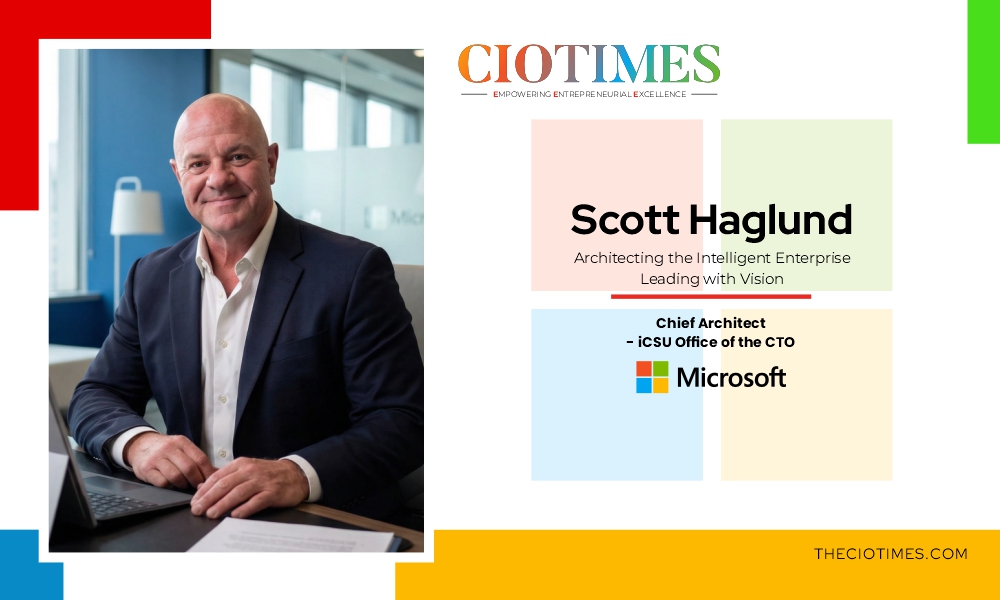
As a technologist and strategist, Scott Haglund has mastered the art of translating complexity into clarity. As Chief Architect within Microsoft’s Office of the CTO, Scott has built a reputation as someone who can bridge the gap between hyperscale innovation and boardroom priorities. His career is a testament to the idea that architecture is not about systems alone. It is about shaping outcomes that matter to global enterprises.
Scott Haglund’s story is one of vision and execution. From Fortune 100 boardrooms to global media networks, he has proven that enterprise architecture is not about chasing the latest technology—it is about building intelligent enterprises that thrive in complexity. As the cover personality of this issue, he embodies the future of enterprise leadership: strategic, adaptive, and relentlessly focused on outcomes.
Scott describes his current role as that of a translator and bridge. “The key is to start with the business outcome, not the technology,” he explains. Whether it’s accelerating market entry, enhancing customer engagement, or building resilient supply chains, his conversations begin with the client’s definition of success. This philosophy has guided some of his most impactful work.
A Career Defined by Cross-Sector Mastery
Scott’s journey across industries has shaped a philosophy that is both holistic and adaptable. He has seen firsthand that while the building blocks of technology may be similar, the priorities and definitions of value differ dramatically from one sector to another.
- Finance & Insurance: At a global insurance provider operating across 22 countries, Scott managed a $1 billion annual budget and a 400-person international team. Deploying a hybrid cloud for 22,000 servers demanded not only efficiency but also compliance with stringent regulatory frameworks. Leveraging Azure’s certifications, he achieved projected savings of $17.3 million while strengthening security and risk management.
- Media & Entertainment: At the world’s largest media conglomerate, Scott faced the challenge of delivering flawless experiences during high-profile events. His hybrid cloud architecture, powered by Azure CDN, ensured elasticity to handle unpredictable traffic spikes, whether a breaking news story or a season finale, while optimizing costs during quieter periods.
- Retail & E-commerce: For a billion-dollar direct-to-consumer retailer, Scott architected systems that achieved 99.8% uptime. By introducing globally distributed databases like Azure Cosmos DB, he safeguarded transactional integrity and tied performance metrics directly to profitability.
- Healthcare & Distribution: At a major healthcare distributor, Scott focused on reliability and interoperability. He emphasizes that today, solutions like Azure API for FHIR are critical for enabling seamless, compliant data exchange across healthcare systems, ensuring continuity in supply chains that millions depend on.
Each of these experiences reinforced a simple truth: the best architecture is not the most advanced, but the most fit for purpose.
Shaping the Future of Global Enterprises
Scott’s current work is about authoring enterprise technology visions that map directly to board-level objectives. His strategies are not abstract, but concrete, multi-year architectural roadmaps that align investment with measurable outcomes. By architecting sovereign and hybrid cloud strategies using Azure Arc, he enables enterprises to expand into new markets while respecting local data residency and regulatory requirements.
What sets Scott apart is his ability to connect technology with business imperatives in a way that resonates with both engineers and executives. He doesn’t just modernize systems; he creates opportunities for growth, resilience, and transformation.
From Legacy Systems to Cloud-First Strategy
Over the course of his career, Scott has watched IT evolve from a capital-heavy cost center into a strategic engine of agility and innovation. For him, this transformation is not just about technology but about redefining the very role of IT in shaping business outcomes.
“The most significant shift has been the redefinition of IT from a capital-intensive cost center to a strategic driver of business agility and innovation,” Scott reflects. He recalls his time as a vice president at a major media publisher, where the old CapEx-dominated model often stifled innovation. “A promising idea could become obsolete by the time the hardware to support it was racked and stacked,” he says.
The move to an OpEx model, enabled by hyperscale platforms like Microsoft Azure, changed everything. It democratized access to enterprise-grade technology, allowing teams to experiment, pivot, and scale with unprecedented velocity. For Scott, this was not just an accounting change—it was a fundamental reimagining of how businesses tie technology investment directly to immediate value creation.
Architecturally, the shift has been just as profound. Enterprises have moved from monolithic, tightly coupled systems to distributed microservices. Scott explains that this evolution is more than a technical preference—it is a strategic necessity. “Monolithic architectures are brittle and slow to change. A small modification in one part of the system requires testing and redeploying the entire application,” he notes.
By contrast, Azure’s elasticity and service-based constructs like Azure Kubernetes Service (AKS) and Azure Functions empower organizations to break applications into smaller, independent services. This enables parallel development, independent scalability, and resilience, while forcing enterprises to treat APIs as the connective tissue of the modern business. The result is a more agile, composable enterprise ready to adapt to shifting market demands.
Equally transformative has been the operational mindset. Scott points to the evolution from manual, ticket-based operations to a culture of DevOps and Platform Engineering. “The goal is no longer just to keep the lights on,” he says. “It is to build intelligent, automated platforms that empower developers to deliver value securely and efficiently.” He recalls leading the transformation of a global virtualization platform for a major financial services firm, where aggressive standardization and automation reduced IT acquisition costs by 30%. That initiative laid the groundwork for the kind of platform thinking now embodied in Azure Landing Zones. For Scott, the cloud is not a destination but a new way of operating.
Yet, despite these advances, many organizations still view cloud migration as a technical initiative rather than a strategic transformation. Scott believes this is the single greatest barrier to unlocking its full potential. “The essential mindset shift is from viewing the cloud as a place to understanding it as a new operating model,” he explains. He emphasizes that successful cloud journeys require executive sponsorship at the highest level. At a global media company, he instituted an IT Steering Committee with executive management to align technology initiatives with business strategy and financial metrics. “A successful cloud journey is not led by the CIO alone; it is championed by the CEO, CFO, and business unit leaders who see it as a vehicle for achieving their strategic goals.”
Scott also highlights the importance of moving from a project-based mentality to a product-based one. In the old model, teams built applications, handed them off, and disbanded. In the cloud-native world, durable, cross-functional teams own products for their entire lifecycle. This fosters accountability, continuous improvement, and a deeper understanding of the customer.
Scott also underscores the cultural shift from risk aversion to managed risk-taking. “The cloud makes the cost of failure negligible,” he says. With tools like Azure Dev/Test Labs, teams can spin up environments, test ideas, and tear them down without capital outlay. This encourages experimentation and agility—the hallmarks of market leaders. “The goal is not to eliminate failure but to learn from it quickly and cheaply,” Scott adds.
Challenges in the Migration Journey
Through his work with the cloud accelerate factory, Scott has seen a consistent set of challenges that organizations face, regardless of their size or industry. These are often less about technology and more about people, process, and strategy.
The most pervasive issue is underestimating legacy complexity. Many organizations begin migration with only a partial understanding of their application portfolio. Midway through, they uncover undocumented dependencies, hard-coded configurations, and layers of technical debt. These surprises lead to delays and spiraling costs. Scott insists on a comprehensive enterprise portfolio assessment by using tools like Azure Migrate as the essential first step to prioritize and phase modernization efforts.
Equally damaging is the skills gap. The demand for cloud-native expertise far outpaces supply. Teams accustomed to managing virtual machines and storage arrays often struggle with Kubernetes, serverless computing, or infrastructure-as-code. The result is poorly designed architectures, security vulnerabilities, and missed opportunities to leverage the full power of the platform.
Another common pitfall is failing to transform the operating model alongside the technical migration. Organizations that cling to manual, ticket-based systems in the cloud negate its agility benefits and sometimes incur higher costs than on-premises. This often leads to “bill shock,” as unchecked provisioning and idle environments drive expenses upward. Scott emphasizes the importance of FinOps discipline and tools like Azure Cost Management + Billing to keep financial governance in check.
Finally, security and compliance paralysis can stall initiatives before they begin. Traditional perimeter-based models are obsolete in the cloud. Without adopting a Zero Trust framework from day one, organizations expose themselves to significant risk.
Guiding Principles for Future-Ready Cloud Architecture
Architecting for the cloud, believes Scott, requires a departure from the principles that governed the static, on-premises world. A future-ready cloud environment, as defined by an Azure Landing Zone, must be dynamic, resilient, and adaptable by design. Scott’s architectural philosophy is built on five core guiding principles.
The first is to design for failure, not perfection. In distributed systems, failures are inevitable. Architectures must detect, tolerate, and recover automatically using Azure Availability Zones, health checks, auto-scaling, and loosely coupled services. This ensures that the failure of one component does not cascade into a total outage.
Second, embrace a Zero Trust security posture. The perimeter-based model is obsolete. Zero Trust requires explicit verification, least-privilege access, and an “assume breach” mindset. Every request must be authenticated and authorized through Microsoft Entra ID, embedded from the very beginning of design.
Third, automate everything with Infrastructure as Code (IaC). Networks, servers, databases, and security policies should be defined in code using Bicep or Terraform. This enables peer review, version control, and automated testing, while eliminating configuration drift. It also allows entire environments to be rebuilt in minutes—a lesson Scott applied in financial services transformations.
Fourth, adopt a Platform Engineering model. A central team should build and maintain an Internal Developer Platform with Azure DevOps, offering curated, self-service tools. This abstracts complexity, enforces governance, and lets application teams focus on delivering business value.
Finally, architect for evolvability and portability. By leveraging open standards, APIs, and containerization with Azure Kubernetes Service (AKS), organizations avoid vendor lock-in and ensure adaptability.
As Scott notes, “Today’s best-in-class service may be obsolete in three years; the architecture must be designed to evolve.”
Balancing Agility with Discipline for Cost Optimization
Balancing innovation and financial discipline has been one of the most critical challenges in cloud management. Scott believes that the answer lies in adopting a FinOps culture, which brings financial accountability to the variable spend model of the cloud. It is the operational embodiment of the principle that cost is a non-functional requirement, a core pillar of the Azure Well-Architected Framework.
The first principle, explains Scott, is visibility and accountability. In the on-premises world, costs were buried in centralized IT budgets. In the cloud, every dollar can be attributed to a specific team, product, or feature. A robust tagging strategy within Azure Cost Management + Billing is foundational. When developers see in real time that a single line of code has increased daily costs by $500, it changes both behavior and architectural decisions.
Second, Scott emphasizes empowering teams to own optimization. FinOps is not about finance policing spend—it is about giving engineering teams the autonomy and tools to make cost-aware choices. Dashboards, automated recommendations from Azure Advisor, and policies that shut down non-production resources outside business hours all reinforce this principle.
Third, cost must be integrated into architectural governance and design reviews. At a global financial firm, Scott established technical architecture review boards where cost was a primary consideration. His work on carbon-conscious patterns further demonstrated that energy-efficient designs are often more cost-efficient.
“Ultimately,” says Scott, “the goal of FinOps is not just to save money, but to maximize the business value of every dollar spent in the cloud, enabling data-driven conversations about trade-offs that keep spending aligned with strategic priorities.”
Security in the Era of Cloud and AI
Scott acknowledges that the convergence of cloud and AI has rendered traditional, perimeter-based security frameworks obsolete. The attack surface has expanded from a well-defined corporate network to a distributed ecosystem of cloud services, IoT devices, third-party APIs, and now, autonomous AI agents. Organizations must fundamentally rethink their approach to security, moving from a reactive, fortress mentality to a proactive, identity-centric framework built on the principles of Zero Trust and AI-driven security operations.
The foundational principle, Scott shares, is: never trust, always verify. Every access request, whether from a user, device, or application, must be authenticated, authorized, and encrypted before gaining entry. Least-privilege access enforced through Microsoft Entra ID, combined with micro-segmentation and continuous monitoring via Microsoft Defender for Cloud, ensures resilience against breaches.
Security must also shift-left through DevSecOps. Instead of being a late-stage check, it becomes embedded in the CI/CD pipeline. Tools like GitHub Advanced Security scan code for vulnerabilities, analyze container images, and enforce policies automatically, making security a seamless part of development.
Scott emphasizes the role of AI in augmenting security operations. With the sheer volume of signals modern enterprises face, human analysts alone cannot keep pace. Platforms like Microsoft Sentinel automate threat detection, correlate alerts, and identify sophisticated attack patterns in real time, enabling autonomous responses within milliseconds.
Finally, the rise of Agentic AI introduces a new frontier. Securing autonomous agents requires governance frameworks that embed ethical principles, monitor behavior with tools like Azure AI Content Safety, and develop containment strategies.
“Instituting a comprehensive AI governance framework is a core part of my current role, ensuring that as we build the autonomous enterprise, we do so securely and responsibly,” asserts Scott.
Bridging Technology and Business for Organizational Alignment
Bridging the gap between technology and business is perhaps the most critical role of a modern technology leader. It is a challenge that Scott has faced in every leadership position he has held. The key, he says, lies in speaking the language of the business, demonstrating value in financial terms, and building relationships based on trust and shared goals.
Technology leaders must communicate in terms of business outcomes, not technical jargon. When Scott presents a multi-year architectural strategy to the board, he talks about accelerating time-to-market, reducing customer acquisition costs, or increasing market share, and not Kubernetes clusters or serverless functions. At a global media company, he instituted an IT Steering Committee to create a shared vocabulary and align technology initiatives with strategic objectives.
Every initiative must also rest on a solid business case. Scott recalls proposing a “reverse auction” to consolidate desktop standards at a media publisher, approved because it saved over $21 million in the first year. Similarly, a grid computing solution for a financial services firm was justified by its cost-effective handling of actuarial computations.
Finally, alignment requires governance structures that foster collaboration. Scott chaired technology committees at major media conglomerates, ensuring business and technology leaders jointly prioritized initiatives. For him, the essence of leadership is making technology strategy inseparable from business strategy.
AI and the Future of Cloud Architecture
The rise of AI is catalyzing the next major evolution in cloud architecture. For the past decade, cloud architecture has been focused on providing the foundational infrastructure for modern applications: compute, storage, and networking. The next era, feels Scott, will be defined by its ability to support the development, deployment, and governance of AI-powered, autonomous systems, a shift from Infrastructure-as-a-Service to what he calls Intelligence-as-a-Service.
At the heart of this transformation is the data layer. AI models are only as strong as the data they are trained on. Future architectures must deliver unified, intelligent platforms or “data fabrics” like Microsoft Fabric that are capable of ingesting, processing, and governing data at massive scale across multi-cloud and hybrid environments, complete with integrated governance and quality controls.
Cloud environments will also need to be optimized for the AI lifecycle. Specialized GPU infrastructure for training, combined with robust MLOps platforms like Azure AI Studio, will automate everything from data preparation to deployment, monitoring, and retraining. Applications themselves will evolve into agentic systems—trained on goals, capable of learning and adapting. Architectures must orchestrate multiple AI agents through Azure OpenAI Service, securing their access to data and enforcing ethical guardrails.
Finally, Scott sees the economics of the cloud shifting from cost-per-server to cost-per-outcome. The true value will lie not in raw compute, but in the intelligence and automation it enables. In this new era, architects will sit at the very center of strategic value creation, designing systems that deliver measurable business outcomes in the most cost-effective way.
Looking Ahead: The Future of Enterprise Technology
Looking forward to the next deacde, Scott sees three interconnected trends that will redefine enterprise technology: the rise of the autonomous enterprise, the shift to composable, platform-based architecture, and the imperative of sustainable and sovereign computing.
The first is the autonomous enterprise, powered by agentic AI. Scott believes we are only at the beginning of this shift, but in the coming years AI will evolve from assisting humans to managing entire business processes independently. Platforms like Azure OpenAI Service will underpin this transformation, requiring enterprises to rethink applications, architectures, and operating models. IT’s role will move from building systems to designing, training, and governing autonomous agents.
Second, enterprises will embrace composable, platform-engineering models. Monolithic applications will give way to unified digital platforms built on microservices, APIs, and containerization, orchestrated with tools like Azure Logic Apps and Azure Functions. Business users will assemble new capabilities from reusable components, accelerating innovation and enabling near real-time adaptation to market shifts.
Finally, sustainability and digital sovereignty will become primary drivers. As AI’s energy demands grow, organizations will face pressure to adopt carbon-aware solutions using the Microsoft Cloud for Sustainability. At the same time, rising geopolitical tensions and stricter data privacy laws will make digital sovereignty essential. Solutions like the Microsoft Cloud for Sovereignty will ensure compliance with complex national and regional regulations.
“These three trends are deeply intertwined, and navigating them will be the defining challenge and opportunity for the next generation of technology leaders,” concludes Scott.
DESIGN HIGHLIGHTS
Quote: “My diverse experience has shown me that the best architecture is not the most technologically advanced, but the most fit for purpose.”
Quote: “As a chief technical advisor, the essence of my role is to ensure that our technology strategy is inseparable from our business strategy.”
Leadership Philosophies
For Scott, leadership is about aligning vision, empowering teams, and keeping the customer at the center of every decision. Over the years, he has developed a leadership philosophy rooted in enabling people to do their best work. His approach rests on the following three pillars:
- Clarity of Purpose
In complex, distributed environments, micromanagement is impossible. Scott believes leaders must provide a clear vision of the “why.” At a global insurance firm, he ensured every member of a 400-person team understood the end-state of a three-year transformation: a fully automated, scalable, and secure private cloud that would save millions and enable growth. - Empowerment with Accountability
Scott hires the best talent, gives them autonomy and resources, and holds them accountable for results. His role is to ask the right questions and remove roadblocks, fostering ownership and innovation. - Relentless Customer Focus
Whether introducing site performance metrics at a major e-commerce retailer or instituting ITIL processes at a media publisher, Scott has always tied operational performance directly to customer experience and business value.
Advice for the Next Generation of Technology Leaders
Over the years, Scott has mentored countless professionals, and his advice for the next generation of cloud architects and technology leaders is both practical and inspiring.
- Cultivate breadth, not just depth.
Be a polyglot. The strongest architects aren’t confined to one specialty—they understand networking, security, data, and application development, and can see how the pieces of the Azure portfolio fit together. Pair deep expertise in a few areas with broad knowledge across disciplines, including finance, marketing, and supply chain. - Speak the language of business.
Success isn’t measured by elegant designs, but by outcomes. Learn to read financial statements, understand company strategy, and tie every architectural proposal to revenue growth, cost reduction, or customer satisfaction. - Stay endlessly curious.
Technology changes fast. The only way to remain relevant is to be a lifelong learner. Read widely, experiment with new tools, attend conferences, and seek mentors—while also mentoring others. The best architects are those who never stop asking “What if?” and “Why?”.