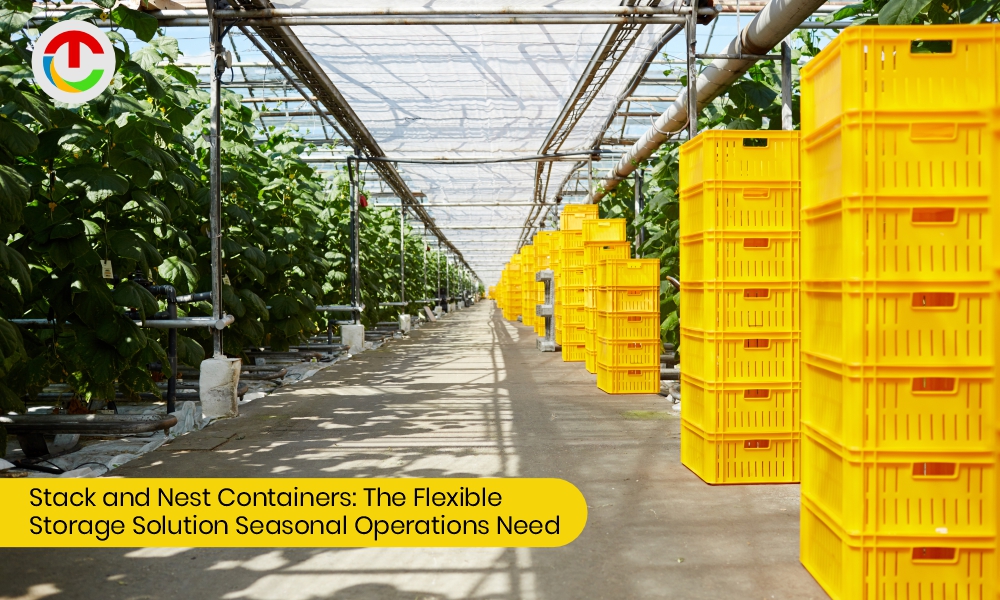
A garden supply distributor spends three months of the year maxed out on storage capacity, moving product as fast as it comes in, and then watches demand drop off and suddenly has hundreds of empty containers eating up floor space with nowhere useful to go. It’s a storage paradox that seasonal operations deal with every year, and most of them are solving it with the wrong containers. There’s a better way to handle the swing between peak capacity and quiet seasons without dedicating half your floor to empty bins.
How Stack and Nest Containers Actually Work?
The mechanism is simpler than it sounds. In the standard orientation, stack and nest containers nest directly on top of each other to hold full loads vertically. Rotate the container 180 degrees, and the walls drop down into the container below, nesting the empty units together into a much more compact footprint.
No special tools or complicated assembly required. One motion and an empty container goes from taking up a full unit of floor space to sharing that space with three or four others. For operations managing large container inventories, that difference is significant.
The Space Math on Empty Stack and Nest Containers
A common nesting ratio is 4:1, meaning four empty containers occupy roughly the same footprint as one. For a facility that runs 200 containers during peak season, that’s the difference between 200 units of floor space and about 50 during the off-season.
In a warehouse where floor space costs real money, that’s not a trivial number. It’s also the difference between a tidy, functional off-season operation and one where empty containers become an obstacle that everyone works around for months at a time.
5 Industries Where Stack and Nest Containers Earn Their Keep
The peak-and-valley storage problem shows up across more industries than most people expect. Any operation tied to seasons, holidays, or cyclical demand runs into the same challenge, and stack and nest containers handle it well across all of them.
1. Agriculture and produce:
Volume swings dramatically with harvest cycles. Stack and nest containers handle peak loads and collapse down neatly when the season ends.
2. Holiday retail:
A fulfillment operation running at full capacity in November and December needs somewhere to put a lot of empty containers come January. Nesting solves that without renting overflow space.
3. Food and beverage:
Production runs tied to seasonal demand create the same empty container problem. Stack and nest containers keep the off-cycle footprint manageable.
4. E-commerce:
Promotional periods and holiday surges create temporary capacity needs. Having containers that store compactly between peaks makes scaling up and down much less painful.
5. Events and exhibition logistics:
Equipment and materials move in large volumes for specific events and then need to be stored efficiently between them. Stack and nest containers fit that cycle naturally.
What to Compare When Buying Stack and Nest Containers
Load capacity in the stacked orientation is the obvious spec to check, but a lot of buyers miss that the nesting orientation often carries a lower weight rating. If containers will ever be partially filled while nested, verify that the nested load rating covers what you’re putting in them.
Nesting ratio matters, too, and varies by design. A 3:1 ratio versus a 5:1 ratio is a meaningful difference when you’re managing hundreds of units. Ask for this number specifically rather than assuming it from the product photos.
Lid compatibility is worth confirming upfront. Not every lid designed for a given container works when the unit is in the nested position. If lids are part of your storage plan, check that they work in both orientations before committing to a purchase.
When evaluating stack and nest containers across suppliers, also check material construction, HDPE versus polypropylene, and whether the containers are rated for your specific environment, including temperature range and any chemical exposure.
Collapsible vs. Stack and Nest: Clearing Up the Confusion
Collapsible containers fold flat using hinged walls. Stack and nest containers don’t fold at all. They nest by rotating and dropping inside each other, which generally makes them more durable since there are no hinge points to wear out or break under load.
For high-cycle applications where containers are filled, emptied, and reconfigured regularly, the lack of moving parts in a stack and nest design is a real durability advantage.
The Right Container for Operations That Don’t Stay the Same
Seasonal businesses shouldn’t have to choose between having enough containers at peak and having too many in the way during the off-season. Stack and nest containers handle both problems with one product.
Container Exchanger is a North American marketplace where businesses buy and sell new and used stack and nest containers across a range of sizes and configurations. Whether you’re building out capacity for an upcoming peak season or rightsizing after one, it’s a practical place to find what your operation actually needs.
Also Read:- CIO Times For More Information