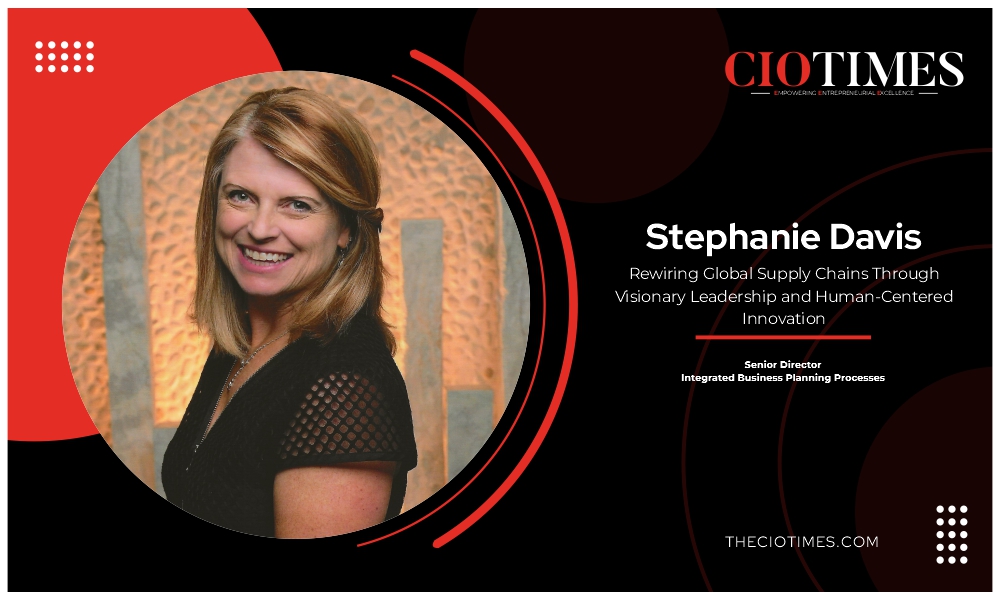
There are some professionals who sit at the intersection of strategy, operations, and technology. They triumphantly juggle moving products and managing operating systems; they also craft resilient ecosystems that keep businesses operating in today’s fairly competitive and volatile world. A similar leader is Stephanie Davis, Senior Director, Integrated Business Planning Processes. From streamlining the end-to-end supply chain system to building agile and data-driven supply networks, she handles it all seamlessly.
Clarity in Team Vision
She poses a straightforward purpose for how the operations will be in favor of customers and the business. She uplifts her teams by imbuing the right combination of the need for change, knowledge to act, and effective tools to manage their tasks as efficiently as possible. Stephanie’s priority is to build trust through credibility, responsiveness, and intimacy through empathetic leadership. Connected relationships, driven by intentional recognition of personal impact, foster team purpose. Accessibility and timely responsiveness give her team security that Stephanie will be there to support them. She focuses on business impact narratives and value-network analysis to clarify decisions and align cross-functional partners.
Innovation isn’t born in a vacuum; it’s cultivated through a narrative that resonates at every level. Over the last year, Stephanie has bridged the gap between high-level strategy and the daily pulse of the front lines, turning complex industry insights into a shared language.
As Supply Chain operations undergo a radical evolution, Stephanie recognizes that it is a necessity to move beyond simply assigning tasks to illuminating the “why” behind the paradigm shifts. By fostering deeper understanding, she has dismantled the usual silos of confusion and natural resistance to change. It is a leadership style that ensures every individual sees their reflection in the company’s broader mission, proving that when people understand their place in the future, they don’t just go through the motions, they feel part of the mission.
Pillars of Decision-making
In the role of leading integrated business planning processes, Stephanie has an approach that has three solid pillars. They are:
- Integration beats functional optimization:
She discovered that optimizing functional silos limits potential, but integrating demand, supply, and commercial narratives unlocks enterprise-level value. That insight became central to how she designs and evolves IBP.
- Scenario thinking is non-negotiable:
In demand reconciliation meetings, her team elevated the S&OP model by leveraging scenario planning to understand various probable consumer responses. Translating this to the supplier assessment, the team is developing more resilient ecosystems to ensure the readiness of the system to support today’s unpredictable consumer behaviors.
- Evidence increases adoption:
By reframing supply chain actions into tangible business value narratives, Stephanie and her team are elevating the power of data with dollar signs. With intuitive dashboards and a value-driven methodology, her team is clearing the fog for stakeholders, trading hesitant guesswork for rapid, high-confidence decision-making.
Balancing Routine Tasks with Creativity
Stephanie uses a bimodal operating approach: “stable core” and “evolution edge.” The core standardizes governance, cadences, and controls; the edge runs boxed experiments that can be scaled once proven.
Sharing an example, she states, “We codified a variable Controlled Allocation approach for constrained items to preserve fairness while avoiding the natural system panic and inventory hoarding behaviors that occur with constrained planning – a pragmatic control born from creative thinking.”
That approach sends a clear cultural signal: creativity isn’t extracurricular, it’s expected. Stephanie focuses on protecting the space for experimentation, streamlining what works, and efficiently retiring what doesn’t, ensuring the organization stays both disciplined and inventive.
Success Stories
Stephanie recalls two instances where she integrated the transformation model that gave tangible business outcomes. She shares:
- Advancing CPFR impact:
Stephanie and her team redefined the leadership standards, clarified cross-partner roles, and collaborative activation protocols for CPFR (collaborative planning, forecasting, and replenishment) operating models, including a “Special Ops” framework for high-profile system events. Clarifying decision rights and elevating collaboration behaviors is driving a sustained Collaboration Index Score of above 85% across events. This score, based on three pillars of decision synchronization, information sharing, and partner value, is an indicator of a healthier, faster end-to-end supply chain execution system.
- Evolving & Innovating S&OP Models
While the team enriched the U.S. S&OP with scenario planning and supplier risk profiling, they also built a “Journey to One S&OP Market” for small-scale markets seeking to consolidate their planning processes into a single “market” approach. This has become a roadmap for the future rollouts in smaller cross-border markets. The result of this is more consistent decision forums and a clearer line‑of‑sight between demand, risk, and capacity choices for markets with limited resources and capabilities.
The Architect of Impact
- Forecast Accuracy Value: Stephanie doesn’t just chase forecast accuracy metrics; her “Value Methodology” bridges the gap between forecast predictability and the real-world financial results of greater accuracy.
- Collaboration Index: By quantifying the pulse of CPFR routines (scoring consistently above 85%), her teams are driving end-to-end alignment and supply chain operational effectiveness in maximizing sales while minimizing cost to serve.
- Supply Chain Service KPI Suites: These supply chain performance dashboards, illustrating financial impact and operational impact, invite cross-functional teams to discover their own self-service insights on how they are impacting business outcomes and where to evolve their practices.
- Maturity Models: Her team develops multi-stage assessments to intelligently direct investments across the entire operating spectrum, from product development to advanced supply chain practices.
- Adoption & Capability Metrics: Beyond mere documentation, she tracks role-based proficiency and governance to ensure new operating models are truly adopted and practices, not just filed away after initial deployments have been implemented.
Handling the Biggies
Executing domestic promotions for a leading QSR foodservice company at a massive scale imbued discipline in Stephanie. Managing multiple concurrent annual events across a massive restaurant footprint is a high-stakes balancing act that she mastered with precision. By keeping supply breaks under 1% and waste below 2% while slashing costs by 40% for an industry-leading gaming event, she proved that scale requires a mix of rigid process oversight and fluid, integrated teamwork.
For her, these victories confirmed that elite planning is part technical rigor and part theater; the data must be flawless, but the narrative is what actually inspires a massive organization to move as one.
Leveraging Data Crunch
She emphasizes data analytics as a pathway to better judgment. Her team equates revenue creation with cost mitigation measures to spotlight where to focus action; scenario planning and risk profiling make trade-offs explicit. Her team is also implementing digital twins to fuel better results and stress test contingencies.
She adds, “From a product perspective, it’s important to author user stories and functional requirements for advanced analytics and planning tech so solutions actually reflect how planners work—reducing adoption friction later.”
Entrepreneurship Teaches
Her previous 2 ventures, Cariloha and Birthday Scenes, toughened her owner’s psyche. Running two retail boutiques to $1M in annual sales, managing 30+ employees with <1% attrition, and staying in the top 10 of 34 locations trained her to sweat unit economics. She could see nothing but customer experience and nurturing cultures where she retained people. She grew empathetic towards corporate leaders when she launched and operated an e-commerce company, leading finance, procurement, logistics, and product.
She adds, “In corporate settings, that translates to clarity on evaluating outcomes over just outputs, developing a practical risk appetite, and a bias toward earning trust and customer satisfaction through quality delivery of services.”
Steering Through Challenges
- Volatility as the Baseline: In an era of routine shocks and data gaps, Stephanie trains her teams in the art of being anti-fragile. The focus has shifted from mere prevention to proactive planning, backed by hardwired contingency playbooks, to drive high-speed recovery when incidents strike.
- Fragmented Decision Rights: To prevent brilliant minds from moving in opposite directions, her team establishes clear governance operating models. By codifying roles and escalation paths within the IBP practices, they ensure a unified front to manage through all execution experiences.
- Adoption Debt: Understanding that tech is useless without a behavioral shift, Stephanie understands the importance of prioritizing change enablement and role-based competency over simply implementing software. This ensures the new tools actually stick and drive the efficiency and quality improvement goals they were designed to achieve.
Ascending Customer-centricity
Stephanie anchors every planning talk in customer impact, using supply chain metrics to link performance to value. Providing partners with drill-down dashboards for integrated transparent insights ensures the operating plan reflects the success of all stakeholders, not just internal ones. Internally, she scales quality by codifying best practices and developing the supply chain talent of the future, moving toward true customer-centric scalability.
Intriguing Future
- AI-Assisted Planning Agents: Stephanie is embedding AI to shrink cycle times, already leveraging Copilot to elevate human judgment and scoping new ways to automate forecast and planning operations.
- Digital Twins at Scale: From event simulations to network “what-ifs,” these twins turn proactive planning into a standard ritual to outline possibilities before a decision is committed.
- Probabilistic S&OP: She is institutionalizing risk distributions over rigid, single-point plans, making the trade-offs decision explicit and aligned.
- Human-Centered Operating Models: Designing process architectures where advanced analytics serve as the foundation, allowing collaborative teams’ decisions to flourish where they matter most.
Advice for the Future Generation
- Master the Model First: Stephanie knows that if decision rights are fuzzy, no platform can save you. Build a governance structure clear enough to explain at every level of the organization.
- Tell Better Data Stories: Move beyond raw metrics. Translate accuracy, waste, and service into the business outcomes executives crave, using value methodologies to prove the financial impact of decisions.
- Design for Volatility: Make contingency playbooks and scenario planning a routine ritual. Reward teams for spotting and escalating risks early, rather than hiding them.
- Invest in the Human Element: Training, competency models, and communication playbooks are the true survivors to ensure the transfer of intelligence within teams.
- Prototype the Future: Use safe sandboxes to pilot AI agents, digital twins, and probabilistic planning, then scale only what truly delivers the greatest impact for your customers.
- Stay Customer-True: Align every roadmap to customer value. Maintain high transparency and let external measures be the ultimate judge of your accountability and success.
Operational Architect
Stephanie focuses on installing lasting behaviors within the organization. For her, true enablement is role-based, competency models that communicate the “day-in-the-life” experiences of supply chain operators. She prioritizes mechanisms, communication protocols, and team roadshows so the new way of working becomes a natural practice. Finally, she fosters coaching and community through intentional and empathetic leadership models, creating an environment where standards are reinforced and progress is celebrated.
Her work demonstrates that modern supply chains aren’t transformed by tools alone, but by leaders who can translate complexity into clarity and empower people to act with confidence. By pairing disciplined operating models with human-centered innovation, she is not just improving processes; she is rewiring how global supply chains think, decide, and evolve.