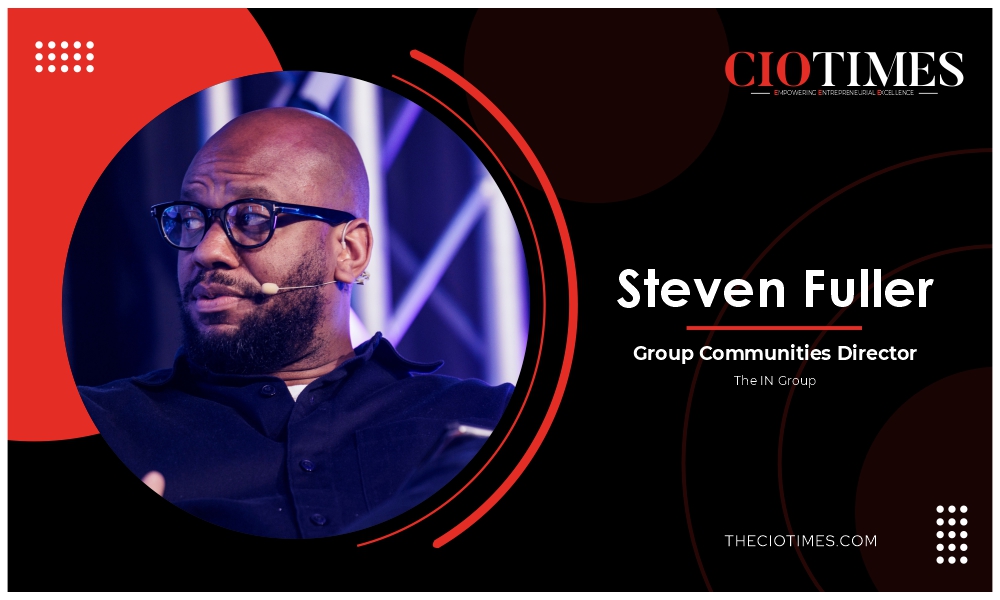
As professionals, we are surrounded by an innovation-focused economy. We come across business leaders who adopt several different measures, like Diversity, Equity, and Inclusion (DEI) with Science, Technology, Engineering, and Mathematics (STEM). These are visionaries who embrace change management and are flexible enough to experiment. They do not want to “fit in.” Such a stand-out business leader is Steven Fuller, Group Communities Director, at The IN Group. Growing up in a musical family, his parents and elder brother played musical instruments. He looked up to his elder brother. Steven himself was classically trained in the Piano, Violin, and Trombone. He then decided to continue his studies as a Jazz Trombonist; where he studied at Trinity Laban Conservatoire of Music and Dance.
He then received an invitation from a close acquaintance who was a professional drummer to rehearse with a promising new pop artist. What started as a single collaboration quickly evolved into years of global touring, performing in stadiums and on main stages at world-renowned festivals, as well as contributing to albums and singles that reached number one on international pop charts.
Following the global financial crisis in 2009, he made a strategic career transition by pursuing teaching qualifications. He went on to teach in both mainstream and special educational needs schools, eventually serving as Director of Music and Performance in 2015.
While he found teaching deeply rewarding, Steven was eager to explore new avenues beyond education. This led to an introduction by a friend to James Cox, now CEO of BioTalent (part of The IN Group), who introduced him to the world of Quality Assurance within the Life Sciences sector. Since then, Steven has specialized in supporting clients across the globe with their life sciences needs, combining his diverse professional background with a passion for excellence and innovation.
Equity Catalyst
During the pandemic, Steven took time to reflect on both his professional and personal experiences, particularly the way organizations were engaging with global clients and the perceptions held by both employers and the diverse talent they sought to attract.
He asserts, “Due to lack of representation across STEM subjects, and from my educational experiences, I founded Race in STEM, which targets how to drive equity for people of colour in STEM careers.”
What began as a series of insightful podcast interviews featuring industry professionals has since evolved into a global initiative. Today, Race in STEM has grown into a recognized platform that delivers keynote speeches at international conferences, facilitates coaching and leadership workshops, and collaborates with organizations to develop practical toolkits that promote inclusion. Under Steven’s leadership, the platform continues to catalyze dialogue, awareness, and meaningful change, driving greater recognition, understanding, and opportunity across the STEM landscape.
Inclusive Leadership
Steven defines true equity and inclusion as a shared responsibility that begins with leadership and extends across every level of an organization. He believes it is achieved through constructive dialogue, honest reflection, and the courage to challenge existing norms in a way that fosters learning rather than defensiveness. For him, equity is not simply about representation; it’s about cultivating an environment where diverse perspectives are heard, valued, and acted upon.
In both business and education, he emphasizes the importance of an inquisitive mindset, one that encourages curiosity, empathy, and open discussion without fear of judgment. He believes that senior leadership plays a pivotal role in shaping this culture by setting clear expectations, modeling inclusive behavior, and creating the psychological safety needed for meaningful conversations to take place.
True inclusion, in his view, is built through consistent investment in awareness, education, and support. When leaders actively champion these principles, organizations can move beyond policy to create environments where equity becomes not just an initiative, but a lived experience for everyone involved.
Community-Driven Inclusion
Steven believes that the foundation of meaningful DEI progress begins within communities, as they represent the true future of talent. He views community engagement as the bridge between awareness and action, an essential driver of lasting cultural transformation across industries.
From his perspective, senior leadership teams, HR professionals, and talent acquisition specialists play pivotal roles in shaping that change. Their influence extends beyond policies and programs; through everyday visibility and decision-making, they help define the cultural dynamics of an organization. By championing inclusivity at the recruitment stage and ensuring diverse voices are represented throughout the employee journey, these leaders set the tone for equitable growth.
For Steven, community and leadership must work hand in hand because creating meaningful DEI change is not just about hiring differently, but about fostering environments where people feel seen, valued, and empowered to contribute authentically.
Evolving Leadership
Steven’s journey across industries from the world of music to the life sciences has shaped a leadership philosophy grounded in accountability, empathy, and continuous learning. Each professional chapter has offered distinct challenges and rewards, reinforcing his belief that adaptability and patience are essential qualities for any effective leader.
He approaches leadership with a mindset of curiosity and humility, prioritizing understanding before influence. For him, true leadership is not about authority, but about listening deeply, learning constantly, and creating space for others to grow. He recognizes that no leader is ever completely growth is a continuous process shaped by experience and reflection.
When it comes to community building, Steven believes success lies in genuine connection and open-mindedness. People bring their own emotions, perspectives, and lived experiences to every interaction, and he sees it as a leader’s responsibility to meet them with empathy and respect. By fostering trust, valuing diverse viewpoints, and remaining inquisitive, he has built communities where collaboration and shared purpose thrive.
Empowered Communities
As Director of Communities at The IN Group, Steven approaches collaboration with underrepresented communities as both a responsibility and a privilege. He believes meaningful engagement begins with creating spaces where people feel seen, heard, and empowered to contribute authentically. Under his leadership, The IN Group partners with several community-led initiatives that focus on amplifying the voices of those who have historically been overlooked, ensuring that inclusion is woven into the organization’s culture, not treated as a separate effort.
Steven views community engagement as more than corporate social responsibility; to him, it’s a long-term investment in people and potential. Through collaborative programs, mentorship initiatives, and educational partnerships, his work helps create opportunities that span from early education to executive leadership levels.
By fostering genuine dialogue and building bridges between individuals, institutions, and industries, Steven ensures that every interaction reflects mutual respect and shared purpose. His vision is to transform community collaboration into a cycle of empowerment where today’s emerging talent becomes tomorrow’s leaders, continuing the mission of representation and inclusion across every level of business and society.
Bridging Inequities
Steven believes that the challenges surrounding racial equity and representation in STEM begin long before individuals enter the workforce; they start in schools. He emphasizes that early awareness and encouragement in STEM subjects are crucial, yet many students from diverse backgrounds face subtle bias that shapes their educational paths. From his own experience, he recalls being naturally gifted in music and encouraged to pursue it, while his deeper interest in English Literature and Engineering received less support. Although these subjects required more effort and understanding, they represented his true passion, one that could have flourished further with the right guidance at a pivotal stage in his academic journey.
He notes that this early bias often echoes later in professional environments, where systemic gaps persist in leadership representation and equal opportunities. True change, Steven suggests, demands that leaders intentionally evaluate their workforce composition and create pathways that support inclusion at every level. He highlights several key approaches leaders can implement to foster lasting equity and representation across industries:
- Recognizing transferable skills from other sectors that bring new perspectives and innovation to STEM roles.
- Investing in apprenticeships to create accessible entry points for diverse talent.
- Empowering talent acquisition teams to understand business needs while prioritizing inclusivity and long-term goals.
- Providing continual coaching and mentorship for all employees, ensuring equitable professional growth opportunities.
Steven’s perspective underscores that progress in racial equity is not achieved through isolated initiatives but through consistent, intentional actions that begin with education and extend into executive decision-making.
STEM Impact
This year, Steven collaborated with a global engineering company seeking to create a programme for their internal professionals to deliver STEM education to students ranging from age 7 through university. Leveraging his community network, he facilitated a partnership with Google at their London headquarters, where 15 students were invited to pilot and contribute to educational materials. This initiative has since opened pathways to job opportunities, apprenticeships, and further projects across the company’s global locations.
Through his work with Race in STEM, he also partnered with a privately owned global manufacturing company aiming to establish a presence in three new U.S. states and recruit 250 employees. By connecting both the company and his community network, he played a key role in identifying top talent, enabling individuals to explore new career opportunities and advance professionally.
Consistency is Key
Steven observes that STEM is set to evolve rapidly, with growing opportunities for talented individuals who bring niche ideas and creative perspectives. He emphasizes a mindset focused not on failure but on continuous improvement. Educational institutions are increasingly working to make STEM subjects more relatable, connecting them to everyday activities and practical applications, which he believes will play a critical role in shaping the next generation of innovators.
Impact Through Inclusion
Steven measures impact both within his corporate role and through initiatives like Race in STEM, primarily through feedback, which indicates how effectively goals are being met with the people they engage. He aims for 90% of participants to experience a positive impact and for 90% to learn something new.
As a speaker and facilitator, he emphasizes that many individuals underestimate their ability to drive change. He believes that inclusion, collaboration, and transformation allow people to enhance their existing skillsets and develop new capabilities. In today’s rapidly evolving world, adapting through these principles is essential.
For emerging professionals looking to champion diversity and inclusion in traditionally underrepresented sectors, Steven advises combining passion with awareness. Observing the existing environment, recognizing those who have paved the way, and understanding global sensitivities are crucial. By making subtle, thoughtful interventions, professionals can achieve meaningful and lasting impact.
Aiming for Equity
Steven’s legacy would be to provide equity with opportunities. He also wants to create an understanding and awareness by inculcating inquisitiveness. He wishes to witness diverse and inclusive companies scaling high through not only appearances but through thought leadership.