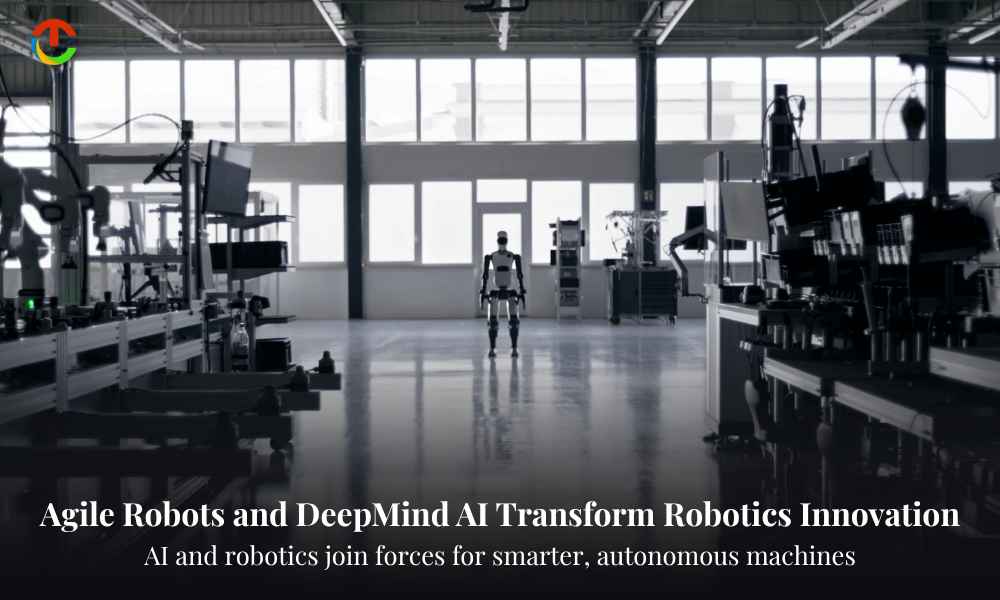
According to industry observers, this merger may hasten the creation of robot LLMs (long language models for robotics), which would improve machines’ comprehension and interaction with their surroundings. It is anticipated that the combination of nimble Robots’ nimble hardware with DeepMind’s AI would transform a variety of sectors, including manufacturing, logistics, healthcare, and service robotics.
DeepMind and Agile Robots: A Fruitful Collaboration
The collaboration combines DeepMind’s AI leadership, which includes advances in neural networks, reinforcement learning, and adaptive behavior modeling, with Agile Robots’ proficiency in physical robotic systems. Insiders claim that DeepMind has released new AI models with the goal of enabling autonomous, responsive, and task-oriented robots that will be useful in real-world situations.
Additionally, this partnership makes use of Gemini Robotics, a DeepMind-led project investigating AI applications in tangible objects. Researchers and developers can securely test AI-enabled robots through initiatives like the Gemini Robotics Trusted Tester Program, honing their skills prior to broader deployment. Additionally, by enhancing efficiency and dependability, Gemini Robotics’ on-device features seek to make robots smarter without exclusively depending on cloud computing.
Developing AI for Robotics
The collaboration is a significant advancement in the use of AI in robotics. DeepMind-powered robots will be able to:
Adaptive learning is the process of continuously enhancing performance by experience.
Improved perception: employing multimodal sensors to comprehend complicated situations.
Making wise decisions in real-time operations is known as autonomous decision-making.
These capabilities, which allow robots to carry out complex jobs with little assistance from humans, are anticipated to completely change how businesses approach automation. Robot LLMs ensure that robots can comprehend complicated orders and natural language instructions, increasing their versatility in commercial, industrial, and residential contexts.
In order to guarantee that robots behave reliably while learning from their environment, the partnership also takes safety and ethical issues into account. Businesses can now investigate new productivity opportunities by combining software intelligence with reliable robotics hardware, such as:
Inventory control and intelligent warehouses
Self-sufficient production methods
Healthcare and hospitality service robots
What This Partnership Means for the Next Phase of Robotics
The emergence of AI-powered robots is also consistent with more general trends in cloud-independent decision-making, robot LLM development, and human-robot cooperation. The technology promises to boost productivity, save expenses, and improve workplace safety as businesses incorporate these robots into routine operations.
This partnership will make robots smarter, quicker, and more capable than it has ever been, altering the role of machines in contemporary society and creating opportunities for innovation across industries.