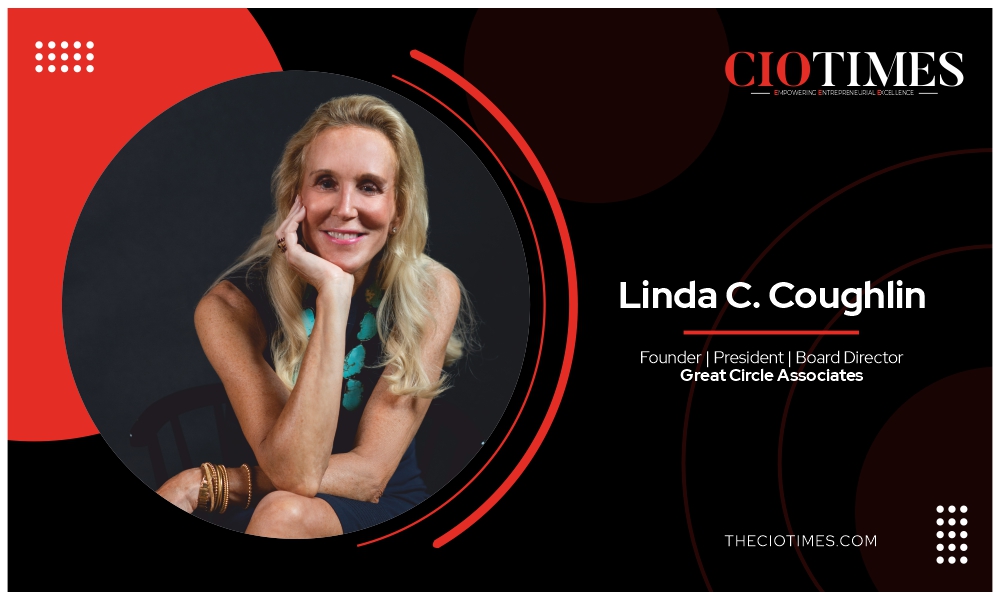
By Lin Coughlin
Strategy does not fail because it lacks intelligence.
It fails because it lacks integration.
In boardrooms and executive suites across industries, leaders are articulating bold visions — AI-enabled transformation, digital acceleration, portfolio reinvention, culture modernization. The slide decks are compelling. The models are sophisticated. The ambition is real.
And yet.
Only a fraction of large-scale change efforts achieve their intended outcomes.
The problem is not the strategy.
The problem is the gap between strategy and human execution.
We are living in a moment where artificial intelligence can redesign operating models, optimize capital allocation, and surface predictive insights at a speed previously unimaginable. But no algorithm can manufacture trust. No system can automate courage. No digital transformation succeeds without behavioral transformation.
The real work of leadership begins where the strategy deck ends.
Pull Quote #1:
“AI can optimize performance. Only leadership can align people.”
Surround Yourself With Leaders Who Can Outrun You
Early in my C-suite career, I made a deliberate decision: I would surround myself with leaders who could do circles around me.
Not because I lacked confidence.
Because I understood scale.
Whether building the AARP Investment Program to $15 billion in assets under management, leading post-merger integrations, or stabilizing global operations during restructuring, I learned that transformation is a leadership multiplier effect. You cannot personally drive every initiative, absorb every shock, or model every behavior.
You build capability.
You invest in growth.
You create ownership.
That philosophy later became foundational in my advisory practice, Great Circle Associates, where I collaborate with executives at significant inflection points — new CEOs, leaders charged with integrating acquisitions, boards navigating strategic pivots, and organizations reimagining business models in the face of digital and AI disruption.
The most durable competitive advantage is leadership depth.
And in an AI-accelerated world, that depth must include digital fluency, ethical discernment, and the ability to translate technological possibility into strategic clarity.
Values as Operating Infrastructure
Twenty-five years ago, long before “purpose-driven leadership” became mainstream language, I articulated seven values to guide the leadership of disruptive change. They were not intended as inspirational artifacts. They were designed as operational guardrails.
Celebrate uniqueness.
Practice generosity of spirit.
Lead with intellectual humility.
Commit to reciprocity.
Embrace transparency.
Reject complacency.
Act with courage.
These values remain foundational today — particularly as organizations deploy AI systems that reshape workflows, roles, and decision-making structures.
Transparency now includes algorithmic transparency.
Humility includes acknowledging what machines can do better — and where human judgment must remain sovereign.
Courage includes confronting ethical dilemmas in data usage, automation, and workforce displacement.
Organizations that operationalize values outperform those that merely publish them.
Pull Quote #2:
“Values are not inspirational slogans. They are decision filters under pressure.”
Inflection Points Reveal the Leader — and the System
Inflection points clarify.
A major acquisition.
A market collapse.
A technological disruption.
A CEO succession.
An AI-driven replatforming.
These moments reveal whether strategy and culture are aligned — or quietly at odds.
When I begin working with a senior leader, we do not start with tactical planning. We begin with discovery. Over six to eight months, we immerse deeply into business model realities, stakeholder expectations, cultural behaviors, and leadership patterns under stress.
One of the most revealing exercises is building a Leadership Timeline — mapping defining moments, successes, failures, recurring triggers, blind spots, and growth inflection points.
What leaders often discover is sobering: the behaviors that drove success in one chapter may inhibit success in the next.
That awareness becomes catalytic.
In the era of AI, this reflection becomes even more critical. Leaders must assess not only strategic readiness, but cognitive readiness — are they comfortable making decisions augmented by data intelligence? Are they willing to revise assumptions in light of predictive modeling? Can they hold authority while inviting machine-driven insight?
AI does not eliminate leadership complexity.
It amplifies it.
From Self-Awareness to Strategic Commitment
Insight is not transformation.
Commitment is.
The discovery phase culminates in what I call a Purpose-Driven Development Plan — a Work-Life Map that integrates leadership aspiration with measurable action.
It includes:
- A clear articulation of purpose
- Explicit behavioral commitments
- Non-negotiables
- Habits to eliminate
- Time-bound initiatives
- Quantitative and qualitative metrics
Leaders share this plan publicly — with boards, teams, or key stakeholders.
Transparency transforms intention into accountability. It signals seriousness. It builds trust capital — the most undervalued currency in enterprise transformation.
And in AI-enabled reinvention, trust is non-negotiable. Employees must trust that automation decisions are principled. Customers must trust that data usage is ethical. Investors must trust that digital investment is disciplined, not impulsive.
Trust accelerates execution.
Pull Quote #3:
“Self-awareness is the entry fee. Accountability is the price of leadership.”
Change Is a Movement — Not a Memo
In one acquisition integration I led, the leadership of the acquired company believed they should have been the acquirer. Their pride was legitimate. Their skepticism was vocal.
Authority could have forced compliance.
Instead, I invested in relationship-building — especially with skeptics and influencers. Their perspective revealed strengths in their results-oriented culture that ultimately enhanced the combined enterprise.
Six months later, we had consolidated three operating centers and launched a new pricing strategy that moved a struggling business from red to black.
Change succeeds when it becomes shared.
Today, the same principle applies to AI transformation initiatives. Organizations that treat AI as an IT rollout experience resistance. Organizations that frame AI as a strategic capability — with cross-functional ownership and transparent communication — generate momentum.
Leaders must become meaning-makers.
They must articulate:
- Why change is necessary
- What it protects
- What it enables
- What will not be compromised
Ambiguity breeds resistance.
Clarity breeds movement.
Pull Quote #4:
“People resist ambiguity more than they resist effort.”
Governance Alters the Leadership Lens
Board service fundamentally reshapes decision-making.
Sitting at a board table shifts perspective from quarterly performance to long-term viability. It reframes oversight from compliance to stewardship. It sharpens sensitivity to risk exposure, succession planning, capital allocation, and reputation management.
AI has added new governance dimensions:
data ethics, cybersecurity resilience, algorithmic bias, workforce displacement, regulatory exposure.
Board-level fluency in digital and AI matters is no longer optional. Leaders must understand not just technological capability, but enterprise implications.
Transformation at scale is enterprise choreography — aligning strategy, culture, talent, governance, and capital discipline.
Misalignment is the silent killer.
Pull Quote #5:
“Transformation is not a project. It is enterprise choreography.”
Why Most Transformations Fail
Only about 30 percent of large-scale change initiatives achieve their intended outcomes.
The most common error? Skipping phases in pursuit of speed.
The illusion of momentum is seductive.
Successful transformation requires disciplined sequencing:
- Establish urgency grounded in market reality
- Build a cross-functional coalition of champions
- Articulate a distinctive and compelling vision
- Operationalize values and cultural norms
- Communicate relentlessly
- Remove structural barriers
- Generate visible short-term wins
- Consolidate and scale progress
- Institutionalize the new operating model
In AI-driven reinvention, this sequencing becomes even more critical. Installing technology without cultural readiness creates fragmentation. Launching predictive systems without governance creates risk.
Speed without integration produces turbulence, not transformation.
Pull Quote #6:
“The illusion of speed is the enemy of sustainable change.”
The Hidden Threat: Politically Toxic Cultures
The most corrosive performance inhibitor I see today is politically motivated toxicity — cultures where avoidance replaces accountability and fear replaces clarity.
AI cannot fix culture.
If anything, automation magnifies cultural fault lines. Leaders who lack transparency may weaponize data. Organizations without trust may interpret digital monitoring as surveillance.
Operationalizing values requires discipline:
- Benchmark behavioral alignment regularly
- Tie values to performance systems
- Publicize stories of values in action
- Hold senior leaders accountable for role modeling
Culture shifts when behavior shifts.
Behavior shifts when incentives align.
Balancing Urgency and Discipline in Volatile Conditions
During major restructuring or stabilization efforts, leaders must hold two imperatives simultaneously:
Urgency protects the present.
Discipline protects the future.
I often recommend establishing a 90-day stabilization anchor — focusing on cash control, margin protection, operational rhythm, and decision simplification. This re-establishes credibility.
In parallel, a strategic track evaluates long-term optionality — portfolio optimization, AI-enabled operating redesign, capital allocation shifts, talent realignment.
When stabilization consumes all oxygen, strategic imagination dies.
Controlled urgency — fast but never frantic — preserves both value and vision.
Pull Quote #7:
“Urgency protects the present. Discipline protects the future.”
The Human Dimension of Large-Scale Rightsizing
Leading a rightsizing of nearly 20,000 employees was one of the most formative experiences of my career.
Operational rigor under pressure reveals whether leaders truly understand how work gets done — or whether assumptions have masked inefficiencies.
But beyond structural alignment lies human impact.
Numbers become faces.
AI and automation introduce similar tensions today. Workforce redesign driven by digital transformation demands careful sequencing, reskilling investment, and transparent communication.
Operational excellence without dignity erodes trust.
Compassion without discipline erodes viability.
Enterprise leadership requires holding both simultaneously.
Unlocking Equitable Leadership Pathways
Despite decades of progress, systemic barriers to women’s advancement remain — opaque promotion systems, sponsorship gaps, economic inequities, intersectional bias.
The AI era introduces new risk: algorithmic bias in hiring, promotion, and compensation systems.
Equity must be designed, measured, and governed — not assumed.
Organizations serious about equitable leadership pathways must:
- Make advancement criteria transparent
- Tie executive compensation to inclusion outcomes
- Audit AI systems for bias
- Expand sponsorship access
- Address pay equity systematically
Equity is not symbolic.
It is strategic.
Non-Negotiable Leadership Attributes for the Next Decade
Reinvention at scale requires leadership attributes that are no longer optional:
Strategic clarity in ambiguity
Adaptive learning agility
Emotional self-regulation
Systems thinking
Courageous decision-making
Trust-centered influence
Talent stewardship
Purpose anchoring
Digital and AI fluency with ethical discernment
The leaders who thrive will not be those who chase every technological wave. They will be those who integrate technology into coherent strategy and human-centered execution.
Pull Quote #8:
“AI expands possibility. Leadership determines direction.”
The Future Belongs to Integrators
We are entering a decade defined by AI acceleration, geopolitical volatility, demographic shifts, and environmental urgency.
The next generation of leaders must integrate:
- Humanity and performance
- Technology and ethics
- Speed and foresight
- Capital discipline and regenerative thinking
- Data intelligence and narrative clarity
The organizations that will endure are not those that digitize fastest. They are those that align fastest — aligning strategy with culture, AI capability with governance discipline, ambition with accountability.
Strategy alone does not create impact.
Impact emerges when leaders embody the future they articulate — when they cultivate trust, design systems thoughtfully, and sustain disciplined execution over time.
The work of leadership is not diminishing in the age of AI.
It is becoming more consequential.
Because the future will not be determined by what machines can do.
It will be determined by what leaders choose to do with them.