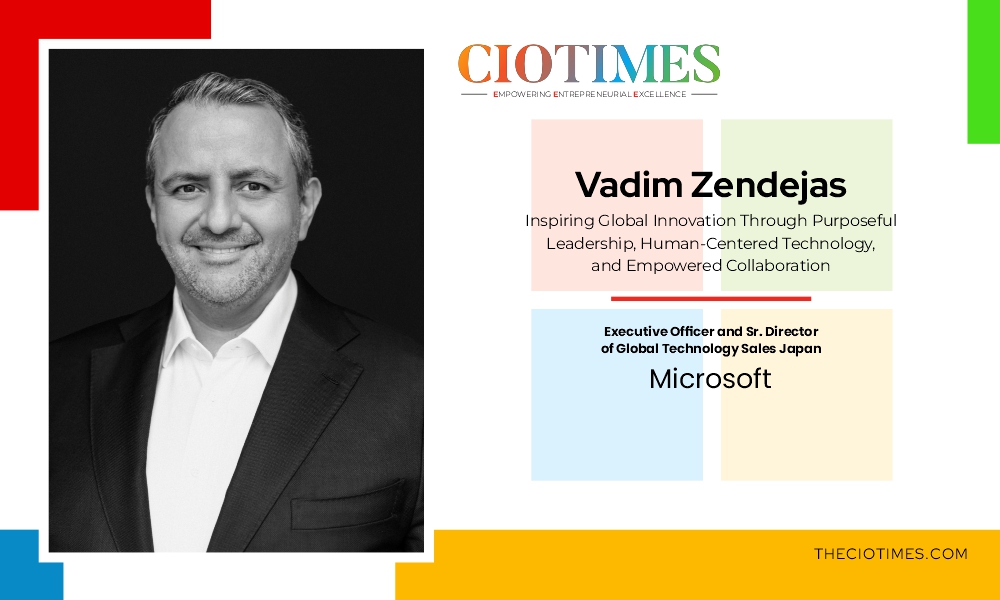
Technology has been unstoppable for the last two decades. We often witness tech experts being in a fix about where it is headed. With the emergence of artificial intelligence (AI), the transformational horizons have widened to immeasurable extents. Tech leaders like Vadim Zendejas, Executive Officer and Sr. Director of Global Technology Sales Japan, at Microsoft, are hopeful about it widening groundbreaking innovations in this landscape. His journey from a passionate young developer to an Executive Officer at Microsoft Japan reflects a lifelong commitment to learning, adaptability, and global collaboration. His fascination with technology began when he wrote his first computer program on a used Amiga, a moment that ignited his curiosity and shaped his career path.
He pursued a Bachelor’s degree in Computer and Systems Engineering from ITESM in Mexico, continued his studies at Nanyang Technological University in Singapore, and later earned a Master’s degree in Information Security from the University of Tokyo. These formative years not only deepened his technical foundation but also nurtured a genuine appreciation for cultural diversity and global perspectives.
Vadim began his professional career as a software analyst and quickly advanced to leadership positions, co-founding startups and serving as CTO for several organizations.
He shares, “I started in the world of global technology leaders at Amazon Web Services, where I led solutions architecture for global strategic partners across EMEA and helped Fortune 500 companies to adopt the cloud.”
His move to Microsoft marked another pivotal stage in overseeing open-source strategy and technical teams across EMEA, leading cloud solution architecture for global clients, and ultimately serving as Executive Officer and Director of Global Technology Sales at Microsoft Japan.
He acknowledges that not every endeavour was a success; some startup ventures fell short of expectations. Yet, Vadim views these experiences as essential milestones that fueled his growth and resilience. Having lived and worked in five countries, he credits his global exposure, particularly his time in Japan, for shaping his leadership philosophy. He leads by example, values hands-on collaboration, and believes positivity and inclusivity are at the core of effective leadership.
Bridging Global Strategy
In his role at Microsoft Japan, Vadim focuses on connecting Microsoft’s global technology strategy with the distinct characteristics of the Japanese and Global market, a landscape defined by its deep respect for tradition and its relentless pursuit of innovation. He views his role as that of a bridge builder, ensuring that global technological advancements align seamlessly with the priorities and cultural values of Japanese enterprises.
His approach centers on active listening, deep understanding, and cultivating strong partnerships. He believes that meaningful transformation begins with collaboration and trust. Microsoft Japan Global Technical Team, under his leadership, serves as both an anchor and an enabler, helping clients design tailored solutions across areas such as AI, cybersecurity, business applications, and infrastructure. Each initiative is developed to comply with Japan’s regulatory frameworks and business norms while remaining aligned with global best practices.
He emphasizes that trust is the cornerstone of success in an increasingly digital world. By maintaining close relationships and encouraging open dialogue, Vadim creates an environment where experimentation and innovation can flourish.
A notable example of this philosophy in action is Microsoft’s collaboration with NTT Data Inc. Over several years, he and his team worked closely with NTT to unify and modernize its fragmented IT systems, enabling agility and remote work readiness. Through cloud adoption and seamless integration of platform and software services guided by Japan’s cultural principles of precision, anticipation, and continuous improvement, the transformation strengthened NTT’s operational continuity and responsiveness to regional market dynamics.
Through such efforts, Vadim continues to exemplify how global strategy and local sensibility can harmonize, driving innovation that honors Japan’s unique blend of heritage and forward-thinking ambition.
Cultural Transformation
Vadim views digital transformation as far more than the adoption of new technologies; it is, at its core, a reimagining of how businesses operate, create value, and connect with their customers. From his perspective, transformation succeeds when technology becomes a true enabler of business outcomes, driving measurable impact across efficiency, innovation, and customer experience.
He believes that while AI, cloud, and security are critical tools, they serve a larger purpose: empowering teams, streamlining operations, and enabling organizations to deliver personalized and meaningful experiences.
He adds, “To transform it requires a cultural change; this is achieved by encouraging experimentation, learning from mistakes, and always improving technical depth.”
Equally important, he emphasizes that transformation is not purely technical; it is cultural. True change requires organizations to foster a mindset of experimentation, continuous learning, and resilience. Encouraging teams to learn from setbacks, deepen their technical expertise, and remain curious is, in his view, essential to long-term success.
At the heart of it all, he believes digital transformation begins with people. Building a culture of empowerment and growth allows technology to realize its full potential, creating not only stronger businesses but also a broader positive impact on society.
Intelligent Convergence
Vadim views the convergence of cloud scalability, cybersecurity, and generative AI as a defining force shaping the future of enterprise technology. From his perspective, this interplay is not merely technical; it’s foundational to how modern organizations evolve and compete.
Cloud scalability, he notes, forms the structural bedrock for innovation, enabling enterprises to expand globally and operate with agility. Cybersecurity, in turn, safeguards trust, an indispensable asset in an increasingly volatile threat landscape. Generative AI amplifies this equation by unlocking new dimensions of creativity, productivity, and automation, empowering businesses to act smarter and respond faster.
Together, these three pillars are accelerating organizational transformation, enabling companies to deliver tailored customer experiences while optimizing decision-making and operational efficiency. Vadim foresees the next phase of enterprise technology focusing on democratizing access, making advanced AI and cloud capabilities available to organizations of all sizes in less time and at greater value.
As enterprises increasingly invest in AI platforms and agentic workflows supported by powerful AI-ready hardware and integrated software, Vadim emphasizes the importance of governed orchestration. Avoiding fragmented “AI silos,” he explains, will be essential to achieving cohesive innovation.
In an era marked by geopolitical complexity, evolving regulations, and rapid AI adoption across every function, Vadim believes enterprises must embrace adaptability. The seamless interconnection of cloud, security, and AI will ultimately determine how organizations navigate and lead in this fast-changing digital landscape.
Evolving Leadership
Vadim’s leadership philosophy has been anchored in a consistent set of core principles: authenticity, curiosity, openness, and empowerment. Throughout his journey from startups to multinational corporations, he has championed leading by example and fostering a culture rooted in action, continuous learning, and trust.
In today’s hybrid and AI-driven business landscape, Vadim believes these principles have become even more essential, yet they must evolve to embrace adaptability and inclusivity. Hybrid work environments, he notes, demand greater transparency, intentional communication, and a deliberate focus on team well-being.
As AI reshapes workflows by automating repetitive tasks and enhancing efficiency, Vadim emphasizes the importance of continuous learning and upskilling. He envisions a leadership model that empowers diverse, globally distributed teams to experiment, innovate, and grow together regardless of location. To him, effective leadership in this new era means maintaining a deep understanding of both technological capabilities and business needs to ensure teams remain agile, relevant, and future-ready.
Transformative Alliance
One of the most transformative initiatives in Vadim’s career has been the landmark strategic alliance between Microsoft and Hitachi, a collaboration that exemplifies how generative AI can drive innovation and reshape industries. Working with an exceptional team, he played a pivotal role in shaping and advancing this partnership, which became a defining milestone in global digital transformation.
Through this initiative, the focus was on enabling Hitachi to integrate AI into its core solutions, streamlining operations, boosting employee productivity, and unlocking new business models. What made this endeavor truly meaningful was not only its global impact on thousands of Hitachi’s enterprise customers but also the scale and depth of transformation it required. The collaboration evolved from simple technology adoption to a genuine strategic partnership, one that redefined how organizations approach workloads and decision-making with AI at the center.
The initiative culminated in a multi-billion-dollar strategic agreement designed to enhance the productivity of 270,000 Hitachi employees, train more than 50,000 “GenAI professionals,” and transform over 20,000 customer organizations worldwide.
He shares, “This success reflects a broader foundation in my work: to partner closely with customers, and align technology with strategic outcomes to ensure that the innovation translates clearly into measurable impact.”
Blending Innovation Cultures
Having experienced both the dynamic world of startups and the structured environment of global tech enterprises, Vadim observes clear contrasts in agility, innovation, and culture. Startups, in his view, thrive on flexibility. They move fast, experiment freely, and embrace calculated risks as part of their growth journey. In contrast, large enterprises bring scale, resources, and the capacity to create impact at a global level. The key distinction, he notes, lies in the speed of decision-making and the degree of tolerance for failure.
He believes that true success lies in blending the strengths of both worlds, fostering the entrepreneurial agility of startups within the stability and reach of a global organization. In his leadership approach, he actively nurtures what he calls “startups within the enterprise,” empowering teams to innovate, test bold ideas, and learn from experimentation while leveraging the expansive capabilities of a global company.
This philosophy has been instrumental in driving growth and meaningful transformation, particularly in expanding Microsoft’s partnerships and customer success across Japan’s global enterprises, a testament to the power of combining startup energy with enterprise scale.
Purposeful Leadership
In his role as an advisor and board member for emerging tech companies, Vadim focuses on partnering with founders who combine passion, resilience, and clarity of purpose. He believes that the most successful entrepreneurs are deeply committed to their ideas and remain steadfast in their mission, even when faced with challenges.
Over the years, he has mentored startups that share common traits: a clear vision, an openness to learning, and the humility to pivot quickly when needed. He particularly values teams that embrace diversity, encourage experimentation, and strive to create a positive impact not only in business but also in society.
At the core, Vadim emphasizes that success always comes down to people, their curiosity, determination, and capacity to inspire those around them. He is especially drawn to founders who view technology as a force for good and who demonstrate unwavering persistence in pursuing their goals.
Strategic Balance
As both a technologist and business strategist, Vadim approaches decision-making with a dual mindset, one that balances technical depth with commercial outcomes. He believes the key lies in staying closely connected to technology while ensuring every innovation directly ties to business value.
He shares, “In every decision I need to make sure I know what the business needs are, what is happening in the market and the competitive landscape – this gives me a good view of the business and commercial requirements.”
With this perspective, he collaborates with technical teams to design solutions that are not only innovative but also commercially viable. He emphasizes the importance of asking the right questions along the way: Does the solution address a real problem? Is it secure, compliant, and scalable? Will it deliver measurable impact for both the customer and the business? This disciplined approach ensures that every technology investment drives both technical excellence and tangible business outcomes.
He also notes that decision cycles are becoming increasingly shorter as AI advances. The industry’s shift from experimental pilots to ROI-driven initiatives highlights the growing need for measurable results. Vadim integrates this thinking by developing a clear P&L hypothesis for each technical decision, aligning engineering intent, such as latency and resilience, with business intent, cycle time, conversion, and risk reduction, enabling faster, more strategic innovation.
Empowering Open Innovation
Vadim views open innovation as a driving force that will continue to reshape how businesses scale and evolve in the coming decade. To him, it represents the breaking down of traditional barriers and the acceleration of progress across industries. By embracing open-source ecosystems and collaborative models, organizations can tap into global talent, share knowledge more freely, and co-create solutions that enable faster, more inclusive, and sustainable growth.
He believes that open innovation will soon form the foundation of modern hybrid technology stacks. Regulated industries, in particular, will increasingly combine proprietary services offering speed and reliability with open-source components that deliver flexibility, cost efficiency, and greater control.
Looking ahead, Vadim foresees open innovation becoming the standard model for corporate technology. This shift, he notes, will allow businesses to adapt more swiftly, optimize costs, and deliver greater value to customers while fostering a more transparent, interoperable, and trusted technology landscape.
Responsible Transformation
Vadim says, “Business leaders have a great responsibility in society, that is to ensure that digital transformation and technology in general benefits not only shareholders, but society as a whole.”
As technology continues to weave itself into every aspect of life, he emphasizes the importance of designing solutions that are inclusive, accessible, and sustainable.
At Microsoft, this philosophy aligns closely with the company’s mission to empower every person and organization to achieve more, a mission that, in Vadim’s view, must also extend to advancing society through responsible innovation.
In the era of AI, he underscores the need for leaders to champion ethical practices, safeguard data privacy, and proactively leverage technology to address pressing social and environmental challenges. Vadim maintains that by aligning social impact with core business objectives, organizations can create meaningful, long-term value, driving progress that uplifts both communities and stakeholders alike.
Mature Leadership
Vadim believes that the next generation of technology executives will be defined by their ability to lead with adaptability, empathy, and a deep understanding of emerging technologies. As AI, automation, and decentralized systems continue to reshape industries, he emphasizes that future leaders must be both digitally fluent and emotionally intelligent, capable of navigating ambiguity while inspiring confidence and trust.
He identifies several key skills that will set effective leaders apart. The first is digital fluency, a strong grasp of evolving technologies and their practical implications. The second is systems thinking, enabling leaders to connect technological advancement to business outcomes and broader societal impact. Just as crucial is cross-cultural collaboration, fostering inclusive and diverse environments where distributed teams feel empowered and valued.
Vadim also highlights the importance of continuous learning, noting that great leaders remain open to change and committed to personal and professional growth. Above all, ethical decision-making stands at the core of leadership in the AI era, requiring a balance between innovation and integrity when navigating complex challenges around privacy, bias, and accountability.
He adds, “It’s critical for leaders to inspire and build trust, encourage people to keep learning and create an environment where people feel encouraged to experiment.”
Collaborative Cloud Evolution
Having worked across both AWS and Microsoft, two of the most influential forces shaping the global cloud landscape, Vadim has witnessed firsthand how competition in the cloud industry has fueled extraordinary innovation. He believes that this competitive drive has broken down technological barriers, enabling organizations and individuals worldwide to access powerful, transformative tools like never before.
At the same time, he emphasizes that collaboration within the industry has become just as vital. Through open standards, strategic partnerships, and shared ecosystems, cloud providers are now working together to tackle complex global challenges such as security, interoperability, and sustainability.
He envisions the next phase of the cloud era as one defined by “coopetition” where leading service providers continue to compete on value and innovation, yet also collaborate to advance industry progress, enhance customer outcomes, and strengthen long-term growth.
Drawing from his experience across both AWS and Microsoft, Vadim recognizes how this balance between competition and collaboration has become essential to the cloud’s evolution. With emerging technologies like AI and quantum computing accelerating change, he believes the future of the cloud will be shaped by partnerships that prioritize customer trust, data security, and the broader good of society.
Outside Microsoft
Vadim has a passion for:
- Membership of the Board of Directors of companies
- Mentoring startups and companies
- Membership of NGOs to support charity and social change (Round Table International)
- Passionate event speaker
- Conducting lectures on technology
Family and curiosity are his heart. Married and a father of two adorable kids, his home is a mix of cultures, languages, and traditions. His journey in life till now has privileged him to live in 5 countries over the past 20 years, including his formative years in Japan and Europe. His first cloud architecture sketch on a napkin in 2003 led him to embrace the technological path.
Launching quite a few ventures, he has learnt from their successes and failures. Advising and mentoring startups keeps him active. He is also fixated on actively helping NGOs and participating in charity projects to make a societal difference. Reading and staying updated fuel his curiosity to learn and share new ideas.
The Dream Big Legacy
Looking ahead, Vadim aspires to be remembered as a leader who empowered others and used technology to create a meaningful, lasting impact. For him, true legacy is not defined solely by business achievements, but by the people, teams, and customers whose growth and success he has helped nurture along the way.
Through his work at Microsoft and beyond, he strives to make technology more accessible, inclusive, and transformative, enabling innovation that benefits both business and society. He takes pride in fostering environments where individuals are encouraged to think boldly, challenge convention, and collaborate with purpose.
Ultimately, Vadim hopes to inspire the next generation of technology leaders to dream big, embrace diversity, and harness technology as a force for good, driving progress that uplifts organizations, communities, and the world at large.