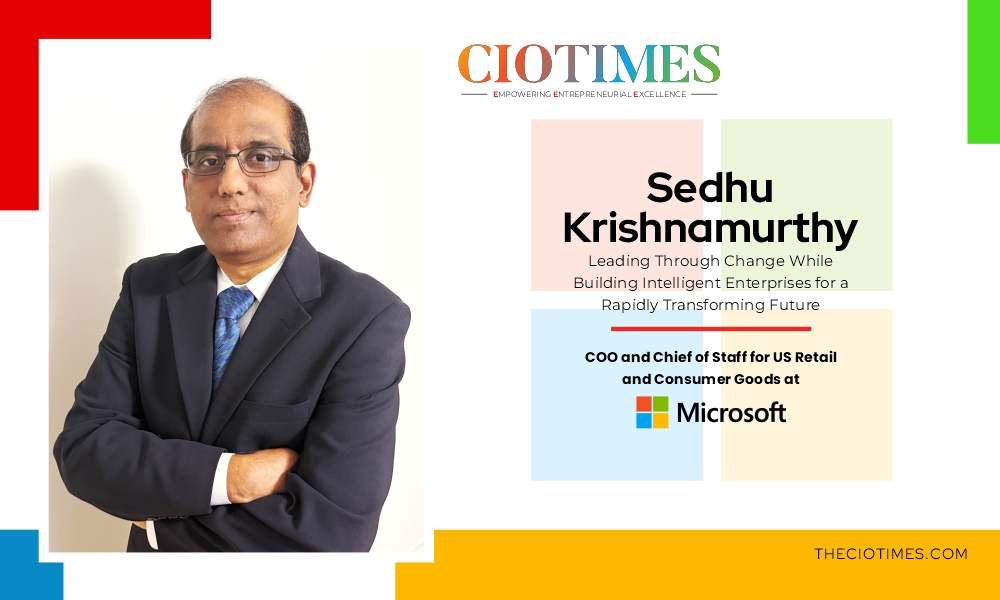
Artificial intelligence is transforming the way businesses operate. Yet, technology alone does not create meaningful transformation. It is visionary leadership that turns innovation into lasting business value. This leadership is improving challenges, increasing efficiency, and creating new growth opportunities. A similar leader is Sedhu Krishnamurthy, COO and Chief of Staff for US Retail and Consumer Goods, at Microsoft. He is a maestro who empowers teams to adapt and succeed in a rapidly changing environment. His focus goes beyond innovation, as he is focused on creating value for customers and advancing AI for broad-based economic growth.
An accomplished business and technology executive, he has spent his career helping global organizations translate digital transformation into measurable business outcomes. With expertise spanning AI, enterprise strategy, organizational transformation, customer engagement, and operational excellence, he has consistently led high-performing teams, accelerated innovation, and delivered sustainable growth. An MBA graduate in Strategy and Finance from the Kellogg School of Management, he combines strategic vision with disciplined execution to help enterprises navigate an increasingly AI-driven future.
Strategic Intelligence
He believes the AI era is fundamentally different from previous waves of digital transformation. While earlier initiatives focused on efficiency, automation, cost reduction, and system modernization, AI is embedding intelligence directly into the way businesses operate. It is changing how decisions are made, what work is, how work is executed, and how value is created. In his view, AI is not simply another technology layer but a force multiplier that enhances enterprise capabilities.
He shares, “In my experience, the real inflection point is not that customers are piloting AI, but that they are beginning to redesign operating models, customer engagement, decision-making, and employee workflows around it.”
He sees AI as a transformative technology with the potential to reshape both business and society. As intelligence becomes more accessible and scalable, organizations are accelerating innovation and shortening the path from ideas to outcomes. He also notes that businesses are moving beyond experimentation and beginning to redesign operating models, customer experiences, and workflows around AI. For him, this marks a shift from using technology to support the business to using intelligence to continuously reinvent it.
Beyond Modernization
Mr. Sedhu Krishnamurthy believes that technology modernization and business reinvention are often mistaken. They are considered the same things, despite them serving severely different purposes. Modernization focuses on upgrading systems, improving efficiency, and enabling scale. Reinvention goes further by reshaping how a business operates, makes decisions, and creates value for customers. The distinction becomes clear when leaders stop asking what technology to implement and start focusing on the outcomes that technology can unlock. While modernization enhances the present, reinvention is about building a different future.
He states, “Many organizations mistake transformation for progress simply because they have adopted new platforms, migrated workloads, or automated isolated processes.”
The AI era for Mr. Sedhu Krishnamurthy represents a fundamental departure from previous waves of digital transformation. While earlier initiatives largely focused on automation, efficiency, and system modernization, AI embeds intelligence directly into business operations, fundamentally changing how decisions are made. Rather than serving as another technology layer, AI is becoming a force multiplier that enables organizations to redesign operating models, elevate customer experiences, and accelerate innovation at scale.
He notes that genuine reinvention is reflected in bigger organizational change. It opens new growth opportunities, creates new forms of value, accelerates execution, and improves enterprise-wide decision-making. Organizations that embrace this approach tend to become more innovative, agile, and outcome-driven because they use technology to rethink what is possible.
He emphasizes that successful organizations are willing to redesign how work gets done. It also covers the context of how value is delivered and how strategic decisions are made. Ultimately, transformation is defined by whether the business emerges more adaptable, resilient, and capable of sustaining long-term competitive advantage.
Beyond Technology Alone
Drawing from his experience leading large-scale transformation programs across diverse organizations, Mr. Sedhu Krishnamurthy believes that the biggest obstacles to AI success are seldom technological. More often, they stem from human behavior, organizational culture, and leadership dynamics. In many cases, these factors determine whether AI becomes a meaningful driver of business value or remains an isolated initiative with limited impact. Among the most significant challenges, he identifies fear as a recurring theme. It includes fear of job displacement, becoming less relevant, and making mistakes during highly visible transformation efforts. When these concerns are not acknowledged and addressed, resistance to adoption often emerges regardless of how capable the technology may be.
He also points to the absence of clear ownership as a major reason many AI programs fail to scale.
He adds, “Many organizations launch AI initiatives without clearly defining who owns the business outcome, who is accountable for the transition from pilot to production, and who will drive adoption at scale.”
As a result, promising initiatives often remain trapped in experimentation. While executive sponsorship is widely recognized as important, it is not always translated into visible action. Without committed leadership, well-defined priorities, and ongoing reinforcement, enthusiasm and momentum can quickly diminish.
Organizational culture also plays an equally critical role, Mr. Krishnamurthy mentions. Companies that prioritize caution and perfection over experimentation and calculated risk-taking often struggle to unlock AI’s full potential. AI creates value not simply through deployment, but when employees trust it enough to reshape workflows, decision-making, and operating models. Achieving this requires new behaviors, aligned initiatives, and leadership that actively supports change.
He also believes that a compelling transformation narrative is often overlooked. Employees need to understand why it matters to them, customers, and the business. Organizations that maximize AI’s value are those that combine strong change leadership, workforce readiness, execution discipline, and a shared commitment to transformation.
Augmented Judgment
Mr. Sedhu Krishnamurthy sees the future of decision-making as a partnership between human expertise and machine intelligence. Each brings a different strength to the table. As AI continues to evolve, it will become even better at processing large volumes of data, identifying patterns, modeling scenarios, and generating insights. This makes AI especially valuable in business environments where complexity is high, and decisions must be made quickly. However, he believes AI increases the importance of human leadership rather than replacing it.
In his view, technology can improve the speed and quality of decisions, but it cannot replace human judgment. Strategic decisions require context, ethics, intuition, and accountability. Leaders must still decide what matters most, which risks are acceptable, and how short-term actions align with long-term goals. AI can recommend options and highlight trends, but it does not own the consequences of a decision. That responsibility remains with people.
Mr. Sedhu Krishnamurthy believes the strongest organizations will treat AI as an enabler, not an autonomous decision-maker. To make that work, companies need clear governance, transparency, and oversight. They must define where AI supports decisions, where human review is mandatory, and how outcomes will be monitored.
He shares, “Organizations will need clear accountability for where AI informs decisions, where human review is mandatory, and how outcomes are monitored over time.”
AI can expand perspectives and accelerate insight generation. Human leaders, however, will continue to provide direction, judgment, and accountability. He expects the relationship between humans and machines to become more collaborative over time. But when decisions carry major business consequences, responsibility will remain firmly in human hands.
The Future Advantage
Mr. Sedhu Krishnamurthy believes that sustainable competitive advantage in the AI era will not come from frontier models alone. It will come from the combination of models and ecosystem that amplifies the power of humans and agentic AI systems. What will matter is how effectively organizations convert intelligence into AI systems to deliver business value. In his view, the companies that succeed will be those that transform proprietary data, workflow, operational expertise, organizational intuition and deep industry knowledge into unique IP that competitors cannot easily replicate.
He sees proprietary data as a critical advantage because it provides context and improves the relevance of AI-driven insights. At the same time, trust will become increasingly important. Organizations that demonstrate responsible AI practices, strong governance, transparency, security, and compliance will be better positioned to earn the confidence of customers, employees, regulators, and business leaders.
He adds, “Operating discipline will increasingly separate pilots from real transformation. Many organizations will experiment with similar tools, but far fewer will be able to move from proof of concept to repeatable production with speed, rigor, and measurable value realization.”
Execution will be another defining factor, Mr. Krishnamurthy feels. Many organizations will have access to similar AI tools, but only a small number will successfully integrate them into everyday operations. The real opportunity lies in embedding AI into workflows, decision-making processes, employee experiences, and customer interactions. The goal is not simply to experiment with AI but to generate measurable and repeatable business outcomes.
He also emphasizes the importance of domain knowledge and expertise. Organizations that have in-depth knowledge of their industries, customers, risks, and operating environments will apply AI more effectively than those relying on generic capabilities. The competitive moat, he views, is shifting from technology ownership to organizational capability. The enterprises that can learn faster, adapt faster, and consistently turn intelligence into value will be best positioned to lead in the decade ahead.
Beyond Cost Savings
Mr. Sedhu Krishnamurthy believes that AI’s greatest long-term value does not lie in any one area. Be it cost savings, revenue growth, innovation, or entirely new business models. Instead, its real potential comes from helping organizations create value at greater speed, scale, and consistency. It also enables businesses to uncover opportunities that may have previously gone unnoticed.
According to him, AI stands out from the crowd because it can influence both day-to-day operations and long-term business strategy. Many organizations begin their AI journey by improving efficiency and reducing manual effort. They do this through copilots, agents, and intelligent workflows. However, the real benefits often emerge beyond automation. As AI connects insights across customer behavior, operational data, and market trends, organizations gain a clearer understanding of where growth opportunities exist. They also discover new ways to create value more effectively.
He notes that this is the point at which AI shifts from a productivity tool to a strategic enabler.
He shares, “AI’s true strategic advantage is its ability to help organizations create value in ways that are compounding, scalable, and faster than ever before.”
It accelerates innovation and reveals new avenues for growth.
In his view, the biggest winners will be enterprises that use AI as a catalyst for reinvention rather than a standalone technology solution. AI can help organizations rethink how they operate, serve customers, and respond to changing market conditions. Ultimately, its most significant value will come from enabling businesses to evolve faster, innovate continuously, and create entirely new possibilities for growth.
Balancing Vision and Execution
Long-term vision and execution are two sides of the same coin, according to him. Throughout his career, spanning strategy, deal-making, execution, and value realization, he has learned that neither can succeed without the other. A bold vision without execution remains an idea, while execution without direction often creates activity without meaningful progress. His approach is to define a clear destination and then break the journey into practical, measurable milestones that teams can work toward with confidence.
According to him, transformational change requires leaders to stay focused on what matters most. That means setting a handful of clear priorities, assigning ownership, tracking progress closely, and addressing roadblocks early. While short-term pressures are unavoidable, he believes leaders cannot allow immediate challenges to distract them from larger goals. Businesses can become busy solving today’s problems while losing sight of tomorrow’s opportunities. Effective leadership requires balancing both.
Mr. Sedhu Krishnamurthy also emphasizes the importance of early wins. Small successes build credibility and help people see that the vision is achievable.
He shares, “Early proof points matter because they build confidence, reinforce belief in the direction, and create the energy needed to sustain larger change.”
At the same time, every action should connect back to the broader strategy. Without that alignment, even good work can lose its purpose.
For him, successful transformation comes from maintaining a long-term perspective while delivering results in the present. It requires clarity, discipline, accountability, and consistency. When those elements come together, transformation moves beyond ambition and becomes lasting business impact.
Leading Forward
Mr. Sedhu Krishnamurthy believes that the next generation of leaders will need a broader mix of skills than any generation before them. Strategic systems thinking will still matter, but so will adaptability, curiosity, and the ability to lead through uncertainty. As AI becomes a bigger part of everyday business, leaders will be expected to anticipate change and help others navigate it with confidence. In his view, courage, curiosity, and compassion will define the most effective leaders.
He believes human judgment will become even more important in an AI-enabled world. While AI can process information, identify patterns, and generate insights at remarkable speed, leaders remain responsible for context, ethics, and accountability. Knowing when to move fast, when to pause, and when trust should take priority will be a critical leadership skill.
He adds, “In the AI era, leaders must do more than communicate change, they must inspire belief, translating the potential of agentic AI systems into a shared vision that advances company’s mission, expands human agency, unlocks new engines of growth and economic opportunity.”
That requires collaboration, alignment, and the ability to earn trust across teams.
Ultimately, he sees leadership becoming less about having all the answers and more about asking the right questions. The leaders who stand out will create clarity during uncertainty, inspire confidence through change, and turn vision into real-world impact.
AI-powered Reinvention
There are some industries with complex workflows, dense data environments, regulatory oversight, and high decision latency that he believes are likely to undergo the fastest and deepest revamping from AI. Mr. Sedhu Krishnamurthy points to crucial examples like retail and consumer goods. AI also has the capacity to mold both customer-facing workflows and the core control systems behind them, so he also highlights financial services and healthcare. He breaks it down further:
In Retail, AI is already moving the model from simply selling products to orchestrating highly personalized shopper experiences, dynamic merchandising, smarter pricing, and more adaptive inventory and supply chain decisions.
In Financial Services, the impact extends across fraud operations, underwriting, claims, servicing, compliance, and portfolio analysis, where AI is enabling institutions to redesign end-to-end workflows around speed, auditability, and risk discipline.
In Healthcare, the pattern is similar across prior authorization, clinical documentation, revenue cycle, care coordination, and patient access, with AI helping reduce administrative burden while improving responsiveness and supporting better decisions at the point of care.
The wider signal in this is that the molding is not limited to industries alone. The support functions will also be redesigned. The strong candidates that depend on repeatable workflows, large volumes of content and transactions, and time-sensitive decisions are:
- Finance
- HR
- Legal
- Procurement
- Marketing
- Customer service
- Supply Chain
- IT
- Enterprise operations
He also mentions that AI possesses an innate ability to compress cycle times in planning, contracting, recruiting, service resolution, compliance monitoring, and internal operations by automating routine work, surfacing insights earlier, and escalating only the exceptions that require human judgment.
The clearest signal is when organizations move from pilots to production deployments tied to mission-critical workflows and measurable business outcomes. At that point, the shift becomes structural rather than superficial: roles are redefined, spans of control change, operating models rebalance, and the boundary between human judgment and machine execution is fundamentally redrawn. The companies that move earliest will be those willing to redesign work itself, not just layer AI onto existing processes.
The Organizational Principles
We asked him, if he were crafting an AI-first enterprise from scratch today, what would be his go-to strategic principles. He added:
Culture and mission must be the foundation in the mindset. It should nurture a culture of learning, experimentation, and continuous innovation anchored in a mission that creates clear value for customers, partners, employees, and society.
The organization should be designed for speed and adaptability, with cross-functional product and workflow teams replacing rigid functional silos so decisions move closer to the work.
Human-in-the-loop decision-making should be explicit in high-consequence scenarios, with clear accountability, judgment, and escalation paths wherever trust, risk, or ethics are involved.
Data, security, governance, and responsible AI should be built in from day one rather than bolted on later; they are core design principles, not compliance afterthoughts.
The enterprise should be built for repeatability through shared platforms, reusable agents, common operating patterns, and standards that allow successful innovations to scale across business units.
Every AI investment should begin with business outcomes rather than tools, with clear measures of value such as growth, productivity, customer experience, quality, or risk reduction.
Social responsibility must remain central, including transparency, fairness, and the broader consequences of adopting AI at scale for secular economic growth.
These would be his foundational principles while crafting an AI-first enterprise from zero. It is so because these determinants are a blueprint to decide whether AI will act as a robust operating advantage or are these just a technology shield.
Enterprise Around Intelligence
Mr. Sedhu Krishnamurthy is an astute professional who has been in proximity to technology, strategy, and business transformation. He highlights the fact that Most leadership teams now recognize that AI can unlock major gains in productivity, speed, customer experience, and innovation. The harder task is building the management system required to capture that value consistently through redesigned operating models, stronger governance, modern data foundations, and the talent, incentives, and accountability needed to move from isolated pilots to enterprise-wide adoption.
He shares, “The risk is not that organizations will ignore AI; it is that many will pursue it in fragmented ways that create cost, complexity, and skepticism without delivering business impact.”
He highlights that the defining opportunity is even grander to keep the enterprise around intelligence. Leaders who succeed will use AI not simply to automate tasks, but to reimagine how decisions are made, how work flows across functions, and how people can spend more time on judgment, creativity, and customer value. They will create organizations that learn faster, adapt faster, and convert insight into action with much greater precision. In that sense, the true frontier is not adoption for its own sake; it is operationalization at scale in a way that strengthens trust, sharpens strategic focus, and changes competitive position. The next five years, will reward leaders who can turn vision into execution at speed, operationalizing agentic AI to deliver measurable business value, strengthen organizational capability, and advance shared economic progress.
Also Read :- CIO Times Magazine for More information