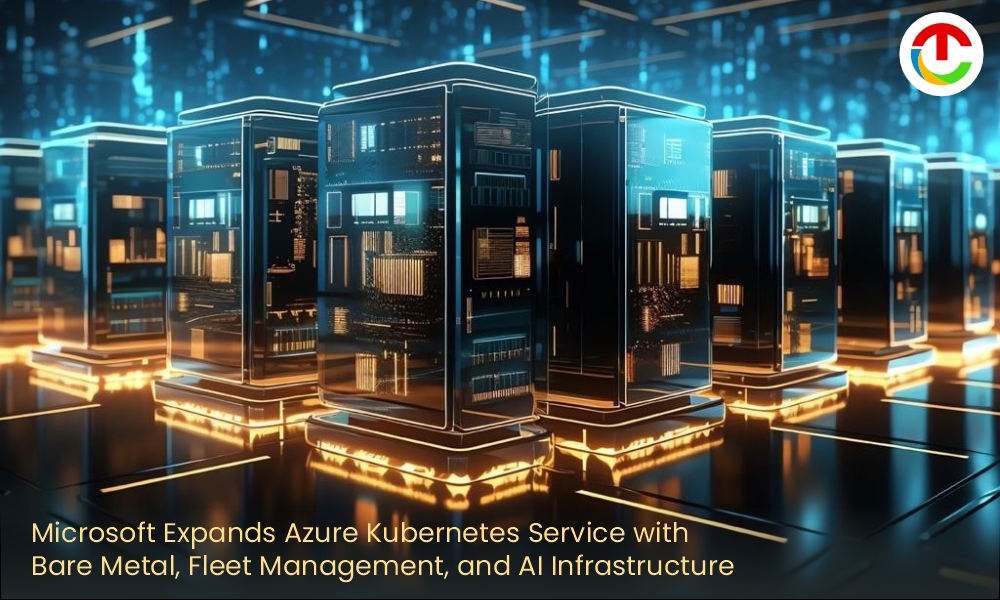
At Microsoft Build 2026, Microsoft unveiled a sweeping set of enhancements to Azure Kubernetes Service (AKS), reinforcing its vision of Kubernetes as the foundation for enterprise AI infrastructure. The announcements span bare-metal computing, multi-cluster management, distributed AI workloads, and model-serving capabilities, highlighting the company’s strategy to make Kubernetes the preferred platform for training, deploying, and managing AI applications at scale.
Simplifying Kubernetes Operations
Microsoft’s first area of focus is reducing the operational complexity of Kubernetes environments. The company announced the general availability of Managed System Node Pools in Azure Kubernetes Service Automatic and Azure Container Linux, a lightweight operating system purpose-built for containerized workloads.
Managed System Node Pools separate critical Kubernetes services from customer applications, allowing Azure to automatically handle patching, scaling, and capacity management. This is particularly valuable for AI workloads running on expensive GPU infrastructure, where resource contention can negatively impact performance.
Azure Container Linux further streamlines operations by providing a minimal, Microsoft-maintained operating system designed to reduce configuration drift and simplify lifecycle management across large Kubernetes deployments. Together, these updates allow organizations to spend less time managing clusters and more time building applications and AI models.
AKS on Bare Metal Targets AI Performance
One of the most significant announcements was AKS on Bare Metal, now available in public preview. By eliminating the virtualization layer, organizations gain direct access to hardware resources such as NVLink, RDMA, and high-performance networking technologies.
Microsoft believes this approach can deliver meaningful performance gains for large language model training and latency-sensitive inference workloads. While virtualization provides flexibility and isolation, it can introduce overhead that becomes increasingly noticeable at AI scale. AKS on Bare Metal aims to combine Kubernetes’ operational consistency with the performance advantages of dedicated hardware, potentially reducing training times and infrastructure costs.
Managing Kubernetes at Enterprise Scale
Microsoft also announced the general availability of Azure Kubernetes Fleet Manager for Arc-enabled clusters. The service extends centralized fleet management across Azure, on-premises environments, and multi-cloud deployments.
Fleet Manager enables organizations to apply policies, manage role-based access controls, orchestrate workload placement, and perform staged rollouts across large numbers of clusters. As enterprises increasingly deploy AI applications across multiple regions and environments, centralized governance and operational consistency have become critical requirements.
New Tools for AI Training and Model Deployment
Beyond infrastructure improvements, Microsoft introduced several AI-focused services. Anyscale on Azure Kubernetes Service , now in public preview, brings managed Ray to AKS, allowing organizations to orchestrate distributed AI workloads across dynamically scaling CPU and GPU clusters.
The company also highlighted AI Runway, a Kubernetes-native deployment framework that simplifies model serving. Combined with the Kubernetes AI Toolchain Operator (KAITO), the platform automates resource provisioning, deploys optimized runtimes such as vLLM, and integrates with Kubernetes technologies including KEDA and Gateway API.
Competing for the Future of AI Infrastructure
Microsoft’s latest AKS enhancements arrive amid intensifying competition among major cloud providers. Amazon continues expanding its AI and Kubernetes offerings through EKS and Bedrock, while Google Cloud is investing heavily in GKE and AI-native infrastructure.
By combining bare-metal performance, fleet-wide management, and Kubernetes-native AI tooling, Microsoft is positioning AKS as a unified platform for the next generation of enterprise AI workloads. The announcements also reflect a broader industry trend: Kubernetes is evolving from a container orchestration platform into the operational backbone of modern AI infrastructure.
Also Read :- Microsoft to End Mandatory Account Requirement in Edge, Google Sign-In Support Arriving Soon