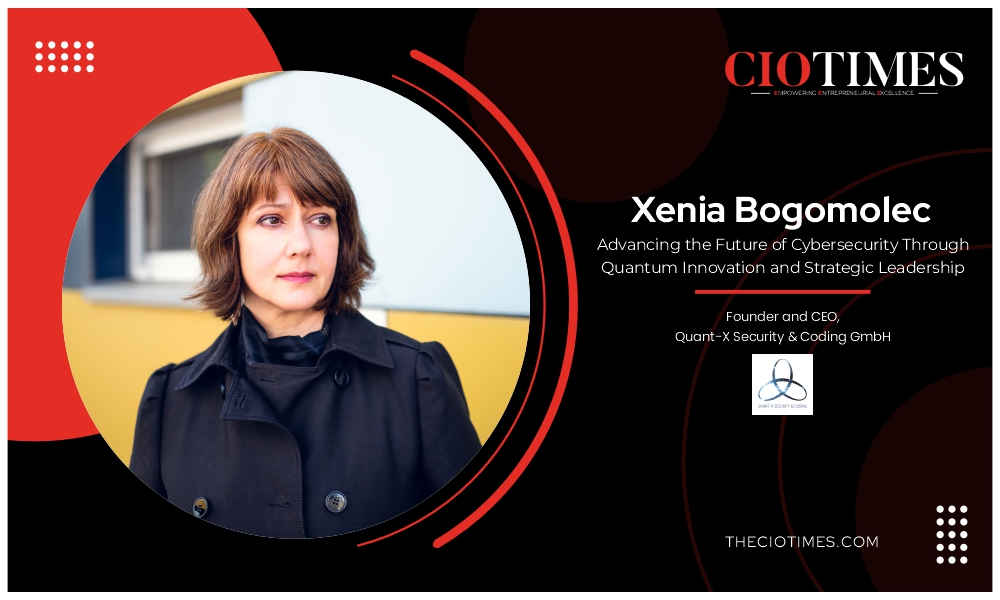
Cybersecurity has never been more crucial as a sector than it is today. The growing digitalisation has inevitably opened doors for a protective shield. This shield has come in the form of digital security that protects crucial data and confidential information. Leaders in this industry understand the aftermath of data breaches, phishing, data being hacked, etc. Thanks to cybersecurity experts like Xenia Bogomolec, Founder and CEO, Quant-X Security & Coding GmbH, who are at the forefront of this shift. Her focus is unmatched when it comes to cybersecurity, cryptology, and post-quantum technologies, as she has a strong practical mindset. She also values collaboration and shared expertise across technical teams. Leaders like her are moulding resilient digital ecosystems for the future of secure computing worldwide and beyond.
Beyond Disciplines
She has had a unique and interesting journey. From mathematics and performing arts into cybersecurity and quantum technologies, Xenia describes it as a continuous evolution. Every experience influenced her to think and solve problems tangibly. Her years in ballet and contemporary dance built strong discipline. Daily training and repetition became a natural rhythm for her. She later carried this mindset into mathematics and professional cybersecurity work. Mathematics came easily to her at school.
Dance, however, taught her something different. It exposed her to the idea that perfection is not being a fixed point. It demands effort, patience, and emotional depth. Over time, discipline turned into flow. In that state, she felt connected to complex tasks, whether movement, equations, or security systems. She also learned to balance this intensity to avoid exhaustion.
Spatial thinking became another key strength. Dance gave her a physical sense of geometry. Later, algebraic geometry expanded this into a multi-dimensional understanding. Today, she uses this intuition to structure complex cybersecurity and quantum systems and to read risks more clearly.
The Quantum Vision
Xenia Bogomolec has always been fascinated by newer technologies and mathematics. Quantum technologies especially fascinated her because of their strong connection to complex mathematical structures. She had already been deeply engaged in related analyses and security concepts since 2016. As her experience grew and she built her own technical team, developing practical solutions became a natural next step.
In the early 2020s, the German government launched several funding initiatives focused on quantum security research. During that period, Quant-X was invited by multiple research organisations to collaborate on industry-led technology transfer projects. One of those initiatives, Quant-ID, was successfully launched through cooperation with the Fraunhofer Institute for Photonic Systems. She recalls being approached with a question about whether a quantum random number generator could have meaningful applications. Her response was instant. She saw strong potential in cryptography and identity access management, where high entropy is essential for secure digital access and data protection.
Future Shield
A ‘future-ready security’ means in a world shaped by constant technological change. She explains that her work has always been focused on anticipating future threats in addition to reacting to current ones. She shares this perspective with many professionals working in post-quantum and quantum security, where long-term resilience is essential. In her view, future-ready security requires continuous awareness, discipline, and responsibility from cybersecurity experts.
She adds, “I have a strict code of conduct in my team. Everyone is allowed to make mistakes. Deliberately endangering data or teammates is a no-go. It is a mindset that can be compared to a group of defence-oriented fighters.”
This principle influences the culture within the team. She often compares this mindset to a defense-focused unit built on trust, accountability, and shared protection.
She also emphasises the fact that post-quantum cryptography is an element that organisations need to start taking seriously. Many leaders still overlook how quickly technological risks evolve. Her message is direct: data shared today could potentially be decrypted years later as quantum technologies continue advancing.
She believes companies cannot afford to ignore this reality, especially at a time when artificial intelligence is already transforming how information can be analysed and misused. The future consequences of today’s data exposure are difficult to fully predict for her. That is why she sees post-quantum security not as a distant innovation, but as an essential requirement for long-term business survival and digital resilience.
Foundational Constants
Xenia Bogomolec has worked across areas such as identity and access management, PKI, and cloud security. Due to this expertise, she envisions that the digital identity would remain with the same foundations. The migration of digital identities to post-quantum security will require massive transformation. Her team also dived deep into the context of quantum entropy. From it, her team came to the conclusion that it is advantageous to integrate. It can also enhance the identity access management aspect from a physical outlook.
She shares, “Quantum mechanical systems are the only true randomness source in nature. All other systems are deterministic, even if they are highly complex.”
True randomness is tough to exhibit. The team has evaluated standards such as BSI AIS 20/31 and the NIST SP 800-90 series with clear requirements and tests for quantum entropy sources. However, even the number Pi would successfully pass all NIST randomness tests.
Nurturing Ideal Etiquettes
Xenia Bogomolec says respect is the foundational point for every strong team. In her experience, people cannot work well together if they dismiss or undervalue each other’s perspectives. Mutual respect creates openness, which is especially important when highly specialised experts are working together.
She believes collaboration improves through regular discussions where teams share progress, exchange ideas, and align around common goals. Whenever possible, she also sees that in-person meetings are of value, although this can be difficult for international teams spread across different regions.
According to her, one of the biggest challenges is learning to understand different expert languages. Specialists from separate fields may use the same terms while meaning completely different things. She often points out that a physicist and a mathematician, for example, can use similar language but interpret it differently within their disciplines.
Valuable Evolution
About the consortium-led initiatives, Xenia Bogomolec says the experience taught her that transforming advanced theory into practical and scalable systems requires discipline, persistence, and flexibility. Many challenges arose throughout the process, but her team continued to push forward to complete the implementations over the last three and a half years.
She asserts, “I never asked my employees to work overtime, but they had to adhere to strict working rules during regular office time. We hardly allow any home office work.”
She recalls spending long hours at the office alongside her family to keep the projects moving. She explains that practical implementation work often becomes difficult because of technological dependencies. At one stage, the team had to wait for Debian versions capable of supporting post-quantum cryptography through OpenSSL. The project began with exceptional Open Quantum Safe libraries in Debian 12 before later moving to Debian 13 with OpenSSL 3.1.2, the first version containing FIPS post-quantum standards. She also remembers replacing OAuth and OIDC libraries after years of development because they no longer worked with fresh components. Looking back, she says this experience taught her to move on faster from outdated setups instead of investing too much time trying to repair systems that no longer fit evolving technologies.
Leadership Through Balance
Xenia Bogomolec balances technical expertise with leadership and strategic responsibilities. She explains that being closely connected to the technical side of her work, even though technical factors alone do not always shape her decisions. In some situations, she has chosen to end collaborations despite strong expertise because of unhealthy or destructive behaviour within the working environment.
In her experience, human behaviour is often more difficult to navigate than technical challenges, especially when leadership is based on trust rather than manipulation. Instead of trying to control people, she prefers working with the mindsets individuals bring into a team and encouraging growth toward shared goals.
She adds, “The decisions in my own company are very much focused on how to create the most effect with a small team.”
Within her company, many decisions are centred on creating the strongest possible impact with a small team. While she does not make decisions for customers directly, she advises them on strategy and decision-making. Because of her technical background, her guidance is strongly rooted in the technical realities and assessments she personally evaluates.
Crypto Agility
Xenia Bogomolec points out that the biggest obstacle is often the technology itself, not being fully ready yet. Many existing source code scanners still struggle to identify all cryptographic libraries and hidden dependencies within complex environments. While some advanced binary scanners can solve parts of the problem, their licensing costs are often difficult for organisations to justify.
Because of these limitations, she believes technical teams must become flexible and inventive in how they approach the problem. In many cases, specialists combine different scanning tools with AI-driven support to create more effective solutions. One of the most exciting aspects of this work is collaborating with other curious and motivated tech experts who enjoy solving difficult problems together.
She adds, “It is awesome to work out solutions with other inspired tech experts.”
She describes crypto agility as something very close to a technology transfer project. The difference, in her view, is that the work becomes much more hands-on and deeply connected to practical implementation inside real operating environments.
Digital Resilience
Her work experience spans several industries such as finance, law enforcement, and academia. Going down the memory lane, Xenia says, those experiences shaped a very realistic view of trust in digital systems. She does not believe technology itself can ever be fully trusted. In her view, cybersecurity is about limiting risks as much as possible through practical and responsible security measures. She often compares it to daily life, where no house can ever be guaranteed completely safe from every threat or intrusion.
One issue she finds especially worrying today is the weakening maintenance of the CVE system. She explains that even under normal conditions, many organisations already struggle to keep up with patching vulnerabilities fast enough. Without a properly maintained CVE ecosystem, attack surfaces continue growing while AI-powered attacks become more effective at exploiting them.
Xenia Bogomolec believes many organisations are entering a period where maintaining cybersecurity will become a constant fight for survival, particularly as cyberattacks increasingly carry geopolitical motives. During a recent Economic Security Conference hosted by German domestic intelligence services, she was reminded how broadly these risks now affect organisations of every kind. She also points to a statement by Claudia Plattner, President of the German Federal Office for Information Security, that strongly stayed with her: “The threat is imminent, but there is a lot we can do: patch, patch, patch.”
Blending Creative with Tech
Before starting in technology, Xenia spent years as a contemporary dancer and choreographer. She brings to our notice some connections between the two. She emphasises that these connections are the high discipline and the state of mind when working on a complex topic.
She also emphasises spatial thinking and feeling. Also, she doesn’t have stage fright and can improvise smoothly as and when required.
Tech Updations
The latest technologies, like Quantum Computing and AI, continue to advance. She shares some advice for leaders and technologists. She emphasises decisive integration of AI, from a benefit in comparison with other tools, not only from a data security perspective. It is crucial to stay up to date with both AI and cybersecurity developments.
The Technology Currency
For aspiring young professionals looking to enter into cybersecurity or quantum technologies, she advises staying flexible and fit. In daily work and physically fit too. The brain functions depending on our health. No one is going to stay in the same cybersecurity field their whole life.
She states, “Being able to learn and understand new technologies quickly is your currency besides the experience you collect.”
Also Read:- CIO Times Magazine for More Information