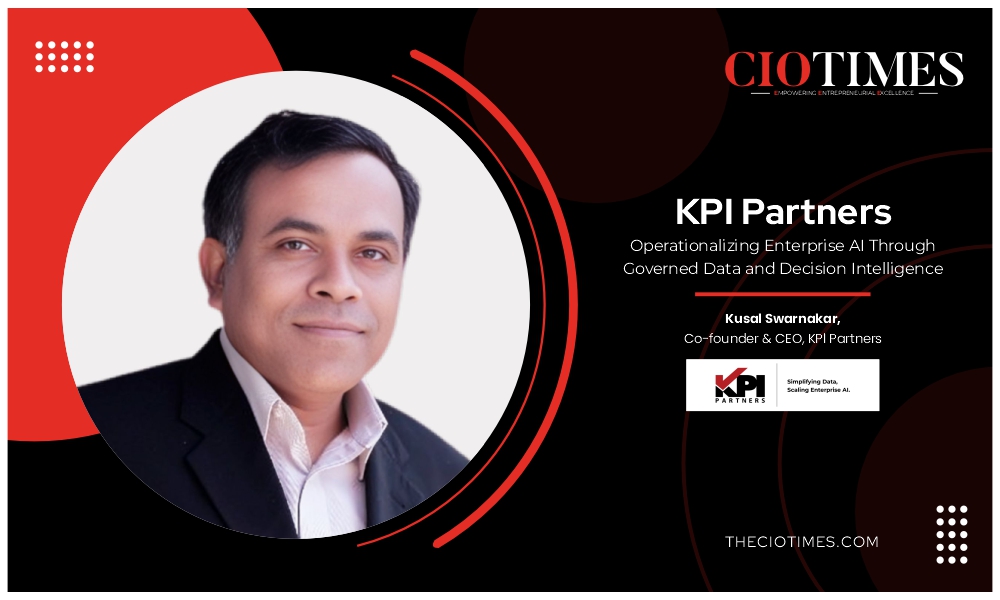
KPI Partners is helping enterprises move beyond fragmented modernization efforts toward data-driven operations at scale. With deep expertise across analytics, data modernization and AI, the company enables organizations to transform complex data environments into actionable business intelligence. Rather than overwhelming enterprises with more dashboards and disconnected insights, it focuses on delivering governed, scalable data foundations that improve decision-making, streamline operations, and embed intelligence directly into business workflows. Its approach reflects a broader market shift where enterprises are no longer simply adopting emerging technologies, but seeking measurable operational value.
As organizations increasingly prioritize operational AI and enterprise-wide analytics maturity, it has positioned itself as a strategic transformation partner capable of connecting technology investments with tangible business outcomes. The company combines advanced analytics capabilities with scalable AI implementation, helping enterprises translate data into faster decisions, greater operational visibility, and long-term business impact. This ability to operationalize intelligence across industries reinforces the firm’s reputation for delivering transformation at scale.
That momentum is also reflected in the company’s rapid growth trajectory. With an expanding global presence, a growing enterprise client base, and continued investment across its capabilities, KPI Partners has emerged as one of the fast-rising players in the data and AI transformation space. In an increasingly crowded market, the company’s differentiation lies not only in articulating technological capability, but in consistently helping enterprises operationalize analytics and AI in ways that are scalable, governed, and aligned with long-term business value.
Intelligence-led Evolution
Headquartered in California, spread across 13 locations globally, KPI Partners focuses on how it can provide ideal solutions to their clients upon completion of a project. Relying only on a seamless go-live process isn’t their goal. Measuring value through transformation until the end is the team’s focus.
This makes value measurable. Such a work ethos depicts the swiftness in teams to access trusted data, the amount of manual effort eliminated from the core operations, how reliably reporting and analytics support decision making, and the level of confidence of leaders in their vision. The team sees transformation as partially done if the team is spending too much energy on reconciling data, waiting for insights, or working around system limitations.
The team’s approach has been reliant on data. Long ago, the team had initiated help for their clientele in terms of establishing data and analytics foundations. The energy spent then is reaping fruitful outputs now because organizations that built strong, governed, scalable data foundations are the ones best positioned to adopt AI in a meaningful way today. As of now, what the team witnesses with AI is a result of the past grind over the decade. Value realization has just begun now.
Across enterprise modernization programs, the firm has helped clients achieve more than an 85 percent reduction in cost and total cost of ownership, 2X faster delivery compared to traditional methods, 100 percent migration accuracy, automation levels of up to 95 percent, and effort reduction of nearly 80 percent. Beyond the numbers, the impact is reflected in faster decision-making, improved operational efficiency, and stronger confidence in enterprise data. For KPI Partners, successful transformation is not just about integrating modern platforms, but about creating scalable, governed, and business-ready foundations that continue delivering value over time.
The Real Data Architects
The team highlights that organizations need to pull up their socks in regard to the effective use of data. Often, it is noticed that the available data rests in disconnected systems, focuses on too many competitive potentials, and the data and business decisions aren’t on the same page.
The KPI Partners Team begins with the deciding factors. They ask questions instead of initiating data volume, tools, or storage. They find answers to questions like:
- What decisions matter most to the business?
- Who needs to make them?
- What information do they need?
- How quickly do they need to act?
The data architecture is the focus once satisfactory answers to these questions are found.
The team’s actions are in favor of data engineering, governance, analytics, and business context to put forth useful data.
The past two decades of expertise have shaped the team’s approach. They helped organizations move through revamping legacy environments, move to cloud platforms, improve analytics maturity, and now prepare for enterprise AI. That long view matters because decision intelligence is built through strong architecture, disciplined governance, and a clear understanding of how the business runs.
Structured frameworks and accelerators are its mantra for a harmonious journey that includes reusable delivery models, platform-specific expertise, and increasingly GenAI-assisted methods that reduce effort and speed up modernization. But the role of these accelerators is not just efficiency; their real value lies in aligning technology faster with business outcomes.
Prolonged Commitment
From the clientele lens, the KPI Partners Team stays until everything is sorted. Job done and disappeared isn’t their style of work. The end point of a project for them is the beginning of value realization. It establishes deep client relationships. Enhancing a platform and moving on isn’t the work ethic. Being there till the client uses and expands its value while consistently evolving as business trends change is what they practice.
With a flexible approach in mind, KPI Partners begin with the client’s problem, business context, constraints, and goals before they suggest the platforms to be used to reach the finish line. [AI1]
The approach is strengthened by certified technical expertise across major ecosystems. Clients want more than a partner who understands platforms at a high level. They want a team that can guide architecture, solve implementation challenges, and help maximize the return on the platform they choose. Expertise speaks for itself here.
As a proof of their commitment, KPI Partners has achieved AWS Advanced Tier Partner Status in the Amazon Web Services Partner Network. This is a big achievement for them. The designation recognizes the company’s proven customer success, AWS-certified technical professionals, validated delivery capabilities, and sustained investment in cloud innovation and marks a significant milestone in their strategic relationship with AWS.
A product-led approach is also followed by the team. Reusable accelerators, structured frameworks, and architectures are designed to evolve rather than static, one-time builds. Sharing an example, they tell us about the use of GenAI-assisted migration accelerators. Many firms still rely on traditional rule-based accelerators, which have been useful for years but often have limits when complexity rises. This shift has improved automation, reduced manual effort, increased speed, and maintained high accuracy across modernization programs.
Undying Focus on Client-first Approach
This approach clearly states one-size-fits-all approach isn’t for everyone. Each client onboarding brings a different technology landscape, different regulatory obligations, different cost considerations, different skill levels internally, and different business priorities. So, the architecture cannot begin with the question, “Which platform do we want to use?” It has to begin with, “What does this client actually need to achieve?”
Hence, the team views platform selection as a design decision, not a default choice. Their experience across top-tier firms like Microsoft, Databricks, Snowflake, AWS, Google Cloud, and other ecosystems allow them flexibility. This flexibility keeps them aligned with the clients’ requirements.
This is where independent guidance plays a vital role. Organizations look for assurance that recommendations are grounded in long-term effectiveness, not influenced by any preferred vendor alignment. Our role is to help them realize full value from the platforms they choose, and where relevant, across multi-platform environments that reflect real-world operational needs.
A client-first architecture is not only about technical alignment. It is about sustained business relevance. It should meet current needs while enabling continuous evolution over time.
Design Philosophies
There are some pillars of philosophy that KPI Partners’ Cloud Analytics follows. The first is that adaptability must be embraced from the beginning. The more rigid a solution is during launch, the harder and more expensive it gets as needs evolve in a business.
Hence, the cloud analytics offerings of the organization are formulated around modular, metadata-driven frameworks. This helps in using it periodically, as the reuse of data models makes sense. Pipelines can be structured for consistency. Reporting layers can be aligned to common business functions. But there is still enough flexibility to adapt to the needs of different industries, use cases, and operating environments.
Another important principle is balancing standardization with relevance. Too little structure creates inconsistency and slows delivery. Too much structure can make the solution feel disconnected from business needs. The team tries to maintain an ideal balance to keep solutions stable and scalable while fitting the client context.
Conclusively, adaptability is what allows analytics investments to remain useful over time. It supports growth, changing requirements, new business questions, and now increasingly AI-driven use cases.
Infinite Achievements
KPI Partners has been bestowed with a heap of achievements. Undoubtedly, as the team works hard enough, they are truly deserving of the same. The list of achievements is as follows:
- 5X Recognition as a Top AI and Data & Analytics Consulting Firm, as received from Gartner.
- Great Place to Work certified 6 times in a row.
- Top Firms to Work for in AI and Analytics – 3AI ACME Award
- Deloitte Technology Fast 50 India 2023, in the D&A Tech category.
Operationalizing Data Framework
KPI Partners foresees whether the solutions are scalable and usable at an enterprise level. This aspect is considered crucial in modern data architecture. Enterprise systems will become more complex as organizations scale, integrate more sources, expand cloud usage, and introduce AI-driven capabilities. But that complexity should not be passed on to the people making decisions.
The team ensures that complexity is away from the user experience. The backend is engineered for scale, resilience, performance, governance, and extensibility. That is where complexity belongs. The decision-maker experience, by contrast, should be clear, simple, and relevant. Business users do not need to understand how pipelines are orchestrated, how metadata is managed, or how workloads are distributed across systems. They need to trust the insights in front of them and act on them with confidence.
This aspect is supported by the organization through modular architectures, reusable frameworks, and a product-led mindset. The team sustains environments that can surge while in support of the right insights. In many cases, that means treating analytics capabilities more like data products than one-off reporting projects.
This becomes even more important as organizations bring AI into the picture. Whether it is advanced analytics, data science, machine learning, Generative AI, or Agentic AI, the systems behind the scenes are becoming more powerful. But if those capabilities create confusion at the point of decision, they will not deliver value. The experience still has to feel usable, understandable, and grounded in a business context.
Practicality is the key to ensuring enterprise-led systems do the needful. Also, clarity and trust at the point of decision.
Enterprise AI
Enterprise AI is creating new possibilities around productivity, knowledge access, automation, and decision support across enterprise environments. But within large organizations, innovation alone is not enough to create lasting value. For AI to operate effectively at scale, it must be supported by strong governance, reliable data foundations, operational discipline, and a clear understanding of how it fits into business workflows and decision-making processes.
The KPI Partners Team guides clients on three frontiers:
1. Clarity of use case
The team scrutinizes where GenAI can solve a real business problem, improve an existing workflow, or measurably remove friction.
2.Foundation
Reliable, well-governed, contextual data makes all of this possible.
3. Control
Accuracy, security, compliance, and monitoring must be built in from the beginning, especially when AI starts touching important enterprise processes.
The team has also witnessed an upgrade in clients’ thoughts about AI. Many begin with simple GenAI accelerators, where users ask questions and receive responses. That can be useful, but it is often only the first step. This is just one part. The team is helping clients move toward more operational forms of Enterprise AI, including Agentic AI, where connected agents can participate in multi-step workflows, pull from enterprise systems, and help automate real business activity.
This is the stage where the Enterprise AI approach takes a front seat. The team supports clients from several frontiers, from GenAI accelerators to help speed up adoption, to Data Science and ML capabilities for predictive intelligence, to Agentic AI frameworks for workflow orchestration and action. There’s one common principle here: AI should be integrated into how the business works. It should not sit off to the side as a disconnected experiment.
The team practices the philosophy that responsible adoption is not about slowing innovation down. It is what makes scaling possible.
For example, in enterprise operations, AI can be integrated into workflows where teams need faster access to trusted information across systems. Instead of employees manually searching across reports, documents, and platforms, AI-enabled agents can retrieve contextual insights, support multi-step decision processes, and help automate repetitive operational tasks while still functioning within governed enterprise environments. The focus is not simply on automation, but on improving accuracy, reducing operational friction, and helping teams act faster with greater confidence.
Asymmetry is the Cause
There exist some blind spots that occur periodically, which are across several different industries. Primary among these is overinvesting in tools while underinvesting in the quality and governance of the data. Organizations often move quickly to adopt new platforms, dashboards, or AI capabilities, but if the underlying data is incomplete, inconsistent, or poorly governed, the value of those investments is limited from the start.
A secondary blind spot the team shares is building analytics without grounding it in decision-making. Clarity on the decisions to be taken is crucial to craft dashboards, as reporting is expected to improve business decisions. It results in more visibility but does not guarantee action.
They also witness organizations running promising pilots that never fully scale. The pilot may prove that the technology works, but scaling requires operating model change, governance, ownership, and sometimes process redesign. If those pieces are not addressed, the initiative remains stuck in a demonstration phase.
At a broader level, the root issue is usually misalignment. Data, process, operating model, and decision-making need to evolve together. When technology moves ahead of the organization’s ability to absorb it, value stalls. Transformation succeeds when those pieces are advanced together, not in isolation.
Endured Insights
Clients often rely on insights shared by the KPI Partners Team. About it, the team says that innovation only creates value when it is introduced on top of uniformity. In the case of high-stakes environments, clients want innovation that brings outcomes and eliminates unnecessary risk.
It means trust should be standing in front. Other aspects like governance, monitoring, testing, quality controls, and business continuity are not secondary concerns, but an integral part of the core design. When these are in place, innovation can be injected with confidence.
The team’s approach is to study new capabilities, whether it is a new analytics method, a GenAI use case, or an automation layer, against two questions. There are some questions that the team goes through:
- Does it improve the business outcome?
- And can it be introduced without compromising reliability, security, or trust?
If answers are unclear to these, the answers need to be worked upon before going to production. The team aims for clients not to have to select between innovation and adaptability. Newer capabilities should be easy to adopt, knowing that the environment underneath them remains governed and predictable. That balance is what turns innovation into something durable.
Building Client Self-sufficiency
The team defines success by what remains post-engagement. For the team, immediate business outcomes matter, and they are important to measure. Cost reduction, faster access to data, improved efficiency, and reduced manual effort are all meaningful indicators. But they are not enough on their own. The deeper measure of success is whether the client is in a stronger position after the engagement than before it.
It indicates that the team looks at how deeply trusted data is being used, how much manual dependency has been removed, how quickly teams can move from question to insight, and how effectively the organization can scale the system on its own as new needs emerge.
This is interlinked to their broader philosophy around sophistication. The team strives to help clients build a data and analytics foundation that continues to support decision-making, innovation, and now AI.
The best sign of success is when the client seems independent and expands their operations with confidence. It is the best moment as the efforts take shape.
Expertise Builds Credibility
Client expectations today are shifting toward being more practical, outcome-focused, and increasingly AI-aware. There is now far less tolerance for extended transformation cycles that take months or years to demonstrate tangible value. Clients are prioritizing faster time to impact, seeking analytics environments that can be adopted quickly, AI capabilities embedded within real workflows, and solutions built with production readiness from the outset.
At the same time, clients are engaging with AI more maturely. The focus is no longer on whether to adopt AI, but on how to implement it responsibly, where it can deliver meaningful value, and how to scale it without introducing additional complexity or risk.
KPI Partners is aligning closely with this shift. The organization benefits from years of experience working with clients to establish the data and analytics foundations that now underpin AI adoption. It also brings together accelerators, Enterprise AI frameworks, deep platform expertise, and cross-industry insights to help clients move faster while maintaining rigor.
The next phase of the market will not be defined by firms that merely articulate capability. It will be shaped by those who execute consistently, connect data and AI in practical ways, and enable clients to translate investments into sustained value. This remains a clear area of focus for KPI Partners.
Kusal Swarnakar: A Tech Professional with a Strong Belief in Adding Value to Clients
A lot of firms are specializing in technical aspects these days. Data interpretation and intelligent systems are the technologies that are being leveraged to transform how organizations operate. Conversion of raw information into meaningful patterns helps leaders make informed choices. Tech leaders focus on enabling faster solutions and help clients make more confident decisions that reduce friction and elevate efficiency. They ensure harmony on the part of clients. Kusal Swarnakar, Co-founder & CEO, KPI Partners, is a leader who cannot go unnoticed. He seamlessly embeds predictive models into customer needs to ensure organizations remain resilient and competent.
Disciplined Virtue
While building KPI Partners, he got a grasp of scaling, being consistent with outcomes rather than focusing only on growth. In the initial days, the focus was on execution, active involvement in solving problems, delivering impact, and making sure clients succeed. As time passes, one realizes that it succeeds when systems are built around it. Sustainable scale comes from repeatable frameworks, strong governance, shared standards, and a culture that can deliver the same level of quality across clients, industries, and geographies.
As the organization gains expertise of more than two decades, with more than 700 consultants, the lesson he shares never gets old. Scaling the company happens when each team involved can deliver tasks with consistency, accountability, and clarity.
Kusal highlights that the team’s client relationships are tangible proof of this belief. Prolonged trust has nurtured their clientele for years and several initiatives. This trust comes not only from contracts. From the client’s perspective, KPI Partners is an organization that adds value, solves core challenges, and grasps insights about their business.
Leadership, too, evolves similarly. It shifts from driving outcomes directly to creating the conditions for others to deliver those outcomes independently.
He shares, “Leadership becomes less about control and more about clarity, enablement, and direction.”
Kusal also believes that modernization should be practical. Organizations operate in complex environments with existing systems, business-critical processes, and ongoing operations. As a result, transformation must be scalable and sustainable rather than driven by technology trends alone.
His outlook on long-term value has evolved, too. It is created when the client continues to benefit long after the initial engagement, when the teams can build on what was delivered, and when the foundation is strong enough to support future needs. Today, that increasingly means supporting data, analytics, and AI in an integrated way.
Scale, leadership, and value addition are interlinked by one pillar for Kusal, and that is consistency.
He says, “The ability to deliver meaningful outcomes repeatedly, build trust over time, and create something that lasts beyond the immediate engagement.”
A Mature Market
The AI-dominated sphere compels the market to embrace value realization rather than only platform adoption. Since the last decade, several organizations have invested heavily in cloud, data platforms, and analytics modernization. It was an ideal time to do so, and now the attention has shifted. Kusal advises that organizations need to ask questions like how to turn past investments into valuable business outcomes.
AI boosts this theory majorly. It has made it clear: organizations cannot scale AI if the underlying data foundation is weak. To make AI an enterprising capability, it needs additional components like governed data, strong pipelines, usable architecture, and business-ready analytics.
He shares that today, KPI Partners is again partnering with past clients to help leverage AI. They are those with whom the team had previously worked to establish their data and analytics foundations. That work may have started before AI became central to the discussion, but it is exactly what makes responsible for AI adoption possible now. The AI moment is not separate from the modernization story. It is the result of it.
He highlights the authoritative discussions among leaders these days. Enterprise buyers now crave structure, as generative AI previously only generated excitement. They want to understand how GenAI can create value in specific workflows, how Agentic AI can support multi-step decision and action cycles, and how Data Science and ML fit into a broader operating model instead of sitting in isolation.
The next phase of the market will be shaped by organizations that can bring data, analytics, and AI together in a practical way. The winners will not necessarily be the ones with the most tools. They will be the ones that have the strongest foundation and the clearest path from technology to business value.
Practical Value Delivered
Kusal frames the heart of KPI Partners around a single, grounded goal: making sure organizations see a lasting return on their investments in data, cloud, and AI. It’s about moving past the buzzwords to find real value that sticks.
With two decades of experience and a global team of 700 consultants, the firm certainly has the scale, but Kusal suggests their true edge isn’t just about headcounts or years on the clock. It’s about the perspective gained from navigating multiple waves of tech modernization. Having guided diverse industries through shifting landscapes, the team has developed a practical, seasoned intuition for what works and what doesn’t.
A big part of their narrative involves the groundwork laid over the last decade. KPI Partners spent years helping companies build sturdy data foundations; today, those same structures are what make scaling AI feel like a natural next step rather than a frantic pivot. They don’t treat AI as a shiny, isolated toy, but as an evolution of the architecture and business processes their clients already have in place.
According to Kusal, strong data foundations remain central to every successful transformation initiative. Whether organizations are pursuing analytics, machine learning, Generative AI, or Agentic AI, long-term success depends on the quality, reliability, and governance of the underlying data environment.
To support evolving enterprise AI and data transformation needs, KPI Partners has established strategic alliances with leading cloud and data platforms, including Microsoft, Databricks, Snowflake, AWS, and Google Cloud. These ecosystem partnerships enable the company to deliver scalable, future-ready solutions aligned with the pace of technological innovation.
What’s also notable is that the organization doesn’t just hand over a finished project and walk away. They tend to stick around, focusing on user adoption and finding new ways to make AI useful in daily workflows. They’re also leaning into innovation where it saves time, using GenAI-driven accelerators to speed up complex migrations and deploying agent-based frameworks that fit naturally into a business.
Ultimately, the KPI Partners difference is straightforward: it’s a mix of deep technical roots, honest guidance, and a genuine commitment to staying by a client’s side until the investment truly pays off.
Elevated Decision Making
Customers have never been more aware of being outcome-driven than they are now. There is more discipline in the evaluation of solutions and partners. A few years ago, the conversation often centered on platform selection, feature comparison, or speed of deployment. Those things still matter, but they are no longer enough. Today, customers want to understand how quickly a solution can create real business value, how well it will fit into their existing environment, and whether it will help them scale over time.
This has shaped their outlook towards partners, too. Clients today demand partners who can guide decisions, bring practical experience, and help them navigate change across data, analytics, cloud, and now AI. They seek perspectives.
Kusal stresses about increased scrutiny around platform bias. Since many firms now partner with the same major ecosystems, customers are asking a different question: who can advise us objectively? Who will help us choose what actually fits our business, rather than simply recommending a preferred stack? That is where unbiased consulting and certified delivery depth become much more important.
A second shift he brings attention to is continuity. Clients look for partners who remain engaged after implementation and help them maximize the value of what has been built. That includes helping them expand use cases, improve adoption, and now move from data readiness to Enterprise AI readiness.
In short, customers are selecting partners less on claims and more on demonstrated ability to help them realize value, adapt over time, and make good decisions in a fast-changing environment.
Expertise Reflects
The Generative AI and advanced analytics technologies have seen a surge. The distinction is quite evident in the foundation, relevance, and discipline. Any major technology wave creates excitement, and generative AI is no exception. But excitement should not be confused with value. In the enterprise, long-term value only comes when the technology is tied to a real business problem, supported by strong data, and deployed in a way that can scale.
Hence, the team starts deep research on the conversation. It goes through some points:
- Where can AI make a measurable difference?
- Is the data ready?
- Are there clear owners, workflows, and controls in place?
The absence of basics can keep it interesting, but it lacks durability. The organization’s rich experience plays a key role here, too. It has witnessed humongous technological shifts while a component remains constant: adopting these shifts with a purpose, rather than following them as it is trendy.
When the team shares advice with clients, they help clients envision a full Enterprise AI Spectrum. That indicates using GenAI enhancers to fuel targeted adoption, applying Agentic AI where multi-step workflow automation makes sense, and leveraging Data Science and ML where predictive intelligence is the better fit.
He states, “The right answer depends on the business problem, not on the popularity of the technology.”
The ideal test for Kusal is whether the capability enhances business operations. Does it help people make better decisions, move faster, reduce effort, or create new value? If it does, and if it can be governed and scaled, it is worth pursuing. If not, it is probably still in the hype phase.
He also emphasizes that technical sophistication alone is never enough. Even the most advanced architecture can fall short if it is difficult for business users to adopt. The objective is to ensure that complexity remains within the underlying systems while the user experience stays intuitive, relevant, and actionable.
He concludes by saying, “AI is powerful, but like any powerful technology, it creates value only when it is applied with discipline and aligned to outcomes that matter.”
Also Read :- CIO Times Magazine For More Information