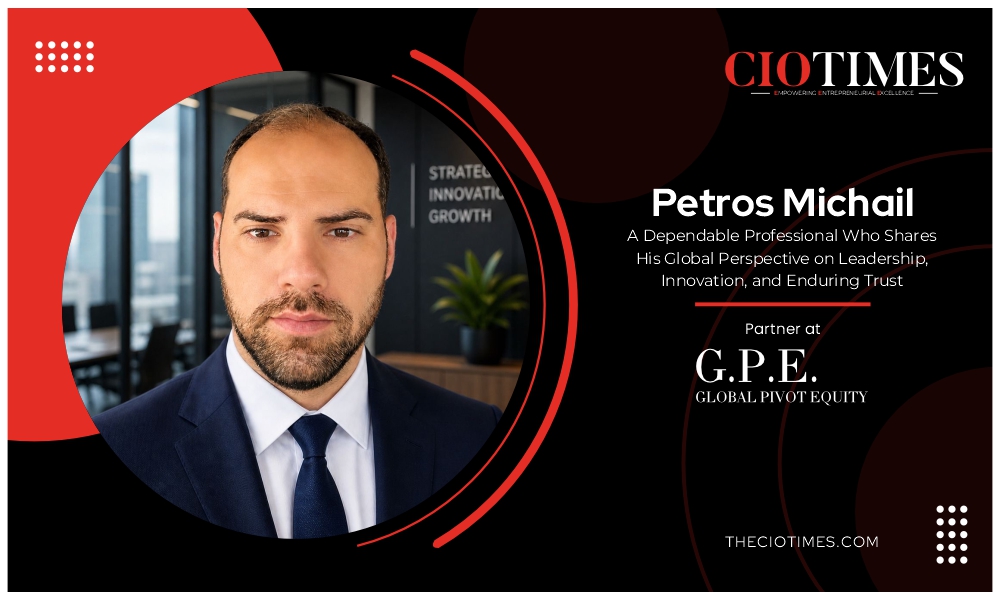
Capital markets are one of the backbones of global investment. They help businesses access funding and pursue growth. Behind this dynamic industry are leaders who understand how value is created over time. Petros Michail, Partner at G.P.E., represents this caliber of leadership. His work reflects the expertise needed to navigate complex market environments. Professionals like him help shape important investment decisions. They bring perspective when markets shift, and opportunities emerge. Their influence extends beyond individual transactions. Through their efforts, capital finds purpose and businesses gain momentum. It is this commitment and vision that continue to drive the industry forward.
Capital Architect
With more than a decade of experience across leading financial institutions, including Societe Generale, J.P. Morgan, and UBS, he has built a strong foundation in institutional finance and regulatory governance. Petros advises European mid-market companies on assessing global capital, U.S. public markets, and strategic growth opportunities. His focus includes U.S IPOs, reverse takeovers, pre-IPO financings, cross-border M&A, and strategic advisory engagements across healthcare, life sciences, financial services, fintech, payments, foreign exchange, and brokerage sectors.
A Global Capital Bridge
Global Pivot Equity (G.P.E.) is a cross-border financial advisory firm focused on helping growth-stage and mid-market companies access international capital markets and strategic opportunities.
With deep expertise in the U.S. capital markets, cross-border M&A, and pre-IPO advisory, the firm supports businesses seeking to accelerate growth and unlock long-term value. Its team has advised on more than USD 18 billion in transaction value across multiple industries and geographies.
Early Influences
Before ascending to leadership roles, Petros Michail worked at institutions such as Société Générale, J.P. Morgan, and UBS. Walking down memory lane, he does not point to a single defining moment. Instead, he credits a series of pivotal experiences that influenced his perspective over time.
His career began at Société Générale, where he was exposed to the realities of markets and risk in an environment that demanded precision and accountability. The experience instilled a lasting respect for risk, one that continues to influence his decision-making. At J.P. Morgan, he developed a deeper appreciation for institutional discipline. The firm’s culture reinforced the importance of rigorous analysis, thorough preparation, and maintaining a strong focus in every engagement. His time at UBS further expanded his outlook, teaching him how to operate within a complex global organization while balancing scale, execution, and integrity.
What united these experiences was not simply the knowledge gained, but the mindset they helped develop.
He states, “I learned to think in systems, to play long games, and to treat reputation as something built slowly and protected with care.”
Above all, they reinforced the belief that excellence is rarely the result of grand gestures. Rather, it comes from executing the fundamentals with discipline and consistency. That principle continues to guide him today, whether advising clients, evaluating opportunities, or leading teams across multiple jurisdictions.
Driven Curiosity
When discussing what keeps him energized while balancing leadership responsibilities across Global Pivot Equity,360 Medical Centre, Petros points to a quality that has guided much of his career: curiosity. He has never been interested in being defined by a single discipline, believing that some of the most interesting challenges emerge where industries overlap, and perspectives collide.
His roles span capital markets advisory, investment operations, and healthcare leadership. At Global Pivot Equity, he works closely with companies pursuing capital, strategic transactions, and growth opportunities. he oversees portfolio and investment operations for institutional and hedge fund clients. At 360 Medical Centre, he carries executive responsibility for both financial and operational performance. While these worlds may appear very different, he sees familiar themes running through all of them. Questions around capital allocation, governance, leadership, and execution surface repeatedly, regardless of industry.
What continues to motivate him is the ability to recognize those patterns while learning from different environments. His involvement in healthcare has been particularly valuable in shaping his perspective. Leading a medical group has given him firsthand exposure to the realities faced by operators, allowing him to engage with healthcare founders from a position of practical understanding rather than purely financial analysis.
That experience has also reinforced an important lesson. Businesses are more than transactions, forecasts, or valuation models. Behind every strategy and financial structure are people working to deliver meaningful outcomes. It is this appreciation for execution and the individuals responsible for it that continues to influence how he leads, advises, and builds lasting relationships.
Discipline Intensity Matters
Petros Michail explains that the assessment often begins much earlier than people expect. Through his work with businesses across healthcare, fintech, financial services, and asset management, he has learned that certain signals emerge even during a first conversation. For him, the strongest indicators are a clear narrative, sound governance, and consistent execution.
He believes the narrative is often the most revealing. Investors are not simply evaluating numbers; they are assessing a vision for the future. The founders and leadership teams that stand out are those who can clearly explain what they do, why it matters, and how capital will help them achieve their goals. Just as importantly, they are comfortable discussing what could go wrong. In his experience, authenticity is difficult to fake, and when a story changes depending on the audience, it rarely goes unnoticed.
Governance is another area he examines carefully. Beyond the business model itself, he looks at how decisions are made, how accountability is maintained, and whether leadership is open to independent oversight. He has found that companies willing to embrace challenge and transparency are often better positioned for sustainable growth.
Petros Michail adds, “I examine the board, the controls, and the alignment of incentives with care, paying particular attention to whether a founder can tolerate genuine independent oversight.”
Execution, however, is where potential ultimately proves itself. He is less interested in perfection than consistency. Teams that do what they say they will do earn trust over time. Those that make promises they cannot keep tend to lose it quickly. More often than not, he believes success comes down to discipline. Great ideas matter, but it is the commitment to the less visible, day-to-day work that often determines whether a business can fulfil its potential.
The Trust Advantage
Reflecting on the realities of cross-border deals, he notes that such transactions may seem exciting from the outside. These transactions often involve significant pressure, complexity, and the challenge of coordinating teams across multiple geographies. Having worked with cross-functional teams spanning New York, Chicago, London, Singapore, and the Cayman Islands, he has learned that transactions are rarely derailed by technical issues alone. More often, the deciding factors are people and communication.
One lesson he values deeply is that clarity signals respect. When teams are spread across different time zones and cultures, even a small ambiguity can quickly evolve into a larger misunderstanding. As a result, he places strong emphasis on communicating expectations, responsibilities, dependencies, and objectives as clearly as possible.
He shares, “When teams are distributed, and the stakes are high, ambiguity multiplies — a vague instruction issued in London becomes a serious misunderstanding by the time it reaches Singapore overnight.”
He also found that trust becomes indispensable when the stakes are high. In demanding situations, people tend to rally behind individuals they trust rather than organizational structures. Consistency, honesty, and reliability during routine moments often establish the credibility needed to navigate more difficult circumstances later on.
Perhaps most importantly, these experiences have reinforced the importance of remaining human as a leader. While high-pressure environments can encourage a command-and-control mindset, he believes the strongest outcomes are achieved when teams feel empowered to collaborate openly and contribute their perspectives. Even when deadlines are tight and challenges emerge unexpectedly, he sees trust, communication, and collaboration as the foundations of effective leadership.
Global Readiness
When discussing founders who dream of expanding internationally or entering the U.S. capital markets, he points out that the obstacles they face today are not the same as they were ten years ago. Access to capital is no longer the hurdle it once was, and information is far easier to obtain. What tends to catch companies off guard now are the less visible challenges. These include navigating different regulatory environments, managing geopolitical realities, addressing tax considerations, and understanding the cultural dynamics that influence business decisions.
From his perspective, one of the most underestimated aspects of the journey is how different the U.S. investment landscape can be from markets in US, Chicago, London, Europe and Cyprus Investor expectations, governance standards, disclosure requirements, and legal obligations often demand an entirely different mindset. He has seen strong businesses with impressive track records struggle to gain momentum in the United States. The reason is rarely their products or operations. More often, they rely on the same narrative, leadership structure, or operating style that worked successfully in their home market.
He views his role as extending well beyond the technical aspects of a transaction. While establishing the right structure, preparing documentation, and bringing together experienced advisors remain critical, he also helps leadership teams understand how their business will be perceived by a new audience. Just as importantly, he helps them recognise what is needed to build confidence in that environment.
He shares, “I regularly observe businesses that are operationally excellent in their home market struggle in the United States simply because they have not adapted their narrative, their governance, or their leadership team to what American institutional investors require.”
In his experience, the companies that succeed across borders are rarely those that assume success is transferable by default. Instead, they are willing to learn, adapt, and embrace unfamiliar perspectives. Sustainable expansion begins with understanding the market, earning trust within it, and building a foundation strong enough to support long-term growth.
Calculated Expansion
Petros Michail’s trajectory highlights working within highly regulated financial environments. It involved thinking about growth, risk, and decision-making. He challenges the idea that regulation and growth are opposing forces. In his view, many of the most resilient businesses have emerged from regulated sectors because those environments demand discipline and long-term thinking from the start.
His experience working within frameworks such as MiFID, SYSC, COLL, CASS, and MAR has reinforced the importance of building strong systems. It has taught him that compliance cannot be treated as an afterthought.
He states, “Compliance cannot be improvised, and governance cannot be bolted on at the end. That discipline now informs everything I do: when I assess a growth opportunity, I consider from the very first day how it will be governed at scale, how it will withstand scrutiny and how it will hold up under stress.”
Governance must be built into the foundation of a business. As a result, whenever he evaluates a growth opportunity, he looks beyond immediate potential. He considers how it will scale, withstand scrutiny, and perform under pressure. Growth and risk cannot be separated, he believes. He views them as two sides of the same decision. Rapid expansion without the right controls may create hidden vulnerabilities, regardless of how successful it appears.
These experiences have also shaped his broader strategic outlook. Operating in regulated environments has taught him patience, credibility, and preparation. He believes businesses endure when they invest in infrastructure, protect their reputation, and establish safeguards early. These qualities may not attract attention, but they often determine long-term success. He also stresses the importance of dialogue between regulators and innovators. This is particularly relevant as developments in digital assets and cross-border activity continue to evolve faster than many traditional frameworks can comfortably accommodate. The most effective outcomes, he believes, emerge when both sides engage constructively and remain open to adaptation.
Human Capital
In the context of relationship-building remaining one of the most important aspects of finance and business development, Petros Michail is unequivocal about it. Despite spending years helping build automation, he believes technology and human relationships serve very different purposes.he led an initiative to automate trade, cash, position, and corporate-actions data flows across multiple custodians and prime brokers. That experience reinforced his belief in technology’s ability to reduce friction, improve efficiency, and minimise errors.
At the same time, he emphasises that automation can only address the predictable elements of business. It cannot replace judgement, trust, or human understanding. When complex transactions are at stake, relationships become strained, or founders are deciding who joins their cap table, technology can support the process but not resolve the uncertainty.
He shares, “When a complex transaction hangs in the balance, when a counterparty relationship is strained, when a founder is deciding whom to admit to the cap table — none of that is resolved by a system.”
In those moments, trust becomes the deciding factor. Business development remains fundamentally a relationship-driven business, according to him.
He also believes many professionals underestimate the long-term value of relationships built early in their careers. Connections formed in routine or behind-the-scenes roles often create opportunities years later in unexpected ways. Throughout his career, he has seen relationships developed in operational positions evolve into opportunities in advisory roles. The reason, he believes, is simple: people remember reliability, honesty, and consistency. While technology continues to raise standards across the industry, Petros remains convinced that genuine trust is what ultimately sets people and organisations apart. The more business becomes automated, the more valuable authentic relationships become.
Digital Convergence
The financial industry is entering a period of real transformation, particularly given his experience across both traditional finance and digital assets. He believes this shift is less about hype and more about maturity. Having worked across asset classes ranging from equities, bonds, EFTs, futures, FX, and derivatives to digital assets, he has observed a notable convergence between the two worlds. What was once viewed as a separate ecosystem is increasingly becoming a part of the broader financial infrastructure.
The more significant story is not speculation but the evolution of systems that support modern markets. Areas such as custody, settlement, reporting, and oversight are being strengthened to accommodate tokenised assets alongside conventional financial instruments. He sees this growing institutional focus on infrastructure as one of the clearest signs that digital assets are becoming a more permanent part of the financial landscape.
He also notes that the firms making the greatest progress are those investing in data, automation, and artificial intelligence while maintaining strong governance and operational discipline. In his view, technology alone is never enough. Sustainable innovation requires robust controls and clear accountability.
While Petros Michail remains measured in his outlook and acknowledges that considerable noise still exists in the market, he believes the underlying technology has genuine long-term potential. As the lines between traditional finance and digital assets continue to blur, he expects the greatest advantages to accrue to organisations that focus on building strong foundations rather than chasing short-term trend
Global Perspectives
Petros Michail describes cultural influences on business relationships and leadership across different markets. He emphasizes it as a defining factor in cross-border business. While trust and competence are universal, the way relationships are built varies significantly across regions.
Having worked across London, Europe, Cyprus, and the US, Chicago, London, Europe and Cyprus , he has seen how different markets approach decision-making, leadership, and long-term partnerships. Some place greater emphasis on process and institutional credibility, while others are more relationship-driven. Neither approach is better; they simply reflect different business cultures.
Petros Michail shares, “What I have learned is to adapt my style while keeping my substance constant. In relationship-driven markets, decisions turn as much upon the people and the enduring relationship as upon the paperwork; in others, the paperwork comes first.”
For Petros, effective leadership means adapting to these differences without compromising core values. He believes the strongest opportunities often emerge where markets, investors, and cultures intersect. Those who understand how to navigate these environments are better positioned to build lasting partnerships and create value across borders.
Beyond Boundaries
Petros Michail has pursued a more multidimensional career path, while many professionals remain within large institutions. When we asked the reason, he says the answer comes down to curiosity and ownership. Although institutional finance provided valuable experience, he eventually felt the need to see the bigger picture and take a more active role in shaping outcomes.
Stepping into leadership positions at Global Pivot Equity, 360 Medical Centre marked a turning point in his career. It shifted his focus from operating within established structures to helping build them. Along the way, he learned that leadership is not about having every answer. It is about asking the right questions, surrounding yourself with talented people, and being willing to take responsibility when the path ahead is uncertain.
Petros Michail adds, “That transition taught me that leadership is less about possessing the answers and more about asking the right questions, assembling the right team and being willing to be accountable for outcomes one cannot fully control.”
He has also remained committed to his own growth. Having completed the MBA Essentials programme at the University of Glasgow, he is currently pursuing an Executive MBA at the London School of Business and Finance. For him, learning is less about qualifications and more about broadening perspective. He believes the discipline gained in large institutions becomes even more valuable when applied to entrepreneurial challenges, where adaptability and long-term thinking matter just as much as technical expertise.
Innovation Ahead
Petros Michail has been exposed to industries that have consistently shifting trends. These industries were finance, healthcare, and technology. The interconnectedness in these shifts has helped him ignite the fire. Rather than viewing them as separate trends, he sees them as part of a broader transformation reshaping how industries operate.
In finance, he is particularly encouraged by developments in digital assets; he has witnessed the growing impact of data, diagnostics, and personalized medicine. While challenges prevail, he sees tremendous potential to improve patient outcomes and make healthcare more effective.
Petros Michail says, “Across all of it sits artificial intelligence — not as a substitute for judgement, but as an accelerant in research, risk management, compliance and operations.”
He also views artificial intelligence as a powerful tool that can enhance research, operations, and decision-making. The most intriguing opportunities emerge when technology helps remove barriers, improve access, and challenge traditional ways of doing things. That intersection of innovation, efficiency, and real-world impact is where he chooses to focus his attention.
Enduring Success
He highlighted three areas where businesses and leaders need to be agile to stay competitively relevant. Mentioned below:
1. Technology with Discipline
While automation and artificial intelligence continue to reshape industries, he believes the real challenge is not adoption but implementation. The organisations that succeed will be those that use technology thoughtfully, embedding it into their operations without losing sight of governance, accountability, and control. In his view, speed alone is never a strategy.
2. Agility Across Borders
As regulations evolve and markets become increasingly interconnected, businesses must be prepared to navigate complexity with confidence. He sees compliance and regulatory awareness as strategic strengths rather than operational obligations. Those that can move effectively across jurisdictions will be better positioned to unlock opportunities in a rapidly changing global environment.
3. People Remain the Difference
As technology takes over more routine work, the qualities that matter most become judgement, character, and leadership. He believes the strongest leaders are those who remain open-minded, adapt when circumstances change, and empower others to grow. For him, the future belongs to organisations that can combine innovation with strong foundations and, above all, invest in exceptional people.
Earned Trust
In his view, careers are not built on a handful of big moments but on countless small decisions that shape how people come to trust and remember you over time. That perspective has influenced the way he approaches both business and life. Throughout his career, he has worked in environments where accuracy, reliability, and sound judgement mattered far more than recognition. Those experiences reinforced his belief that credibility is earned gradually and can never be taken for granted.
Petros Michail adds, “My career was built in the parts of finance where being correct matters more than being impressive, where the work is invisible when performed well and catastrophic when it is not. There are no shortcuts, and those who attempt to bypass the difficult middle stages of a career almost always find themselves exposed.”
The same lesson extends beyond the workplace. Looking back, he believes many of the most meaningful relationships and opportunities in his life were built on simple qualities: honesty, consistency, and the willingness to do what he said he would do. Trust was rarely established overnight, but once earned, it often became the foundation for lasting partnerships and future opportunities.
For that reason, he continues to place great value on the fundamentals. Stay grounded, pay attention to the details, and treat trust as something to be earned rather than expected. While industries and technologies may continue to evolve, Petros believes those principles remain timeless, and they have served him remarkably well throughout his journey.
Also Read :- CIO Times Magazine for more information