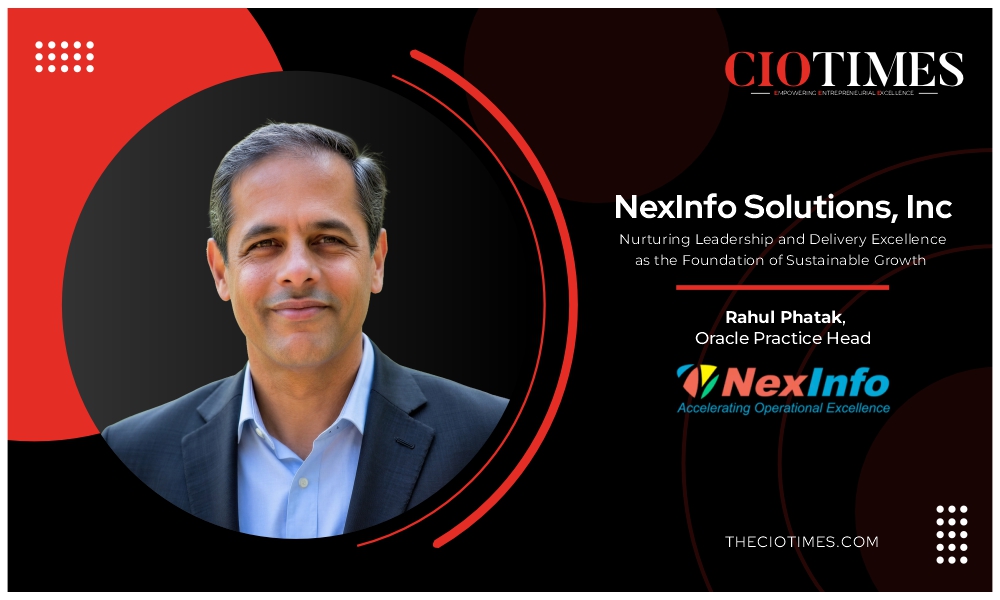
Today, growth demands more than technology. It demands vision, trust, and the ability to adapt with confidence. The value of true technology has never been greater. Oracle Partners have emerged as reliable enablers of business transformation, helping organizations adopt, implement, and optimize advanced Oracle Solutions with confidence. Also, today’s IT leaders define the direction of business through insights derived from such trusted platforms. Rahul Phatak, Oracle Practice Head at NexInfo Solutions, Inc, is an expert who works alongside fellow technology leaders to solve complex challenges, modernize enterprise systems, and unlock greater agility.
A Growth Architect
He is a seasoned technology leader with deep expertise in global ERP delivery, enterprise transformation, and strategic sales enablement. With experience across diverse industries, he brings a client-first approach focused on building lasting partnerships and delivering measurable business value.
Throughout his career, he has led cross-functional teams in the successful implementation and optimization of ERP ecosystems, driving operational efficiency, seamless integration, and strong return on investment. He is passionate about using technology as a catalyst for innovation, helping organizations solve complex business challenges and accelerate growth. He believes valuable transformation begins with collaboration, strategic vision, and a clear understanding of business goals.
A Cloud Strategist
As Head of Oracle Practice at NexInfo, he is focused on building a practice that remains relevant as Oracle continues to redefine its cloud and platform capabilities. He believes
Oracle’s pace of innovation demands continuous realignment rather than periodic adaptation. Under his leadership, NexInfo stays closely aligned with Oracle’s product roadmap while maintaining active collaboration with Oracle’s product and engineering teams. He also prioritizes continuous certification and upskilling to ensure consultants are prepared not only for current technologies, but for emerging capabilities as well.
Rahul Phatak has structured the practice around specialized domains, including Cloud ERP, Finance, SCM, EPM, OCI, AI, and Analytics. Each area is led by dedicated architects responsible for solution strategy, innovation, and delivery quality. He encourages proactive client engagement, often introducing discussions around Oracle AI agents, Fusion Data Intelligence, and evolving cloud capabilities before organizations fully recognize the opportunity.
He adds, “Staying relevant also requires clarity about where we create the most value.”
He believes NexInfo’s strength lies in its deep Oracle expertise and its ability to translate platform innovation into practical enterprise outcomes for clients.
Dedicated Support
NexInfo is positioned as a trusted Oracle Partner that remains focused on long-term value orientation. The conviction starts with a simple and principled belief: a successful go-live is
the beginning of the engagement’s real value, not its conclusion. Before the rollout, the NexInfo team follows multiple stage gates to ensure the solution is built around clearly defined business requirements and expected outcomes. It also leans towards a robust governance model that keeps execution tied back to business objectives.
At each stage, the NexInfo team encourages their peers to ask different questions beyond the one ‘Did we deliver what was scoped? Instead, the team asks, ‘Is the client’s business measurably better because of what we built?’ The answer to this question gives solutions about design, engaging with stakeholders, and defines the success definition.
Once trust is placed by a client, the team remains dedicated to helping them realize the value of the investment beyond the rollout.
Rahul Phatak adds, “
We provide hypercare support, managed services, and advisory guidance that connect Oracle platform capabilities to the client’s evolving strategic priorities. Trust, in my view, is built through consistency between what we promise and what the client experiences not once, but over many years.”
Congruence of Mindset and Governance
ERP is often treated as infrastructure instead of a strategic lever. The distinctive factor in this, according to Rahul, is leadership mindset and governance outlook. Technical excellence has no role in it. Organizations that extract competitive advantage treat their Oracle platform as a living capability. They build a continuous improvement culture around the system and continue evolving the platform through quarterly upgrade cycles. They also establish clear governance structures and ownership models to ensure Oracle evolves with the business strategy rather than becoming locked around legacy assumptions. Most importantly, they invest in their people’s ability to use what has been deployed, and they actively measure adoption and business outcomes.
He states,
“Organizations that merely deploy Oracle often treat go-live as the finish line. When that happens, the gap between what Oracle can do and what the organization actually uses widens every quarter.”
He always asks a question to executive sponsors: “Who in your organization owns the roadmap for this platform two years from now?” If the answer is vague or points to IT alone, that is a signal. Strategic advantage requires business ownership of the platform. His experience says that the organizations that truly gain a competitive edge from Oracle Cloud Fusion are the ones that treat it as a strategic business platform rather than a back-office system.
Platform Reorientation
The most crucial shift for Rahul is the move from a deployment mindset to a platform mindset. He sees enterprises needing to stop treating Oracle as separate applications and instead view it as an integrated digital platform where cloud, data, and AI function as one unified capability stack. This, in his view, requires a cloud-first, standardization-led approach that stays aligned with Oracle’s innovation cycle while still allowing architectural modularity.
Practically, he notes this translates into using SaaS for core business processes, PaaS for extensions and integrations, and a strong data foundation that enables real-time insights and
AI-driven decision-making. For manufacturing organizations, this also means thinking about how data from MES systems, IoT devices, and field operations can be easily integrated into Oracle Cloud ERP. Collaboration between customers and suppliers should be enabled within the platform where possible, rather than relying on disconnected external tools.
Oracle’s AI and analytics capabilities, including Fusion Data Intelligence, AI agents embedded in Fusion workflows, and OCI AI services, are only as powerful as the data quality and architecture underneath them.
The second shift is around architectural agility. The NexInfo enterprises that will thrive are those that can absorb Oracle’s quarterly innovations without major disruption because they have kept their implementations clean, standardized, and close to core. Customization debt is the tax that makes future readiness expensive.
Third, enterprises need to build internal capability alongside vendor partnerships. The organizations getting the most value from Oracle have developed genuine internal expertise, enabling them to evaluate new Oracle capabilities and make fast, confident adoption decisions.
Investment Gaps
About the adoption of Oracle Cloud, Rahul mentions that it is about an organization’s conscious decision of adoption rather than about technology. Enterprises underinvest in the areas that ultimately determine whether the investment pays off: change management, data quality, business readiness, and adoption of modern best practices. Realized value depends on how effectively the business standardizes processes, embraces change, and continues to optimize after implementation.
His expertise has shown him three failure patterns:
- Organizations are migrating broken processes into the cloud.
- A desire to carry forward legacy customizations rather than adopting standard cloud capabilities.
- Comparing every new process to the existing ERP or legacy process instead of evaluating it against the future operating model.
In addition, some leadership teams still treat Oracle adoption as an IT project rather than a business transformation, and many programs lack a clearly defined value hypothesis. They cannot clearly articulate what “successful” should look like 18 months after go-live.
NexInfo bridges this gap through what the team calls a value-back delivery model. We start every engagement by building a business case tied to specific, measurable outcomes that matter to the client. Those outcomes become our north star throughout the delivery process. It has also architected a methodology called NCAM, the NexInfo Cloud Adoption Model, which helps clients see value and understand the impact on their business processes earlier in the implementation cycle.
It is also increasingly common to embed change management capabilities directly into our practice rather than treating change management as a separate workstream. The integration of change management and technical delivery is where transformation succeeds or stalls.
Organized Processes
Global delivery would demand operational challenges in professional services. The NexInfo Team channelizes this unison by anchoring all regions to a single operating model and unified delivery framework. This standardizes governance, delivery practices, and quality benchmarks while allowing controlled flexibility at the local geography level.
Alignment is driven through clearly defined value streams, common KPIs, and a unified program governance structure that ensures every geography is working toward the same business outcomes. Accountability is embedded through role clarity, stage-gate controls, and transparent metrics that track progress, quality, and value realization in real time.
He adds, “Execution discipline is reinforced through reusable accelerators and standardized testing frameworks. When a team in India and a team in the U.S. are both speaking the same governance language, the coordination cost drops significantly.”
The NexInfo team has also invested in cross-geography leadership relationships. It nurtures genuine peer relationships between regional leads who feel collective ownership of overall practice performance. That social infrastructure matters more than organizational charts.
Accountability demands the owning factor with no ambiguity across time zones. The team is explicit about decision rights: what gets decided locally, what gets escalated, and what requires cross-geography alignment. It also crafts a build review modulation that is frequent enough to surface issues early but lean enough to avoid bureaucratic overhead.
A Holistic Approach
In a large-scale Oracle-led transformation, glitches between business intent and execution is an ongoing challenge. A strategic drift in large programs is nearly inevitable without deliberate mechanisms to prevent it. Programs move fast, priorities shift, and the gap between organizational intent and the delivery team’s daily decisions can compound quietly over time.
He shares, “Our primary mechanism is what I call strategic anchoring. We document the business use case and detailed requirements very clearly, not just at a high level, as outlined in the original proposal, but in a much more
detailed and actionable way. This happens after project kickoff, during solution discovery and design sessions.”
Every significant scope or design decision is scrutinized in context to this: Does this choice advance or compromise the original strategic intent?
The NexInfo Team crafts explicit checkpoints into Steering committee meetings. In these meetings, executive sponsors and delivery leads sit at the table to review alignment. They also go through questions like:
- Is the program still aligned with the agreed scope?
- Have business conditions changed in ways that should reshape priorities?
These meetings bring harmony and avoid uninvited surprises.
The NCAM methodology helps to dodge the hindrances associated with it. The business stakeholders also visualize the future-state processes using the data at early stages. This reduces costly rework, limits scope deviations, and keeps the program anchored to the outcomes it was designed to deliver.
Intelligent Balance
Rahul sees this as equally a discipline question and a technology question. In his experience, the most common mistake is AI adoption driven by excitement rather than a clearly defined business need, deploying a capability simply because it is available, not because it solves a problem in a fundamentally better way.
The measure of meaningful differentiation is simple: Does the capability improve an important decision or enhance the speed, efficiency, or cost of an activity that drives real business value? He believes Oracle’s embedded AI capabilities for anomaly detection in financial transactions, predictive analytics across supply chains, and intelligent document processing in procurement clearly meet that benchmark because they deliver scale, speed, and accuracy that manual processes cannot economically achieve.
He believes the strongest outcomes come when AI is embedded directly into core workflows such as forecasting, procurement, order management, and financial close, where it can improve the speed, consistency, and confidence of decisions.
He shares, “Where I see over-engineering is when AI is layered into processes that would benefit more from simplification. Before we apply AI to a workflow, we ask whether the workflow itself is well designed. Automating a broken process faster is not a transformation.”
He believes organizations should first simplify and optimize workflows before introducing AI. In his view, accelerating an inefficient process is not transformation. He also notes the risks of relying on unstable data foundations, overly customized analytics, or AI outputs that teams cannot confidently audit or override.
His approach is to introduce AI incrementally, measure outcomes transparently, and craft internal capability so teams can continuously validate and interpret what the system recommends.
Measuring ERP Value
Rahul Phatak believes ROI measurement for ERP has always mattered, but in many organizations, it has lacked real rigor. What is changing now, he notes, is the level of accountability. CFOs and boards are asking sharper questions, and simply saying processes have optimized will no longer do the deed. He sees this shift happening in two key areas.
Financial metrics
These are becoming more precise and accurate. Instead of broad discussions around TCO reduction, or productivity gains, stakeholders now expect measurable outcomes such as faster cycle times, higher automation, procurement savings, improved revenue recognition, and shorter month-end close cycles. He emphasizes that these metrics should be defined before the go-live and tracked consistently after implementation. He also sees a growing focus on decision speed, data quality, and the use of embedded analytics and AI to generate predictive insights rather than only reporting past performance.
Growing interest in enterprise resilience metrics
He measures these metrics that exhibit how the platform strengthens agility, compliance, and risk management. He points to examples such as onboarding acquisitions more quickly,
responding faster to supply chain disruptions, and improving the quality of data used for strategic decisions. While these outcomes are harder to quantify, he believes they are becoming increasingly important in evaluating long-term enterprise value.
He shares, “Our practice has built more formal value realization frameworks that cover both dimensions. We are having these metric-setting conversations at program inception, not during the retrospective.”
Scaling Transformation Successfully
His experience in driving multiple Oracle Fusion programs reinforced a key principle: speed to value is often just as critical as delivering a fully comprehensive solution. He believes that in fast-moving environments, where planning cycles are short and market shifts are constant, a strong, constant, and practical solution delivered quickly can create greater business impact.
At Gilead Sciences, Rahul recognized the importance of integrating regulatory and compliance requirements into enterprise systems from the very beginning. Within the life sciences industry, he views an enterprise platform not simply as operational tools, but as a core concept of the compliance framework itself.
Western Digital exposed him to gaining insights on complexity at scale, global manufacturing, multi-entity structures across countries, and supply chain dependencies that demand extraordinary cross-functional coordination. It taught him how closely operational execution is tied to financial and supply planning, and how ERP systems must be resilient enough to handle changes in demand and supply that ultimately impact order prioritization and revenue.
He adds,
“Technology roadmaps need careful planning, should avoid siloed processes, and must use standard ERP capabilities to their fullest. Ultimately, those factors determine
whether the technology investment delivers on its promise.”
Credibility-focused Growth
Rahul believes the tension between growth and delivery excellence is something every business leader must continuously manage. In his view, the objective is not to remove that tension completely, but to handle it with discipline and clarity.
He considers delivery quality to be non-negotiable. Rather than viewing it as something that can be traded against revenue goals, he sees it as the foundation that enables sustainable growth. According to Rahul, growth and delivery excellence are not competing priorities; they strengthen each other. He believes credibility is what ultimately drives long-term success in an Oracle practice and that credibility is earned through consistent execution, transparent client partnerships, and measurable outcomes.
He shares, “On the sales side, I try to stay genuinely engaged with both the sales teams and the client, so I understand the opportunity and what it truly requires. When you are genuinely curious about what a client is trying to achieve, trust builds quickly, and that trust is what creates durable growth.”
Growth is not defined only by revenue expansion, he says. It is equally about building enduring partnerships where clients view NexInfo as a dependable Oracle Partner known for consistency, integrity, and meaningful business value.
Leadership Evolution
Reflecting on the evolution of his leadership philosophy, Rahul mentions that his early approach was shaped largely by his functional and technical Oracle expertise first as an individual contributor and later as a team lead. At that stage, leadership was primarily about guiding teams through knowledge and execution. Over time, however, he realized that the approach becomes difficult to sustain as teams grow larger and more globally distributed.
He sees leadership less as directing execution and more as creating the environment for teams to succeed with clarity, ownership, and confidence. In globally distributed organizations, he believes strong performance comes not just from oversight, but from shared purpose, consistent standards, open communication, accountability, and trust across teams and
geographies. When people genuinely understand the ‘why’ behind decisions, they are able to make smarter decisions independently without constant direction.
He states, “I have also learned to calibrate my communication differently depending on the context, being more explicit, more documented, and more deliberate about assumptions when working across time zones and cultures.”
In his experience, what may feel like excess of communication in one setting is often what keeps global teams aligned and effective.
Defining Trusted Partnerships
Looking ahead to 2026, Rahul believes the most trusted Oracle partners will be distinguished not simply by the number of deployments they complete, but by the business outcomes they consistently deliver. In his view, trust will increasingly depend on a partner’s ability to translate Oracle Cloud innovation and AI capabilities into measurable, long-term business value while continuing to provide honest and objective guidance.
Trust is earned when consultants have the confidence and integrity to tell clients what they genuinely need to hear, even when those conversations are difficult. The partners who earn the deepest relationships are those whose recommendations are clearly shaped by the client’s best interests, not by partnership incentives.
The NexInfo Team is investing in repeatable accelerators, strong governance, and continuous learning. It is nurturing a practice that is domain-led, delivery-disciplined, and value-oriented, where our teams understand both the technology and the business context behind every engagement.
He states, “I am shaping us toward that standard by investing in two things above all else: talent and intellectual honesty. We will remain focused on building trust and driving longterm client success beyond go-live.” During tough calls, the decisions they make are what make them most trusted in 2026. That is the stature Rahul envisions for the NexInfo Team.
Also Read :- CIO Times Magazine For More information