A CIO reviewing real-time customer communication analytics on an enterprise dashboard
For years, SMS sat in the marketing department’s toolbox, treated as a side channel for the occasional promo blast. That’s no longer where it lives. Adoption jumped from 66% of businesses at the start of 2025 to 75.3% in 2026, and Infobip’s 2026 Messaging Trends Report found a 34% year-on-year increase in SMS use across marketing use cases alone. Behind those numbers is a quieter story: SMS has moved from campaign tool to operational system, and that reclassification changes who owns it.
When a channel starts triggering order confirmations, fraud alerts, appointment reminders, and delivery updates at scale, it stops being a marketing decision. It becomes a question of uptime, integration, and regulatory exposure, the kind of question that lands on a CIO’s desk rather than a campaign manager’s.
Why SMS Automation Is Now an Infrastructure Decision?
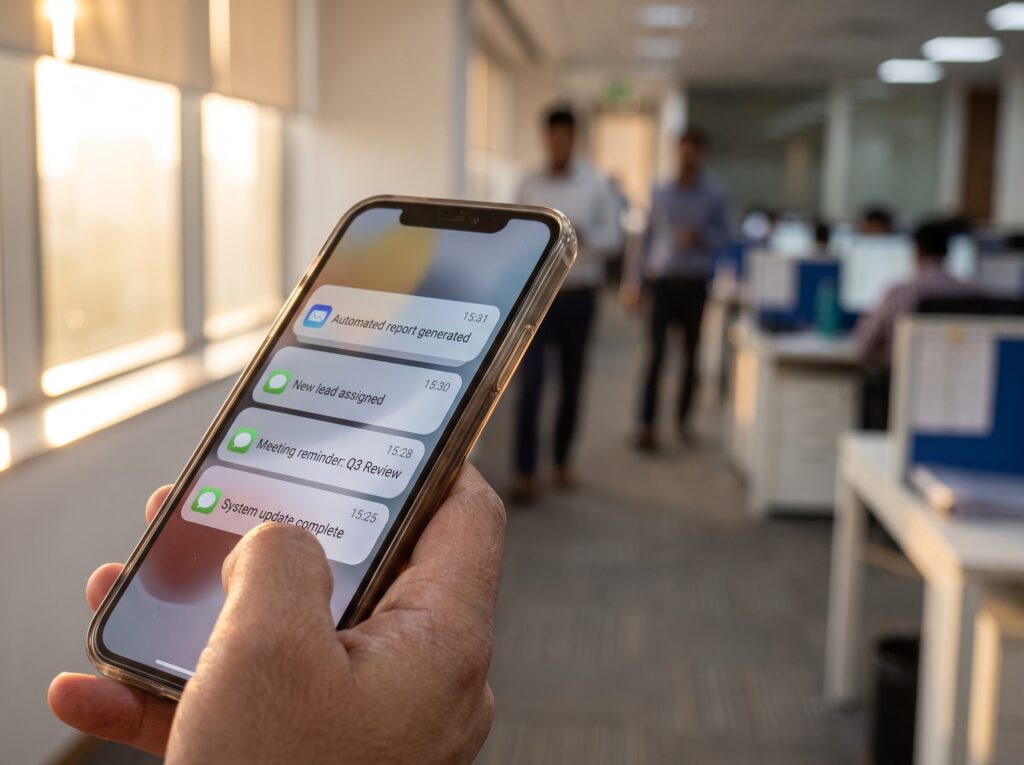
Automated SMS notifications guiding a customer through order confirmation, shipping, and delivery
The shift from manual, marketing-owned texting to automated, systems-integrated messaging didn’t happen overnight, but it accelerated fast once businesses saw the numbers. SMS open rates sit at 90-98%, with 90% of messages read within three minutes of delivery, compared to roughly 20% for email. Those figures explain why so many transactional workflows, shipping confirmations, appointment reminders, two-factor codes, now route through text rather than inbox.
That volume can’t run on a marketing team manually sending messages from a spreadsheet. It needs a platform that triggers off CRM and support-system events, scales during demand spikes, and keeps a clean delivery record for audits. This is where enterprise-grade platforms come in. A tool such as the Infobip SMS solution is built for exactly this kind of triggered, high-volume messaging, the sort of infrastructure decision that technology leaders now have to evaluate with the same rigor they’d apply to a CRM or a payments processor, not the casual scrutiny a marketing tool might get.
Treating SMS as infrastructure also means treating outages as incidents. If a delivery-notification workflow silently fails during a peak sales weekend, that’s not a marketing miss, it’s a system failure with revenue and support consequences. CIOs increasingly ask the same questions of their messaging stack that they ask of any core system: what’s the uptime guarantee, how does failover work, and who gets paged when it breaks.
The Business Case: ROI, Engagement, and Revenue Impact
Executives don’t move ownership of a channel just because it’s technically demanding. They move it because the revenue case is real. SMS delivers an average ROI of 32x, with top-performing brands seeing up to 45x, according to SimpleTexting’s 2026 SMS Marketing Statistics report. More telling: 64% of SMS revenue now comes from automated flows rather than one-off campaigns, a clear signal that the value has shifted from broadcast messaging to systems that respond to customer behavior in real time.
That 75.3% adoption figure, up from 66% just a year earlier, tracks closely with this move toward automation. Businesses aren’t sending more one-time blasts, they’re building persistent, triggered workflows: cart-abandonment nudges, renewal reminders, lead-nurture sequences that fire based on CRM stage changes. This is much closer to automating customer engagement workflows than it is to traditional campaign marketing, and it’s why the conversation increasingly involves IT rather than staying confined to the marketing org chart.
Retention use cases show this clearly too. A reactivation text sent the moment a support ticket closes, or a renewal reminder tied to a subscription’s billing cycle, only works if the messaging system talks directly to the systems of record. Bolt-on tools that require manual list exports can’t keep pace with that kind of trigger logic, which is exactly why the ownership question keeps landing on technology leadership.
The Governance Side: What CIOs Must Get Right on Compliance

A compliance team reviewing consent documentation required under updated FCC text-messaging rules
The upside of automated SMS comes with real regulatory teeth attached, and this is the part that too many growth-stage rollouts skip. The FCC’s one-to-one consent rule, effective January 27, 2025, now requires written consent tied to a single, identified sender, according to the Federal Register’s Second Text Blocking Report and Order. Companies can no longer rely on blanket consent shared across a network of partners or affiliates, a practice that used to be common in lead-gen and affiliate marketing setups.
The penalties aren’t theoretical. TCPA violations carry statutory fines of $500 per unauthorized text, rising to $1,500 for willful violations, with no cap on aggregate liability, per ActiveProspect’s TCPA Guide for 2026. Send an automated flow to a list that wasn’t properly re-consented under the new rule, and a single bad campaign can generate liability that dwarfs whatever revenue it produced. A core FCC prohibition against autodialed or automated texts sent without proper consent still anchors the whole framework, and the 2025 update tightened it rather than loosened it.
This is precisely the risk side of the infrastructure decision raised above. A platform that can trigger a thousand messages an hour also needs an audit trail proving each recipient consented, when, and to what. Governance and scale aren’t separate problems, they’re the same problem viewed from different angles, and a CIO evaluating an automation platform has to weigh both at once.
Evaluating and Deploying an SMS Automation Platform

An IT leadership team mapping SMS automation integration points across CRM and support systems
Choosing a platform for this kind of infrastructure means running it through a different checklist than a marketing team would use. A few criteria matter more than they used to:
- Integration depth with the existing CRM and support stack, not just a generic webhook
- Built-in audit trails that log consent status, timestamps, and opt-out events
- Proven scalability for volume spikes without message delays or drops
- Analytics that tie message delivery to downstream outcomes, not just open rates
Smaller organizations evaluating automation more broadly, without the scale to justify an enterprise SMS platform on day one, often start with lighter tooling and grow into it. Our piece on free CRM automation tools covers some of the entry points worth testing before committing to a heavier platform.
Whatever the starting point, the deployment process itself deserves the same change-management discipline applied to any core system rollout: a staging environment to test trigger logic, a rollback plan if a workflow misfires, and a named owner once it’s live. Treating the launch casually because “it’s just texting” is how teams end up with the compliance and reliability problems described above.
Conclusion
SMS automation has crossed a line. It’s no longer a marketing tactic that happens to run on a mobile network, it’s a piece of core business infrastructure that touches revenue, customer experience, and regulatory risk all at once. The businesses getting real value from it in 2026 aren’t the ones sending the most messages, they’re the ones who measured the ROI, integrated the platform properly, and built compliance into the workflow from day one.
For CIOs, that means SMS automation earns a spot on the same evaluation checklist as any other system of record: reliability, integration, and governance, in that order. Get those right and the channel pays for itself many times over. Skip them, and the same automation that drives 32x ROI becomes the fastest way to rack up TCPA exposure.
c
Also read :- CIO Times Magazine For more information