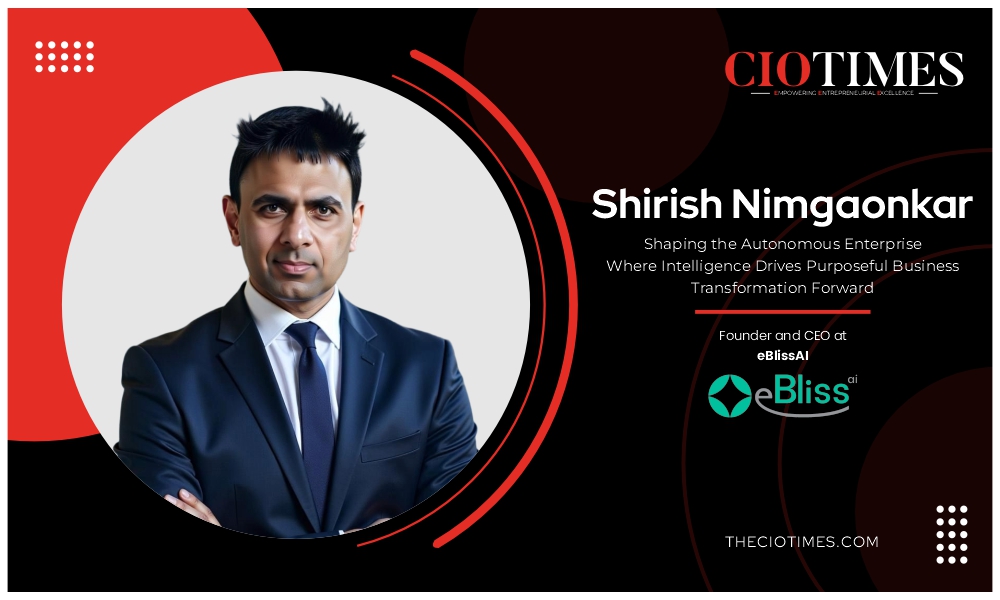
Influential business leaders are distinguished by the significance of their impact. They sense opportunities where others sense uncertainties. They transform bold ideas into enterprise-level aims that shape global markets gradually. Shirish Nimgaonkar, Founder and CEO at eBlissAI, is a leader who remains focused on unwavering commitment and cultivates innovation. As challenges continue to crop up, leaders like him stand at the forefront of progress and meaningful change. This creates an influential impact on the future of business, leaving a legacy that is far beyond commercial success.
Visionary Architect
Few leaders bring together multiple perspectives to own their personality. An entrepreneur, engineer, investment banker, strategist, and classical musician like Shirish Nimgaonkar . His career reflects an enduring curiosity and a belief that meaningful leadership is built on creating lasting value. He is driving a new era in enterprise IT through autonomous operations and AI-led innovation. An alumnus of IIT Bombay, Stanford, and Harvard Business School, he has held leadership roles at Intel and Alantra while building and scaling technology businesses across the US, Europe, and Asia.
He also serves as Entrepreneur in Residence at Harvard Business School. Away from business, he is a trained classical musician and lead singer of Kashish, supporting education and women’s empowerment through music. He believes technology is at its best when it works in silence, allowing people to focus on what truly matters.
An Intelligent Enterprise
As enterprises adopt AI-led transformation, organizations require technology partners that can simplify complexity while accelerating innovation. eBlissAI addresses this need by delivering intelligent solutions that enhance operational efficiency and enable businesses to adapt to evolving market demands. Its approach combines advanced automation, AI-driven insights, and enterprise expertise to create seamless, scalable, and future-ready IT environments. Focused on delivering measurable business value, the organization helps enterprises unlock greater agility and drive sustainable growth.
Diversity Molds Intellect
Shirish Nimgaonkar’s journey has exposed him to engineering, investment banking, enterprise technology, and currently AI entrepreneurship. Reminiscing on this, every chapter has given him a distinct outlook. Engineering at Intel inculcated first-principles rigor. He understood he cannot challenge physics and data. Global investment banking at Alantra gave him insights about how value is actually created and destroyed: markets reward durable advantage, not activity. Scaling multiple venture- and private-equity-backed technology companies taught me that strategy is worthless without execution. There were three phases of leadership lessons.
1. Pursuit of excellence
His foundational years at IIT Bombay, Stanford, and Harvard, taught him the philosophy that excellence earns respect.
2. Authenticity
He learnt to align his work with his true self. Authenticity, for him, creates clarity that builds confidence.
3. Empathy and impact
He realized that leadership is not control, but energy.
Ideal leadership for him is aligning people toward a shared purpose and enabling them to grow. Founding eBlissAI is more than converging it into a single urgent, first-principles bet.
Shirish Nimgaonkar adds, “Ideas without action are hallucinations. Execution is where imagination becomes value.”
Technology Delight
He is crafting technology that prevents and predicts failure in advance. Therefore, he is vocal about the fact that the future of enterprise AI is less about replacing human effort and more about freeing people to think at a higher level. Autonomy needs to stop wasting human effort. He believes IT continues to be burdened by repetitive diagnosis and resolution work. As autonomous systems assume these tasks, people will focus on judgment, architecture, exception management, and advancing AI itself.
Shirish Nimgaonkar addshttps://www.linkedin.com/in/shirishnimgaonkar/, “The best technology disappears — so humanity takes center stage.”
He describes eBlissAI’s mission as ‘engineering bliss’, where AI acts rather than watches, enabling people to think, create, and lead at a higher level. He sees this as the next industrial evolution. Just as machines transformed physical work, autonomous execution is reshaping digital operations. Enterprises that embrace this shift will be defined by imagination.
Engineering Intelligent Autonomy
The defining moment came from observing people instead of broken machines. Across the enterprises he led and advised, he saw exceptional IT professionals, consumed by alerts, tickets, and relentless firefighting. Their expertise was buried beneath operational noise, exhibiting what he saw as a systemic failure rather than a simple inefficiency.
His conviction deepened, and the scale of the challenge became undeniable. With 30 billion connected devices expected by 2030, alongside the growing complexity of cloud, AI, edge computing, security, and compliance, human capacity can no longer keep pace. The result is a widening operational gap that contributes to $725 billion in annual losses from unplanned downtime, while enterprises continue to rely on visibility without autonomous execution.
Shirish Nimgaonkar states, “The inefficiency was philosophical, not technical. The industry had accepted that humans must remain the execution layer of IT. I refused to accept that.”
The challenge was fundamentally philosophical. He envisioned AI capable of understanding, anticipating, and resolving issues autonomously. That conviction ultimately became the foundation of eBlissAI.
Empowered Intelligence
Technology should never complicate human effort; in turn, it should elevate the same. While speed and scale are valuable outcomes, he views calm as the defining principle of truly intelligent systems. He highlights three ways for this:
1. Championing invisible AI
He leverages embedded intelligence that operates seamlessly rather than competing for human attention. Every issue resolved autonomously represents an interruption eliminated, productivity preserved, and human potential.
2. Enterprise Intelligence must be inherently contextual.
Recognizing that developers, field teams, and executives engage with technology differently, eBlissAI adapts to individual roles, behaviors, and operating environments, embedding empathy into every interaction.
3. Measuring human impact by human impact, not technical outputs.
Reduced interruptions, accelerated resolution, and time returned to people are the metrics that matter most. The ultimate measure of AI lies in what it empowers people to achieve.
Tackling Uninvited Risks
During his trajectory at Alantra, Shirish’s background comprises technical depth and years of strategic and financial advisory experience. Investment banking gave him a lens. After every transaction, businesses demand enduring value that rents momentum sometimes. This is an ongoing pattern. Durable value comes from structural advantage economics that improve with scale, moats that deepen with use, and demand that is pulled rather than pushed. Everything else is noise dressed as growth.
This outlook has crafted his vision for eBlissAI. The team scrutinizes each decision against compounding and not velocity. It creates a platform that gets smarter with every customer, and every resolution has fundamentally different economics from one that must be rebuilt for each deployment.
Shirish Nimgaonkar adds, “On risk, the advisory years taught me that the biggest risks are rarely the visible ones. Complacency inside and doubt outside are more dangerous than any competitor.”
The team manages both aspects in the same manner: a challenger mindset internally, and credibility through measurable results externally. The technical depth keeps the financial discipline honest. He can test whether a prospective advantage is real architecture or a marketing gimmick.
Enhanced Trusted Collaborations
The enterprise infrastructure has traditionally been viewed as an operational necessity rather than a strategic advantage. AI is transforming operations in IT for boards and leadership teams. Shirish points out that the change already exists around us. In the last eighteen months, the external view of the CIO role has shifted decisively: CIOs are now trusted partners to CEOs in the AI age, with board-level mandates for AI adoption. The technology function has moved from the basement to the boardroom.
Shirish Nimgaonkar shifts attention to a hidden reality that AI adoption is high, yet fewer than 1% of enterprises are seeing real, company-wide benefit.
He adds, “The gap — between mandate and outcome — is the defining CXO challenge of this decade, and the window to close it is measured in quarters, not years. A human-intensive operating model simply cannot deliver board-level outcomes, no matter how many tools it buys.”
Sharing some statistical information, he mentions, between October 2025 and April 2026, legacy IT and SaaS stocks fell 30–60% while AI infrastructure stocks rose 19–35%, with no structural collapse in the broader market. This isn’t macro, but a rotation, he mentions. Visibility without execution is being devalued, and capital is flowing into systems that act, not systems that watch.
Shirish Nimgaonkar states, “Enterprises don’t need more dashboards — they need autonomy”
The Regional Prerequisites
Shirish has had exposure to work in several geographical boundaries across the US, Europe, and Asia. The way organizations in these regions handle and adopt innovation is noteworthy. He bifurcates each of them to explain well:
- The US leads with speed and risk appetite. Silicon Valley treats failure as an opportunity to learn. He has witnessed a lot of dot-com cycles from Stanford, where innovation is periodic while agility is survival. He is very sure when he says that American enterprises move first, correct fast, and reward conviction.
- Europe leads with trust and governance. These organizations ask more in-depth questions about accountability, privacy, and long-term consequences, and those questions make technology better. Much of what the world now demands from responsible AI, Europe was the first to so.
- Asia leads with scale and pragmatism. Organizations there adopt technology with extraordinary speed when the value is proven, and they think in decades, not quarters. The ambition is matched by execution discipline that Western companies often underestimate.
Bringing all these elements together will be the true leaders in the upcoming decade. Bringing together American velocity, European trustworthiness, and Asian scale-mindedness demands patience, knowledge, and the right knack. That synthesis is deliberately built into eBlissAI: a globally diverse team, autonomy designed with governance at its core, and a platform architected for scale from day one. Innovation has no home address anymore. The advantage belongs to those who can listen across all three cultures.
Not Accepting Stagnation
As he remains associated with emerging founders through his role as an Entrepreneur in Residence at Harvard Business School, he has marked some qualities in the first few conversations. There are momentum founders who function with the market’s hype. Then some enduring founders look for an offensive problem. Ideal companies kickstart by denying the situation. This contradiction keeps them moving and helps them sustain.
He brings to notice three qualities of people who build rather than who only skim through. These are:
1. Principles conviction
Lasting founders are quite aware of their vision and how to build it from scratch. They craft their own credibility without following the trends. A good reason holds on to conviction. Following a trend need not be the aim each time.
2. Customer truth over investor applause
Lasting founders are obsessed with what customers actually do, not what audiences applaud. He instills a mindset in every founder he mentors by asking a question: what measurably changed for the customer this quarter?
3. Execution stamina
Vision inspires, but execution delivers transformation. The founders who endure treat setbacks as data, run short smart experiments, and compound small wins with discipline.
A buildup is a tailwind that easily changes roadmaps which isn’t practical. Purpose, conviction, and execution are the only propulsion a founder actually owns. He is on the lookout for founders building something that the future will get value from. Not something that sounds merely intriguing.
Shirish Nimgaonkar states, “Revolutions don’t start with consensus — they start with conviction.”
The Non-negotiables in Autonomy
AI and human judgment have been the latest tensional topics today. He disagrees with the framing that autonomy and human judgment are opposed. Properly built, autonomy is the product of human judgment encoded, governed, and continuously refined. Autonomy without governance is not innovation; it is liability.
Emergent trust is his way of thinking. Enterprises should never allow full decision-making in the very beginning. Mechanization needs to be earned in three stages:
- The system observes and demonstrates that its diagnoses are correct
- It acts within tightly defined guardrails
- Its scope expands as it proves reliability
AI’s greatest value lies in elevating the human role, not replacing it. As intelligent systems assume routine execution, people shift toward defining intent, establishing governance, and exercising strategic judgment, while exceptions remain under human oversight.
Shirish Nimgaonkar considers explainability a non-negotiable of enterprise AI. Every autonomous action must be transparent, traceable, and auditable, ensuring leaders understand not only what happened but why. Regardless of its capabilities, a black-box system has no place in mission-critical operations. This balance is inherently dynamic. As AI proves its reliability, the boundaries of delegated responsibility can expand. The organizations that will lead this era will be those that scale autonomy only as quickly as trust is earned.
The Systemic Guiding Star
The pace of AI is exhilarating. He operates at the forefront of this transformation while being focused on building meaningful, enduring solutions rather than reacting to industry noise. Shirish hints that this is easier said than done.
Firstly, Shirish Nimgaonkar mentions that the problem that the organization solves does not change with the trend cycle. Model releases, funding announcements, and hype waves come weekly; the underlying physics of enterprise operations does not. When the aim is structured, outside noise loses its power.
Secondly, Shirish Nimgaonkar gauges every aspect against customer outcomes. Every roadmap decision must answer one question: does this measurably reduce struggle for the enterprises we serve? If a shiny capability cannot survive that question, it does not enter the roadmap, no matter how loudly the industry celebrates it.
Lastly, category clarity. His team is crafting the autonomy layer for enterprise IT. It is a system of autonomous execution, as foundational to this era as systems of record were to the last one.
Shirish Nimgaonkar says, “Anchor to problems, not headlines.”
Also, music has been his silent supporter. He mentions that a performer who reacts to every sound in the room loses the melody. One needs to listen carefully, then adapt voluntarily. Never surrender to the whole composition. Focus is refusing to be conducted by the world.
Reframing Authority
In his exuberant career to date, unlearning authority has been his toughest leadership lesson. In his yesteryears, he associated leadership with having all the answers. As he was considered the sharpest analyst in the room, he had the ability to think beyond the problem. Gradually, he realized this would only work in an individual setup, not in an organizational one.
An eye-opening moment came abruptly: when leading a band. Leadership, when on stage, is about creating space for different voices to come together in harmony. Not being able to play each instrument made him realize that his music improved. The same logic was for business.
Shirish Nimgaonkar adds, “A leader’s real job is to align people toward a shared purpose and then enable them to grow beyond you”
This shift demanded listening more than speaking. Treating disagreements with respect rather than taking them on as a challenge each time. This also included measuring success of the team in his absence. Mental peace is a necessity for clear thinking, he mentioned.
Shirish Nimgaonkar says, “The strongest leaders I know are calm in chaos, decisive in uncertainty, and generous with credit. My mantra now: lead with purpose, act with precision, and persist with grace.”
Combining Art with Daily Operations
Shirish Nimgaonkar is a classical musician and through it helps initiatives like education, health, and women’s empowerment. Music has helped him shape his creativity, discipline and business leadership. Music isn’t just a hobby to him; it is the way he functions in business too.
The discipline and commitment in classical training brought him an insight about discipline opening doors of freedom. He manages eBlissAI in a similar manner: clear goals and ownership provide the structure, and within it, teams have real autonomy to experiment. Freedom without structure creates confusion; structure without freedom creates stagnation. Great leadership, like great music, balances precision with improvisation.
On-stage performances taught him composure. The audience judges only the final performance, so preparation matters far more than panic. That calm under pressure sets the tone for an entire organization.
Shirish Nimgaonkar adds, “Structure and improvisation are not opposites — they are the conditions for harmony”
Being the lead for his band, Kashish (a fusion-focused band that blends Indian and Western music), taught him an underrated skill: listening. Harmony is created by making space for different voices, not by playing louder.
Music gave way to his work. He found purpose beyond business. Through Kashish, the team supports causes in child education and women’s empowerment. It is a tangible proof, in a small way, that technology and art can both have a soul. Purpose is the sum of excellence and empathy; that is where impact lives.
Strategic Autonomy
Enterprise AI is the next defining enterprise platform for him. This evolution will unlock one of the most significant value-creation opportunities of the decade. Beyond commercial impact, he views AI’s greatest promise as elevating human potential. As intelligent systems absorb repetitive work, they enable people to focus on innovation, strategic judgment, and higher-value decision-making.
Shirish Nimgaonkar states, “The technology will be extraordinary. Whether the era is, depends on the character of those who lead it.”
However, progress, from his lens, must be anchored in responsibility. Autonomy should be explainable, auditable, and earned through trust, while organizations must equip their people for more strategic roles. Conclusively, he believes AI will amplify leadership’s intent, making governance and vision the true differentiators in the autonomous era.
Also Read :- CIO Times Magazine For More Information