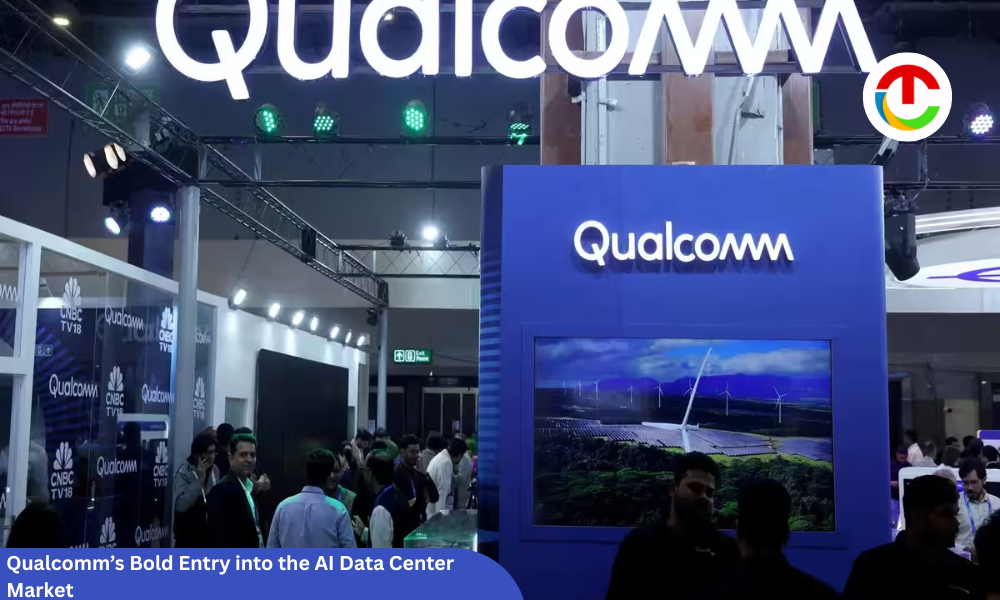
Qualcomm has unleashed two new AI accelerator chips for the booming data center market. It takes direct aim at GPU king Nvidia’s AI market dominance. With cloud computing, generative AI, and edge infrastructure booming, the company’s pivot signals more than just business diversification; it could reshape the competitive landscape for data center infrastructure in the U.S. and globally.
Strategic Rationale: Why the Shift Matters?
The AI infrastructure market is projected to grow exponentially over the next decade, with inference operations (running trained models) becoming a central cost driver. The U.S chipmaker’s entry comes at a time when cloud service providers, enterprises, and hyperscalers are seeking higher efficiency, lower power consumption, and more flexible architectures for AI workloads. By leveraging its existing expertise in mobile neural-processing and power-efficient design, the semiconductor giant aims to capture a slice of this rapidly expanding market.
What is Qualcomm Bringing to the Table?
The semiconductor giant’s new offerings, namely the AI200 and AI250 accelerator cards and rack-scale systems, are engineered specifically for AI inference in data centers. Slated for availability in 2026 and 2027, respectively, these solutions showcase features like up to 768 GB of memory per card, liquid-cooling support, and a software stack built for large-language models. Early traction is already visible: a major deal with Saudi AI firm HUMAIN signals global demand and ambition.
For U.S. cloud operators, this means a potential alternative to the dominant players, opening new pathways for hardware procurement and architecture innovation.
Competitive Landscape and Challenges
Currently, the AI data center field is led by established giants. Qualcomm enters the ring acknowledging that its challengers have a years-long head start. To stand out, the mobile chip leader must deliver on performance, compatibility with popular AI frameworks, strong ecosystem partnerships, and cost efficiency. Moreover, the U.S. market is highly scrutinized supply-chain constraints, regulatory reviews, and ecosystem inertia all pose considerable hurdles.
However, the mobile chip leader’s power efficiency credentials, mobile-to-cloud experience, and strategic deals may shift the dynamics in its favour especially among service providers seeking diversification and better total cost of ownership (TCO).
Implications for U.S. Tech and Cloud Infrastructure
For American cloud operators and enterprise tech buyers, the silicon innovator’s arrival offers several potential benefits:
1. More competitive choices:
With Qualcomm in the mix, procurement may see more innovation in pricing and architecture.
2. Energy efficiency gains:
As data centers scale, power usage becomes a major cost driver. The 5G pioneer’s designs promise lower watts per inference.
3. Supply-chain diversification:
Relying less on one dominant supplier could mitigate risk and foster healthier competition.
4. New design models:
Flexible rack-scale systems from AI chip developer may enable hybrid deployments or modular builds tailored to AI workloads.
These factors align well with U.S. priorities in cloud infrastructure resilience, sustainability, and innovation.
What to Watch: Milestones and Risk Factors?
Key milestones that will determine the U.S chipmaker’s success include:
- The commercial launch of AI200 in 2026 and AI250 in 2027.
- Additional design-win announcements or deployments with major cloud providers.
- Calculation of actual performance and cost savings compared to incumbent solutions.
- Supply-chain readiness and manufacturing yields for rack-scale hardware.
- On the risk side, the 5G pioneer must contend with:
- An entrenched competitive ecosystem and high bar for performance.
- Potential delays in shipment or adoption.
- Ensuring full compatibility with established AI frameworks and software stacks.
- Navigating regulatory and export challenges in the U.S. semiconductor industry.
Conclusion
Qualcomm’s bold entry into the AI data center market is a high-stakes play that could resonate far beyond hardware buyers. For U.S. tech infrastructure, this shift introduces fresh competition, new architecture possibilities, and potential cost-efficiency gains. While execution risks remain, the company’s move marks a pivotal moment in the evolution of AI infrastructure. Cloud operators, enterprise architects, and investors alike will be watching closely as the silicon innovator transitions from mobile-chip specialist to data-center contender.
Also Read :- Qualcomm Forecasts Softer Q4 Profit as Apple Revenue Declines, Bets on AI Data Centers for Future Growth