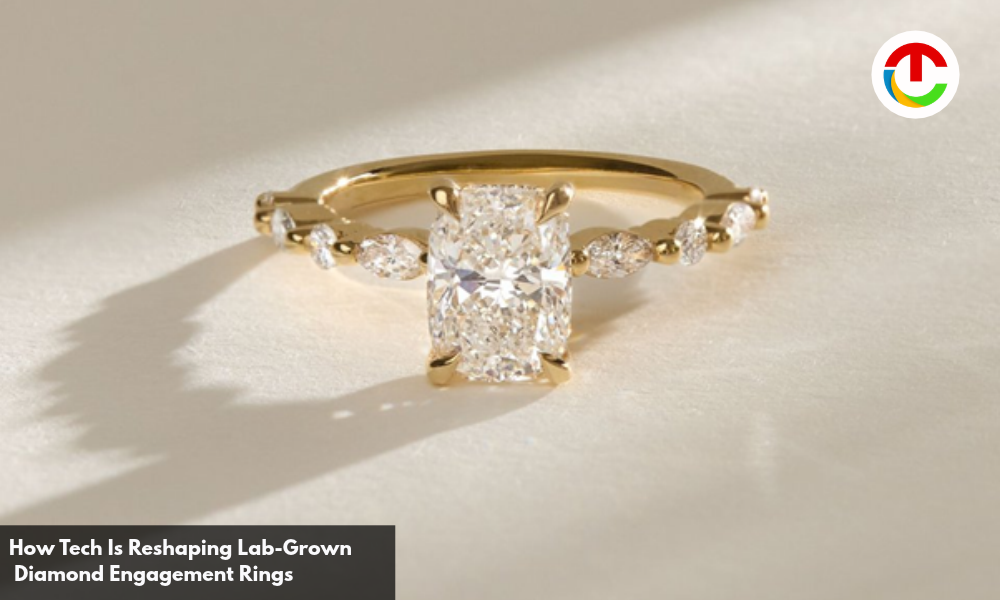
A diamond used to need a billion years and a mining company before it reached anyone’s finger. Now one can come out of a reactor in a few weeks and be set in a band that was printed overnight. That shift is changing how lab-grown diamond engagement rings are made and sold.
Growing a Lab Diamond Is Now a Manufacturing Problem
Most lab diamonds come from one of two processes. HPHT (high pressure, high temperature) squeezes carbon in a press at around 1,500°C, recreating conditions deep underground. CVD (chemical vapour deposition) is quieter. A thin diamond seed plate sits in a vacuum chamber, a methane and hydrogen mix is heated into plasma, and carbon atoms settle onto the seed one layer at a time.
Neither method is new. What’s changed is control. Growers now adjust gas ratios and chamber conditions through software and monitor each run in real time, so reactors that once produced patchy, brownish crystals can turn out colourless stones reliably. Yields went up. Prices came down. Retailers have built whole ranges on the back of it, and Australian jeweller Cullen Jewellery is a good example, offering lab diamond rings where buyers choose the grown stone and the made-to-order setting separately instead of settling for whatever’s sitting in a cabinet.
Software Now Plans the Cut
Before a rough lab diamond meets a blade, it usually gets scanned. 3D mapping systems build a model of the crystal, flag inclusions and work out which shapes waste the least material. A cutter might see several outcomes on screen (a 1.8 carat oval versus a cleaner 1.5 carat round, say) and pick whichever suits current demand.
Lasers then handle much of the sawing and shaping. It’s faster than traditional cleaving, and far less risky. One bad strike on a valuable rough used to mean a ruined stone. A planned laser cut mostly takes that gamble off the table.
CAD and 3D Printing Moved Ring Design Online
The setting has gone digital too. Jewellers model rings in CAD software, print them in castable resin, and burn that resin out during casting to leave the metal form behind. That’s what makes a proper online configurator possible. You can swap a plain solitaire for a hidden halo, widen the band from 1.8mm to 2.2mm, and see a rendered preview before anything is made.
For someone in Townsville or regional WA without a big jeweller nearby, this matters more than it sounds. The full range isn’t limited to what fits in a display case in Sydney.
Proving What You’re Buying?
1. Grading and laser inscriptions
Here’s the catch with a stone that’s chemically identical to a mined one: you can’t tell them apart by eye. So detection has had to keep pace. Labs such as IGI and GIA use spectroscopy and photoluminescence equipment to confirm a diamond is lab-grown and identify the growth method. Most graded lab stones also carry a microscopic inscription on the girdle matching the report number, which takes seconds to check under a loupe.
2. The energy question
Reactors run hot for weeks, and power-hungry growth was a fair criticism early on. Some growers now run on hydro or solar and publish certification for it, which gives the sustainable claim something measurable behind it.
So when two stones look identical on paper, ask the question most buyers skip: how was this grown, and can you show me? A good jeweller will hand over the growth method and report number without hesitating. That paperwork is where all this technology actually starts working for you.
Also Read :- Your Wedding Is Coming: When Should You Start Preparing?