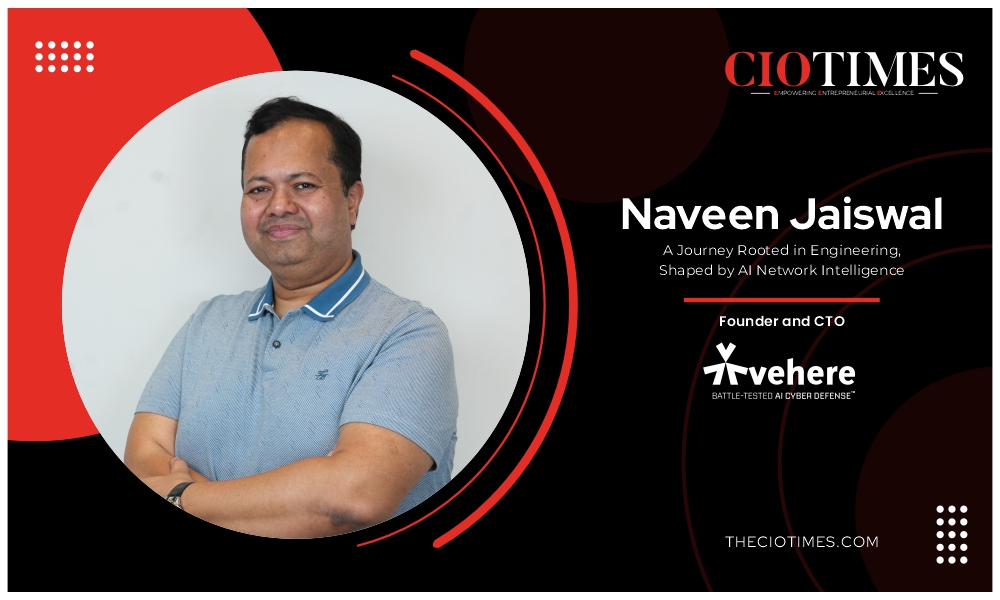
Long before artificial intelligence became the defining conversation in cyber defense, Naveen Jaiswal was building the systems that would eventually give AI something valuable to work with.
With a background in systems engineering, Naveen Jaiswal completed his MS in System Level Integration at the University of Edinburgh before taking on R&D roles at the University of Strathclyde and Giesecke & Devrient. His technical experience spans operating systems, network-on-chip architectures and large-scale system integration.
In 2006, he co-founded Vehere with his brother, Praveen. The company’s early work centered on Signals Intelligence (SIGINT) and Communications Intelligence (COMINT). By 2009, Vehere was working with national security agencies, and in 2011, it joined an R&D program with the Defence Research and Development Organization (DRDO) to develop indigenous security solutions.
Building technology for these environments established a demanding engineering standard; systems had to perform reliably under high volumes of data, with little tolerance for error.
“A defining moment came when government and national security organizations began deploying our technology. Their operational requirements demanded reliability, scale, and precision from the outset, leaving very little room for compromise,” recalls Naveen.
Over the years, Vehere evolved from its roots in communications intelligence and national security to develop cyber situational awareness and AI Network Intelligence capabilities. Its Network Detection and Response (NDR) and Full Packet Capture (PCAP) capabilities provide deep visibility into network activity, while Vision AI serves as the network-aware intelligence layer across the platform, combining machine learning, LLMs and deep behavioral analytics to interpret network data and generate actionable insights.
This evolution reflects a consistent engineering principle at Vehere, where the quality of AI-powered intelligence depends on the depth and fidelity of the network data behind it.
The Network as a Source of Truth
As Vehere moved from capturing communications to analyzing activity across networks, the network itself became a richer source of intelligence. The challenge was to make sense of activity unfolding across connected systems and extract intelligence from the traffic moving between them.
The engineering questions that emerged from this evolution would later shape Vehere’s AI Network Intelligence platform, where Full Packet Capture (PCAP), Network Detection and Response (NDR), and Vision AI bring network data and AI-powered analysis into a common architecture.
An individual alert could indicate a possible intrusion, but the surrounding traffic could reveal where the connection came from, what happened next, and whether the activity formed part of something larger.
Naveen Jaiswal puts it simply, “The network is the single source of truth.”
The belief has shaped the way Vehere has built its technology over the years. Full Packet Capture preserves the underlying traffic so investigators can return to the evidence when questions arise, while NDR examines network activity for behavior that may point to an attack. An analyst can start with the alert, move into the traffic behind it and follow the activity across the environment to understand how an incident unfolded.
For Naveen Jaiswal , that wider view is what makes network visibility useful for cyber situational awareness, because it puts an individual event back into the context of the environment around it.
Cyber Situational Awareness
Once the network becomes the source of truth, the focus shifts to understanding what its evidence reveals about an intrusion. Cyber situational awareness helps security teams interpret activity across an environment in relation to an adversary’s presence, objectives and potential impact.
An attacker may gain access through a compromised endpoint and then move between systems, potentially using valid credentials or legitimate tools to avoid raising suspicion. An alert may identify the affected device, but investigators still need to establish what happened next. By examining related network events, analysts can trace subsequent connections, identify signs of lateral movement and determine whether the intrusion has spread to other parts of the environment.
“True situational awareness does not just flag an anomaly; it delivers the clarity to understand what happened, why it matters to the enterprise, and how to orchestrate an effective response,” Naveen explains.
By correlating network activity and examining packet-level evidence, security teams can build a clearer picture of an incident, establish its scope and identify where further investigation is needed. This context helps teams prioritize threats based on their potential impact and make better-informed decisions about containment and response.
The Data Behind AI
The more complex a network becomes, the harder it is to understand an incident from individual alerts alone. The clues may lie across different connections, systems and exchanges, with each revealing only part of the picture. AI can help make sense of these relationships, but its ability to do so depends on the depth of network data available to it. This makes data fidelity a fundamental consideration in how Vehere develops its AI capabilities.
Vehere’s investment in Full Packet Capture (PCAP) and deep network visibility supports this requirement by retaining detailed information about network activity for analysis. This gives AI systems a richer evidentiary basis for interpreting security events than individual alerts or limited telemetry can provide.
“AI delivers better outcomes when it’s built on complete, high-fidelity network intelligence rather than isolated events or limited telemetry,” Naveen says.
Every SOC he speaks with is dealing with another practical reality; security data keeps growing, but analyst capacity doesn’t. “That makes intelligence and automation increasingly important. AI can correlate events, enrich alerts, and help analysts focus on what deserves immediate attention,” says Naveen.
This is where Vision AI brings the platform’s network intelligence and AI capabilities into a common analytical framework. As the intelligence fabric underpinning Vehere’s platform, it combines supervised and unsupervised machine learning, deep learning, LLMs and agentic AI within a multi-agent architecture. Specialized agents support alert triage, threat insight enrichment, evidence-based reasoning and response orchestration, helping security teams distinguish meaningful threats from benign activity and make informed decisions based on network evidence.
Innovation at the Network Layer
The value of network intelligence depends on how effectively large volumes of traffic can be examined and interpreted. This requires efficient retrieval of raw IP packets, fewer false alerts in Network Detection and Response (NDR), and the ability to distinguish normal activity within encrypted communications.
Vehere’s patent portfolio addresses these challenges through techniques for indexing Internet Protocol (IP) packets, reducing false alerts in NDR, and classifying normal encrypted network traffic separately from TLS-based virtual private network (VPN) traffic.
The packet-indexing patent describes organizing packet data using metadata and data structures to support efficient storage and retrieval, while the encrypted-traffic classification patent uses packet timing information and machine learning to distinguish normal encrypted sessions from TLS-based VPN sessions.
Naveen Jaiswal is named as an inventor on the IP packet-indexing and encrypted-traffic classification patents. These inventions address two specific demands of network analysis; retrieving relevant packet-level evidence efficiently and identifying encrypted traffic patterns from observable network behavior.
Engineering and Leadership Philosophy
At Vehere, engineering is closely tied to questioning what a security system should actually be able to do. Complex network environments rarely offer clean problems or obvious answers, so the development process has to leave room for engineers to challenge assumptions, test ideas and question decisions.
Naveen Jaiswal describes the culture in simple terms, “People and trust matter just as much as execution. We’ve tried to build a culture where curiosity is encouraged, and ideas are challenged respectfully.”
The principle has a practical place in Vehere’s product development. A technical decision can affect how a system performs when it is processing large volumes of network data or when a security team is investigating an incident under pressure. Encouraging engineers to question those decisions early creates space to identify limitations before they become product constraints.
For a company that has built a defense-grade AI Network Intelligence platform around real network data, leadership also means keeping engineering decisions grounded in the realities of security operations.
A Foundation Built on Trust
Technology can earn attention when it is new. Trust is built over the years that follow, through the way a system performs and the way a company stands behind it.
Vehere’s customer relationships have grown alongside its technology. Staying closely engaged throughout deployments gives the company a direct view of how its platforms are being used, where teams need greater clarity, and what they expect when network data becomes part of an investigation. Transparency is ultimately part of that relationship for Naveen.
“From the beginning, we’ve focused on building dependable technology and staying closely engaged with customers throughout the lifecycle of every deployment, while being transparent about what the technology actually does,” Naveen Jaiswal explains.
For a company serving national security organizations, critical infrastructure operators, telecom providers and enterprises, trust is built through consistent technology and clear expectations. Security teams need to know what the platform can show them, how it handles large volumes of network data, and how much confidence they can place in the evidence available during an investigation.
Over time, those expectations become part of the relationship itself. The technology has to earn trust every time a customer relies on it, and the company has to earn trust every time it stands behind that technology.
India’s Cybersecurity Growth
India’s cybersecurity industry is entering a phase where indigenous technology is becoming increasingly important. Government R&D programs are placing greater emphasis on developing and productizing home-grown cybersecurity capabilities, creating stronger links between research, engineering and commercial technology.
Artificial intelligence is adding another dimension to that growth. As AI becomes part of how cyber threats are detected, analyzed and understood, the ability to develop AI capabilities around specialized security data will become increasingly important. India’s strength in software engineering and advanced technology creates an opportunity to build such systems for both domestic and international requirements.
For companies operating in specialized areas of cyber defense, the opportunity extends beyond meeting domestic requirements. India’s engineering ecosystem can support technologies designed for complex security environments and developed with international markets in mind.
Vehere represents one example of this shift. The company has built its technology base in India while serving national security organizations, critical infrastructure operators, telecommunications providers and enterprises across different markets. Its growth reflects the increasing ability of Indian technology companies to develop specialized cybersecurity products for customers at home and abroad.
For Naveen Jaiswal , the opportunity is larger than the growth of a single company. It lies in building an enduring technology capability in India, where research and engineering can produce intellectual property, specialized products and AI-powered technologies with relevance beyond the country.
The shift gives India a stronger position in the global cyber defense landscape, with home-grown companies increasingly contributing technology to a field where advanced AI and specialized engineering are becoming closely connected.
What’s Next for Cybersecurity?
AI is already changing the speed at which digital systems can be analyzed, automated and attacked. As these capabilities become more accessible, defenders will have to account for threats that adapt faster than conventional security processes were designed to handle. Security systems must make intelligent decisions while preserving a clear connection to the evidence behind them.
The answer, for Naveen Jaiswal , begins with architecture. AI analysis must have access to data with enough depth and context to connect events across systems and over time. Network intelligence provides that broader view, while packet-level evidence allows investigators to examine the activity behind an analytical conclusion.
The challenge extends to the security of AI systems themselves. Adversarial manipulation, synthetic activity and automated attacks can introduce new uncertainties into cyber defense.
Meanwhile, advances in quantum computing are prompting researchers to examine whether today’s cryptographic methods will remain secure as computing capabilities evolve. The US National Institute of Standards and Technology (NIST) has published post-quantum cryptography standards to prepare for this shift. Vehere’s development of quantum-ready firewall technology brings this emerging concern into the company’s technology roadmap.
Naveen Jaiswal’s journey from communications intelligence to AI Network Intelligence reflects a sustained effort to extract meaning from complex network data. As AI expands the possibilities of cyber defense and computing advances reshape the threats ahead, the ability to establish what happened, how it happened and what the evidence reveals will always remain at the core of effective network intelligence. The strength of any analysis ultimately rests on the evidence behind it, and on the engineering that makes that evidence available, complete and meaningful.
Also Read :- CIO Times Magazine For More Information