As a Databricks Consulting and System Integrator Partner, KMS Technology helps enterprises modernize legacy data platforms and build governed, scalable foundations for analytics and AI. By combining Databricks expertise with application modernization, AI engineering, and AI-powered delivery capabilities, KMS bridges the gap between data modernization and enterprise execution, helping organizations turn trusted data and intelligence into measurable business outcomes.
From Digital Transformation to Enterprise Execution
KMS Technology is a global, AI-native technology services company focused on Enterprise Execution, helping organizations turn business intent into measurable outcomes. It builds and modernizes applications, creates trusted data foundations, puts AI into production, and continuously runs and improves the systems that execute the work. Its integrated approach emphasizes the control, reliability, and governance required to scale, enabling organizations to move beyond technology adoption toward measurable business execution.
Engineering the Execution Economy
KMS Technology believes that most businesses are still approaching AI from the wrong perspective. Many treat it as an enhancement layer, adding copilots or automation to existing operating models that were never designed for AI, and consider it transformation. While these efforts can create value, they rarely change how businesses actually operate.
It identifies a more fundamental shift: from systems of record to systems of engagement and, lastly, systems of execution. For decades, enterprise software has stored information and presented it to people, while moving work forward has largely depended on human co-ordination.
It describes this emerging landscape as the Execution Economy. As intelligence becomes increasingly accessible, competitive advantage will belong to organizations that translate it into co-ordinated action faster, more reliably, and with less friction. Digital engineering now involves designing systems that act, rather than simply applications that inform. This requires governed data, modern applications, orchestrated workflows, and AI capable of executing tasks within clearly defined boundaries.
It encourages business leaders to move beyond asking, “How do we use AI?” Instead, it challenges them to consider which tasks no longer require human coordination and where human judgment continues to deliver the greatest value. This is where intelligence begins to translate into measurable business outcomes.
Bridging Execution
KMS Technology believes that most enterprises do not have an information problem; they have an execution problem. After a decade of transformation spending, leadership teams continue to rely on dashboards, reports, and analytics, yet many struggle to consistently convert information into action at scale.
KMS Technology attributes this challenge to organizations continuing to optimize workflows designed for a different era of technology and labor. Historically, businesses were structured around human limitations. Information moved slowly, decisions required meetings, and coordination depended on layers of management. Entire processes emerged to bridge communication gaps and move work across disconnected systems. This opportunity is seen as going beyond process optimization to reconsider whether some existing processes need to remain in their current form.
As AI makes intelligence increasingly accessible, execution remains a key differentiator. It focuses on closing this gap by helping clients redesign how work flows across data, applications, people, and AI, reducing value lost through handoffs, escalations, and manual coordination. It is also applying this shift internally, moving from project-based effort toward measurable outcomes and repeatable execution.
Building Intelligent Ecosystems
An intelligent operating environment requires three elements working together: a governed data foundation, modern applications and workflows, and AI capable of operating within them. It builds solutions across all three areas.
As a Databricks Consulting and System Integrator partner, KMS Technology helps clients transform fragmented legacy environments into governed, scalable data foundations designed to support analytics and AI. However, KMS recognizes that data modernization alone is insufficient.
In most enterprises, applications remain closely tied to outdated data models, fragile integrations, and undocumented business logic. Modernising data without upgrading the surrounding systems and workflows leaves much of the execution challenge unresolved. It therefore integrates application modernisation with data modernisation rather than treating them as separate initiatives. Its Velox platform provides the workflow and orchestration layer, connecting systems, people, and AI-assisted execution.
The objective extends beyond improving visibility to reducing handoffs, minimising coordination overhead, and enabling work to move end-to-end through deliberately designed systems. Databricks establishes the governed data foundation, modern engineering connects applications, and Velox orchestrates execution. Together, these capabilities help KMS to transform disconnected technologies into an integrated operating system for business.
Transitioning to AI-Native
KMS Technology identifies a clear divide between two approaches to AI adoption. Some organizations are becoming AI-enabled by adding copilots, automation, and agents to existing workflows. Others are becoming AI-native by redesigning their operating models around what systems can execute, where people must remain accountable, and how authority is shared between the two. KMS emphasizes that this distinction is critical. Being AI-native does not mean pursuing full autonomy; it means adopting AI with clear intent. Certain tasks can be fully automated, others require supervision or approval, while some must remain human-led because they depend on judgment, relationships, or significant consequences.
Meaningful progress is measured not by the number of pilots an organization runs, but by its willingness to redesign the operating model. It is pursuing the same transformation internally, moving from AI-enabled services toward AI-native delivery by putting AI into production and rethinking how work gets done. KMS helps clients make the same transition by integrating intelligence into everyday business execution rather than simply adding it to existing processes.
Balancing Innovation with Enterprise Accountability
Today’s technology leaders must deliver innovation without compromising on governance, scalability, or return on investment. KMS says that organizations cannot restructure around AI while overlooking governance, cost, or accountability, as these are often the areas where transformation efforts fail. It follows an AI-native, human-governed approach. AI can accelerate specification, development, testing, documentation, and operational workflows. However, qualified professionals remain accountable for architecture, security, quality, approvals, and production outcomes.
While systems can execute faster, human responsibility remains essential. Within Databricks environments, KMS Technology establishes governance through data lineage, access controls, quality management, and observability from the outset. It applies the same discipline to financial performance by evaluating architecture, workload behavior, computing usage, and operating costs to identify opportunities for optimization.
For a European fashion retailer, this approach helped reduce data-related costs by 70%, freeing resources for continued migration, governance, and expansion. It also prioritizes reusable solutions over one-time delivery. Reference architectures, migration utilities, testing patterns, and operational standards help each new workload build on previous experience. It maintains that innovation and discipline are complementary. Strong governance, quality, and cost control make innovation scalable.
Engineering Resilient Digital Enterprises
For much of the technology industry’s history, digital engineering focused on developing applications that helped people perform their work. KMS Technology recognizes that this definition is expanding. Today, it brings together capabilities that have traditionally operated separately: application engineering, data and AI, and workflow orchestration.
This integrated approach is important because enterprises are moving beyond isolated application challenges to redesigning how their businesses operate across interconnected systems. KMS’s modernization services establish the technological foundation, while its data capabilities ensure information remains governed and accessible for meaningful use. Its Velox platform helps connect execution across applications, workflows, and AI.
Its managed-service models further strengthen this approach by maintaining accountability beyond implementation and go-live, rather than simply transferring responsibility back to clients. The long-term advantage lies in building resilient businesses. Organizations that depend on fragmented systems and labour-intensive coordination remain vulnerable to disruption, as every change can require additional meetings, integrations, and handoffs.
In contrast, businesses built on trusted data and coordinated system execution can adapt more quickly, reuse successful approaches, and scale expertise more effectively. This evolution forms the foundation of KMS strategic direction, bringing engineering, data, AI, and execution together to help enterprises build resilient operations and support sustainable growth.
Turning Trusted Data into Business Execution
Enterprise value increasingly comes from what organizations can execute using their data. But that requires data they can trust. Many organizations still struggle with inconsistent definitions, limited lineage, weak quality controls, fragmented ownership, and unreliable pipelines, making it difficult to use data confidently for analytics, automation, or AI.
It establishes a governed data foundation and connects it directly to business execution. For one client, KMS Technology unified data from multiple operational systems through Databricks, using near-real-time ingestion to create trusted information for faster decision-making and downstream automation. However, consolidation alone produces only better information. The real value emerges when trusted data feeds the applications, workflows, machine-learning models, and AI systems that determine what happens next. Data becomes actionable when it moves beyond something an organization simply reviews and becomes something its business operations run on. Achieving this requires the data foundation, operating model, and execution layer to work together seamlessly across all business operations.
Outcome-Driven Innovation
As industries become more interconnected, KMS Technology ensures its innovation roadmap stays closely aligned with the evolving priorities of global enterprises by focusing on enterprise friction and measurable outcomes, rather than technology fashion. It pays close attention to where customers are losing time, money, or execution capacity: fragmented data, legacy systems, manual handoffs, slow software delivery, weak governance, and growing coordination overhead.
These challenges guide its investment priorities. The global footprint also plays an important role, as operating realities differ across markets. Teams in the United States, Vietnam, Poland, and Mexico provide direct exposure to different regulatory, delivery, and customer environments. It also stays closely connected with platform partners, operators, and investors, as each offers a different perspective on where enterprise value is moving. However, accountability remains the most important mechanism. As it moves more of its work toward outcome-based models and ongoing managed services, it receives continuous feedback from the environments it operates. When it is responsible for results, its roadmap quickly separates what is interesting from what actually matters.
Redefining Enterprise Technology
The defining shift is easy to state and difficult to fully absorb. For thirty years, software helped people do the work. The next generation of systems will increasingly perform portions of the work themselves, within intentional boundaries. That changes the basis of competition. As access to intelligence becomes less scarce, execution throughput becomes more important: how quickly an organization can learn, decide, act, and adapt.
Companies that reduce execution friction will move faster, operate at lower cost, and compress decision cycles. Leadership changes too. The role of leaders shifts from coordinating every step of the work toward designing the systems, rules and accountability structures through which work gets executed. KMS is adapting to these changes across its own operations and customer engagements. It is transforming into an AI-native engineering, data, and orchestration firm, embedding artificial intelligence into its own operating model.
For its customers, it strengthens data infrastructure, updates legacy technology, introduces continuous operational accountability, and integrates AI into core business workflows. Its ambition extends beyond helping organizations implement AI solutions. It also aims to enable businesses to fundamentally transform how they function and deliver value through AI.
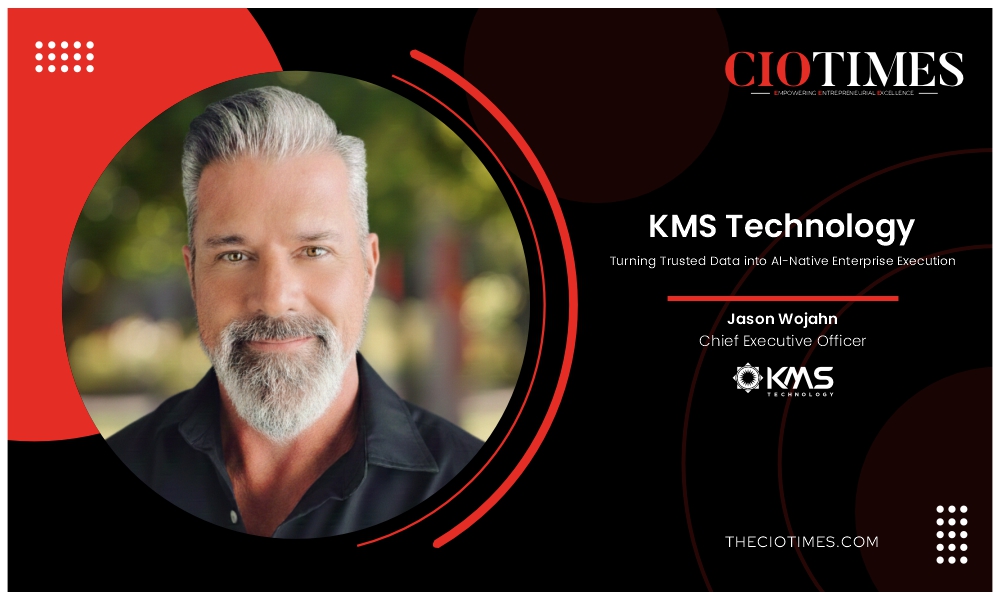
We also got a chance to interact with the KMS Technology CEO, Jason Wojahn. The seasoned technology executive has 30 years of experience building, scaling, and transforming global technology-services businesses. He has driven AI-native innovation and enterprise transformation. His focus is on turning emerging technologies into measurable business outcomes.
He shares three leadership lessons with us:
1. Sustainable value in services business
Sustainable value in a services business does not come simply from adding people. It comes from building repeatable systems, intellectual property, and operating models that allow expertise to scale without a proportional increase in labor.
2. Business outcomes need to take precedence over technology
When the problem and measurable results are clearly defined, selecting the right architecture and delivery model becomes significantly easier.
3. Transformation must begin before circumstances demand it
Markets eventually expose operating models that have become ineffective. Jason believes organizations should identify structural changes early and challenge their own models before external forces compel them to change.
He adds, “Those lessons shape how I am approaching KMS today: building repeatable execution, focusing on measurable outcomes, investing in platforms like Velox, and changing the services model rather than simply making the old one more efficient.”
Innovation Through Execution
A strong innovation culture emerges when organizations treat innovation and execution as complementary priorities rather than competing objectives. Many companies encourage experimentation but fail to translate it into meaningful changes in business operations. As a result, innovation risks becoming a performance rather than a driver of progress. Jason aims to build a culture that continuously questions existing practices while maintaining the discipline to transform them.
This approach begins with measurable outcomes. KMS Technology’s teams must experience the transformation firsthand. It is integrating AI into its delivery models, workflows, and operating practices before encouraging customers to follow suit. This strengthens its credibility.
Every initiative must contribute to customer success. Innovation is essential in a rapidly evolving market, but without execution, it delivers little value. He values teams that remain ambitious about future possibilities while maintaining rigorous standards for what they deliver.
Reimagining Technology Services
Jason’s long-term vision is to position KMS Technology as the partner enterprises turn to when they are ready to move beyond superficial AI adoption and redesign their operating models around execution. He aims to establish KMS Technology as a leading example of what an AI-native services company can become. For customers, this means building lasting capabilities through stronger systems, faster execution and greater opportunities for employees to focus on judgment, creativity, and growth.
Talking more about his vision, he says, “For our people, I want KMS to be a place where they do meaningful work at the front edge of how technology and business are changing. And for the broader industry, I want us to help prove that the technology-services model itself can be reinvented.”
Conventionally, the model has grown primarily through increased headcount. The next generation will scale expertise, intellectual property, and outcomes. If KMS demonstrates that a services company can deliver greater value without proportionally expanding its workforce while remaining accountable for measurable customer outcomes, it will create a lasting legacy.
Also Read :- CIO Times Magazine For More information