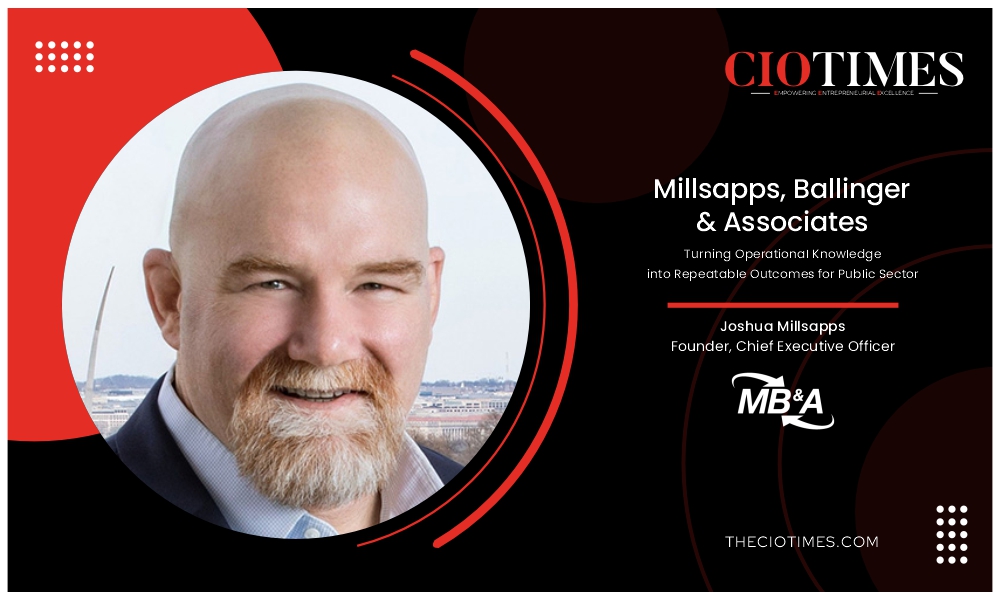
CEO of Millsapps, Ballinger & Associates Joshua Millsapps is building on ExAM4Enterprise, Salesforce, and years of experience in regulated environments to help organizations connect information, action, and accountability.
“We have noticed all too often that decisions at all levels of organizations are made with the information that is available, rather than the information actually needed to make the decision.”
Joshua Millsapps, CEO, MB&A
Consider an inspector who identifies a deficiency. What happens next?
Someone must determine whether action is required. The work has to be assigned. The organization may need to confirm that the person performing it is qualified. The corrective action must be documented, and leadership ultimately needs to know whether the issue was actually resolved.
Each step may involve a different person, department, or system. Yet the organization remains responsible for the outcome.
For Joshua Millsapps, CEO of Millsapps, Ballinger & Associates (MB&A), that sequence illustrates one of the central challenges of modernization. Organizations may have capable technology and large amounts of data, but still struggle to connect the information they collect with the decisions and actions that should follow.
The problem, in Millsapps’ view, often begins even earlier. Organizations frequently make decisions based on the information that happens to be available rather than first defining the information actually needed to make the decision.
Millsapps, Ballinger & Associates works backward from that question.
What decision needs to be made? What information is required to make it? How should that information be collected, routed, acted upon, and ultimately verified?
MB&A’s ExAM suite, built on Salesforce, is designed around those connections. The ExAM suite spans inspections, assessments, compliance, assets, learning, and work management. But the broader strategy is not simply to provide more applications. It is to shorten the distance between information and action while making the resulting process easier to understand, repeat, and trust.
That philosophy has also shaped MB&A’s evolution from solving individual customer problems to turning recurring operational lessons into reusable software.
Turning Operational Experience into Software
Over its history, Millsapps, Ballinger & Associates has increasingly focused on public-sector organizations and other regulated environments where the consequences of incomplete information, disconnected processes, or missed handoffs can be significant.
Those environments have taught the company to look beyond the initial technology request.
A customer may ask for an inspection application, for example, but the inspection itself may only be one part of the actual operational problem. A finding may need to create corrective work. That work may relate to an asset with its own history. The person assigned may require specific training or qualifications. Management may need evidence that the issue was resolved.
Understanding those connections often reveals requirements that are not obvious in the original request.
MB&A therefore spends significant time understanding existing workflows, the information users rely on, and the decisions managers need to make. Over time, patterns began appearing across customers and industries.
Those recurring patterns helped shape ExAM.
Instead of treating every engagement as a custom software project, Millsapps, Ballinger & Associates builds on reusable product foundations and proven templates. Public sector and enterprise buyers shouldn’t have to fund the redevelopment of core capabilities that already exist across similar operating environments.
The ExAM suite today includes ExAM4Enterprise, ExAM Assets, ExAM Tracker, and ExAM Achieve, connecting assessment, asset management, work tracking, and learning capabilities into a broader operational platform.
The philosophy is practical: standardize what organizations have in common, configure what makes them different, and develop custom software only where the requirement genuinely demands it.
Terminology, approval structures, integrations, reporting, and organizational models can vary substantially from one customer to another. A reusable product foundation should accommodate those differences without forcing every customer to rebuild capabilities that already exist.
That approach also recognizes that customers rarely have perfect visibility into every future requirement at the beginning of a project.
A working solution gives users something tangible to evaluate. Their experience creates a stronger basis for determining what should change next.
Connecting the Full Operational Process
One of the recurring lessons from Millsapps, Ballinger & Associates’s work is that organizations often manage closely related activities as separate systems.
inspection identifies a finding. The finding requires corrective work. The work relates to an asset. A qualification or training record may help determine who can perform it. Reporting must then make those relationships understandable to managers.
“When those functions operate in isolation, employees often become the integration layer.”
They move information between spreadsheets, send follow-up emails, reconcile records, track down missing documentation, and assemble evidence after the fact. Every manual handoff creates another opportunity for delay, duplication, or lost context. Connecting those activities creates a more complete operational record.
Teams can follow an issue from identification through resolution. Managers can see where work is overdue, where problems are recurring, and whether corrective actions are having the intended effect. The same information that supports daily operations can also help demonstrate how an organization responded to a requirement.
Consider a recurring equipment deficiency. Recording the finding may satisfy the immediate inspection requirement. But solving the underlying problem could require maintenance, a procedural change, additional training, or some combination of the three.
Looking at the finding, asset history, corrective work, and employee qualifications together creates a much stronger basis for understanding why the issue occurred and whether the response actually prevented it from happening again.
This is where Millsapps’ emphasis on information becomes practical. A dashboard is not useful simply because it displays data. It becomes useful when it helps someone make a decision or changes what happens next.
The process therefore begins by identifying the decision, determining what information it requires, and establishing how that information will be captured, trusted, routed, and acted upon.
Getting More from the Platform You Already Have
Salesforce provides the foundation beneath many of ExAM’s operational capabilities.
Millsapps, Ballinger & Associates builds on the platform’s data, identity, workflow, reporting, security, and integration capabilities while focusing its own product development on the operational processes customers need to manage.
For Millsapps, that creates an important opportunity for organizations that already use Salesforce but continue to view the platform primarily through the lens of the application that originally brought it into the organization.
A platform introduced for one purpose may be capable of supporting many additional operational needs. That changes the modernization conversation.
Before purchasing another disconnected system, a CIO can first ask whether an existing enterprise platform, combined with available applications, can address the requirement.
That does not mean every workload belongs on Salesforce. Fit, security, integration, cost, operating requirements, and long-term support all matter.
But it does mean organizations should consider whether they can make more deliberate use of investments, skills, and infrastructure they already have.
Millsapps, Ballinger & Associates has seen relatively small Salesforce teams expand the range of business processes they support by reusing established platform capabilities and products such as ExAM.
The advantage is not simply technical consolidation. It is organizational leverage.
Teams can build on familiar security models, reporting structures, integrations, and administrative skills instead of creating another isolated technology environment.
Learning Across Regulated Environments
Millsapps, Ballinger & Associates’s approach has also been shaped by working across different regulated environments.
The company’s experience with housing inspections, for example, has provided visibility into the process from multiple perspectives, including Housing and Urban Development administering requirements, inspection organizations conducting the work, and Public Housing Authorities responsible for responding to findings.
Looking at the same process from several sides reveals where information can disappear between participants.
A workflow that appears complete from one organization’s perspective may create duplicate work, delays, or uncertainty for another.
The same underlying pattern appears in other environments.
A housing organization responding to an inspection deficiency, a hospital team addressing a quality or safety issue, and a defense organization managing an operational requirement may perform very different missions. But each depends on the ability to capture reliable information, route work appropriately, maintain accountability, and adapt as requirements change.
Millsapps, Ballinger & Associates’s experience includes supporting health and quality-assurance processes across hospitals as well as modernization initiatives in defense environments.
Those experiences reinforce a recurring lesson: a technical requirement is only one part of the problem.
Users must understand how the process works. Managers need visibility into execution. Technology must operate within existing security, governance, and organizational constraints. And the organization must be capable of sustaining the solution after implementation.
Domain knowledge therefore shapes not only what MB&A builds, but also the questions its teams ask before building it.
Delivering Value Before the Plan Becomes the Product
Millsapps is skeptical of modernization efforts that spend years refining requirements before users experience meaningful value.
In many cases, the right first contract is smaller and focused on demonstrating initial operational impact before committing to a broader transformation.
MB&A favors a more iterative model: establish the outcome, deliver a useful capability, learn from real use, and expand with purpose.
“Establish the outcome, deliver a useful capability, learn from real use, and expand with purpose.”
Early user involvement makes assumptions visible.
Once people can interact with a working solution, they can identify what fits, what does not, and what should be prioritized next.
That same philosophy applies to legacy technology.
Some systems genuinely need to be replaced. Others may remain effective systems of record and benefit more from integration, automation, or a better user experience.
In some circumstances, retaining an existing system is the better decision.
MB&A evaluates those choices against business value, data dependencies, security, technical risk, cost, and the disruption associated with change.
That requires candor during discovery.
A reusable product may cover much of the requirement, but integrations, historical data, operating constraints, or organizational dependencies still need to be understood. Identifying those realities early helps customers make better decisions about scope and sequencing.
Governance plays an important role in making that speed sustainable.
Through experience supporting Centers of Excellence in organizations including the Department of Veterans Affairs and the U.S. Air Force, Millsapps, Ballinger & Associates has seen the value of clear standards, reusable assets, ownership, and support models.
Good governance should not simply add another layer of approval. Properly designed, it creates the guardrails that allow teams to deliver faster without producing solutions the organization cannot maintain.
The same principle applies to measurement.
Metrics such as time to resolution, manual reconciliation eliminated, documentation completeness, or the number of unresolved issues help both leadership and delivery teams understand whether modernization is producing meaningful operational improvement.
Millsapps, Ballinger & Associates ‘s product, delivery, and client-success functions each play a role in that process.
Product teams develop reusable capabilities. Delivery teams adapt them to the customer’s environment. Ongoing support provides another source of learning, revealing where processes remain unclear, where users need additional guidance, and where capabilities may deserve broader product investment.
In that sense, the customer relationship continues to influence the software long after the initial implementation.
AI Shortens the Distance Between Information and Action
Artificial intelligence adds a new layer to this operating model.
Information that once required manual review can increasingly be summarized, classified, compared, or prepared for action. Existing assessments and documents can be digitized more quickly. Questionable or incomplete information can be flagged for review.
Available today in ExAM AI are core capabilities for automated document digitization, text extraction, and data quality checks, while advanced image summarization, predictive classification, and automated cross-application workflows shape the active product roadmap.
But Millsapps connects the opportunity around AI to many of the same principles that govern traditional automation.
Organizations still need to understand their data. They still need to define the process. They still need to control access, establish what the system is permitted to do, and decide who remains accountable for the outcome.
AI simply makes those decisions more consequential because software can increasingly interpret information and influence what happens next.
Deploying AI should directly serve a clear operational outcome while offering a solid economic case. Maintaining clear risk boundaries ensures that automated intelligence accelerates decision-making without bypassing human judgment where accountability matters most.
For many regulated environments, Millsapps expects adoption to progress in stages.
- AI may first help a person understand information.
- Next, it may recommend an action.
- Eventually, within well-defined boundaries, it may be trusted to execute an approved action.
DATA & INFORMATION
↓
AI ANALYZES THE INFORMATION
↓
IDENTIFIES INSIGHTS & PATTERNS
↓
RECOMMENDS THE NEXT BEST ACTION
↓
DECISION-MAKING
↓
FASTER, MORE INFORMED ACTION
↓
MEASURABLE OUTCOMES
The level of autonomy should depend on the task, the consequences of error, and the organization’s governance requirements.
Preparing a draft summary for an employee to review is fundamentally different from closing a corrective action or making a compliance determination. Organizations can move quickly on the first while being far more deliberate about the evidence, approvals, controls, and auditability required for the second.
The opportunity is significant, but the objective remains familiar: shorten the distance between information and action without losing accountability or exposing the organization to unnecessary risk along the way.
Scaling Knowledge Through Repeatable Software
That brings the strategy back to the same idea that shaped ExAM in the first place.
Every customer engagement creates an opportunity to learn something about an operational problem. The question is whether that knowledge remains inside one project or becomes something reusable. Millsapps, Ballinger & Associates is increasingly focused on the latter.
The company continues to expand existing products and develop packaged offerings around recurring needs in specific industries. The goal is to create a stronger starting point for future customers rather than asking each organization to define and fund the same capabilities from scratch.
Greater repeatability can reduce the effort required to specify common functionality and allow implementation teams to concentrate on the requirements that truly differentiate one organization from another.
It also creates a role for partners and organizations with deep domain expertise to play a more integral role in implementation.
A specialized partner may understand the policies, procedures, assessment content, or training required in a particular industry. MB&A can contribute the software foundation, implementation methods, and platform experience needed to make that knowledge operational. Together, those capabilities can turn specialized expertise into something that is easier to deploy consistently across multiple organizations.
Packaging that knowledge still requires judgment.
Customers in the same industry may share many requirements while differing significantly in organizational structure, terminology, integrations, operating procedures, or risk tolerance. The challenge is to standardize what is genuinely repeatable without hiding the differences that matter.
Millsapps expects AI to accelerate this model and sees responsible integration with MB&A’s existing applications as the next step. More broadly, he believes organizations should stop treating platform investments as isolated IT projects and instead view them as foundations for continuous execution.
By connecting Salesforce, ExAM, and purposeful uses of AI, organizations can reduce the distance between an initial assessment and final resolution. The goal is not simply to automate more activity. It is to create processes in which information leads more reliably to action, responsibility remains visible, and outcomes can be verified.
The ultimate measure of success is whether organizations can answer critical operational questions with confidence. What happened? What action was required? Who was responsible? Was the issue resolved? And can the organization prove it?
That brings the story back to the principle at the center of MB&A’s approach: learn from each implementation, turn what is repeatable into software, and give the next organization a stronger starting point.
Millsapps is building Millsapps, Ballinger & Associates around making this model easier to execute, easier to verify, and increasingly unnecessary for each new customer to build from scratch, helping organizations get hands-on with a focused initial capability in weeks, not years, to deliver immediate value and establish a foundation for long-term operational success.
Also Read :- CIO Times Magazine For More information