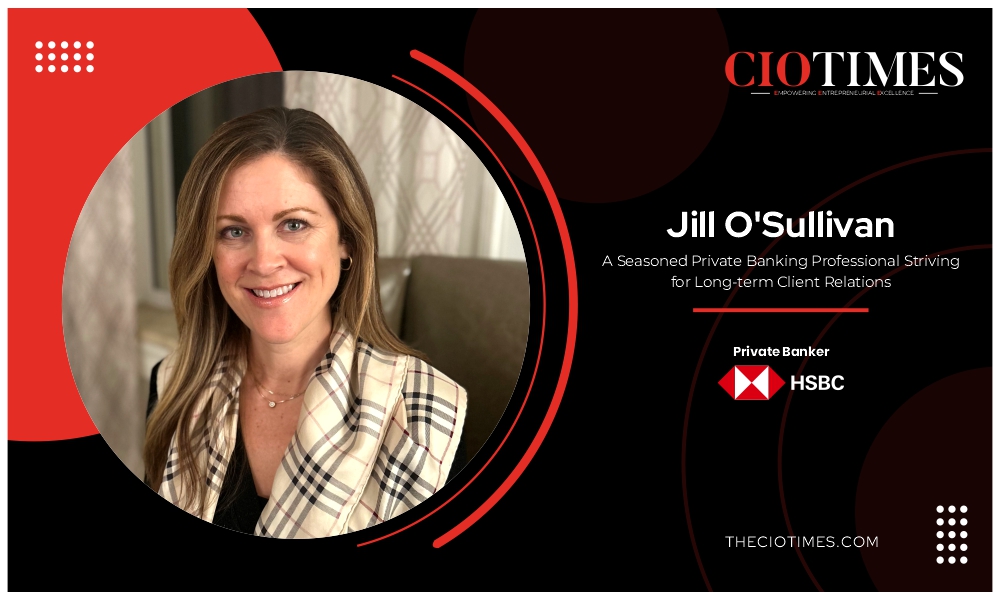
Women in business means authority. They are professionals who are curious about a particular work aspect while clearing the air around it. Bringing in intellect, ease, and balance in the daily operations is their forte. From technology innovators to financial strategists, women have been shining, and the influence extends beyond traditional corporate boundaries. These sharp minds are focused on the target to achieve and do so with strategic ability. A professional whose name cannot be missed is Jill O’Sullivan, Senior Vice President at HSBC Bank, New York. She describes her personality as a connector; her contributions in the banking sector have been impeccable.
Parents Guidance
Calling herself an accidental banker, she felt inclined throughout her high school and college years to pursue a career in the service sector. She reckons it may be attributed to her Catholic school upbringing. Not knowing if this path involved the Peace Corps or a nonprofit-focused major, she sought direction from her parents, whom she admired as role models. Her mother worked a part-time job and has been her consistent supporter in choosing an ideal career so O’ Sullivan could possess good things. Her father spent his entire professional life working at the NYSE, while pushing her towards pursuing finance as a career, which she also obliged to. She was hopeful to connect finance with her desire for service.
Obeying her parents proved fruitful for her, and she secured her first job at Smith Barney, where she worked at a retirement planning help desk. Not the job she envisioned, but it proved to be a primary introduction to the finance industry. Immediately after, she was offered the position of a Relationship Officer (a Junior Banker) at Citibank. Upholding her desire to serve others, she took the plunge to enter wealth management and private banking. Humbled enough to consider herself lucky to get mentorship from a senior leader who took her along to client meetings.
She shares, “My role was primarily opening accounts for high- and ultra-high net worth individuals, which included compiling ‘Source of Wealth’ profiles. I was fascinated by our clients’ personal stories of starting businesses, creating foundations, supporting the arts, sitting on impressive boards, and working on projects that positively changed the world.”
Witnessing their stories and achievements ignited a zeal in her as she was helping them make crucial financial decisions. That was the eureka moment when she gained insight into her career, and she was enjoying it to the fullest.
Exposure Imparts Growth
She has worked with pioneers of the financial sector, like Citi, Smith Barney, J.P. Morgan, Wells Fargo, and HSBC. These experiences have been an eye-opener that has shaped her perspective on her work. Initially, during her private banking career, she keenly observed seasoned bankers and advisors at several institutions. She often fell into self-doubt, thinking about whether or not she could be a banker herself someday.
The feeling was due to her less developed professional network and lack of self confidence in the early stages of learning about the financial markets. She wondered if she expressed herself convincingly when interacting with clients dealing with complicated investment decisions. But somewhere she also knew she was gradually defining what type of work she wanted to do in this field and what type of advisor she aspired to become.
As she got promoted to a banker, she learnt that she could be herself rather than mirroring anyone.
She shares, “I could be successful just being myself, as long as I made the client my top priority.”
Working in large organizations taught her to be of value to clients, to maintain a strong alliance with external networks, too. She made thoughtful use of the resources around her to bring to life initiatives that truly reflected her values, particularly those focused on supporting women through specialized events and educational programs. Along the way, she grew into the kind of advisor she had once hoped to find herself, someone approachable, committed, and genuinely driven by a desire to make a meaningful difference in people’s lives.
Establishing Trust
She deals with high-net-worth and ultra-high-net-worth clients, which means trust building is crucial. In this sphere, these clients seek an accurate amount of attention, which is rare to find. They yearn to be heard and also want a quick and practical response. Due to extremely busy schedules, they need their financial choices to be made clear. Being an advisor, O’Sullivan considers her role as one of deep understanding. Exhibit ideal solutions to make things easy. It established a bond that the clients cherish for a long time.
She aligns personalized client service with the institutional goals and risk management agendas crafted.
She shares, “These things should all be aligned, so if we’re doing good business, we should be able to meet our goals without presenting a risk to the bank.”
Aligned Minds
About leadership qualities, O’Sullivan stresses that being passionate about people in the private banking sector is crucial. Being intrigued consistently to solve a client problem should be the goal. Value proposition for the business is a key for the whole team to gain ideal insights into.
She adds, “We have to be on the same page in terms of our desire and ability to serve the client. It’s when we all have a vested interest in the outcome of the business that we succeed together.”
Human Touch
As technology and digital transformation are redefining wealth management, financial advisors and clients will be able to access information with ease. But in the high- and ultra-high net worth space, O’Sullivan thinks clients will still need the high, white-glove touch that comes down to a human level of service, which is irreplaceable.
Balanced Motivation
With more than two decades in the finance industry, she is motivated by her clients’ work and their financial journeys. The motivation has a dual approach:
- She finds bliss in helping them reach their anticipated financial goals.
- A mother of two daughters, she constantly sets positive examples for them. She and her husband impart the message to their daughters that they should strive to do whatever they wish to do with hard work, and they should be on a mission to do something that makes them proud and be passionate about it, too.
Learning Through Challenges
Private banking operates in a constantly changing landscape. The events of 9/11 took place sometime after O’Sullivan joined the private banking sector. Many aspects changed overnight. It was quite a shock for people who lived and worked in NYC on a personal level. The sector overall made major shifts in the way it did business.
She shares, “Our AML and KYC standards were completely overhauled, and strict new rules were applied to the onboarding of new clients.”
Many of these measures are still in place today to ensure agility and manage risks.
Advice for Future Professionals
For aspiring finance professionals, O’Sullivan suggests taking time to focus on building a strong network. It is an aspect that will evolve throughout their lives, and it shouldn’t stop when they get their first job.
She shares, “They should seek out good mentors and sponsors and find ways to build bridges across their company and industry. I’d also encourage them to find non-profit or volunteer work that they love.”
This will help to build an authoritative resume while developing connections in different fields that could last a lifetime.
Constant Evolvement
As technology and AI continue to move at an extraordinary pace, she understands that many areas of the wealth management industry are steadily becoming automated. The next generation of clients is growing up with unprecedented access to information far more than their parents ever had at their fingertips. Yet, she believes that no matter how advanced technology becomes, it cannot replace the reassurance and clarity that come from a trusted human relationship. Clients still want someone who can listen, interpret complexity, and guide them with perspective and care.
O’Sullivan sees her own role naturally evolving in response to this shift, especially as many of her clients become increasingly global in their ambitions and lifestyles. For her, the future is about deepening those relationships and finding meaningful ways to connect clients with the right global resources both within the banking world and beyond so they feel supported wherever their journeys take them.
After some business conversations, we shifted the conversation to some casual questions, which she was kind enough to answer. The questions we asked were:
- What book are you reading currently? Hamnet with my work book club, and I just finished re-reading A Tree Grows in Brooklyn (a national treasure!) with a local book club I started.
- One word that best describes your personality: Connector
- What’s the most important lesson you’ve learned? (Personal or professional): I didn’t fully realize that I shouldn’t try to be anyone but myself until I was about 10 years into my career. Today, I know that being authentic, staying true to my values and my faith, and having a relentless drive to do good make me a role model for my daughters, and for others.
- What’s the best professional advice you’ve received? A best practice from my banker partner, Andrew Passeri: Stop e-mailing and pick up the phone! Even better – meet in person.
- What is your favorite quote?: If not me, then who? If not now, then when?