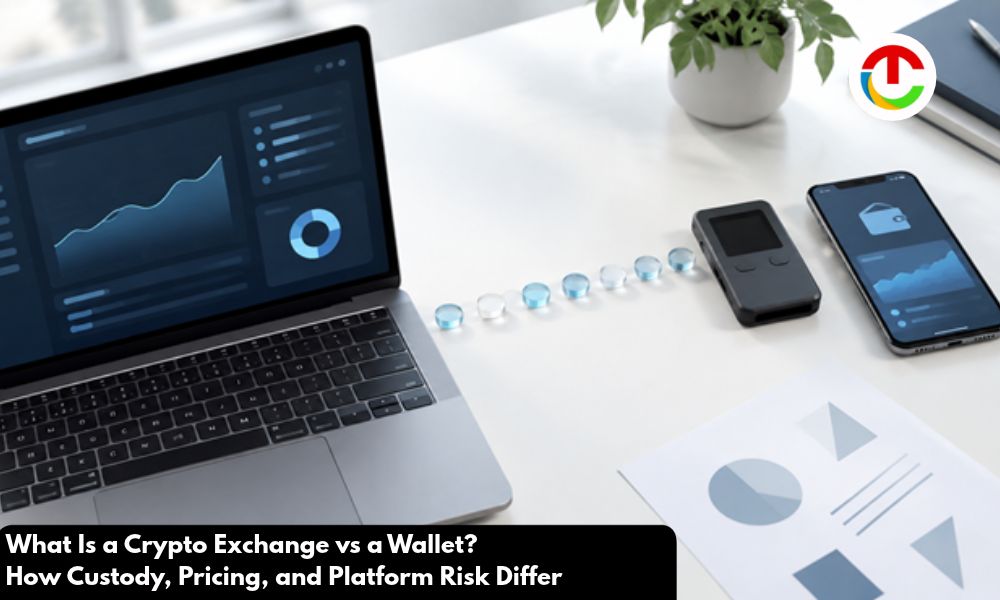
Crypto Exchange and a wallet solve different problems. A centralized exchange is primarily an account and trading service: it lets a customer buy, sell, convert, and withdraw assets under the platform’s rules. A self-custody wallet manages the credentials used to authorize actions on a blockchain. The practical question is not which one is universally better. It is who controls access at each stage, what record shows the balance, and what can interrupt a transfer.
This distinction matters before a first purchase, not only after something goes wrong. An exchange can make buying with local payment methods and placing orders straightforward. A wallet can let a person interact directly with a public blockchain and decide when to sign a transaction. Those benefits come with different failure modes. This guide explains the boundary, follows an asset from purchase to withdrawal, and offers a way to match the setup to the job. It does not rank platforms, recommend a token, or replace local legal, tax, or security advice.
Cover image: Unbranded exchange workspace, hardware wallet, and phone representing a transfer from account custody to self-custody.
What Is a Crypto Exchange vs a Wallet in Practice?
The shortest useful answer is that an exchange organizes trading and account services, while a wallet manages signing authority. That description is more accurate than saying crypto is simply “kept” in one app or another. Blockchain records associate assets with addresses and authorization rules. A wallet supplies the keys or other credentials that allow a valid transaction to be signed. A typical centralized exchange maintains customer balances in its own internal ledger and operates the custody infrastructure behind those balances.
That is why a purchase can appear in an exchange account immediately without an on-chain transaction to a personal address. The exchange may update its books after matching the trade or executing a conversion. A withdrawal is a separate event: the platform reviews the request, applies any fees or limits, and, if it proceeds, broadcasts an on-chain transaction to the destination address.
The practical boundary is simpler than product branding: a service may restore account access when it operates the account system, while a self-custody setup may depend on recovery material or wallet-specific recovery features. The applicable terms, recovery method, and withdrawal screen still matter because products do not all work alike.
| Question | Centralized exchange account | Self-custody wallet |
| Main job | Trading, conversions, fiat access, and account services | Signing transactions and accessing on-chain applications |
| Who operates the key environment? | Usually the platform | Usually the wallet holder |
| What may restore access? | The platform’s account-recovery process | Recovery material or another setup-specific recovery method |
| What record normally reflects the action? | The platform’s internal account ledger for an exchange trade | A public record for an on-chain transfer or DEX swap after broadcast; confirmations increase assurance |
| Main risk to examine | Platform, account-access, and withdrawal risk | Key protection, signing, recovery, and smart-contract risk |
The table is a map, not a verdict. Ask who can authorize movement of assets and which record you are reading.
Follow One Asset Through the Boundary
Consider a simple, hypothetical sequence. A customer funds an exchange account, buys an asset, and later requests a withdrawal to an address controlled by a self-custody wallet. There are at least three distinct records to understand:
1. Account funding.
The payment provider or the exchange credits the account under its own processing rules. The available balance may differ from the settled balance while a payment is being reviewed.
2. The trade.
The Crypto Exchange records the order fill, conversion, fee, and new account balance. This can all happen inside the venue’s systems.
3. The withdrawal.
The customer selects the asset, network, destination address, and amount. The exchange applies its withdrawal process; only when a transaction is broadcast can a public blockchain explorer show it. The receiving wallet shows the result according to its network support and confirmation rules.
Each step has a different error pattern. A payment delay is not necessarily a blockchain delay, and a filled trade does not prove that a withdrawal was submitted. A transaction identifier matters only after the destination asset and network are matched correctly.
Before a withdrawal, verify the receiving network, not just the ticker. Some destinations also require a memo or tag. A small test transfer can validate a path, but it incurs fees and does not replace the platform’s requirements. Never share a recovery phrase, private key, one-time code, or screen-control access.
Prices Are References Until You Identify the Market
An Crypto Exchange screen and a broad market page may display different numbers without either being wrong. One might show its latest trade for a particular pair, while another presents a composite reference across venues. A derivatives mark, a midpoint between the best bid and ask, and a spot last trade all answer different questions. Quote currency and timestamp matter as much as the asset name.
When comparing a venue’s price with a wider reference, a crypto market live tracker can provide context for market capitalization, price movement, and the market-wide view. It cannot tell a reader exactly how a particular exchange order will fill. For that, inspect the relevant pair, whether the product is spot or derivative, the bid and ask, visible depth, applicable fees, and the size of the intended order.
Price data and custody meet at the handoff, but they answer different questions. The quote helps describe the trade; the withdrawal screen establishes what the platform says it will send. Before confirming a withdrawal, match the asset and network on both sides, read the fee and minimum, and keep the request reference. Once the platform reports a transaction identifier, inspect that identifier on the correct network. A transaction on a different chain, or a receiving wallet that does not support the asset, is not evidence that the intended transfer will be usable. A visible transaction also may need further confirmations before a receiving service treats it as final.
This is also why an exchange leaderboard should be treated as a research starting point. A list of top crypto exchanges can help a reader locate data about trading volume, liquidity, markets, and fiat support. It is not a personal recommendation, a solvency conclusion, or evidence that a particular pair is liquid enough for a particular order. Check conditions for the actual account and jurisdiction, because availability and product access can differ.
Decide What You Need to Control, Not Which Label Sounds Safer
People often turn this into a false choice: exchange or wallet. One person may use an exchange for a purchase, move a portion to a wallet for an on-chain application, and later return assets to a venue to sell. The relevant choice is the control and responsibility accepted at each point.
For a custodial account, assess account-security options, recovery, withdrawal controls, supported networks, fees, restrictions, and status communications. Strong passwords and multi-factor authentication reduce some account-takeover risk; they do not remove platform operational risk or disruption.
For self-custody, assess how recovery material is protected, which devices can sign, network support, and whether an interaction asks for a transaction, signature, or token approval. Key control does not prevent lost recovery material, malware, phishing, blind signing, or malicious approvals. The suitable setup depends on the activity and the consequences of an error.
A useful written decision record is short:
- What must I do: trade, hold, transfer, or use an application?
- Which service is responsible at this stage, and how is access restored?
- What exact asset and network are involved?
- What fees, minimums, limits, and processing conditions apply?
- What evidence would show that the next step has actually happened?
Writing those answers turns an abstract custody debate into an operational plan. It also makes it easier to distinguish an account issue from an on-chain issue when support is needed.
Keep Operational Updates Separate From Market Commentary
Market headlines can be useful context, but they should not be the only place someone checks a transfer, service, or product condition. A news page may summarize a security incident, a policy development, or a large market move. The account-specific source remains the platform’s own notice, account interface, and support route. Official project documentation matters when a network migration, token contract, or wallet update is involved.
Readers looking for broader developments can use cryptocurrency news today to follow reported market and industry updates, then return to the primary record for any decision involving their own account. Check the publication date, the jurisdiction or entity named, and whether the article reports a proposal, an allegation, a confirmed event, or an analysis. A headline about a market reaction does not explain the status of an individual withdrawal.
During fast-moving periods, a viral claim may reflect one unresolved support case or an old maintenance message, while a real notice may apply only to one network. Preserve the asset, network, approximate time, and request status before drawing a conclusion.
Conclusion
An Crypto Exchange is a trading and account service; a wallet manages authorization for on-chain actions. Compare the record you are seeing, the actor controlling the next step, and the conditions that apply before sending anything. That produces a clearer decision than a slogan about custody.
FAQ
1. Can an Crypto Exchange account have a deposit address and still be custodial?
Yes. A platform can provide an address for deposits while operating the private-key and custody infrastructure itself. The address helps route incoming transfers; it does not by itself establish that the customer can sign from it or export its key.
2. Why does a withdrawal sometimes remain pending before a transaction appears on-chain?
The platform may still be processing security checks, batching requests, applying a network-specific rule, or waiting for a maintenance condition to end. Until it broadcasts a transaction, there may be no blockchain record to inspect. The account’s withdrawal-status details are therefore the relevant first evidence.
Also Read :- How Pawn Loans Actually Work: A Plain-English Guide to Turning Valuables Into Fast Cash