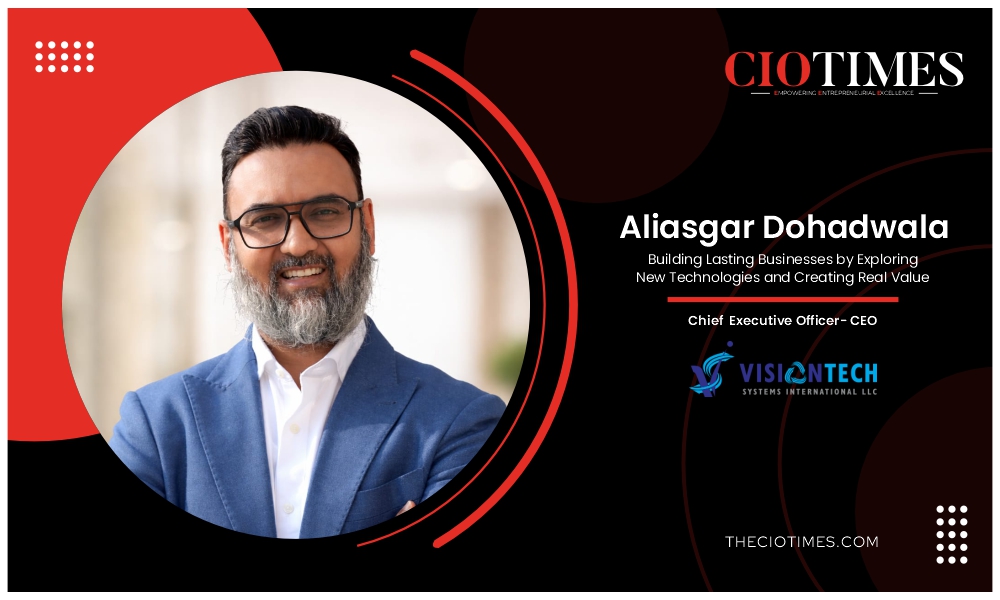
Innovation is crucial for attaining business success in today’s competitive world. It enables the creation of adaptive solutions to satisfy changing needs of customers and thereby remain ahead of the curve. With a passion for building innovative solutions, Aliasgar Dohadwala, Founder and CEO of Visiontech Systems International, has contributed to the success of the organization. Such visionary leaders are vital for achieving business growth as they turn novel ideas into practical, value-creating solutions that allow organizations to survive and grow. They emphasize building forward-looking strategies that ensure sustainable business viability.
A Self-driven and Focused Leader of the Arab World
Aliasgar is a recognized and self-made entrepreneur in the Arab world. He has 25+ years of experience in the IT industry in sales and business development initiatives. With his consistent effort and expertise in leading robust teams, he has contributed to Visiontech’s organic growth. He emphasizes building healthy relationships, which equips him to channel sales, bring new collaborations, and build new markets.
Building Enduring Companies
In a rapidly evolving era, multiple waves of technological disruption have significantly altered the relationship between technology and business. According to him, technology becoming an essential part of business strategy was a fundamental shift. Enterprise digitization laid the foundation, and cloud accelerated it. It made leaders rethink serving customers, entering markets and scaling businesses. With AI, this relationship has evolved, influencing decision-making and the execution of work.
Conversation among customers has also moved. From asking, “Which system should we buy?” to “What should our business be capable of?” indicates that a different kind of technology partner is needed who possesses an understanding of the business objective and the ability to take responsibility beyond implementation.
Aliasgar Dohadwala has spent 23 years building Visiontech. He shares a clear lesson that he learnt, saying, “A company’s relevance cannot depend on a particular technology or vendor. It has to come from understanding customers, developing people and consistently delivering on commitments. Our expertise must evolve as their challenges evolve.”
Building an enduring company requires judgment about the pace of change. Curiosity to explore new technologies and discipline to create real value is essential. Lasting businesses require building trust, accountability and a long-term commitment to customers.
Developing Lasting Institution
Aliasgar Dohadwala distinguishes between a successful company and a lasting institution. He believes a successful company is built around an entrepreneur’s ambition and ability to seize opportunities, but for building a lasting institution, entrepreneurs have to focus on building something that goes beyond their personal involvement. Leadership, judgment, and accountability are significant factors that create distinction. If the founder is responsible for every decision, growth comes to a halt. Employees should possess the authority to act, capability to make sound decisions and a clear understanding of the standards they are expected to maintain.
Sharing his take on reinvention, he says, “Over the years at Visiontech, I have also learned that reinvention requires us to question what previously made us successful. Customer needs change, capabilities need to evolve, and familiar ways of working can become constraints. Experience is valuable only if it keeps us open to learning.”
Consistency is essential for an institution to earn trust. Its behaviors such as how it treats its people, honors its commitments and responds when things go wrong, must become part of the culture.
Examining Commercial Relevance of Emerging Technology
To evaluate the commercial relevance of emerging technology, Aliasgar Dohadwala focuses on the business problem, then examines what the technology demands. He observes whether the change can materially enhance a decision, remove an operational constraint or create a commercially viable opportunity. He focuses on things like a meaningful advantage over existing approaches, a trusted path to adoption and economics that remains strong beyond a demonstration. A solution performing impressively in a controlled environment cannot be financially valuable. Its commercial value depends on integration, security, the skills required to operate it and the total cost of ownership.
Another significant signal is customer behavior. When a company regularly uses technology, manages and measures its results, it indicates the technology’s influence on the business operations. A real inflection point emerges when it changes the budgets, processes and expectations. Before recommending an investment to customers, he examines whether the technology would be transformative or not.
Sharing more about the evaluation process, he says, “I favor focused pilots with clear success criteria. They allow us to test assumptions, establish value and decide whether to scale. The discipline is to remain curious while being commercially exacting.”
Innovating with Technology and Culture
Aliasgar Dohadwala has observed digital transformation unfold across different markets like UAE and Africa. He thinks technology creates possibilities, but culture, policy and institutional readiness influence turning those possibilities into progress.
The UAE illustrates what a country can achieve when it has a strong vision, clear government plans, investment in infrastructure, and organizations that are willing to adopt new ways of working. In the case of African markets, the opportunities and conditions vary considerably. Understanding those differences is essential to making sound investment and implementation decisions.
Culture is important within organizations too. Employees should trust a new system, understand its purpose and feel equipped to use it. Even a sophisticated technology can fail in adoption if it overlooks how decisions are made or how services are delivered locally. Institutional readiness is equally important. The capability of an initiative to deliver actual value depends on clear ownership, effective governance, reliable data and the ability to operate and maintain systems.
His experience across different markets has reinforced the importance of combining international expertise with local knowledge and capability.
Sharing his take on innovation, he says, “For me, innovation becomes meaningful when an institution can absorb it, sustain it and use it to improve outcomes. That is where leadership, policy and technology have to work together.”
Cybersecurity: An Enabler of Business Resilience
Traditionally, cybersecurity has been viewed as a function of risk management. However, it is increasingly becoming crucial for business resilience and competitive trust. Aliasgar expects cybersecurity to become a defining factor in achieving business growth, forming partnerships, and adopting new technologies. With organizations becoming more interconnected and AI systems taking greater responsibility, security decisions will influence commercial choices.
The boardroom conversation will go beyond security-related discussions. Leaders should ask: Which operations must continue during an incident?
- How quickly can critical services be restored?
- Is it possible to trust the integrity of data and decisions?
Such crucial questions connect cybersecurity directly to revenue, customer commitments, and business continuity.
Building trust is also essential, as customers and partners will expect organizations to demonstrate how they protect information, govern access, and manage dependencies. Therefore, cybersecurity should be embedded earlier in strategy, from acquisitions and market expansion to product development and AI adoption. It also needs closer ownership across the business. Even though security teams bring mastery, executives must determine acceptable exposure, fund resilience and remain responsible for the consequences.
Sharing his perspective as an MSSP, he says, “From our perspective as an MSSP, this means helping customers connect prevention, detection, response and recovery around their most critical business services. The objective is to limit disruption and sustain confidence when an incident occurs.”
Building Enduring Partnerships
Aliasgar Dohadwala has built a successful business through partnerships, distribution ecosystems, and collaborative networks. He believes that partnerships that create enduring value exist beyond the immediate transaction. Each party brings capability that the other lacks and delivers the outcome. In technology, that requires more than access to a product portfolio. It requires alignment around customer needs, investment in expertise, and clarity about responsibility for delivery.
During unfavourable times, such as project delays or unfamiliar technical challenges, the real test of the partnership is experienced. The willingness of both parties to stay engaged, maintaining transparency about limitations and ability to resolve challenges, reveals the strength of their relationship.
Enduring partnerships emphasize evolving with circumstances. Changes in technologies, market maturity, and customer expectations are inevitable. Both parties should develop skills and share knowledge, and revisit how they work together.
Emphasizing the quality of the relationship, he says, “Over the years, I have learned that the strength of an ecosystem comes from the quality of the relationships within it. For me, the best partnerships combine complementary expertise with shared accountability. They make us more capable, more responsive, and more dependable for the customers we serve.”
Reshaping the Architecture of Enterprises
As organizations are increasingly leveraging the capabilities of AI and blockchain, their impact will deepen. Aliasgar believes they will influence how enterprises distribute decisions, establish trust and coordinate work across organizational boundaries.
AI could influence the relationship between information and authority. Currently, most of the organization’s structure prioritizes gathering and interpreting information, and using it to make decisions. As intelligent systems perform more of such tasks, they will be responsible for the execution of decisions. However, leadership will play a key role in deciding which actions require human approval and which can be handed over to systems, and in maintaining accountability. This could reshape roles and organizational structures. Formation of teams will be around business outcomes, with people and AI systems contributing different capabilities.
Blockchain could influence the architecture between enterprises. In cases of suitable applications, the technology can transform how assets, obligations and transactions are recorded and reconciled. The capability of a shared model to offer a practical advantage over established alternatives will determine whether it is valuable or not. AI and blockchain do not remove the need for governance. Both the technologies emphasize who has decision-making power, who can access things, who owns them and how disagreements will be settled.
Sharing his thoughts on strongest enterprises, he says, “Over the next decade, the strongest enterprises may be those that redesign their operating models around these capabilities while keeping responsibility explicit. The opportunity extends well beyond faster processes to how an organisation makes decisions and works with others.”
Balancing Technological and Human Aspects
Businesses are becoming increasingly data-driven and AI-powered. Technology can enhance the evidence available to leaders. AI can identify patterns across large volumes of information, challenge forecasts, model scenarios and surface risks earlier. It can help recognizing a problem and understand the options available to address it. Effective use of these capabilities enables leaders to analyze consequences and thereby exercise judgment. But better analysis does not lead to a better decision. Examining the quality of the data, the assumptions behind a recommendation and knowing whose interests are missing is essential.
Aliasgar recognizes the significance of technology adoption, but also emphasizes human aspects. He believes the responsibility to decide what matters is crucial. An organization can optimize for growth, efficiency or profitability, but to use them for employee wellbeing, customer trust and long-term resilience, human values are required. During uncertain times, people prefer leaders for honesty, conviction and a willingness to stand behind difficult decisions. Such qualities are earned through behavior.
Sharing about balancing technology and accountability, he says, “I believe the strongest executives will become more capable through technology while remaining personally accountable for their choices. As systems become more intelligent, accountability becomes even more important.”
Leading with Discipline
Aliasgar Dohadwala possesses varied experience, as his work spans entrepreneurship, strategic consulting, board governance, and international market development. Working across these roles has taught him that leadership requires judgment across different time horizons. As an entrepreneur, one observes the immediate consequences of decisions, while in strategic consulting, understanding a business before proposing a direction is essential. International market development challenges assumptions because an approach that succeeds in one market may need substantial adaptation in another.
Together, these perspectives have made Aliasgar more conscious of the consequences beyond the immediate result. A commercially viable opportunity can affect organization’s capacity. Leaders have to recognize these trade-offs and take responsibility for them.
To maintain leadership discipline, he follows habits like listening carefully, questioning assumptions, inviting challenges and making decisions with incomplete information.
Aliasgar Dohadwala Sharing about his responsibility, Aliasgar says, “My responsibility as a leader is to establish a clear direction, create the conditions for people to deliver and remain accountable for the outcome. The measure is how well the organisation performs, and how thoughtfully it responds when circumstances change.”
Shaping the Understanding of ‘Timing’
Earlier in his career, he associated good timing with moving quickly. But his experience taught him that timing is about recognizing when customer demand, organizational capability and commercial viability are sufficiently aligned to act. Entering the market at premature times can consume capital and management attention, while waiting for a longer period of time can result in losing the opportunity to build expertise and establish relationships. The judgement lies in determining which uncertainties are workable and which could affect investment. He earned this understanding by building partnerships, developing new capabilities and entering markets. These experiences have taught him to distinguish interest from commitment. An enthusiastic discussion is encouraging, but a customer’s willingness to allocate budget, people and ownership is a decisive factor.
Explaining his own readiness, he says, “I have also learned to examine our own readiness honestly. Can we support what we sell? Do we have the right people? Can we sustain the investment if adoption takes longer than expected? Those questions often matter more than the pressure to move first.”
For him, walking away is also important. He considers time and attention to be finite resources, and continuing due to earlier investment can result in losing better opportunities.
Abandoning Irrelevant Assumptions
Aliasgar Dohadwala has spent more than two decades building businesses while advising others. Over the course of his career, he has abandoned some assumptions about entrepreneurship. One of them is that a compelling product will naturally find its market. Technical capability is essential, but customers also need a clear business case, confidence in delivery and the readiness to adopt change. His experience with building and advising businesses has taught him to effectively understand those conditions before committing to a solution.
He also assessed the belief that growth validates every aspect of a business. Revenue can increase even if the performance of delivery capacity, margins and customer experience is ineffective. Over time, he has become more attentive to the quality of growth and focuses on whether it strengthens the organization and improves the ability to adhere to the commitments that come with it.
The founder’s role is another major shift. To maintain control and quality, personal involvement of the founder is required. But, over time, it can come across as a constraint. Developing capable leaders and giving them genuine authority requires patience, but it creates the capacity for the business to mature. Finally, he no longer assumes that expertise remains unchanged between different markets. His experience with international expansion has reinforced the understanding that local priorities, relationships and institutional conditions influence success. Experience is essential, but it does not solve every challenge.
Explaining where these shifts come from, he says, “These shifts came from seeing the distance between a sound idea and a sustainable outcome. Today, I place greater value on listening, testing assumptions and building the organizational capacity to deliver. Experience should make a leader more discerning, and more willing to learn.”
Achieving Vision with Commitment and Reinvention
Aliasgar Dohadwala distinguishes between a vision that deserves unwavering commitment and one that demands reinvention with changing market realities. He believes in staying committed to those visions that solve a significant problem and provide value to people or businesses, while keeping evolving as customers, economics and technology evolve. The main goal at Visiontech is to help their customers use technology to enhance their businesses. For that purpose, he emphasizes building capabilities, delivering solutions and serving markets must evolve with changing customer priorities.
It becomes difficult when evidence challenges the vision itself. He observes some patterns and verifies whether the customer needs exist, and whether they are solving a problem worth investing in, whether setbacks cause execution issues, or whether any fundamental change has occurred. One challenging quarter should not dictate direction, but repeated evidence deserves serious attention. Leadership’s role is essential; if teams feel obliged to defend the founder’s view, conviction can become isolated from reality.
Aliasgar Dohadwala Sharing his views on unwavering commitment, he says, “For me, unwavering commitment is earned through continued relevance. Reinvention becomes necessary when the original premise no longer holds. Leadership requires the discipline to recognized that point, and the humility to change direction without allowing personal attachment to outweigh the interests of the business.”
Contributing to People’s Development
In this era of technological transformation, Aliasgar believes the defining leadership challenge is managing the widening gap between what technology makes possible and what organizations’ readiness to understand, govern and take responsibility for. The ability to automate decisions, connect institutions and scale services is accelerating at an unprecedented pace. However, leaders must decide about granting autonomy, protecting trust, and preparing employees to adapt to changes. Such choices will shape the consequences of this era as much as the technologies themselves. The real challenge lies in building the judgment and institutional capacity to utilize that power well. That includes making difficult decisions related to investments, choosing appropriate safeguards to establish, and ensuring that progress creates value for customers.
Elaborating on his own contribution, he says, “As for my own contribution, I would hope to be remembered for building a business that helped customers move forward with confidence, developed people who became leaders in their own right and earned trust across the markets it served.”
Aliasgar Dohadwala considers Visiontech’s capability to remain adaptable with evolving technology, honoring its commitments and creating opportunities for others a meaningful legacy. His most enduring contribution is to prepare people and build a strong organization that can continue the work and achieve greater possibilities.
Also Read :- CIO Times Magazine For More information