A revenue leader announces a bold new strategy at the all-hands meeting, and the room applauds. The approval workflow, the quota model, the single dashboard everyone actually trusts: none of it draws applause. All of it decides whether the strategy survives contact with an actual sales quarter.
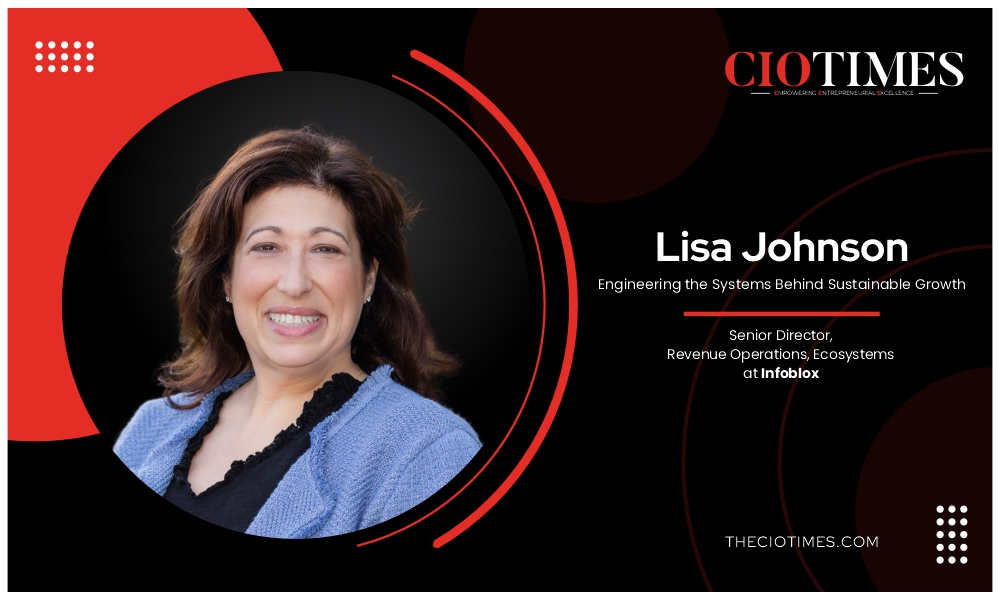
Lisa Johnson, Senior Director, Revenue Operations, Ecosystems at Infoblox, has built her career on that second kind of work. She does not dispute that vision matters. A strong operating model can help a business refine even a mediocre strategy, because clean data, clear ownership, and consistent execution make it easier to see what is working and adjust quickly. But a brilliant strategy will still fail if the forecast is unreliable, if ownership is unclear, or if the data conflicts. The best organizations need both.
The Systems Beneath the Growth
At one company, Lisa Johnson helped support 60 percent year-over-year ARR growth, driven by forecast discipline, clear territory and quota design, and the visibility to act early. She says, “Growth does not come from one heroic decision alone; it comes from the systems underneath it.” Strategy sets the target. Whether the organization actually gets there, and keeps moving after any single leader exits, comes down to the operating principles underneath it.
Four Principles That Hold the Line
Across every environment she has worked in, Lisa returns to four principles for building commercial infrastructure. The first is that policies should be simple and built into the platform. As Lisa puts it, “If a rule only works because someone remembers it, it is not a control; it is a liability that grows with headcount.”
The second is designing for exceptions without letting them define the whole model. Most transactions are standard, she notes, so the priority is keeping that standard path fast and automated, then routing exceptions to a person with the right context.
The third is choosing configuration over customization, since every custom shortcut becomes technical debt and makes future change harder. The fourth is maintaining one source of truth, even when it is inconvenient, because once sales, finance, and operations are working from different numbers, the organization is managing discrepancies instead of the business.
All four serve the same goal: reducing dependence on memory, heroics, and improvisation. As she puts it, “Control and agility are not opposites. Good governance creates both.”
What Survives a Shock?
Lisa has moved through scale-ups, acquisitions, public companies, and several restructurings. In each case, she says, resilience came down to the same basics: clean data and clear ownership, the things that determine whether an organization can absorb a shock. During one major acquisition, success depended less on strategy than on whether people knew who decided what and whether the numbers were real.
Ambiguity does more damage than bad news. Teams can handle a hard quarter or a delay. What they cannot manage, she says, is uncertainty about ownership and decisions. She spent three and a half years running operations on-site for a $200 million enterprise program, where clarity between customer executives and delivery teams was one of the most important stabilizers.
Discipline compounds quietly and shows up in a crisis. Forecast rigor, documented process, and a single source of truth can feel invisible in good times, but they become the shock absorbers when conditions change. “Resilience is not built in the crisis. It is revealed by it,” Lisa adds.
Beyond a Better Interface
For Lisa, the real test of transformation is simple: did the business change how it works, or did it just buy a better tool to run the old process faster? Many organizations modernize their software while preserving the same spreadsheet logic, approval chains, and workarounds underneath. “That is not transformation. It is legacy with a new interface.”
Real evolution starts with a best-practice-first mindset: define the standard, then adapt the process to it. As she puts it, “The tool is not the destination. It is the opportunity to decide whether the old process still deserves to exist.”
She looks for a few signals to tell whether a commercial engine was actually designed or whether a handful of people are holding it together manually. The first is how exceptions move: in a designed model, non-standard deals follow a defined path, while in an improvised one, they disappear into inboxes and side conversations.
The second is what she calls the new-hire test, whether a rep a few weeks in can produce a compliant quote without relying on tribal knowledge. If not, the tenured people are the system, and that does not scale. The third is whether governance feels invisible, meaning guardrails are embedded and the standard deal still moves. The best operating models strike a balance where governance enables selling rather than smothering it.
Proving the Invisible
Lisa Johnson does not wait for leadership to take conviction on faith. As she puts it, “I do not ask people to fund conviction. I make the invisible measurable and prove it small before asking anyone to believe it big.”
One example from her own career began as a partner program that leadership had reason to doubt. The team secured a $65,000 pilot budget, tied it to clear KPIs, and let the results speak. Over eight quarters, by her account, it grew into a $1 million initiative with a 30-to-1 return on investment.
She follows the same pattern every time: run a focused experiment, measure it rigorously, and expand only once the results are clear. Foundational capabilities often look invisible at first, she says, because their value shows up later in what does not break. Her job is to translate that future value into evidence a leadership team can act on now.
Where Judgment Still Belongs to People?
Lisa Johnson is candid that the efficiency gains from artificial intelligence are real, but calls them the least interesting part of the opportunity. The bigger shift is pattern recognition at a scale no human analyst can hold at once. In partner operations, that means spotting renewal risk earlier, identifying whitespace more accurately, and shifting the function from explaining last quarter to shaping the next one.
Human judgment remains essential. AI performs well inside clear guardrails and poorly at the edges. Non-standard deals, strategic exceptions, and tradeoffs between short-term margin and long-term trust still require people. She says, “AI can optimize what you ask it to optimize. Human leaders still have to decide what matters.”
One Model for Every Kind of Partner
Lisa Johnson At Infoblox, partners are involved in most transactions, but Lisa Johnson describes the ecosystem as anything but a single motion. It spans hyperscalers, global systems integrators, MSSPs and MSPs, and traditional resellers and distributors.
As she frames it, “The goal is not to build a separate model for each. It is to build one adaptable model that can support all of them.” Her starting thesis is straightforward: decouple partner revenue growth from internal headcount. If every new dollar of partner revenue requires a proportional dollar of internal effort, the channel is not scalable.
In practice, that means governed self-service, platform-based quoting and approvals, API-first integration across partner systems, distributors, and marketplaces, and an embedded AI layer for guided quoting and lifecycle intelligence. As she puts it, “The objective is to govern the standard path tightly, free people for the exceptions, and build a model that can evolve without being rebuilt.”
Retiring the Old Assumptions
Lisa Johnson believes the biggest misconception about scale is that it comes primarily from adding people. Hiring increases capacity, but it also increases coordination cost, inconsistency, and fragility. Systems scale differently. A well-governed system can handle many times the volume without requiring many times the effort.
She points to a related misconception: that the technology is the hard part. “Usually, it is not. The hard part is governance design. Once that is right, most competent platforms can execute it.”
Revenue operations has moved over the past decade from back-office reporting to a strategic growth function, and that shift means retiring a few old assumptions. The deal desk, she argues, does not need to touch every transaction if pricing and approvals are governed in the platform. More customization does not equal more sophistication. In many cases, it creates a fragile architecture that only a few people can operate, and that ultimately slows the business down.
Partners, she says, increasingly do not want access to a vendor’s team. When a partner is leading a deal, they want capability: “fast, clear, low-friction execution without unnecessary human intervention.” With the right strategy, focus, and investment, the operating model stops being overhead and becomes a growth lever.
Frictionless Outside, Disciplined Inside
Lisa Johnson counts making Infoblox easy to do business with among the most rewarding parts of her role. Partners sell across many vendors, so they naturally gravitate toward whichever ones are easiest to understand and transact with. That makes it Infoblox’s job to keep quoting, ordering, and invoicing as frictionless as possible for them.
The approach is to absorb new capabilities and acquisitions into one operating model instead of bolting on parallel ones. She says, “Every seam we leave internally becomes friction externally.” Commercial sustainability comes from the same discipline: building on configuration over customization, and measuring success through partner-facing outcomes such as cycle time, reduced friction, and greater scalability, rather than through features delivered alone.
A System Built to Outlast Her
Asked what she hopes future leaders inherit, Lisa returns to the same conviction that runs through the rest of her philosophy: something that works without her in the room.
As she puts it, “If a system depends on my interpretation to function, I have built a dependency, not an institution.” The legacy she wants to leave is an operation where good decisions are built into the way the business runs, so the next leaders inherit clarity rather than reliance on any one person.
She would also want future leaders to inherit a way of working: move quickly, get the objective clear early, solve problems simply, and focus on progress that makes it easier for people and partners to do business. That mindset, she notes, shapes how she hires, valuing will, curiosity, and drive in people who learn quickly and create momentum.
“I like to leave things sturdier than I found them, so the next person can go further than I did,” she concludes.
Also Read :- CIO Times Magazine For More Information